
Sign in
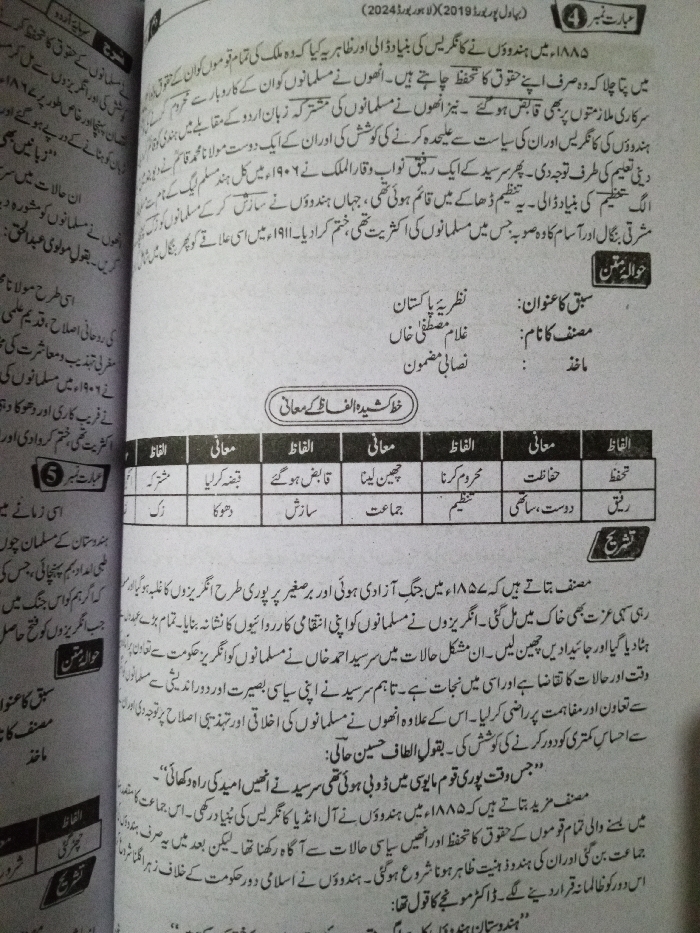
The image displays a slightly angled close-up of an open textbook page, primarily featuring Urdu text. The page is part of a lesson, indicated by "عبارت نمبر 4" (Passage No. 4) at the top.

The content focuses on historical events related to the Indian subcontinent and the formation of Pakistan. It discusses the establishment of the Indian National Congress in 1885 by Hindus and its impact on Muslim rights, the efforts of Sir Syed Ahmad Khan, and the formation of the All-India Muslim League in 1906. Key figures like Maulana Muhammad Qasim and Nawab Waqar-ul-Mulk are mentioned.

A "حوالہ متن" (Reference Text) section identifies the "سبق کا عنوان" (Lesson Title) as "نظریہ پاکستان" (Ideology of Pakistan), the "مصنف کا نام" (Author's Name) as "غلام مصطفیٰ خاں" (Ghulam Mustafa Khan), and the "ماخذ" (Source) as "نصابی مضمون" (Textbook Essay).

A vocabulary table, titled "خط کشیدہ الفاظ کے معانی" (Meanings of Underlined Words), lists various Urdu words and their definitions. Examples include "تحفظ" (protection), "محروم کرنا" (deprive), "تنظیم" (organization), "سازش" (conspiracy), and "رفیق" (companion).

The "تشریح" (Explanation) section details the aftermath of the 1857 War of Independence, the British policies towards Muslims, Sir Syed Ahmad Khan's role in Muslim education and political awareness, and the Hindu mindset expressed through the Congress. It includes quotes, such as one attributed to Altaf Hussain Hali. Another section "عبارت نمبر 5" is partially visible. The overall scene suggests a study material or an academic text.
Bilal Zafar

Jan 19, 2025, 1:10 PM

Renala Khurd, Pakistan

Stake attention in this memory

The image displays a slightly angled close-up of an open textbook page, primarily featuring Urdu text. The page is part of a lesson, indicated by "عبارت نمبر 4" (Passage No. 4) at the top. The content focuses on historical events related to the Indian subcontinent and the formation of Pakistan. It discusses the establishment of the Indian National Congress in 1885 by Hindus and its impact on Muslim rights, the efforts of Sir Syed Ahmad Khan, and the formation of the All-India Muslim League in 1906. Key figures like Maulana Muhammad Qasim and Nawab Waqar-ul-Mulk are mentioned. A "حوالہ متن" (Reference Text) section identifies the "سبق کا عنوان" (Lesson Title) as "نظریہ پاکستان" (Ideology of Pakistan), the "مصنف کا نام" (Author's Name) as "غلام مصطفیٰ خاں" (Ghulam Mustafa Khan), and the "ماخذ" (Source) as "نصابی مضمون" (Textbook Essay). A vocabulary table, titled "خط کشیدہ الفاظ کے معانی" (Meanings of Underlined Words), lists various Urdu words and their definitions. Examples include "تحفظ" (protection), "محروم کرنا" (deprive), "تنظیم" (organization), "سازش" (conspiracy), and "رفیق" (companion). The "تشریح" (Explanation) section details the aftermath of the 1857 War of Independence, the British policies towards Muslims, Sir Syed Ahmad Khan's role in Muslim education and political awareness, and the Hindu mindset expressed through the Congress. It includes quotes, such as one attributed to Altaf Hussain Hali. Another section "عبارت نمبر 5" is partially visible. The overall scene suggests a study material or an academic text.

Loading AttnAds…

transactions
revenues
stakers
Earliest
Latest
Highest stake

No transactions found

More from this user

More from Renala Khurd

Bilal Zafar

Jan 19, 2025, 1:10 PM

Renala Khurd, Pakistan

Licensed under Creative Commons Attribution 4.0 International License. You are free to share and adapt this content with proper attribution.