Sign in
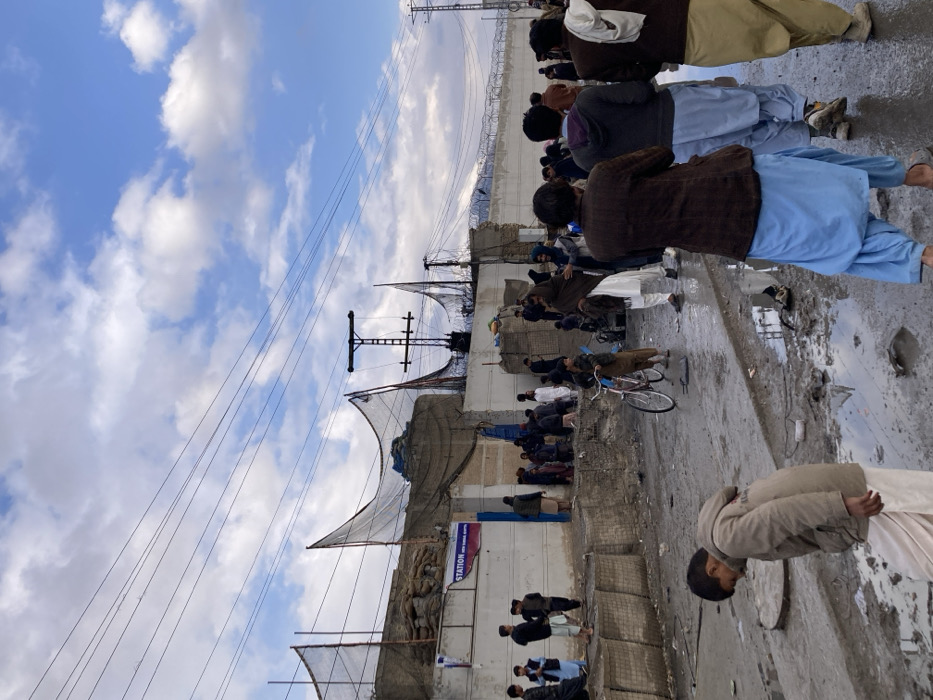
The image depicts an outdoor scene filled with people, under a sky with scattered clouds. The overall impression is that of a bustling street or public area in what appears to be a developing region, possibly in South Asia or the Middle East, given the traditional attire of the individuals.

The sky, occupying the upper portion of the frame, is a clear blue adorned with numerous white, fluffy cumulus clouds. Several thin, dark power lines stretch across the sky, originating from and leading towards unseen utility poles, one of which is partially visible towards the center-left.

The ground is a rough, uneven surface, possibly a dirt or gravel path partially covered with concrete or asphalt, and it appears wet in several places, indicating puddles and dampness, perhaps from recent rain.

A significant number of men and boys are present throughout the scene. They are predominantly dressed in traditional clothing, often consisting of long, loose-fitting tunics (kameez) over baggy trousers (shalwar), in various shades of brown, grey, and light blue. Most individuals are standing or walking, appearing to go about their daily routines or gathering in groups.

In the immediate foreground, a boy or young man wearing a light brown jacket and light-colored trousers stands with his head slightly bowed, facing towards the right. Further back, on the right side of the frame, several men are walking or standing, some with their backs to the viewer, one notably wearing a dark brown jacket and light blue shalwar kameez. In the mid-ground, a young boy with a white bicycle is visible.

Along the left side of the frame, a series of makeshift or temporary structures are visible. These include several large, tent-like coverings made of light-colored mesh or fabric, supported by poles, creating shaded areas. Behind these structures and a lower wall, there is a more substantial wall, possibly a perimeter barrier, topped with what appears to be barbed or razor wire, adding a sense of security or enclosure to the area. Near the base of this wall, several sandbag-like barriers are also present.

On one of the structures or walls in the mid-ground, a blue and red sign is visible. The text on the sign, though partially obscured and somewhat blurry, reads "STATION" with "AND FOOD SUPPLIES" below it. Further smaller text is visible, including "WITH THE SUPPORT OF" and what appears to be "WORLD" (with the rest of the word cut off). This suggests the area might be a distribution point or a humanitarian aid station.

The time of day appears to be daytime, likely morning or afternoon, due to the natural light and visible shadows. There are no strong indications of specific emotions, but the gathering of people suggests a social environment, possibly a market, a distribution point, or a general public space.
Aziz Sabawoon

Jan 31, 2026, 11:58 AM

Quetta City Tehsil, Pakistan

Stake attention in this memory

solemn
poverty
resignation
austerity
hope

The image depicts an outdoor scene filled with people, under a sky with scattered clouds. The overall impression is that of a bustling street or public area in what appears to be a developing region, possibly in South Asia or the Middle East, given the traditional attire of the individuals. The sky, occupying the upper portion of the frame, is a clear blue adorned with numerous white, fluffy cumulus clouds. Several thin, dark power lines stretch across the sky, originating from and leading towards unseen utility poles, one of which is partially visible towards the center-left. The ground is a rough, uneven surface, possibly a dirt or gravel path partially covered with concrete or asphalt, and it appears wet in several places, indicating puddles and dampness, perhaps from recent rain. A significant number of men and boys are present throughout the scene. They are predominantly dressed in traditional clothing, often consisting of long, loose-fitting tunics (kameez) over baggy trousers (shalwar), in various shades of brown, grey, and light blue. Most individuals are standing or walking, appearing to go about their daily routines or gathering in groups. In the immediate foreground, a boy or young man wearing a light brown jacket and light-colored trousers stands with his head slightly bowed, facing towards the right. Further back, on the right side of the frame, several men are walking or standing, some with their backs to the viewer, one notably wearing a dark brown jacket and light blue shalwar kameez. In the mid-ground, a young boy with a white bicycle is visible. Along the left side of the frame, a series of makeshift or temporary structures are visible. These include several large, tent-like coverings made of light-colored mesh or fabric, supported by poles, creating shaded areas. Behind these structures and a lower wall, there is a more substantial wall, possibly a perimeter barrier, topped with what appears to be barbed or razor wire, adding a sense of security or enclosure to the area. Near the base of this wall, several sandbag-like barriers are also present. On one of the structures or walls in the mid-ground, a blue and red sign is visible. The text on the sign, though partially obscured and somewhat blurry, reads "STATION" with "AND FOOD SUPPLIES" below it. Further smaller text is visible, including "WITH THE SUPPORT OF" and what appears to be "WORLD" (with the rest of the word cut off). This suggests the area might be a distribution point or a humanitarian aid station. The time of day appears to be daytime, likely morning or afternoon, due to the natural light and visible shadows. There are no strong indications of specific emotions, but the gathering of people suggests a social environment, possibly a market, a distribution point, or a general public space.

Loading AttnAds…

transactions
revenues
stakers
Earliest
Latest
Highest stake

No transactions found

More from this user

More from Quetta City Tehsil

Aziz Sabawoon

Jan 31, 2026, 11:58 AM

Quetta City Tehsil, Pakistan

Licensed under Creative Commons Attribution 4.0 International License. You are free to share and adapt this content with proper attribution.