
Stake attention in this memory
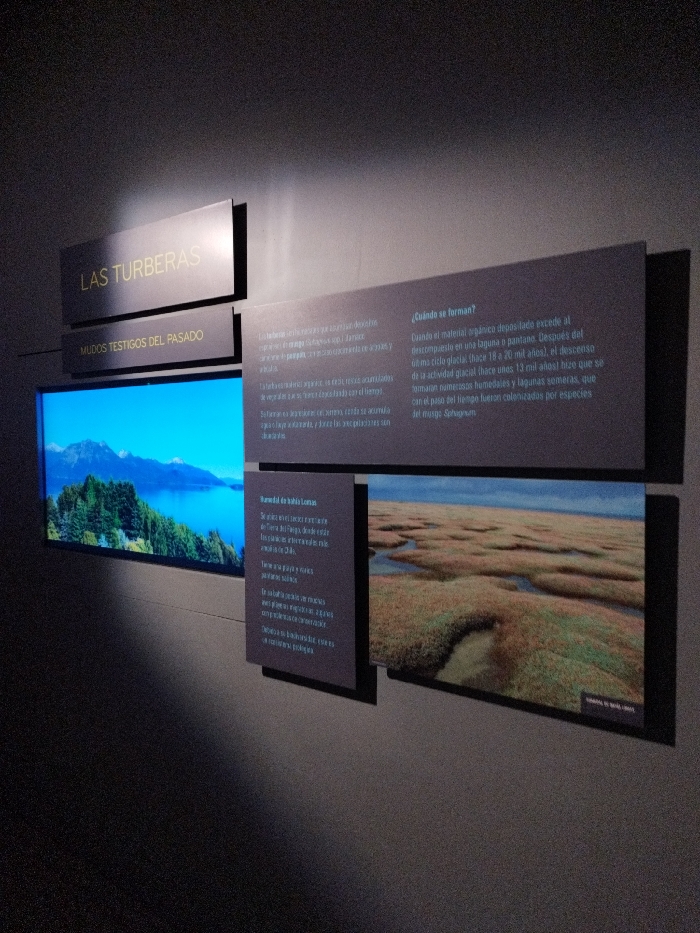
An informational exhibit about peatlands is displayed on a dark wall, likely within a museum or educational center in Santiago, Chile. The display features several dark-grey panels with light-colored text and two illuminated screens. At the top left, two stacked panels read "LAS TURBERAS" (The Peatlands) and "MUDOS TESTIGOS DEL PASADO" (Mute Witnesses of the Past). To their right, a larger panel poses the question "¿Cuándo se forman?" (When do they form?). The text explains that peatlands form when organic material deposited in a lagoon or swamp exceeds decomposition. It further elaborates that after the last glacial cycle (18-20 thousand years ago) and the subsequent decrease in glacial activity (13 thousand years ago), numerous wetlands and shallow lagoons formed, which were later colonized by Sphagnum moss species. Below the main title panels, a screen displays a vivid landscape image of a clear blue lake surrounded by green coniferous trees and majestic mountains under a bright blue sky. Adjacent to this screen and below the large text panel, another dark-grey panel is titled "Humedal de bahía Lomas" (Lomas Bay Wetland). The text describes its location in the northern part of Tierra del Fuego, noting it as Chile's second most important wintering ground for migratory shorebirds, and mentions its saline marsh and beach characteristics, highlighting its biodiversity and geological significance. To the right of this panel, a second screen shows an aerial or elevated view of an extensive wetland, characterized by reddish-brown vegetation interwoven with winding water channels. The phrase "HUMEDAL DE BAHÍA LOMAS" is partially visible at the bottom right of this screen, identifying the depicted landscape. The exhibit uses a modern, layered design with indirect lighting, focusing attention on the educational content. No people are visible in the scene.
No transactions found