Sign in
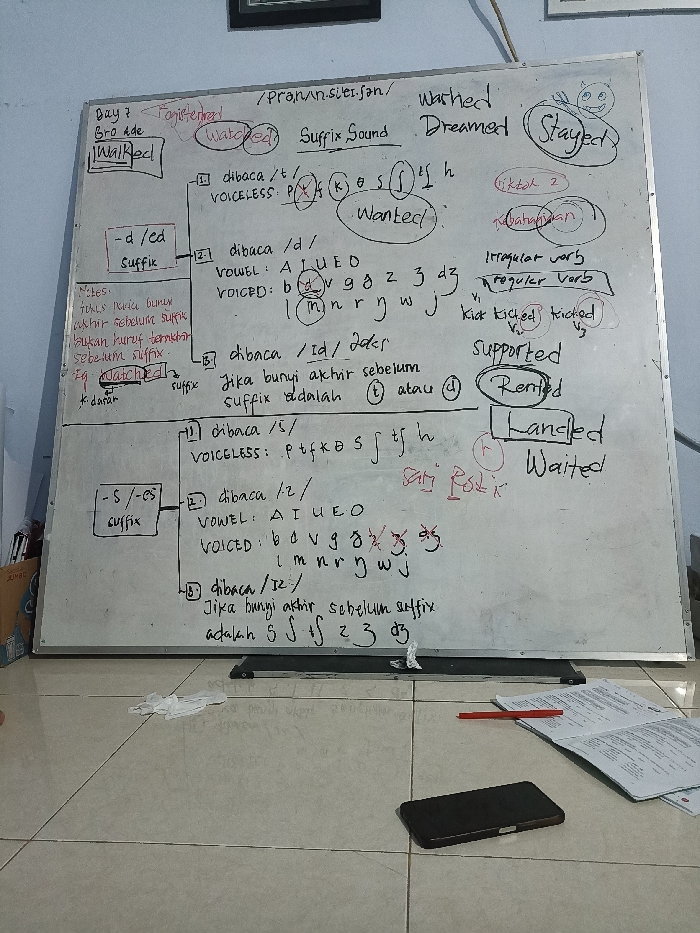
A whiteboard filled with handwritten English language lesson notes is the central focus of the image. The board is mounted on a plain wall, above a tiled floor. A red pen, a black smartphone, and an open notebook are visible on the floor in front of the whiteboard.

The primary topic on the whiteboard is "Suffix Sound," specifically addressing the pronunciation rules for the past tense -ed suffix and the plural/third-person singular -s/-es suffix. The title appears to be a misspelling of "Pronunciation."

For the -ed suffix, three pronunciation rules are outlined in Indonesian:
1.  "dibaca /t/" (read as /t/) for voiceless consonant sounds such as /p/, /k/, /s/, /f/, /θ/, /tʃ/, /ʃ/. Examples include 'watched', 'Walked', 'Washed'.
2.  "dibaca /d/" (read as /d/) for vowel sounds (A, I, U, E, O) and voiced consonant sounds like /b/, /d/, /g/, /z/, /dʒ/, /l/, /m/, /n/, /r/, /w/, /j/. Examples are 'Supported', 'Rented'.
3.  "dibaca /ɪd/" if the final sound before the suffix is /t/ or /d/. Examples include 'Landed', 'Waited'.
A note emphasizes focusing on the sound of the last letter before the suffix rather than the written letter itself. Several example words are circled, such as 'Watched', 'Dreamed', 'Stayed' (with a small devil drawing next to it), 'Wanted', 'Supported', and 'Rented'. There are also notes about "Irregular verb" and "Regular verb," with an example 'kick kicked kicked'.

For the -s/-es suffix, similar rules are presented:
1.  "dibaca /s/" for voiceless sounds.
2.  "dibaca /z/" for vowel and voiced sounds.
3.  "dibaca /ɪz/" if the final sound before the suffix is /s/, /ʃ/, /tʃ/, /z/, /ʒ/, /dʒ/.

Other visible text includes "Day 7," "Bro Ade," "Pagistenrad" (unclear), "tiktok 2," "kebahagian" (happiness), and 'Sam Potir' written in red. The scene suggests an indoor educational setting, likely a classroom or study area in Kecamatan Pare, Indonesia.
FM-DWNFF3

Dec 10, 2024, 1:43 PM

Kecamatan Pare, Indonesia

Stake attention in this memory

A whiteboard filled with handwritten English language lesson notes is the central focus of the image. The board is mounted on a plain wall, above a tiled floor. A red pen, a black smartphone, and an open notebook are visible on the floor in front of the whiteboard. The primary topic on the whiteboard is "Suffix Sound," specifically addressing the pronunciation rules for the past tense -ed suffix and the plural/third-person singular -s/-es suffix. The title appears to be a misspelling of "Pronunciation." For the -ed suffix, three pronunciation rules are outlined in Indonesian: 1. "dibaca /t/" (read as /t/) for voiceless consonant sounds such as /p/, /k/, /s/, /f/, /θ/, /tʃ/, /ʃ/. Examples include 'watched', 'Walked', 'Washed'. 2. "dibaca /d/" (read as /d/) for vowel sounds (A, I, U, E, O) and voiced consonant sounds like /b/, /d/, /g/, /z/, /dʒ/, /l/, /m/, /n/, /r/, /w/, /j/. Examples are 'Supported', 'Rented'. 3. "dibaca /ɪd/" if the final sound before the suffix is /t/ or /d/. Examples include 'Landed', 'Waited'. A note emphasizes focusing on the sound of the last letter before the suffix rather than the written letter itself. Several example words are circled, such as 'Watched', 'Dreamed', 'Stayed' (with a small devil drawing next to it), 'Wanted', 'Supported', and 'Rented'. There are also notes about "Irregular verb" and "Regular verb," with an example 'kick kicked kicked'. For the -s/-es suffix, similar rules are presented: 1. "dibaca /s/" for voiceless sounds. 2. "dibaca /z/" for vowel and voiced sounds. 3. "dibaca /ɪz/" if the final sound before the suffix is /s/, /ʃ/, /tʃ/, /z/, /ʒ/, /dʒ/. Other visible text includes "Day 7," "Bro Ade," "Pagistenrad" (unclear), "tiktok 2," "kebahagian" (happiness), and 'Sam Potir' written in red. The scene suggests an indoor educational setting, likely a classroom or study area in Kecamatan Pare, Indonesia.

Loading AttnAds…

transactions
revenues
stakers
Earliest
Latest
Highest stake

No transactions found

More from this user

More from Kecamatan Pare

FM-DWNFF3

Dec 10, 2024, 1:43 PM

Kecamatan Pare, Indonesia

Licensed under Creative Commons Attribution 4.0 International License. You are free to share and adapt this content with proper attribution.