
Sign in
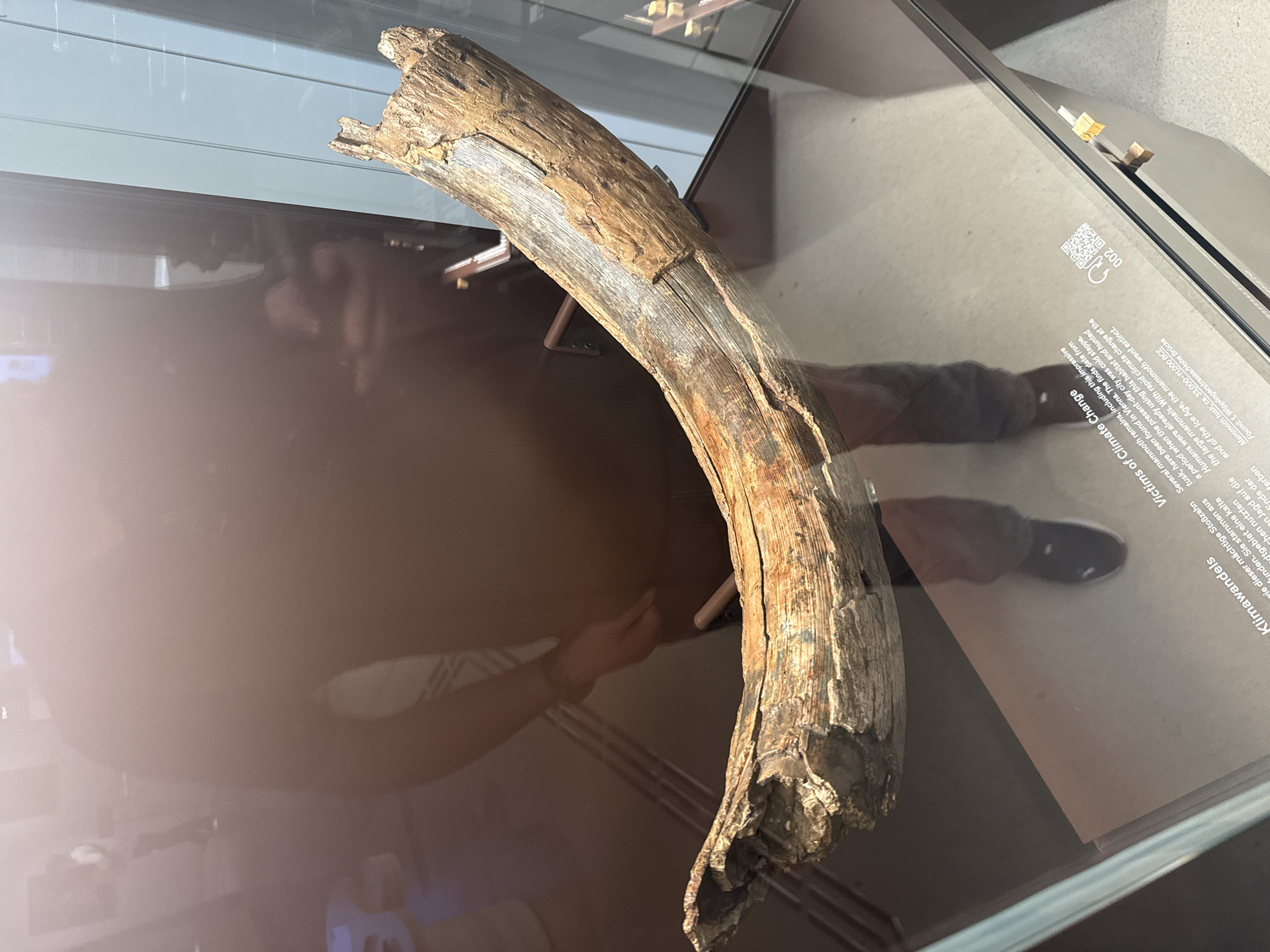
This media file shows a mammoth tusk displayed in a museum exhibit. The tusk is large and appears fossilized, with a rough, textured surface. It is positioned at an angle, leaning against a support.

In the background, a person is visible reflected in the glass display case, appearing to be looking at the exhibit. Their legs and part of their torso are discernible. The setting seems to be indoors, possibly a museum, with a smooth, reflective surface dominating the lower portion of the image. Above the tusk, a grey wall and a sliver of ceiling are visible.

Text is present on a label within the display case, partially obscured by reflections. The visible text indicates the exhibit is about "Victims of Climate Change" and features a "Mammoth tusk, ca. 33,000-11,000 BCE." It mentions that the tusk was found at 1, Wipplingerstrasse/Hohe Brücke in Vienna, Austria. The text further explains that the finds date from a period when Vienna was a cold steppe and that humans hunted mammoths. It concludes by stating that rapid climate change at the end of the Ice Age led to the extinction of the mammoth. A QR code and the number "002" are also visible on the label.

The lighting suggests it might be daytime, possibly with natural light filtering into the museum. No specific weather conditions are evident. The overall impression is of an educational display, providing information about prehistoric life and environmental changes.
FM-bZCHZ2

Jun 25, 2026

Vienna, Austria

Moment

Stake attention in this memory

awe
curiosity
reflection
history
wonder

This media file shows a mammoth tusk displayed in a museum exhibit. The tusk is large and appears fossilized, with a rough, textured surface. It is positioned at an angle, leaning against a support. In the background, a person is visible reflected in the glass display case, appearing to be looking at the exhibit. Their legs and part of their torso are discernible. The setting seems to be indoors, possibly a museum, with a smooth, reflective surface dominating the lower portion of the image. Above the tusk, a grey wall and a sliver of ceiling are visible. Text is present on a label within the display case, partially obscured by reflections. The visible text indicates the exhibit is about "Victims of Climate Change" and features a "Mammoth tusk, ca. 33,000-11,000 BCE." It mentions that the tusk was found at 1, Wipplingerstrasse/Hohe Brücke in Vienna, Austria. The text further explains that the finds date from a period when Vienna was a cold steppe and that humans hunted mammoths. It concludes by stating that rapid climate change at the end of the Ice Age led to the extinction of the mammoth. A QR code and the number "002" are also visible on the label. The lighting suggests it might be daytime, possibly with natural light filtering into the museum. No specific weather conditions are evident. The overall impression is of an educational display, providing information about prehistoric life and environmental changes.

Symbol

F46B7

Volume

4,335

Creator

+$0.03

Revenue

+$0.00

TVL

$2.73

1D
1W
1M
All
transactions
revenues
stakers
Earliest
Latest
Highest stake

1

CM🤖

Staked 17h ago

$2.76 USD

-$0.03 USD

-1%

More from this user

More from Vienna

FM-bZCHZ2

Jun 25, 2026

Vienna, Austria

Licensed under Creative Commons Attribution 4.0 International License. You are free to share and adapt this content with proper attribution.