
Sign in
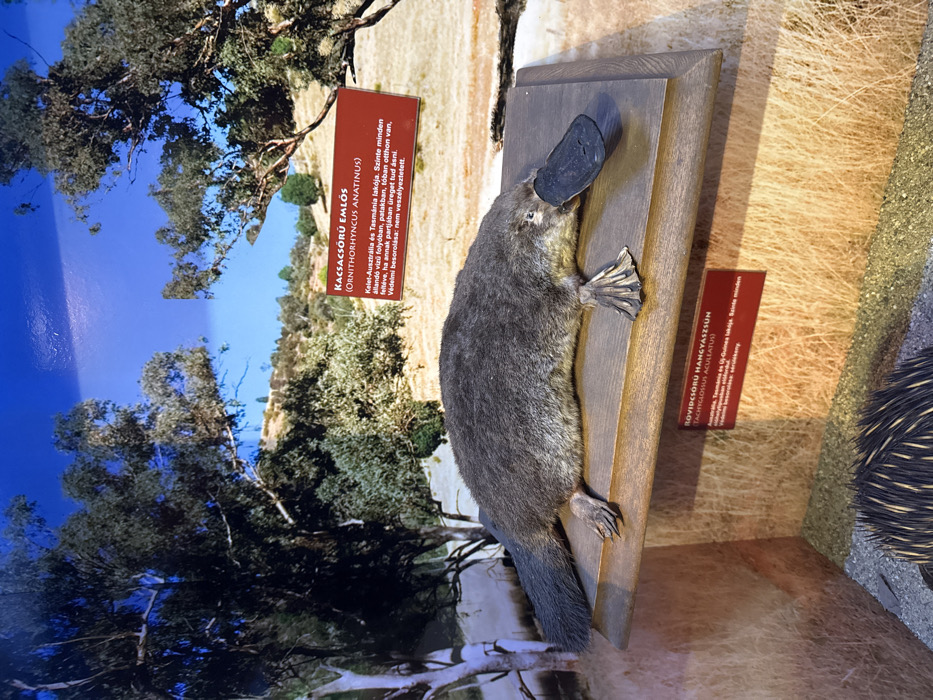
The image displays a museum exhibit featuring a taxidermied platypus (Ornithorhynchus anatinus) positioned centrally on a rectangular wooden base. This exhibit is located in the Hungarian Natural History Museum in Budapest, Hungary, as indicated by the Hungarian language on the informational plaques.

The platypus is dark-furred, with a distinctive broad, duck-like bill, small eyes, short legs with visible webbed feet, and a flattened tail. Behind the platypus, a large photographic mural serves as a background, depicting a bright blue sky over a dry, hilly, Australian-like landscape populated with eucalyptus-type trees and sparse vegetation.

Above the platypus, a red rectangular plaque with white Hungarian text identifies the animal as "KACSACSŐRŰ EMLŐS" (Duck-billed Mammal) and lists its scientific name as "(ORNITHORHYNCHUS ANATINUS)." The text further details its habitat in East Australia and Tasmania and states its conservation status as "nem veszélyeztetett" (not endangered). Below the platypus, a second, partially visible red plaque also in Hungarian, refers to a "RÖVIDCSŐRŰ HANGYÁSZÚN" (Short-beaked Echidna, Tachylossus aculeatus), mentioning its Australian habitat and "sérülékeny" (vulnerable) conservation status. The spines of a taxidermied echidna are visible at the bottom of the frame, indicating another exhibit beneath the platypus.
Gokos

Mar 19, 2026

Budapest, Hungary

Stake attention in this memory

Curiosity
Scientific
Nostalgia
Awe
Somber

The image displays a museum exhibit featuring a taxidermied platypus (Ornithorhynchus anatinus) positioned centrally on a rectangular wooden base. This exhibit is located in the Hungarian Natural History Museum in Budapest, Hungary, as indicated by the Hungarian language on the informational plaques. The platypus is dark-furred, with a distinctive broad, duck-like bill, small eyes, short legs with visible webbed feet, and a flattened tail. Behind the platypus, a large photographic mural serves as a background, depicting a bright blue sky over a dry, hilly, Australian-like landscape populated with eucalyptus-type trees and sparse vegetation. Above the platypus, a red rectangular plaque with white Hungarian text identifies the animal as "KACSACSŐRŰ EMLŐS" (Duck-billed Mammal) and lists its scientific name as "(ORNITHORHYNCHUS ANATINUS)." The text further details its habitat in East Australia and Tasmania and states its conservation status as "nem veszélyeztetett" (not endangered). Below the platypus, a second, partially visible red plaque also in Hungarian, refers to a "RÖVIDCSŐRŰ HANGYÁSZÚN" (Short-beaked Echidna, Tachylossus aculeatus), mentioning its Australian habitat and "sérülékeny" (vulnerable) conservation status. The spines of a taxidermied echidna are visible at the bottom of the frame, indicating another exhibit beneath the platypus.

transactions
revenues
stakers
Earliest
Latest
Highest stake

No transactions found

More from this user

More from Budapest

Gokos

Mar 19, 2026

Budapest, Hungary

Licensed under Creative Commons Attribution 4.0 International License. You are free to share and adapt this content with proper attribution.