
Stake attention in this memory
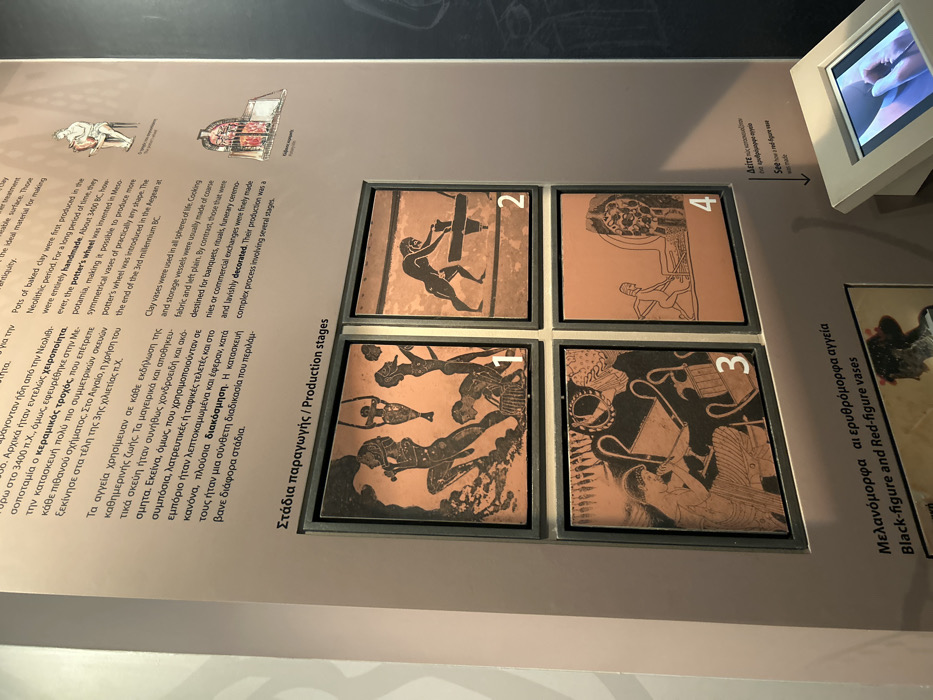
This media file captures a museum exhibit detailing the production of ancient pottery, likely located in Athina, Greece. The main subject is a large display board featuring bilingual text (Greek and English) and several illustrations. The text provides historical context, explaining that pots were handmade in the Neolithic period until the potter's wheel was invented in Mesopotamia around 3400 BC and introduced to the Aegean by the end of the 3rd millennium BC. It describes the varied uses of clay vases—from coarse cooking and storage vessels to finely decorated pieces for banquets, rituals, and trade—and mentions the complex process of their production. Below the main text, a prominent section titled "Στάδια παραγωγής / Production stages" showcases four framed illustrations numbered 1 through 4, depicting key steps in pottery creation. Illustration 1 shows multiple figures engaged in clay preparation or initial shaping. Illustration 2 features a single figure working at a potter's wheel. Illustration 3 illustrates the decoration phase, with a person painting a vase, highlighting black-figure and red-figure techniques, as noted by the subtitle "Μελανόμορφα αι ερυθρόμορφα αγγεία / Black-figure and Red-figure vases." Illustration 4 depicts the firing of pottery inside a large kiln, with a person attending it. Above the main text, two smaller illustrations further clarify the process: one shows a potter at a wheel, and the other a kiln. To the right, a small digital screen displays a video, indicated by an arrow and the text "Δείτε πώς κατασκευάζονταν / See how they were made." The scene is brightly lit by artificial museum lighting.
No transactions found