Stake attention in this memory
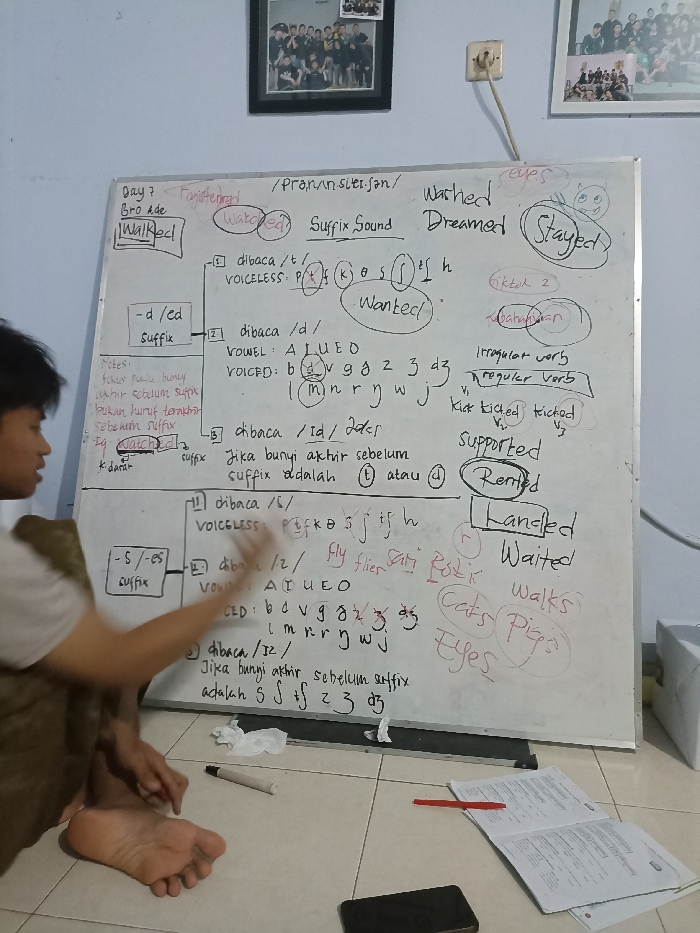
A young man is seated barefoot on a tiled floor, facing and pointing towards a whiteboard covered in English language lesson notes. The scene appears to be an indoor room, possibly a study area or a classroom, located in Kecamatan Pare, Indonesia. The young man, with short dark hair, is wearing a light-colored t-shirt. He is actively engaged with the whiteboard content, gesturing towards it with his right hand. The whiteboard is densely filled with handwritten text and phonetic symbols, primarily focusing on the pronunciation rules for the -d/-ed and -s/-es suffixes in English. Visible text on the whiteboard includes: "/praninsuler.jan/" (pronunciation), "Suffix Sound," "Day 7," and "Bro Ade." Sections detail when suffixes are pronounced as /t/, /d/, or /ɪd/ for -ed, and /s/, /z/, or /ɪz/ for -es, based on whether the preceding sound is voiceless or voiced. Phonetic symbols are used extensively, alongside lists of voiceless consonants (e.g., /p, f, k, θ, s, ʃ, tʃ, h/) and voiced sounds (vowels and voiced consonants like /b, d, ɡ, v, g, z, ʒ, dʒ, l, m, n, r, ŋ, w, j/). Examples like "Walked," "Washed," "Dreamed," "Wanted," "Supported," "Rented," "Landed," "Waited" illustrate the -ed suffix, while "Cats," "Pigs," "Eyes," and "Walks" are used for -s/-es. A note emphasizes focusing on the "bunyi akhir sebelum suffix" (final sound before the suffix) rather than the "huruf terakhir" (last letter). There's also a brief mention of "Irregular verb" and "regular verb" with "kick kicked kicked" as an example. On the floor in front of the man are a black marker, a red pen, an open book or workbook, and a black smartphone. Above the whiteboard, two framed pictures adorn the light-colored wall, one showing a group of people. A power outlet is also visible on the wall. The lighting suggests an indoor setting with ambient light.
Loading AttnAds…
No transactions found