
Sign in
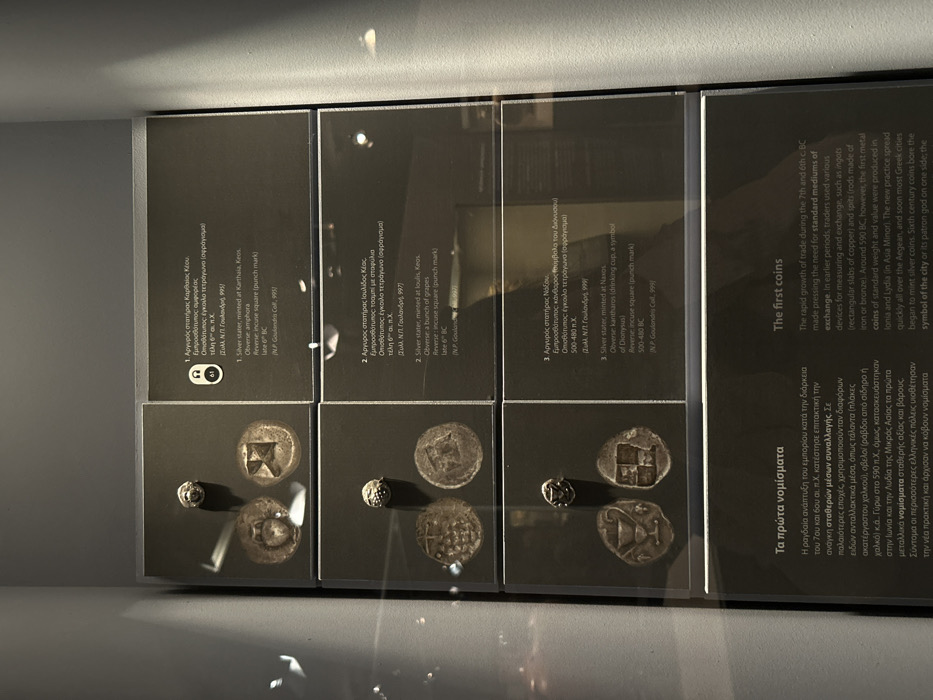
The image displays a museum exhibit showcasing ancient Greek silver coins, presented in a dimly lit glass case against a dark background. Three individual compartments each hold a small ancient coin, accompanied by a descriptive plaque in both Greek and English. Reflections on the glass surface indicate overhead lighting and the presence of onlookers or surroundings.

The larger descriptive panel on the right, titled "Τα πρώτα νομίσματα" (The first coins), explains the historical context. It details the necessity of stable exchange mediums due to rapid trade growth in the 7th and 6th centuries BC. It mentions earlier forms of exchange like copper ingots and iron/bronze spits, noting that the first metal coins with standard weight and value were produced around 590 BC in Ionia and Lydia. This practice quickly spread across the Aegean, with Greek cities adopting coinage that often bore symbols of their city or patron god.

The individual plaques describe the three silver staters:
1.  **From Karthala, Keos (late 6th BC):** Obverse depicts an amphora; reverse features an incuse square (punch mark).
2.  **From Ioulis, Keos (late 6th BC):** Obverse shows a bunch of grapes; reverse features an incuse square (punch mark).
3.  **From Naxos (500-480 BC):** Obverse displays a kantharos (drinking cup), a symbol of Dionysus; reverse features an incuse square (punch mark).

All coins are part of the N.P. Goulandris Collection. The setting is likely a museum in Athina, Greece, dedicated to ancient history and numismatics.
FM-zLJPr2

Jan 11, 2025

Athina, Greece

Stake attention in this memory

The image displays a museum exhibit showcasing ancient Greek silver coins, presented in a dimly lit glass case against a dark background. Three individual compartments each hold a small ancient coin, accompanied by a descriptive plaque in both Greek and English. Reflections on the glass surface indicate overhead lighting and the presence of onlookers or surroundings. The larger descriptive panel on the right, titled "Τα πρώτα νομίσματα" (The first coins), explains the historical context. It details the necessity of stable exchange mediums due to rapid trade growth in the 7th and 6th centuries BC. It mentions earlier forms of exchange like copper ingots and iron/bronze spits, noting that the first metal coins with standard weight and value were produced around 590 BC in Ionia and Lydia. This practice quickly spread across the Aegean, with Greek cities adopting coinage that often bore symbols of their city or patron god. The individual plaques describe the three silver staters: 1. **From Karthala, Keos (late 6th BC):** Obverse depicts an amphora; reverse features an incuse square (punch mark). 2. **From Ioulis, Keos (late 6th BC):** Obverse shows a bunch of grapes; reverse features an incuse square (punch mark). 3. **From Naxos (500-480 BC):** Obverse displays a kantharos (drinking cup), a symbol of Dionysus; reverse features an incuse square (punch mark). All coins are part of the N.P. Goulandris Collection. The setting is likely a museum in Athina, Greece, dedicated to ancient history and numismatics.

transactions
revenues
stakers
Earliest
Latest
Highest stake

No transactions found

More from this user

More from Athina

FM-zLJPr2

Jan 11, 2025

Athina, Greece

Licensed under Creative Commons Attribution 4.0 International License. You are free to share and adapt this content with proper attribution.