Sign in
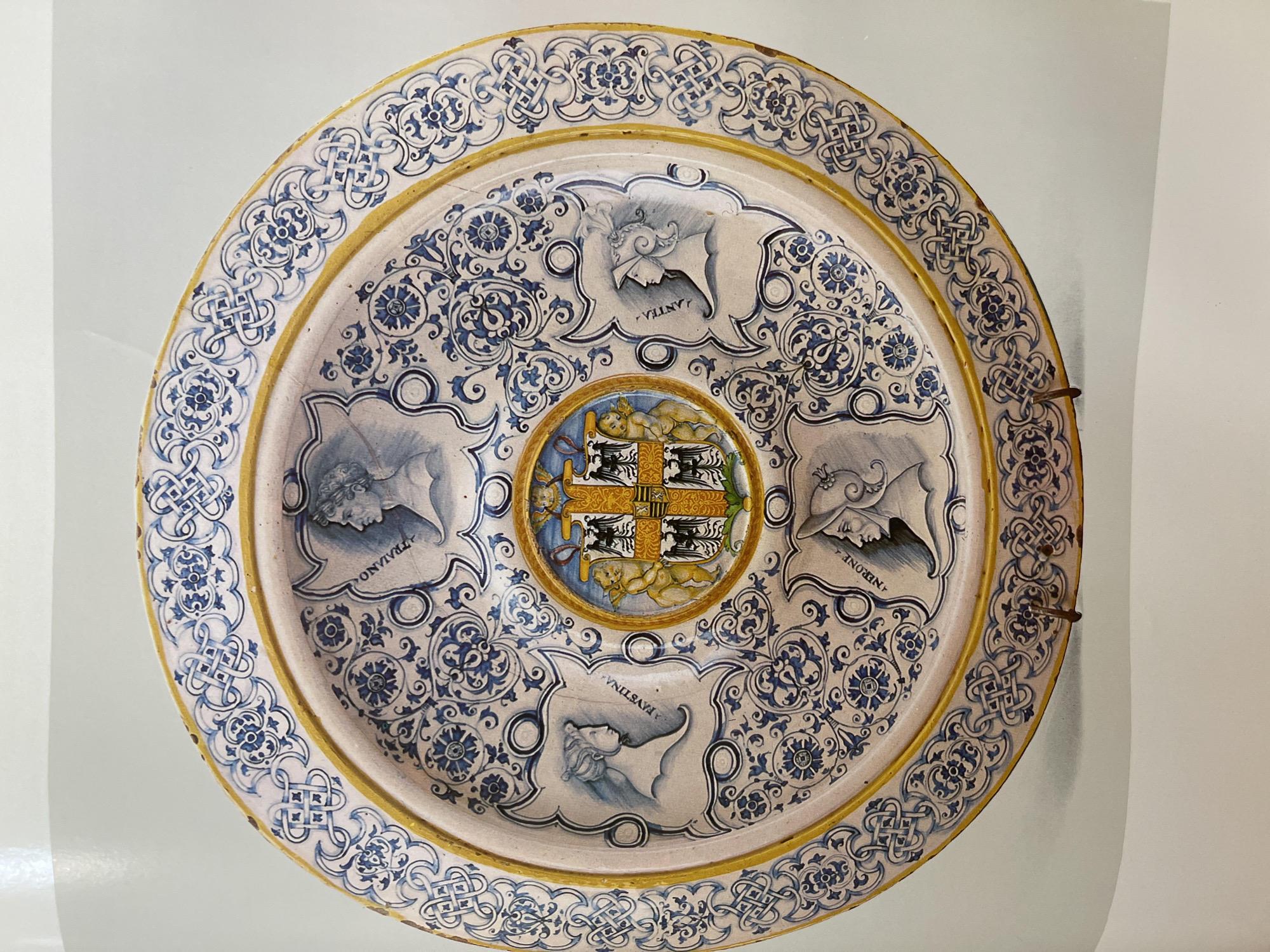
This media file showcases a circular, decorative ceramic plate, likely majolica or faience, distinguished by its intricate blue and white patterns and yellow/gold accents.

The plate's central feature is a circular medallion enclosing a polychrome coat of arms. This heraldic design is quarterly, displaying a rampant lion in the first and fourth sections, and a cross in the second and third. Two putti or cherubs are depicted supporting the shield from below.

Around this central emblem, four framed cartouches each contain a profile portrait rendered in blue monochrome. These figures, reminiscent of classical Roman emperors and empresses, are identified by inverted text: "ANTIA" (Antia) at the top left, "NERONE" (Nero) at the top right, "TRAIANO" (Trajan) at the bottom right, and "FAVSTINA" (Faustina) at the bottom left. Each portrait features a figure with distinct headwear, such as a helmet or elaborate coiffure.

The remaining surface of the plate is filled with dense, scrolling floral and foliate motifs in blue against a white background, creating a symmetrical and ornate pattern. A bright yellow or gold band delineates the central medallion and the outer rim of the plate. The overall style suggests a Renaissance or Baroque origin. The plate is presented against a plain light background, possibly indicating a display in a museum or art gallery, with a metal hanger visible on the right side. No specific activity or event is taking place; the plate itself is the subject, serving as a decorative and commemorative art piece.
FM-C5aP83

Jun 4, 2026

Almaty, Kazakhstan

Stake attention in this memory

elegant
historical
intricate
ornate
vintage

This media file showcases a circular, decorative ceramic plate, likely majolica or faience, distinguished by its intricate blue and white patterns and yellow/gold accents. The plate's central feature is a circular medallion enclosing a polychrome coat of arms. This heraldic design is quarterly, displaying a rampant lion in the first and fourth sections, and a cross in the second and third. Two putti or cherubs are depicted supporting the shield from below. Around this central emblem, four framed cartouches each contain a profile portrait rendered in blue monochrome. These figures, reminiscent of classical Roman emperors and empresses, are identified by inverted text: "ANTIA" (Antia) at the top left, "NERONE" (Nero) at the top right, "TRAIANO" (Trajan) at the bottom right, and "FAVSTINA" (Faustina) at the bottom left. Each portrait features a figure with distinct headwear, such as a helmet or elaborate coiffure. The remaining surface of the plate is filled with dense, scrolling floral and foliate motifs in blue against a white background, creating a symmetrical and ornate pattern. A bright yellow or gold band delineates the central medallion and the outer rim of the plate. The overall style suggests a Renaissance or Baroque origin. The plate is presented against a plain light background, possibly indicating a display in a museum or art gallery, with a metal hanger visible on the right side. No specific activity or event is taking place; the plate itself is the subject, serving as a decorative and commemorative art piece.

transactions
revenues
stakers
Earliest
Latest
Highest stake

No transactions found

More from this user

More from Almaty

FM-C5aP83

Jun 4, 2026

Almaty, Kazakhstan

Licensed under Creative Commons Attribution 4.0 International License. You are free to share and adapt this content with proper attribution.