Sign in
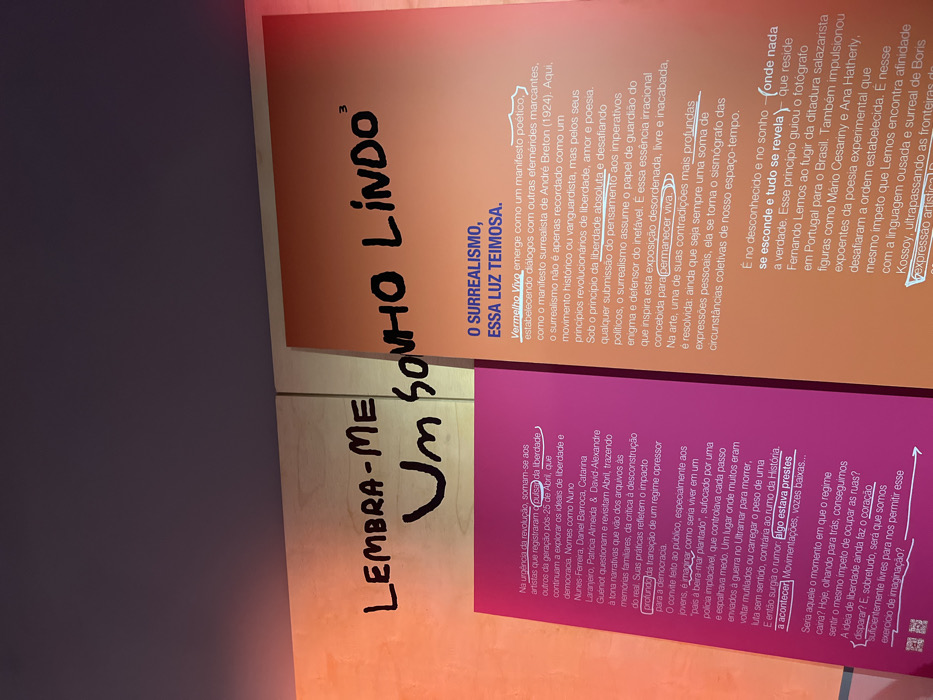
The image displays two large, vertically oriented informational panels, likely part of an exhibition in a museum or gallery. The lighting is soft and even, suggesting an indoor setting.

The panel on the left is purple/magenta, and the one on the right is orange/peach. Both feature black text. Across the top of both panels, in a handwritten-style font, are the words "LEMBRA-ME Um SONHO LINDO" (Remember Me A Beautiful Dream).

The right, orange panel is titled "O SURREALISMO, ESSA LUZ TEIMOSA" (Surrealism, That Stubborn Light). Its text discusses Surrealism, drawing parallels between the "Vermelho Vivo" (Vivid Red) manifesto and André Breton's 1924 surrealist manifesto. It emphasizes Surrealism's revolutionary principles of "liberdade absoluta" (absolute freedom), its role as a "guardião do enigma e defensor do inefável" (guardian of the enigma and defender of the ineffable), and its nature as a "luz teimosa" (stubborn light) meant to "permanecer viva" (remain alive). It also mentions the principle "onde nada se esconde e tudo se revela" (where nothing hides and everything reveals), and connects it to Portuguese figures like photographer Fernando Lemos (who fled the Salazar dictatorship to Brazil), Mário Cesariny, Ana Hatherly, and Boris Kossoy, highlighting their experimental artistic expressions.

The left, purple panel begins "Na urgência da revolução" (In the urgency of the revolution). It discusses artists who captured the "pulso da liberdade" (pulse of freedom) from the post-April 25th (1974 Portuguese Revolution) generation, including Nuno Nunes-Ferreira, Daniel Barroca, Catarina Laranjeiro, Patricia Almeida & David-Alexandre Guéniot. This section explores themes of freedom, democracy, memory, and the "impacto profundo da transição de um regime opressor" (profound impact of the transition from an oppressive regime). It invites the public to imagine life under a repressive regime, with references to the "guerra no Ultramar" (Overseas War), and the anticipation that "algo estava prestes a acontecer" (something was about to happen). The text concludes by questioning if the idea of freedom still makes the "coração disparar" (heart race) and if people are free enough for the "exercício de imaginação" (exercise of imagination).

The exhibition explores the intersection of Surrealism, political revolution, freedom, and artistic expression in a Portuguese and Brazilian context.
F
FM-3Wd0j2

Feb 2, 2025

Fortaleza, Brazil

Stake attention in this memory

The image displays two large, vertically oriented informational panels, likely part of an exhibition in a museum or gallery. The lighting is soft and even, suggesting an indoor setting. The panel on the left is purple/magenta, and the one on the right is orange/peach. Both feature black text. Across the top of both panels, in a handwritten-style font, are the words "LEMBRA-ME Um SONHO LINDO" (Remember Me A Beautiful Dream). The right, orange panel is titled "O SURREALISMO, ESSA LUZ TEIMOSA" (Surrealism, That Stubborn Light). Its text discusses Surrealism, drawing parallels between the "Vermelho Vivo" (Vivid Red) manifesto and André Breton's 1924 surrealist manifesto. It emphasizes Surrealism's revolutionary principles of "liberdade absoluta" (absolute freedom), its role as a "guardião do enigma e defensor do inefável" (guardian of the enigma and defender of the ineffable), and its nature as a "luz teimosa" (stubborn light) meant to "permanecer viva" (remain alive). It also mentions the principle "onde nada se esconde e tudo se revela" (where nothing hides and everything reveals), and connects it to Portuguese figures like photographer Fernando Lemos (who fled the Salazar dictatorship to Brazil), Mário Cesariny, Ana Hatherly, and Boris Kossoy, highlighting their experimental artistic expressions. The left, purple panel begins "Na urgência da revolução" (In the urgency of the revolution). It discusses artists who captured the "pulso da liberdade" (pulse of freedom) from the post-April 25th (1974 Portuguese Revolution) generation, including Nuno Nunes-Ferreira, Daniel Barroca, Catarina Laranjeiro, Patricia Almeida & David-Alexandre Guéniot. This section explores themes of freedom, democracy, memory, and the "impacto profundo da transição de um regime opressor" (profound impact of the transition from an oppressive regime). It invites the public to imagine life under a repressive regime, with references to the "guerra no Ultramar" (Overseas War), and the anticipation that "algo estava prestes a acontecer" (something was about to happen). The text concludes by questioning if the idea of freedom still makes the "coração disparar" (heart race) and if people are free enough for the "exercício de imaginação" (exercise of imagination). The exhibition explores the intersection of Surrealism, political revolution, freedom, and artistic expression in a Portuguese and Brazilian context.

transactions
revenues
stakers
Earliest
Latest
Highest stake

No transactions found

More from this user

More from Fortaleza

FFM-3Wd0j2

Feb 2, 2025

Fortaleza, Brazil

Licensed under Creative Commons Attribution 4.0 International License. You are free to share and adapt this content with proper attribution.