Sign in
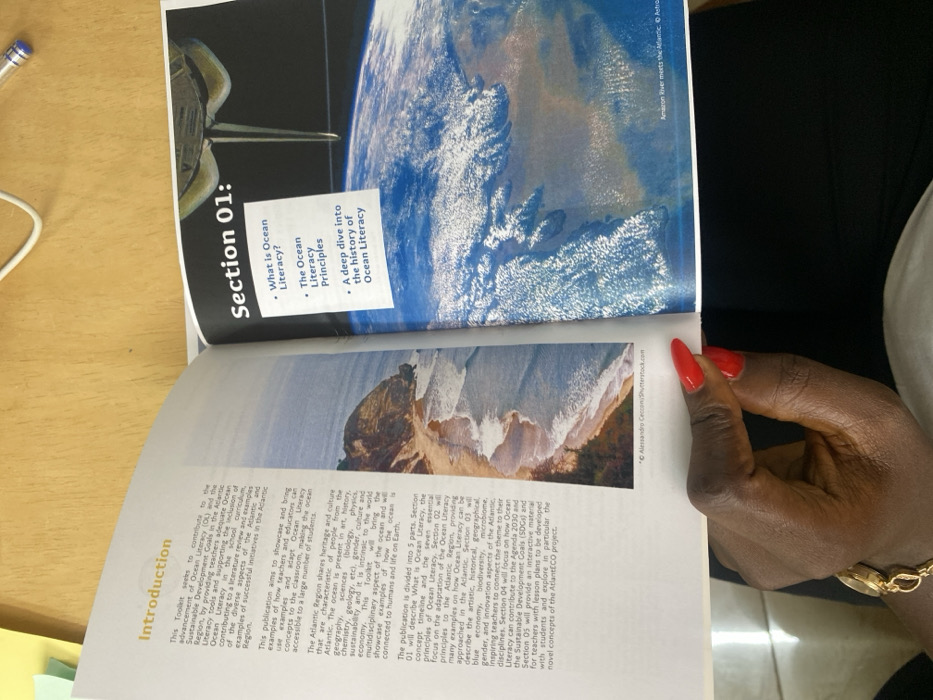
An open book titled "Toolkit for the Advancement of Ocean Literacy in the Atlantic Region" is held by a person's left hand, adorned with red nail polish. The book rests on a dark blue surface. The right page displays a satellite-like image of the Amazon River meeting the Atlantic Ocean. This image features a clear blue ocean, land with green vegetation, a coastal region with a beach, white sand, white waves, and a narrow, vegetated land strip extending into the ocean.

The left page shows the 'Introduction' section. The text explains the Toolkit's aim: to advance Ocean Literacy (OL) and Sustainable Development Goals (SDGs) in the Atlantic Region by supporting trainers/teachers, fostering inclusive curricula, and reviewing successful initiatives. It showcases how educators can make ocean concepts accessible to students. The Atlantic region's influence on culture, geography, heritage, and various sciences (biology, chemistry, physics, geochemistry) is highlighted, along with its relevance to sustainability, gender, and economy. The Toolkit employs a transdisciplinary and interdisciplinary approach, connecting life on Earth to humans, and is divided into five parts.

Section 01 defines Ocean Literacy. Section 02 provides examples of OL adaptation in the Atlantic, covering themes like biodiversity, microbiome, gender, and artistic aspects. Section 04 addresses OL's contribution to Agenda 2030 and SDGs. Section 05 offers interactive student material and lesson plans, linked to the novel concepts of the AtlantiCO project.
Forbah Sandra

Mar 22, 2025

Limbe, Cameroon

Stake attention in this memory

Educational
Informative
Curious
Inspiring
Hopeful

An open book titled "Toolkit for the Advancement of Ocean Literacy in the Atlantic Region" is held by a person's left hand, adorned with red nail polish. The book rests on a dark blue surface. The right page displays a satellite-like image of the Amazon River meeting the Atlantic Ocean. This image features a clear blue ocean, land with green vegetation, a coastal region with a beach, white sand, white waves, and a narrow, vegetated land strip extending into the ocean. The left page shows the 'Introduction' section. The text explains the Toolkit's aim: to advance Ocean Literacy (OL) and Sustainable Development Goals (SDGs) in the Atlantic Region by supporting trainers/teachers, fostering inclusive curricula, and reviewing successful initiatives. It showcases how educators can make ocean concepts accessible to students. The Atlantic region's influence on culture, geography, heritage, and various sciences (biology, chemistry, physics, geochemistry) is highlighted, along with its relevance to sustainability, gender, and economy. The Toolkit employs a transdisciplinary and interdisciplinary approach, connecting life on Earth to humans, and is divided into five parts. Section 01 defines Ocean Literacy. Section 02 provides examples of OL adaptation in the Atlantic, covering themes like biodiversity, microbiome, gender, and artistic aspects. Section 04 addresses OL's contribution to Agenda 2030 and SDGs. Section 05 offers interactive student material and lesson plans, linked to the novel concepts of the AtlantiCO project.

transactions
revenues
stakers
Earliest
Latest
Highest stake

No transactions found

More from this user

More from Limbe

Forbah Sandra

Mar 22, 2025

Limbe, Cameroon

Licensed under Creative Commons Attribution 4.0 International License. You are free to share and adapt this content with proper attribution.