Sign in
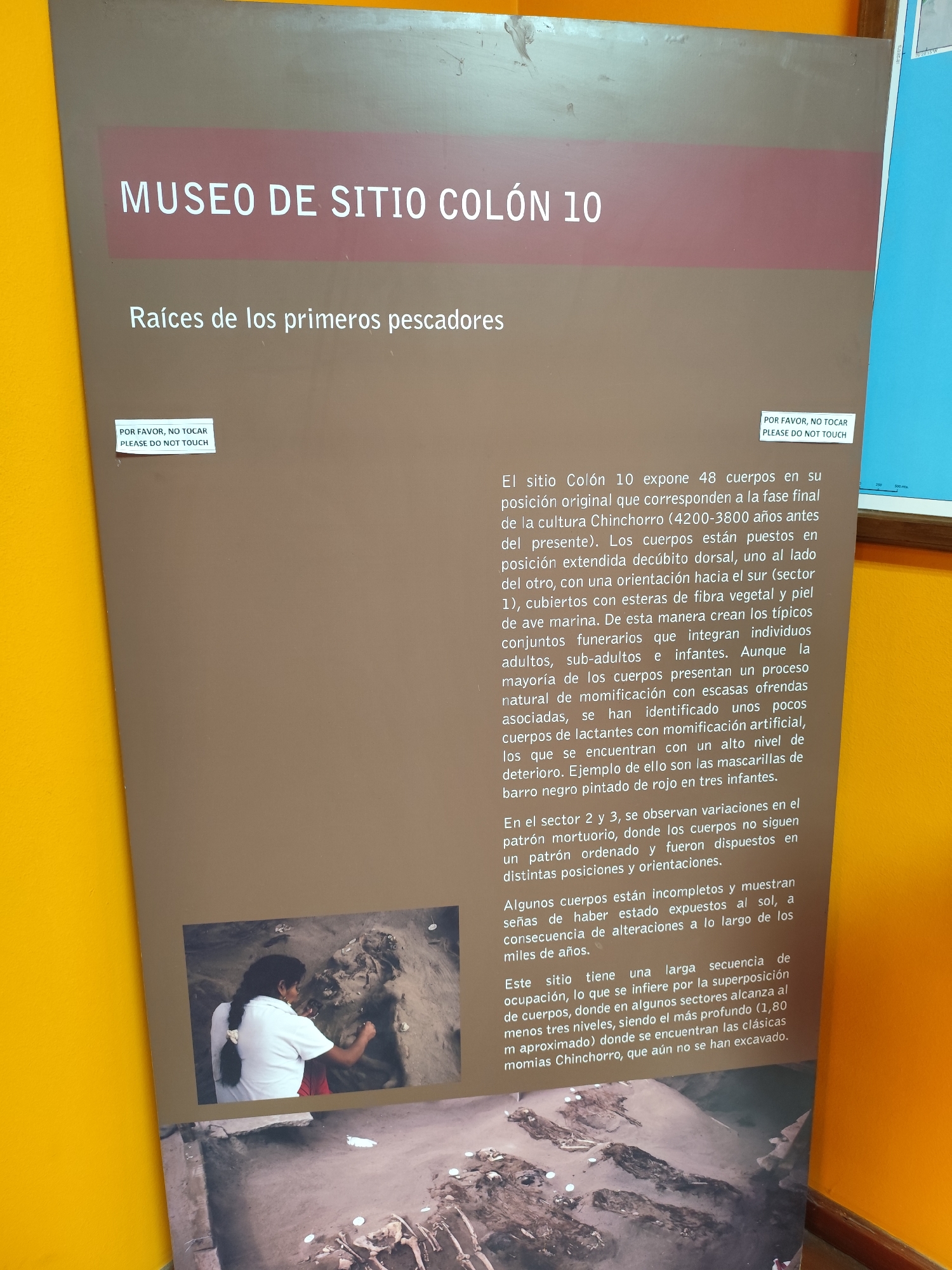
This media file is an informative sign at the "Museo de Sitio Colón 10" in Arica, Chile. The sign's primary subject is the "Roots of the first fishermen," detailing findings from the Chinchorro culture. The text explains that Colón 10 exhibits 48 bodies in their original positions, dating back to 4200-3800 BCE. These bodies were placed extended on their backs, oriented south, and covered with plant fiber mats and marine bird skin, creating funerary ensembles of adults, sub-adults, and infants. While most bodies show natural mummification, some infant bodies with artificial mummification and red-painted black clay masks have also been found. Sectors 2 and 3 show variations in burial patterns, with bodies not following a strict order. The sign also notes that some bodies are incomplete due to prolonged sun exposure over millennia. The site reveals a long occupation sequence, evidenced by the superposition of bodies, with the deepest level containing unexcavated classic Chinchorro mummies.

A photograph on the sign shows an archaeologist, likely a woman with long dark braided hair and a white shirt, carefully excavating human remains in what appears to be an archaeological dig. The scene is dusty and filled with bones and artifacts. Another photograph below shows a partially excavated burial site with multiple skeletons laid out. The overall setting is an indoor exhibition space with a bright yellow wall in the background. Two "PLEASE DO NOT TOUCH" signs are visible on the display.
cynthia🇨🇱📈

Jun 26, 2026

Arica, Chile

Stake attention in this memory

Historical
Archaeological
Intriguing
Educational
Solemn

This media file is an informative sign at the "Museo de Sitio Colón 10" in Arica, Chile. The sign's primary subject is the "Roots of the first fishermen," detailing findings from the Chinchorro culture. The text explains that Colón 10 exhibits 48 bodies in their original positions, dating back to 4200-3800 BCE. These bodies were placed extended on their backs, oriented south, and covered with plant fiber mats and marine bird skin, creating funerary ensembles of adults, sub-adults, and infants. While most bodies show natural mummification, some infant bodies with artificial mummification and red-painted black clay masks have also been found. Sectors 2 and 3 show variations in burial patterns, with bodies not following a strict order. The sign also notes that some bodies are incomplete due to prolonged sun exposure over millennia. The site reveals a long occupation sequence, evidenced by the superposition of bodies, with the deepest level containing unexcavated classic Chinchorro mummies. A photograph on the sign shows an archaeologist, likely a woman with long dark braided hair and a white shirt, carefully excavating human remains in what appears to be an archaeological dig. The scene is dusty and filled with bones and artifacts. Another photograph below shows a partially excavated burial site with multiple skeletons laid out. The overall setting is an indoor exhibition space with a bright yellow wall in the background. Two "PLEASE DO NOT TOUCH" signs are visible on the display.

transactions
revenues
stakers
Earliest
Latest
Highest stake

No transactions found

More from this user

More from Arica

cynthia🇨🇱📈

Jun 26, 2026

Arica, Chile

Licensed under Creative Commons Attribution 4.0 International License. You are free to share and adapt this content with proper attribution.