Sign in
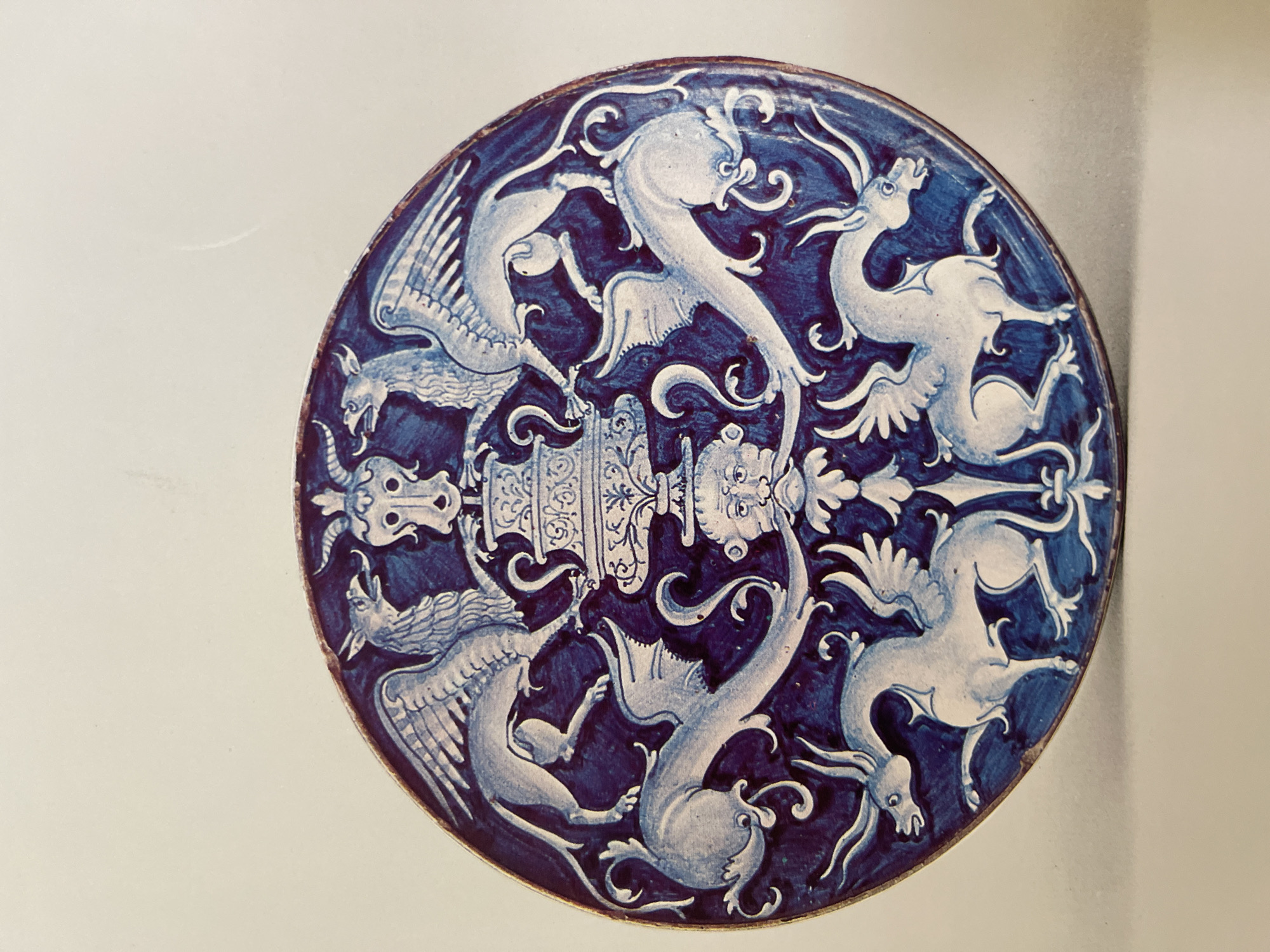
The image displays a round, highly decorated ceramic plate, likely tin-glazed pottery such as maiolica, set against a plain, light-colored background. The dominant colors of the artwork are a deep, rich blue for the background and lighter blue-white for the decorative elements.

At the center of the plate is an ornate, stylized vase or urn, detailed with intricate relief work including grotesque faces and scrolling patterns. Symmetrically arranged around this central motif are four fantastical creatures. Two of these creatures are depicted with winged forelimbs, elongated bodies ending in serpentine or fish-like tails, and heads that resemble mythical sea beasts or griffins. The other two creatures appear to be winged quadrupeds, resembling deer or antelopes with prominent horns, also featuring dynamic, curved tails and depicted in lively, almost leaping postures.

All the creatures are intertwined with elaborate, swirling white-blue scrollwork and foliate designs, which fill the entire surface of the plate and create a sense of flowing movement. The rim of the plate has a subtle, narrow reddish-brown band. The style suggests European decorative arts, possibly from the Renaissance or Baroque period. There is no visible text in the image.
FM-C5aP83

Jun 4, 2026

Almaty, Kazakhstan

Stake attention in this memory

majestic
mythical
intricate
enchanting
vibrant

The image displays a round, highly decorated ceramic plate, likely tin-glazed pottery such as maiolica, set against a plain, light-colored background. The dominant colors of the artwork are a deep, rich blue for the background and lighter blue-white for the decorative elements. At the center of the plate is an ornate, stylized vase or urn, detailed with intricate relief work including grotesque faces and scrolling patterns. Symmetrically arranged around this central motif are four fantastical creatures. Two of these creatures are depicted with winged forelimbs, elongated bodies ending in serpentine or fish-like tails, and heads that resemble mythical sea beasts or griffins. The other two creatures appear to be winged quadrupeds, resembling deer or antelopes with prominent horns, also featuring dynamic, curved tails and depicted in lively, almost leaping postures. All the creatures are intertwined with elaborate, swirling white-blue scrollwork and foliate designs, which fill the entire surface of the plate and create a sense of flowing movement. The rim of the plate has a subtle, narrow reddish-brown band. The style suggests European decorative arts, possibly from the Renaissance or Baroque period. There is no visible text in the image.

transactions
revenues
stakers
Earliest
Latest
Highest stake

No transactions found

More from this user

More from Almaty

FM-C5aP83

Jun 4, 2026

Almaty, Kazakhstan

Licensed under Creative Commons Attribution 4.0 International License. You are free to share and adapt this content with proper attribution.

The image displays a round, highly decorated ceramic plate, likely tin-glazed pottery such as maiolica, set against a plain, light-colored background. The dominant colors of the artwork are a deep, rich blue for the background and lighter blue-white for the decorative elements. At the center of the plate is an ornate, stylized vase or urn, detailed with intricate relief work including grotesque faces and scrolling patterns. Symmetrically arranged around this central motif are four fantastical creatures. Two of these creatures are depicted with winged forelimbs, elongated bodies ending in serpentine or fish-like tails, and heads that resemble mythical sea beasts or griffins. The other two creatures appear to be winged quadrupeds, resembling deer or antelopes with prominent horns, also featuring dynamic, curved tails and depicted in lively, almost leaping postures. All the creatures are intertwined with elaborate, swirling white-blue scrollwork and foliate designs, which fill the entire surface of the plate and create a sense of flowing movement. The rim of the plate has a subtle, narrow reddish-brown band. The style suggests European decorative arts, possibly from the Renaissance or Baroque period. There is no visible text in the image. in Almaty, Kazakhstan | Collective Memory