
Stake attention in this memory
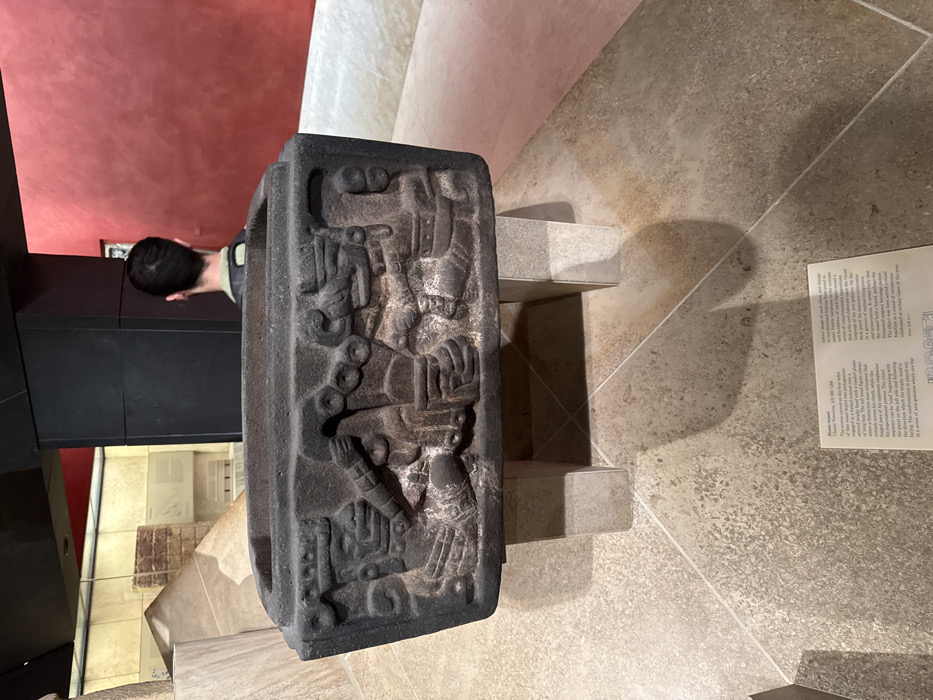
The image captures an indoor scene, likely within a museum or art gallery in London, United Kingdom. The primary focus is a large, dark grey or black stone artifact with intricate, raised carvings. The artifact appears rectangular, possibly a monument or altar, and is displayed on a low, light-colored plinth. The carvings on the visible side of the artifact depict complex, stylized figures, possibly anthropomorphic or zoomorphic, with distinct headwear and intertwined elements. The style of the carvings is highly reminiscent of ancient Mesoamerican art (e.g., Aztec or Mayan), characterized by its blocky forms, geometric patterns, and symbolic representations. The stone itself has a rough, weathered texture, indicative of age. In the background, a person with dark hair, seen from behind, is observing the artifact. They are positioned to the left of the stone block, slightly bent over, suggesting they are examining it closely or reading an accompanying label. The setting includes a red-brown wall in the background, contrasting with lighter, possibly beige or off-white, walls and structures. The floor is made of large, light-colored stone tiles with visible seams and a mottled texture. Artificial lighting casts clear shadows from the artifact and its stand onto the floor. An information plaque or card is visible on the floor to the right of the artifact. Although partially obscured and at an angle, some text is legible. The title or first line of the description reads "ROMAN VESSEL," followed by an identification number "AX 1300." The text continues to describe the carvings, mentioning an "ancient stone," "carved on the first side," "figure," "head," "left side," and "right side." The visual style of the carvings, however, strongly suggests a Pre-Columbian Mesoamerican origin, which presents a discrepancy with the "ROMAN VESSEL" label on the plaque.
Loading AttnAds…
No transactions found