
Sign in
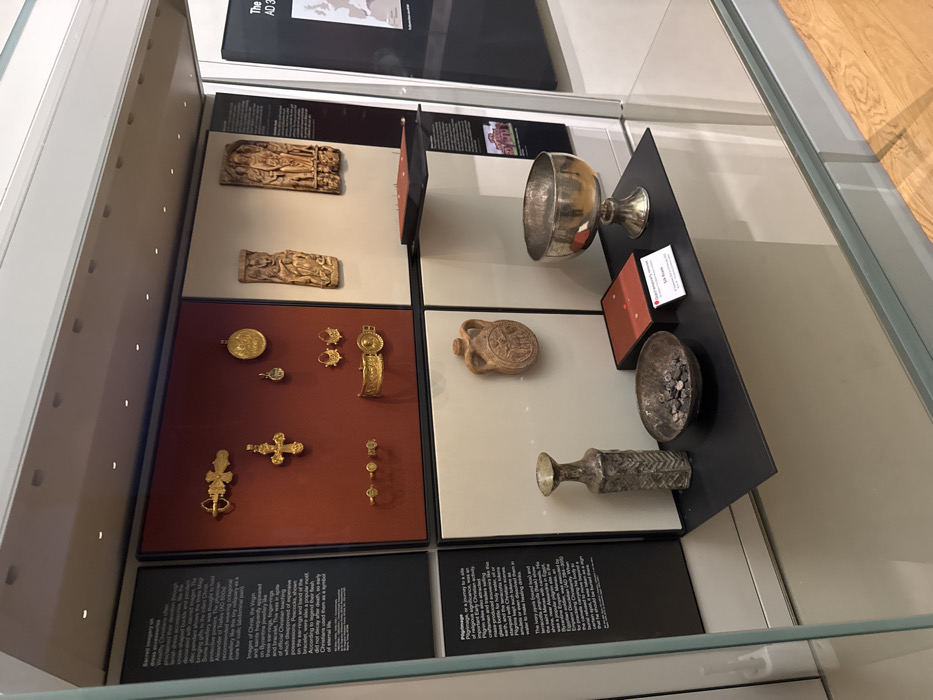
This image captures a museum display case showcasing various ancient artifacts, likely from early Christian or Roman periods, in an indoor setting.

The main subjects are a collection of historical objects. On the left, several pieces of **gold jewelry** are presented on a reddish-brown background, including a large circular pendant, smaller pendants, earrings, an ornate cross, and a segment of a bracelet. Above these, two rectangular, intricately **carved panels**, possibly made of ivory or bone, depict figures in relief.

On the right side of the display, various **vessels** are exhibited on a lighter background and a black elevated platform. These include a large, polished **silver goblet** on a footed stand, a smaller **ceramic jug** with circular relief carvings, a **silver bowl** filled with small coins, and a distinctively patterned **silver or metal bottle/vase**.

The artifacts are neatly arranged within individual compartments of a glass display case, illuminated by internal lights. Below the displayed objects, interpretive panels provide context.

Visible text on these panels offers detailed information:
*   A top panel partially reads "AD 3" and references "AD 500."
*   A long text block on the left discusses "Images of Christ, the Virgin and saints frequently appear on these earrings, fingerings, and bracelet." It mentions "official Christian teaching which disapproved of expensive possessions," and describes peacocks on the jewelry, noting that "According to legend, the peacock's flesh did not decay after death, so early Christians used them as a symbol of immortality."
*   A panel on the right provides information about "Pilgrimage: a journey to a holy place or shrine, was a central activity of religious observance." It explains that "Pilgrims often acquired religious souvenirs: small ampullae... were filled with holy water or oil, which could be drunk or applied to the body to effect a cure." It specifically mentions "ampullae from the tomb of St Menas in Egypt (dated about AD 500-650)."
*   A smaller label near the silver goblet identifies it as "Chalice from the Water Newton Hoard, c. AD 350."

The exhibit provides historical insights into early Christian beliefs, practices, and artistic expressions, likely from a collection in London, United Kingdom.
punit03

Dec 13, 2024, 4:37 PM

London, UK

Stake attention in this memory

This image captures a museum display case showcasing various ancient artifacts, likely from early Christian or Roman periods, in an indoor setting. The main subjects are a collection of historical objects. On the left, several pieces of **gold jewelry** are presented on a reddish-brown background, including a large circular pendant, smaller pendants, earrings, an ornate cross, and a segment of a bracelet. Above these, two rectangular, intricately **carved panels**, possibly made of ivory or bone, depict figures in relief. On the right side of the display, various **vessels** are exhibited on a lighter background and a black elevated platform. These include a large, polished **silver goblet** on a footed stand, a smaller **ceramic jug** with circular relief carvings, a **silver bowl** filled with small coins, and a distinctively patterned **silver or metal bottle/vase**. The artifacts are neatly arranged within individual compartments of a glass display case, illuminated by internal lights. Below the displayed objects, interpretive panels provide context. Visible text on these panels offers detailed information: * A top panel partially reads "AD 3" and references "AD 500." * A long text block on the left discusses "Images of Christ, the Virgin and saints frequently appear on these earrings, fingerings, and bracelet." It mentions "official Christian teaching which disapproved of expensive possessions," and describes peacocks on the jewelry, noting that "According to legend, the peacock's flesh did not decay after death, so early Christians used them as a symbol of immortality." * A panel on the right provides information about "Pilgrimage: a journey to a holy place or shrine, was a central activity of religious observance." It explains that "Pilgrims often acquired religious souvenirs: small ampullae... were filled with holy water or oil, which could be drunk or applied to the body to effect a cure." It specifically mentions "ampullae from the tomb of St Menas in Egypt (dated about AD 500-650)." * A smaller label near the silver goblet identifies it as "Chalice from the Water Newton Hoard, c. AD 350." The exhibit provides historical insights into early Christian beliefs, practices, and artistic expressions, likely from a collection in London, United Kingdom.

Loading AttnAds…

transactions
revenues
stakers
Earliest
Latest
Highest stake

No transactions found

More from this user

More from London

punit03

Dec 13, 2024, 4:37 PM

London, UK

Licensed under Creative Commons Attribution 4.0 International License. You are free to share and adapt this content with proper attribution.