
Sign in
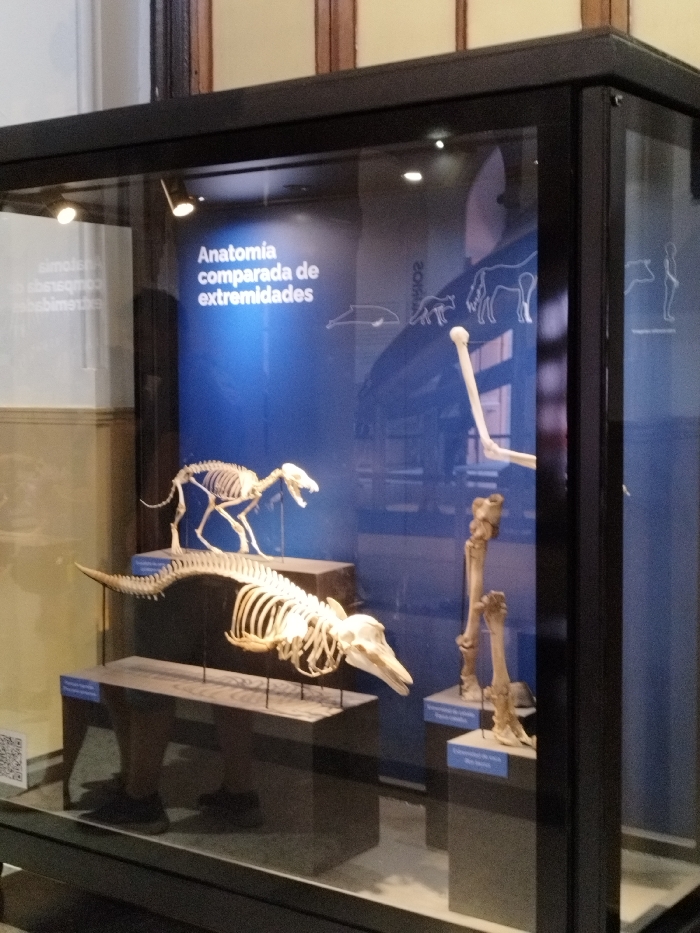
The image captures a museum exhibit displayed within a glass-fronted case with a black frame. The exhibit focuses on comparative anatomy.

Inside the well-lit case, a blue background panel features the prominent Spanish text "Anatomía comparada de extremidades" (Comparative anatomy of limbs). Below this title, several line drawings depict the outlines of various animals, including a marine mammal (like a dolphin), a fox, a horse, and a human, arranged horizontally.

The main subjects of the exhibit are skeletal remains. In the foreground on the left, a complete skeleton of a marine mammal, possibly a dolphin or porpoise, is displayed lying horizontally on a stand. Its delicate ribcage and skull are clearly visible. Above and slightly behind it, the skeleton of a terrestrial mammal, resembling a dog or a small hoofed animal, is posed in a walking or running stance on another stand.

To the right, separate skeletal elements are arranged vertically, showcasing individual limb bones. These appear to be from larger animals, possibly illustrating differences in bone structure and articulation across species. One clearly visible set of bones represents a complete limb, likely from a hoofed animal, standing upright on a small pedestal.

The glass case reflects parts of the museum interior, including inverted text from the exhibit title on the left panel. A faint reflection of a person's shoes is visible at the bottom, suggesting a visitor standing in front of the display. The overall impression is an educational exhibit in a natural history or science museum in Santiago, Chile, dedicated to illustrating evolutionary relationships and adaptations through skeletal comparison.
Mrv

Jan 7, 2025

Santiago, Chile

Stake attention in this memory

The image captures a museum exhibit displayed within a glass-fronted case with a black frame. The exhibit focuses on comparative anatomy. Inside the well-lit case, a blue background panel features the prominent Spanish text "Anatomía comparada de extremidades" (Comparative anatomy of limbs). Below this title, several line drawings depict the outlines of various animals, including a marine mammal (like a dolphin), a fox, a horse, and a human, arranged horizontally. The main subjects of the exhibit are skeletal remains. In the foreground on the left, a complete skeleton of a marine mammal, possibly a dolphin or porpoise, is displayed lying horizontally on a stand. Its delicate ribcage and skull are clearly visible. Above and slightly behind it, the skeleton of a terrestrial mammal, resembling a dog or a small hoofed animal, is posed in a walking or running stance on another stand. To the right, separate skeletal elements are arranged vertically, showcasing individual limb bones. These appear to be from larger animals, possibly illustrating differences in bone structure and articulation across species. One clearly visible set of bones represents a complete limb, likely from a hoofed animal, standing upright on a small pedestal. The glass case reflects parts of the museum interior, including inverted text from the exhibit title on the left panel. A faint reflection of a person's shoes is visible at the bottom, suggesting a visitor standing in front of the display. The overall impression is an educational exhibit in a natural history or science museum in Santiago, Chile, dedicated to illustrating evolutionary relationships and adaptations through skeletal comparison.

transactions
revenues
stakers
Earliest
Latest
Highest stake

No transactions found

More from this user

More from Santiago

Mrv

Jan 7, 2025

Santiago, Chile

Licensed under Creative Commons Attribution 4.0 International License. You are free to share and adapt this content with proper attribution.