Sign in
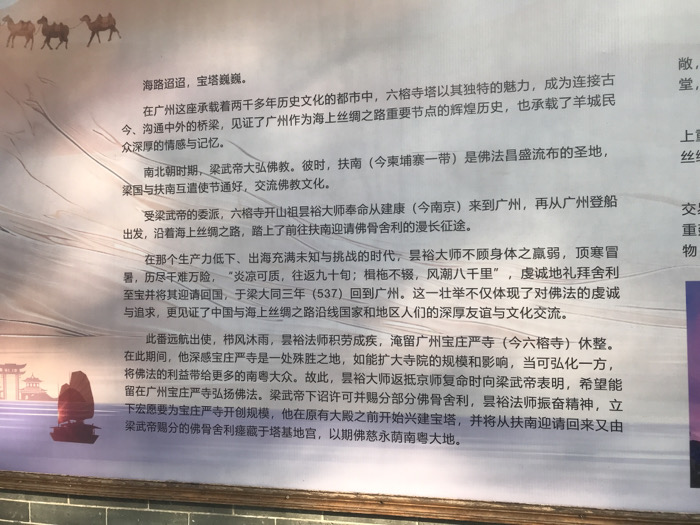
The image displays a large informational panel with Chinese text, likely in a museum or exhibition setting. At the top left, there's a subtle illustration of three camels. At the bottom left, a small, stylized illustration depicts a traditional Chinese sailing boat, possibly a junk, on water with blurred background elements that resemble ancient pagodas or buildings.

The visible text, titled "海路迢迢,宝塔巍巍" (Long maritime journey, magnificent pagoda), details a historical account related to Guangzhou and the Six Banyan Temple. It describes how, during the Southern Dynasties period, Emperor Wu of Liang sent the monk Tanyou from Jiankang (present-day Nanjing) to Funan (present-day Cambodia) via the Maritime Silk Road to retrieve Buddhist sarira (relics).

The text highlights Tanyou's arduous journey, enduring harsh conditions and challenges at sea, before successfully returning to Guangzhou in 537 AD. This event is presented as a testament to deep Buddhist faith and significant cultural exchange between China and countries along the Maritime Silk Road. Upon his return, Tanyou recuperated at Baozhuangyan Temple (now Six Banyan Temple) in Guangzhou. Recognizing its potential, he sought and received permission from Emperor Wu of Liang to establish a pagoda there. He constructed the pagoda to enshrine the brought-back sarira, intending to spread Buddhist teachings throughout the Lingnan region.
F
FM-qn0Jb2

Dec 11, 2024, 7:22 AM

Guang Zhou Shi, China

Stake attention in this memory

The image displays a large informational panel with Chinese text, likely in a museum or exhibition setting. At the top left, there's a subtle illustration of three camels. At the bottom left, a small, stylized illustration depicts a traditional Chinese sailing boat, possibly a junk, on water with blurred background elements that resemble ancient pagodas or buildings. The visible text, titled "海路迢迢,宝塔巍巍" (Long maritime journey, magnificent pagoda), details a historical account related to Guangzhou and the Six Banyan Temple. It describes how, during the Southern Dynasties period, Emperor Wu of Liang sent the monk Tanyou from Jiankang (present-day Nanjing) to Funan (present-day Cambodia) via the Maritime Silk Road to retrieve Buddhist sarira (relics). The text highlights Tanyou's arduous journey, enduring harsh conditions and challenges at sea, before successfully returning to Guangzhou in 537 AD. This event is presented as a testament to deep Buddhist faith and significant cultural exchange between China and countries along the Maritime Silk Road. Upon his return, Tanyou recuperated at Baozhuangyan Temple (now Six Banyan Temple) in Guangzhou. Recognizing its potential, he sought and received permission from Emperor Wu of Liang to establish a pagoda there. He constructed the pagoda to enshrine the brought-back sarira, intending to spread Buddhist teachings throughout the Lingnan region.

Loading AttnAds…

transactions
revenues
stakers
Earliest
Latest
Highest stake

No transactions found

More from this user

More from Guang Zhou Shi

FFM-qn0Jb2

Dec 11, 2024, 7:22 AM

Guang Zhou Shi, China

Licensed under Creative Commons Attribution 4.0 International License. You are free to share and adapt this content with proper attribution.