Sign in
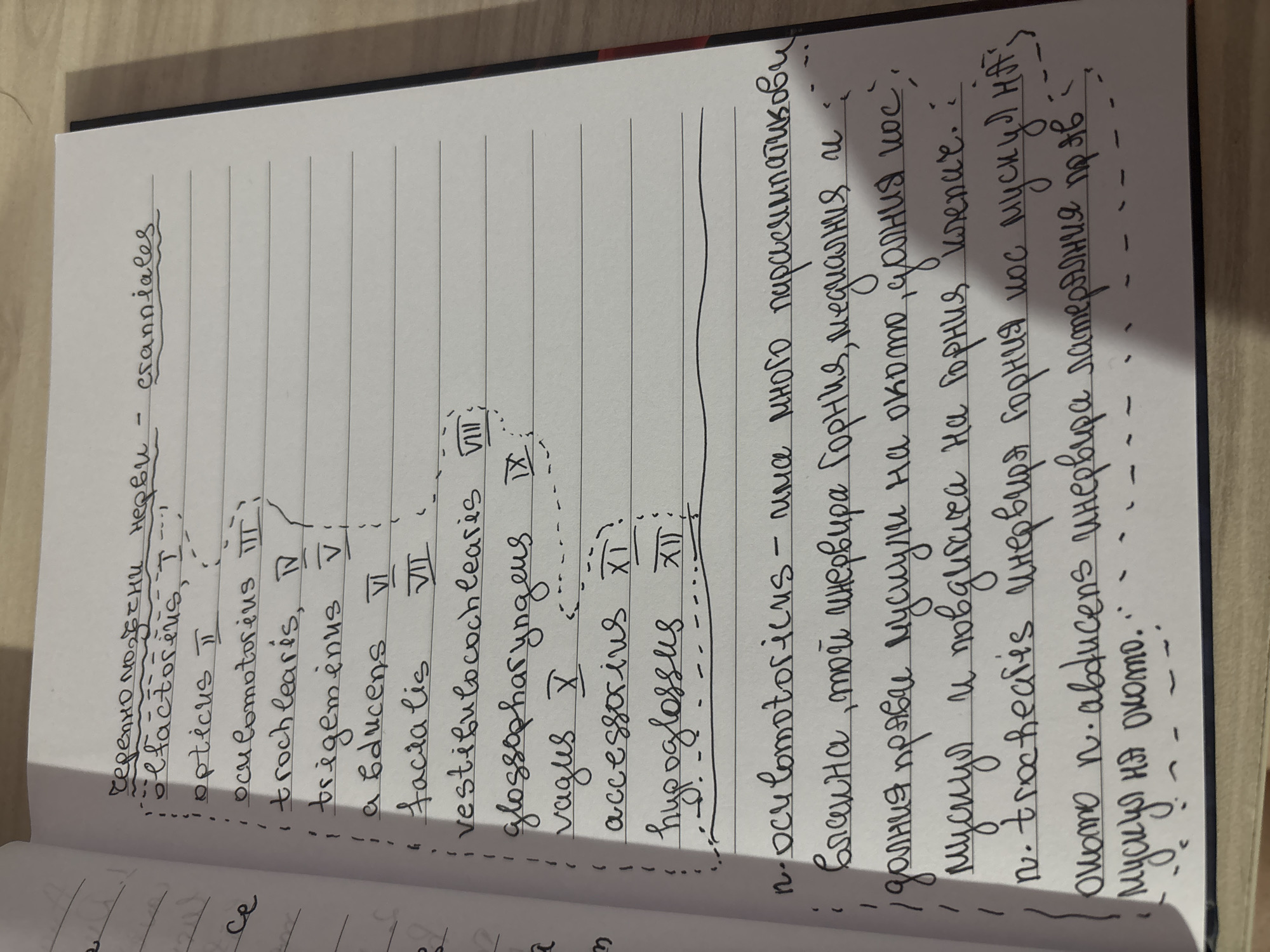
The image displays a handwritten page from an open notebook, resting on a light-colored wooden surface, possibly a desk. The page is filled with neatly written notes in black ink, primarily in Bulgarian with Latin anatomical terms. The notes list the twelve cranial nerves with their Roman numerals and Latin names on the left side, under the heading "ЧЕРЕПНОМОЗЪЧНИ НЕРВИ - CRANIALES" (Cranial Nerves). These include Olfactorius (I), Opticus (II), Oculomotorius (III), Trochlearis (IV), Trigeminus (V), Abducens (VI), Facialis (VII), Vestibulocochlearis (VIII), Glossopharyngeus (IX), Vagus (X), Accessorius (XI), and Hypoglossus (XII).

On the right side of the page, detailed descriptions are provided for specific nerves. The oculomotor nerve (n. oculomotorius) is described as having many parasympathetic fibers, innervating the superior, medial, and inferior rectus muscles of the eye, the inferior oblique muscle, and the levator palpebrae superioris. The trochlear nerve (n. trochlearis) is noted to innervate the superior oblique muscle of the eye, and the abducens nerve (n. abducens) innervates the lateral rectus muscle of the eye.

The overall scene suggests an academic or study environment, likely in Pleven, Bulgaria, given the location context and language. The lighting indicates it is likely daytime or a well-lit room. A shadow from a pen is visible on the page, suggesting recent use.
FM-Hwpo92

Jun 4, 2026, 6:55 PM

Pleven, Bulgaria

Moment

Stake attention in this memory

academic
studious
focused
organized
diligent

The image displays a handwritten page from an open notebook, resting on a light-colored wooden surface, possibly a desk. The page is filled with neatly written notes in black ink, primarily in Bulgarian with Latin anatomical terms. The notes list the twelve cranial nerves with their Roman numerals and Latin names on the left side, under the heading "ЧЕРЕПНОМОЗЪЧНИ НЕРВИ - CRANIALES" (Cranial Nerves). These include Olfactorius (I), Opticus (II), Oculomotorius (III), Trochlearis (IV), Trigeminus (V), Abducens (VI), Facialis (VII), Vestibulocochlearis (VIII), Glossopharyngeus (IX), Vagus (X), Accessorius (XI), and Hypoglossus (XII). On the right side of the page, detailed descriptions are provided for specific nerves. The oculomotor nerve (n. oculomotorius) is described as having many parasympathetic fibers, innervating the superior, medial, and inferior rectus muscles of the eye, the inferior oblique muscle, and the levator palpebrae superioris. The trochlear nerve (n. trochlearis) is noted to innervate the superior oblique muscle of the eye, and the abducens nerve (n. abducens) innervates the lateral rectus muscle of the eye. The overall scene suggests an academic or study environment, likely in Pleven, Bulgaria, given the location context and language. The lighting indicates it is likely daytime or a well-lit room. A shadow from a pen is visible on the page, suggesting recent use.

Symbol

FD6DB

Volume

4,343

Creator

+$0.00

Revenue

+$0.00

TVL

$0.42

1D
1W
1M
All

Loading AttnAds…

transactions
revenues
stakers
Earliest
Latest
Highest stake

1

FM-Hwpo92

Staked 1mo ago

$0.42 USD

$0.00 USD

0%

More from this user

MemoryMemory

More from Pleven

FM-Hwpo92

Jun 4, 2026, 6:55 PM

Pleven, Bulgaria

Licensed under Creative Commons Attribution 4.0 International License. You are free to share and adapt this content with proper attribution.