
Sign in
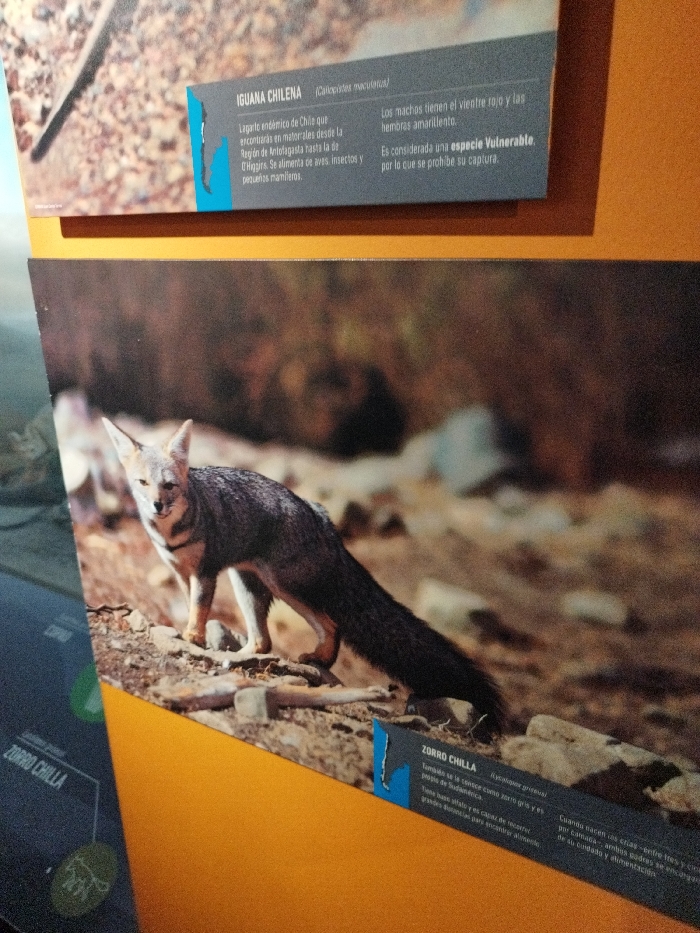
This media file captures an indoor museum or exhibition display in Santiago, Chile, featuring two educational panels about Chilean wildlife.

The top panel, partially visible, focuses on the "Iguana Chilena" (scientific name: Liolaemus maculatus). The accompanying text, mostly legible, states it's an endemic Chilean lizard found in scrublands from the Antofagasta Region to O'Higgins. It feeds on birds, insects, and small mammals. Distinctively, males have red bellies, while females are yellowish. The text highlights its status as a Vulnerable species, prohibiting its capture. A blue silhouette of Chile illustrates its distribution.

The larger, prominent bottom panel displays a clear photograph of a "Zorro Chilla" (Chilla Fox), scientifically known as Lycalopex griseus. The fox, with its greyish fur, lighter underside, and bushy tail, stands alertly on rocky, dry ground, looking towards the viewer. The background is blurred, suggesting a natural habitat. The text below the image describes it as also known as the grey fox, native to South America. It notes its keen sense of smell and ability to travel long distances for food. It also mentions that litters consist of three to eight cubs, cared for by both parents. This panel also includes a blue silhouette of Chile.

The two panels are separated by a bright orange border, indicating the structured layout of the exhibit. The image suggests an informative and educational setting for learning about local fauna.
Mrv

Jan 7, 2025

Santiago, Chile

Stake attention in this memory

This media file captures an indoor museum or exhibition display in Santiago, Chile, featuring two educational panels about Chilean wildlife. The top panel, partially visible, focuses on the "Iguana Chilena" (scientific name: Liolaemus maculatus). The accompanying text, mostly legible, states it's an endemic Chilean lizard found in scrublands from the Antofagasta Region to O'Higgins. It feeds on birds, insects, and small mammals. Distinctively, males have red bellies, while females are yellowish. The text highlights its status as a Vulnerable species, prohibiting its capture. A blue silhouette of Chile illustrates its distribution. The larger, prominent bottom panel displays a clear photograph of a "Zorro Chilla" (Chilla Fox), scientifically known as Lycalopex griseus. The fox, with its greyish fur, lighter underside, and bushy tail, stands alertly on rocky, dry ground, looking towards the viewer. The background is blurred, suggesting a natural habitat. The text below the image describes it as also known as the grey fox, native to South America. It notes its keen sense of smell and ability to travel long distances for food. It also mentions that litters consist of three to eight cubs, cared for by both parents. This panel also includes a blue silhouette of Chile. The two panels are separated by a bright orange border, indicating the structured layout of the exhibit. The image suggests an informative and educational setting for learning about local fauna.

transactions
revenues
stakers
Earliest
Latest
Highest stake

No transactions found

More from this user

More from Santiago

Mrv

Jan 7, 2025

Santiago, Chile

Licensed under Creative Commons Attribution 4.0 International License. You are free to share and adapt this content with proper attribution.