Stake attention in this memory
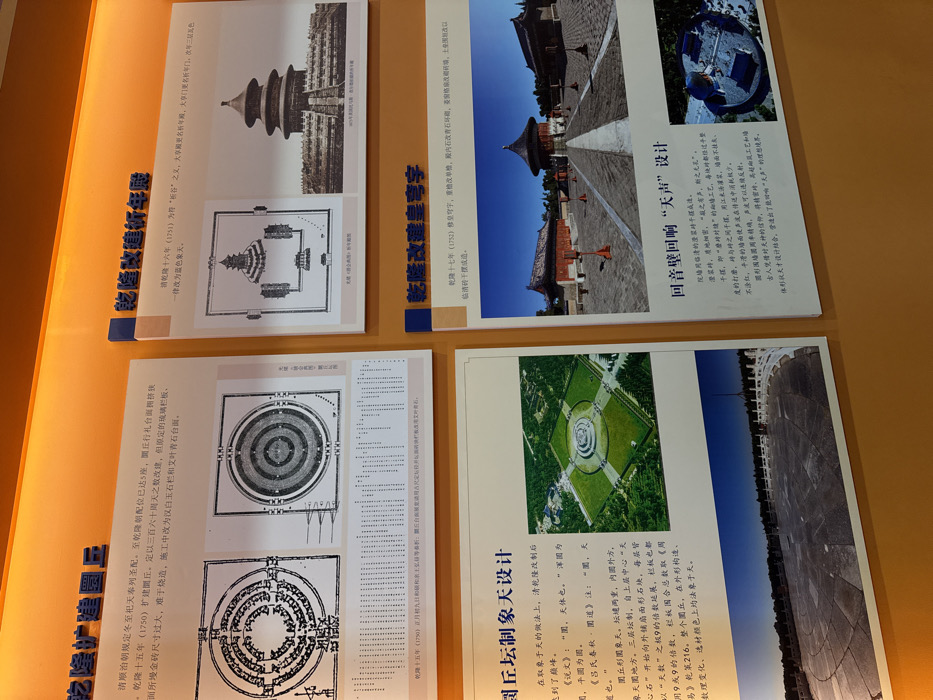
This media file displays four informational panels, likely from a museum or exhibition, arranged in a 2x2 grid, set against an orange background. The panels are rotated to appear vertically oriented. The top-left panel, titled "乾隆改建祈年殿" (Qianlong rebuilt the Hall of Prayer for Good Harvests), features a black and white historical image of the Hall of Prayer for Good Harvests and an architectural plan. The text details the renaming of the hall in 1751 and the change of its roof tiles to blue, symbolizing heaven. The bottom-left panel, with titles "清顺治建园丘" (Qing Shunzhi built the Altar of Heaven) and "乾隆改建圜丘" (Qianlong rebuilt the Circular Mound Altar), shows two black and white architectural diagrams of a circular altar. The text describes the expansion of the Circular Mound Altar in 1750, including changes in building materials from glazed tiles and golden bricks to white marble and green stone. The top-right panel, titled "乾隆改建皇穹宇" (Qianlong rebuilt the Imperial Vault of Heaven), includes a color photograph of the Imperial Vault of Heaven with its distinctive blue roof. The text explains renovations in 1752, such as changing roof tiles to blue, using blue-green stone for the floor, and altering window grilles and the overall floor plan. The bottom-right panel features two sections: 1. "圜丘坛制象天设计" (Circular Mound Altar Astronomical Design): This section includes a color aerial photograph of the Circular Mound Altar, showcasing its concentric circular design within a green landscape. The text elaborates on the altar's design principles, linking its circular and square elements, three-tiered structure, and numerical patterns to celestial concepts and ancient texts like the "Book of Changes." 2. "回音壁回响“天声”设计" (Echo Wall Echoes "Voice of Heaven" Design): This section presents a color photograph of the curved white Echo Wall. The text describes the wall's construction using fine "Linqing bricks" and dry-stacking, which facilitates sound transmission. It highlights how the precise circular shape allows continuous sound reflection, creating an echoing effect perceived as the "Voice of Heaven." The overall setting appears to be an indoor exhibition, likely a museum in Beijing, China, detailing the architectural history and design philosophy of the Temple of Heaven during the Qing Dynasty, particularly the Qianlong era. There are no people visible, and the time of day is not indicated.
Loading AttnAds…
No transactions found