
Sign in
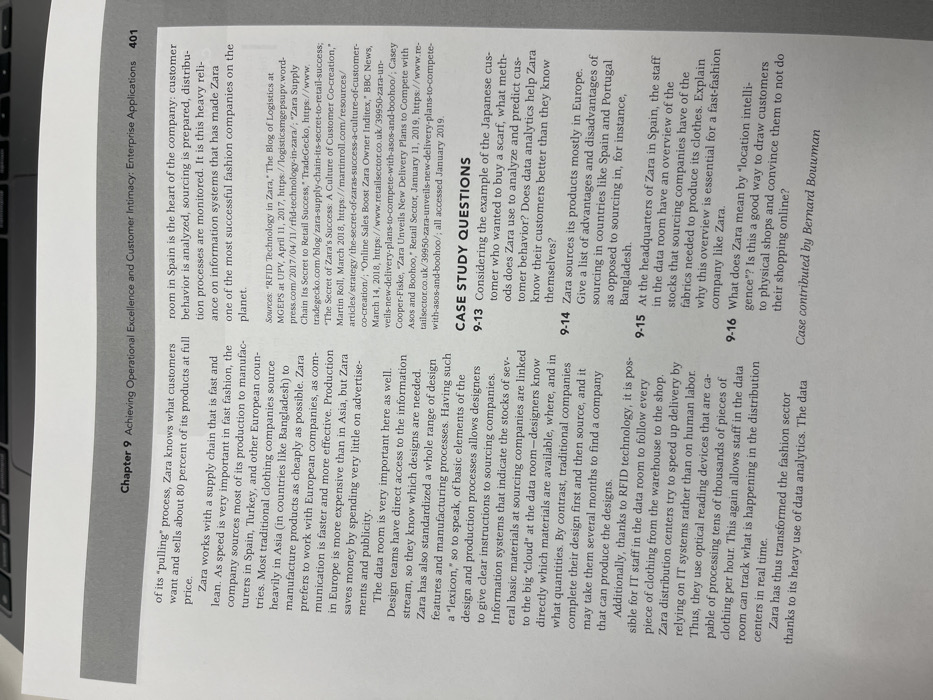
The image displays page 401 from a textbook chapter titled "Achieving Operational Excellence and Customer Intimacy: Enterprise Applications." The page contains a detailed case study about Zara.

The text describes Zara's operational model, focusing on its "pulling" process, fast and lean supply chain, and sourcing strategy which prioritizes European countries (Spain, Turkey) for quicker communication and speed, contrasting with traditional companies that often source from Asia (e.g., Bangladesh) for lower costs. It highlights Zara's minimal advertising expenditure and the crucial role of its "data room" in Spain, which acts as the company's central hub for analyzing customer behavior, preparing sourcing, and monitoring distribution processes. The text explains how design teams use information systems linked to a "big cloud" to access real-time data on material stocks from sourcing companies. It also details the implementation of RFID technology to track clothing from warehouses to shops and the use of optical reading devices in distribution centers for high-speed processing. The section concludes by stating that Zara's heavy reliance on data analytics has transformed the fashion industry.

A "Sources" section lists several online articles from 2017 to 2019 that provide further information on Zara's technology and supply chain. Below this, a "CASE STUDY QUESTIONS" section poses four questions (9-13 to 9-16) that delve into Zara's customer behavior analysis, European sourcing advantages and disadvantages, the significance of the data room for managing fabric stocks, and the concept of "location intelligence." The case study is attributed to Bernard Bouwman. A partial view of a black object, possibly a keyboard, is visible on the left side of the page in some crops.
FM-kkr2I2

Jan 13, 2025

Reims, France

Stake attention in this memory

The image displays page 401 from a textbook chapter titled "Achieving Operational Excellence and Customer Intimacy: Enterprise Applications." The page contains a detailed case study about Zara. The text describes Zara's operational model, focusing on its "pulling" process, fast and lean supply chain, and sourcing strategy which prioritizes European countries (Spain, Turkey) for quicker communication and speed, contrasting with traditional companies that often source from Asia (e.g., Bangladesh) for lower costs. It highlights Zara's minimal advertising expenditure and the crucial role of its "data room" in Spain, which acts as the company's central hub for analyzing customer behavior, preparing sourcing, and monitoring distribution processes. The text explains how design teams use information systems linked to a "big cloud" to access real-time data on material stocks from sourcing companies. It also details the implementation of RFID technology to track clothing from warehouses to shops and the use of optical reading devices in distribution centers for high-speed processing. The section concludes by stating that Zara's heavy reliance on data analytics has transformed the fashion industry. A "Sources" section lists several online articles from 2017 to 2019 that provide further information on Zara's technology and supply chain. Below this, a "CASE STUDY QUESTIONS" section poses four questions (9-13 to 9-16) that delve into Zara's customer behavior analysis, European sourcing advantages and disadvantages, the significance of the data room for managing fabric stocks, and the concept of "location intelligence." The case study is attributed to Bernard Bouwman. A partial view of a black object, possibly a keyboard, is visible on the left side of the page in some crops.

transactions
revenues
stakers
Earliest
Latest
Highest stake

No transactions found

More from this user

More from Reims

FM-kkr2I2

Jan 13, 2025

Reims, France

Licensed under Creative Commons Attribution 4.0 International License. You are free to share and adapt this content with proper attribution.