CM:

ATTN

Get the app

Athina, Greece

30 memories from Athina, Greece

A woman is lying on her side on a white surface, surrounded by scattered hundred-dollar bills. She is wearing thigh-high shiny black boots with stiletto heels, a black leather-like bustier with a white Playboy bunny logo on the front, and fingerless gloves. She is holding a gun in her right hand, which is raised above her head. Her hair is long and reddish-brown. There is no indication of location in Athina, Greece, or any other city.

A woman is lying on her side on a white surface, surrounded by scattered hundred-dollar bills. She is wearing thigh-high shiny black boots with stiletto heels, a black leather-like bustier with a white Playboy bunny logo on the front, and fingerless gloves. She is holding a gun in her right hand, which is raised above her head. Her hair is long and reddish-brown. There is no indication of location in Athina, Greece, or any other city.

Athina
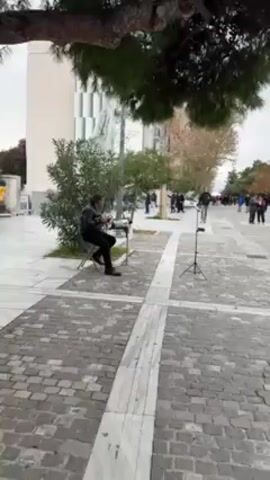
The video shows a man playing music on a paved outdoor walkway. The man sits on a folding chair, wearing a black jacket and dark pants. He is positioned to the left of the frame. He is playing an instrument, likely a keyboard of some kind, placed on a folding table in front of him. In front of the table, and towards the right of the frame, is a music stand on a tripod with what appears to be a donation box beneath it. The walkway is made of square paving stones with lighter-colored lines creating a grid pattern. In the background, there are blurred figures of people walking in the distance. There are buildings on either side of the walkway, including one with a large mural on its side. There are also trees around the walkway, some obscuring the view. The weather appears overcast. The video suggests a street performance or busking event.

The video shows a man playing music on a paved outdoor walkway. The man sits on a folding chair, wearing a black jacket and dark pants. He is positioned to the left of the frame. He is playing an instrument, likely a keyboard of some kind, placed on a folding table in front of him. In front of the table, and towards the right of the frame, is a music stand on a tripod with what appears to be a donation box beneath it. The walkway is made of square paving stones with lighter-colored lines creating a grid pattern. In the background, there are blurred figures of people walking in the distance. There are buildings on either side of the walkway, including one with a large mural on its side. There are also trees around the walkway, some obscuring the view. The weather appears overcast. The video suggests a street performance or busking event.

Athina
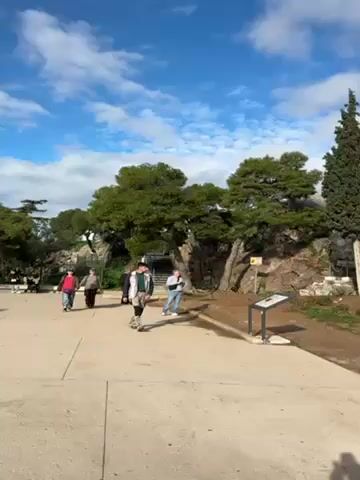
The video shows a stone walkway with several people strolling on it. To the right of the walkway is a rocky hill with trees. A signpost with a map or information panel stands near the edge of the walkway. At the top of the rocky hill, some people are sitting. The sky is blue with white clouds. The scene appears to be a park or historical site with people exploring the area.

The video shows a stone walkway with several people strolling on it. To the right of the walkway is a rocky hill with trees. A signpost with a map or information panel stands near the edge of the walkway. At the top of the rocky hill, some people are sitting. The sky is blue with white clouds. The scene appears to be a park or historical site with people exploring the area.

Athina
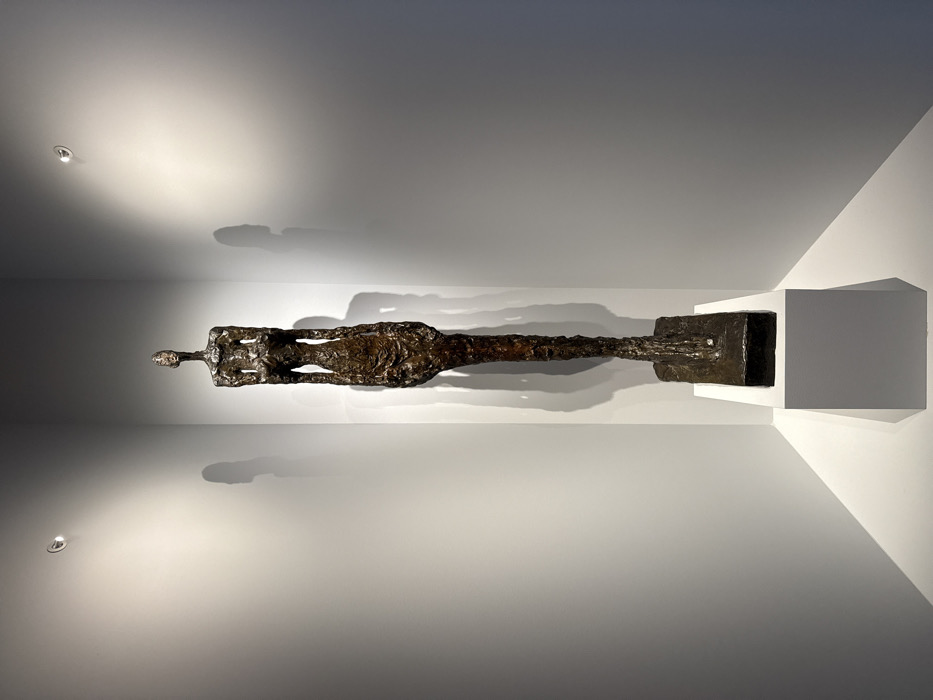
The image shows a bronze sculpture of a female figure standing on a white pedestal. The sculpture is located in a corner of a gallery space, with white walls and two spotlights illuminating the artwork. The figure is depicted with an elongated torso, slender limbs, and a simplified face. The sculpture casts a shadow on the wall behind it, adding depth and dimension to the composition. The coordinates provided (latitude: 37.97, longitude: 23.743) correspond to the city of Athina, Greece. The specific location within the city, however, cannot be determined from the image. The photograph captures the sculpture from a frontal perspective, showcasing the artist's craftsmanship and the unique aesthetic of the piece. The gallery space is empty, with no other people or objects present in the image.

The image shows a bronze sculpture of a female figure standing on a white pedestal. The sculpture is located in a corner of a gallery space, with white walls and two spotlights illuminating the artwork. The figure is depicted with an elongated torso, slender limbs, and a simplified face. The sculpture casts a shadow on the wall behind it, adding depth and dimension to the composition. The coordinates provided (latitude: 37.97, longitude: 23.743) correspond to the city of Athina, Greece. The specific location within the city, however, cannot be determined from the image. The photograph captures the sculpture from a frontal perspective, showcasing the artist's craftsmanship and the unique aesthetic of the piece. The gallery space is empty, with no other people or objects present in the image.

Athina
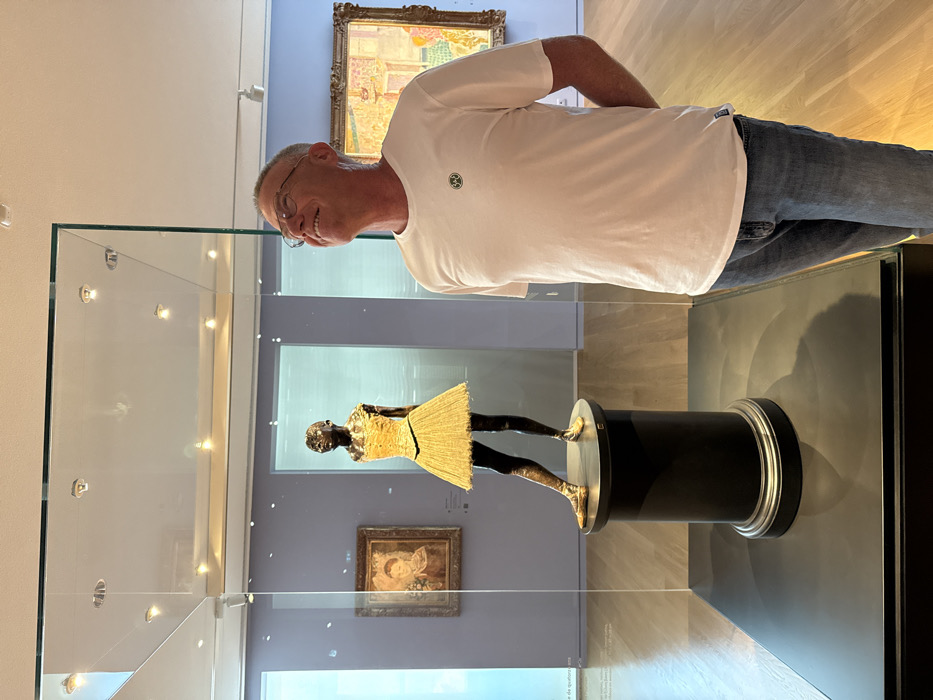
The image shows a man standing in front of a glass display case containing a bronze sculpture of a young ballerina. The ballerina, with a golden tutu, stands on a black pedestal, her arms held in a graceful ballet pose. The man is wearing a white t-shirt and blue jeans and is looking up at the sculpture with a smile. There are recessed ceiling lights above the display case, illuminating the scene. The man is standing on a wooden floor and there are other exhibits in the background. This location appears to be the Benaki Museum, located at 37.97 latitude and 23.743 longitude in the city of Athens, Greece.

The image shows a man standing in front of a glass display case containing a bronze sculpture of a young ballerina. The ballerina, with a golden tutu, stands on a black pedestal, her arms held in a graceful ballet pose. The man is wearing a white t-shirt and blue jeans and is looking up at the sculpture with a smile. There are recessed ceiling lights above the display case, illuminating the scene. The man is standing on a wooden floor and there are other exhibits in the background. This location appears to be the Benaki Museum, located at 37.97 latitude and 23.743 longitude in the city of Athens, Greece.

Athina
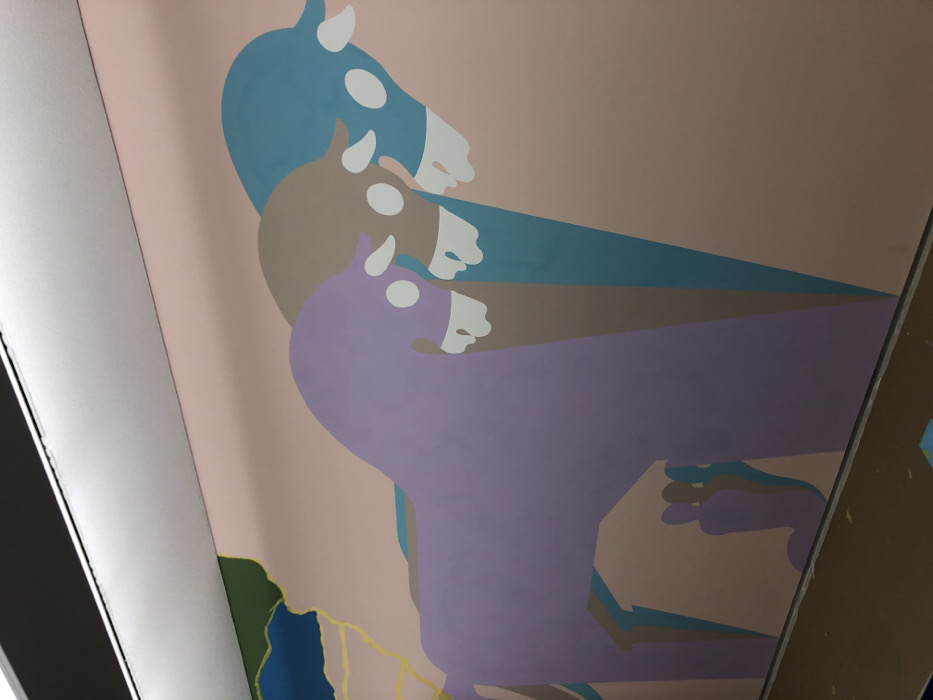
A close-up image of a wall in a building located in Athina, Greece at the coordinates 37.963, 23.725. The wall is painted with three abstract shapes, resembling animals, in various shades of teal, brown, and purple. Each shape has white circular features painted on them, which appear to be eyes. The shapes are stacked on top of one another, with the teal shape on top, followed by the brown shape, and finally the purple shape. The wall is a light pink color. The image is taken from a low angle.

A close-up image of a wall in a building located in Athina, Greece at the coordinates 37.963, 23.725. The wall is painted with three abstract shapes, resembling animals, in various shades of teal, brown, and purple. Each shape has white circular features painted on them, which appear to be eyes. The shapes are stacked on top of one another, with the teal shape on top, followed by the brown shape, and finally the purple shape. The wall is a light pink color. The image is taken from a low angle.

Athina
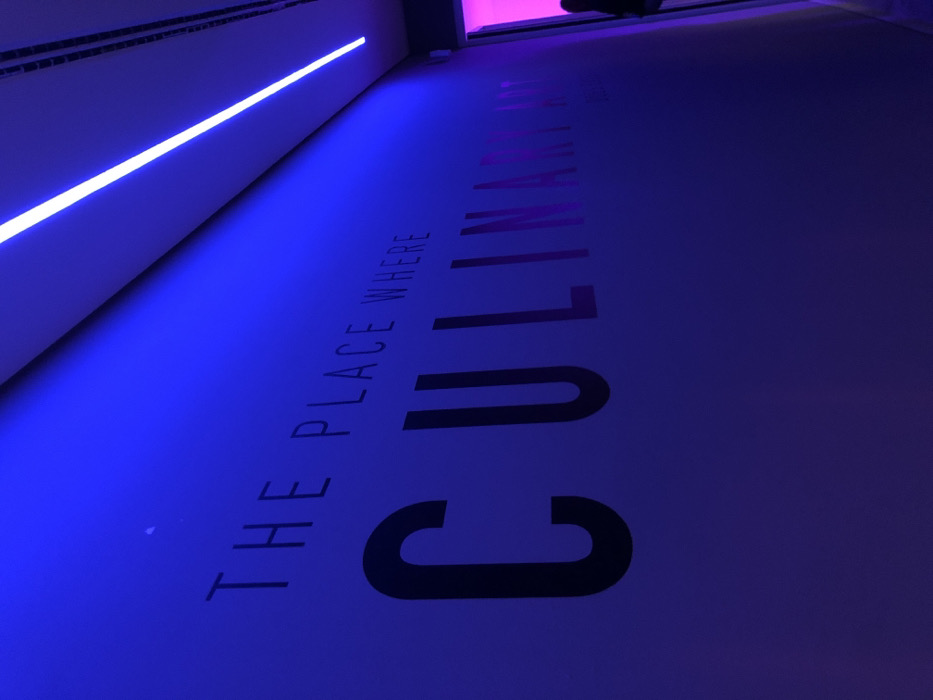
The image shows a white wall with the words "THE PLACE WHERE CULINARY" written in black. The wall is illuminated by a blue light emanating from the top left corner of the image. The perspective is low, looking upward towards the wall. The image is likely from a restaurant or culinary school located in Athens, Greece, at the coordinates provided.  There are no people or other objects in the image.

The image shows a white wall with the words "THE PLACE WHERE CULINARY" written in black. The wall is illuminated by a blue light emanating from the top left corner of the image. The perspective is low, looking upward towards the wall. The image is likely from a restaurant or culinary school located in Athens, Greece, at the coordinates provided. There are no people or other objects in the image.

Athina
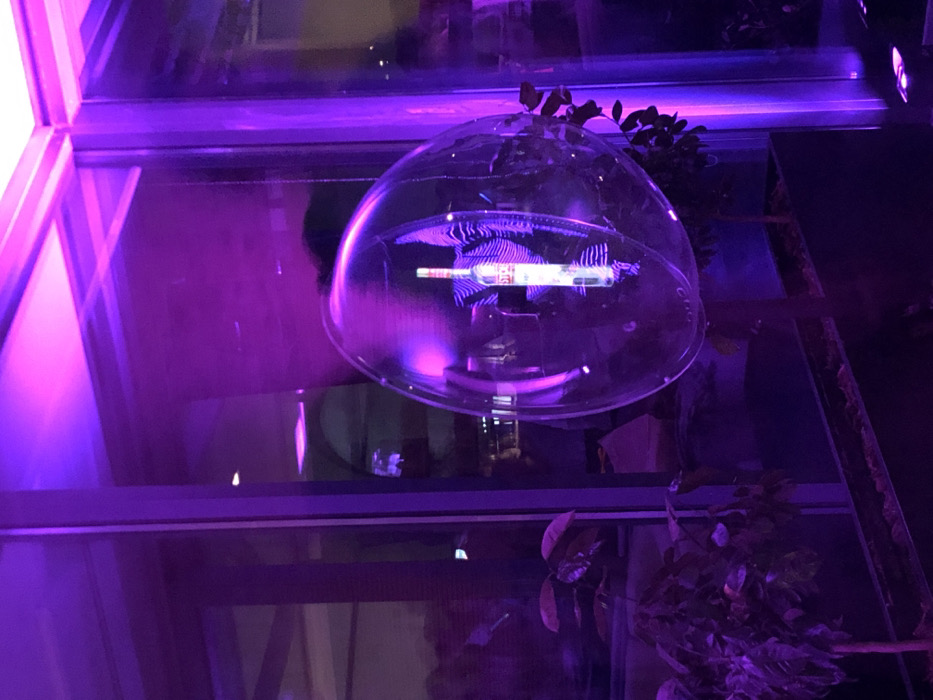
The image shows a clear plastic dome, lit from within by a purple light, hanging from the ceiling of an indoor space. The dome appears to be covering a small object or plant.  The background is out of focus, but appears to be a dark space with a few plants and some glass surfaces reflecting purple light. The image was taken in Athens, Greece (37.963, 23.725).

The image shows a clear plastic dome, lit from within by a purple light, hanging from the ceiling of an indoor space. The dome appears to be covering a small object or plant. The background is out of focus, but appears to be a dark space with a few plants and some glass surfaces reflecting purple light. The image was taken in Athens, Greece (37.963, 23.725).

Athina
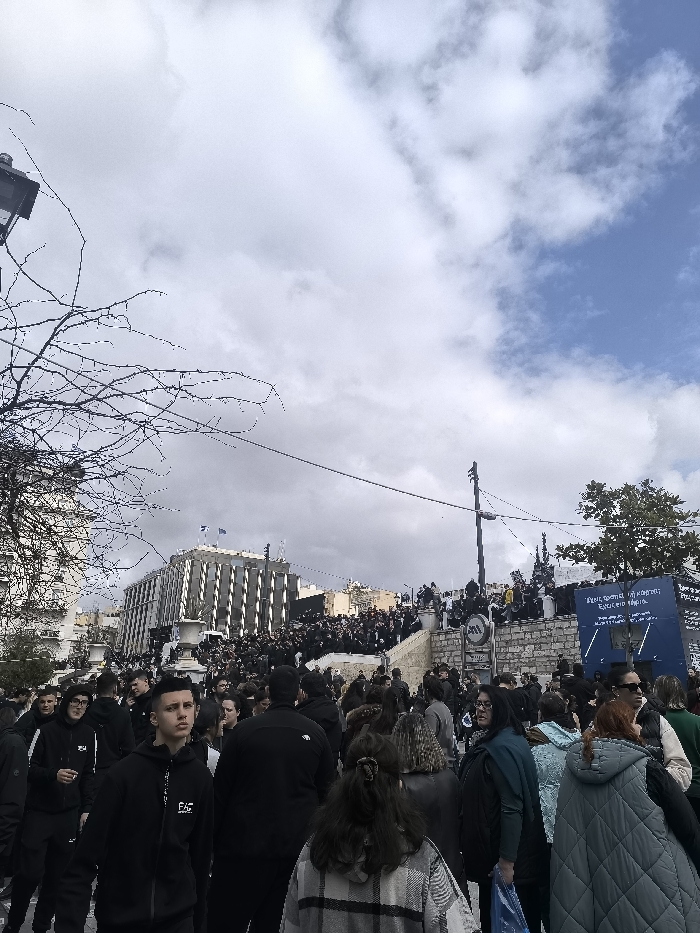
The image shows a large crowd of people gathered on a street in Athina, Greece, at the coordinates 37.975, 23.735. The crowd is dense and mostly comprised of young adults. The people are mostly dressed in dark clothing, many wearing black jackets or hoodies. Some individuals are holding signs or flags. In the foreground, several individuals are facing the camera. The scene is dominated by the crowd and the street, but some buildings can be seen in the background. The weather is overcast, with some sunlight breaking through the clouds, and the sky is a mix of white and blue. The environment includes several street lamps, wires, and a tree in the background. The mood of the crowd is difficult to assess, as the focus is on the individuals in the foreground.  The crowd is moving towards the right side of the image, towards a wall with a large blue sign, with Greek writing on it. The sign is covered in smaller signs and posters. The camera is positioned on the ground, looking slightly upwards, capturing a perspective of the dense crowd from within.  The overall scene depicts a gathering of people in an urban setting, likely an event or a demonstration.

The image shows a large crowd of people gathered on a street in Athina, Greece, at the coordinates 37.975, 23.735. The crowd is dense and mostly comprised of young adults. The people are mostly dressed in dark clothing, many wearing black jackets or hoodies. Some individuals are holding signs or flags. In the foreground, several individuals are facing the camera. The scene is dominated by the crowd and the street, but some buildings can be seen in the background. The weather is overcast, with some sunlight breaking through the clouds, and the sky is a mix of white and blue. The environment includes several street lamps, wires, and a tree in the background. The mood of the crowd is difficult to assess, as the focus is on the individuals in the foreground. The crowd is moving towards the right side of the image, towards a wall with a large blue sign, with Greek writing on it. The sign is covered in smaller signs and posters. The camera is positioned on the ground, looking slightly upwards, capturing a perspective of the dense crowd from within. The overall scene depicts a gathering of people in an urban setting, likely an event or a demonstration.

Athina
The image, taken in a vertical orientation but displayed horizontally, captures a view through a train or metro carriage window, with a strong reflection of the interior superimposed on the exterior scene. To the right, a smooth, white interior wall or door of the carriage is visible.

Through the window, the scene is layered. The underlying view shows what appears to be a station platform or an indoor terminal, characterized by a pattern of diagonal lines, possibly from architectural elements or lighting. Overlaid on this exterior is a distinct reflection of the carriage's interior. This reflection includes a ceiling with a square grid pattern, featuring multiple round, recessed white light fixtures and one prominent linear fluorescent light.

Several indistinct figures of people are reflected in the glass, appearing somewhat dark and distorted, suggesting passengers inside the train. One figure, in the upper reflected area, is wearing a reddish top. Other reflected objects include a small, rectangular metallic handle or panel and a black circular element below the linear light. A faint, pixelated digital display is also discernible in the lower part of the reflection.

In the upper-left reflected area, inverted and blurry text can be seen on a rectangular object. The characters are Greek, appearing to spell "ΒΟΛΟΣ" (Volos), a city in Greece. The dominant artificial lighting from the reflected fixtures suggests an indoor setting or nighttime. The scene depicts a transit environment, consistent with a train or metro station in Athina, Greece.

The image, taken in a vertical orientation but displayed horizontally, captures a view through a train or metro carriage window, with a strong reflection of the interior superimposed on the exterior scene. To the right, a smooth, white interior wall or door of the carriage is visible. Through the window, the scene is layered. The underlying view shows what appears to be a station platform or an indoor terminal, characterized by a pattern of diagonal lines, possibly from architectural elements or lighting. Overlaid on this exterior is a distinct reflection of the carriage's interior. This reflection includes a ceiling with a square grid pattern, featuring multiple round, recessed white light fixtures and one prominent linear fluorescent light. Several indistinct figures of people are reflected in the glass, appearing somewhat dark and distorted, suggesting passengers inside the train. One figure, in the upper reflected area, is wearing a reddish top. Other reflected objects include a small, rectangular metallic handle or panel and a black circular element below the linear light. A faint, pixelated digital display is also discernible in the lower part of the reflection. In the upper-left reflected area, inverted and blurry text can be seen on a rectangular object. The characters are Greek, appearing to spell "ΒΟΛΟΣ" (Volos), a city in Greece. The dominant artificial lighting from the reflected fixtures suggests an indoor setting or nighttime. The scene depicts a transit environment, consistent with a train or metro station in Athina, Greece.

Athina
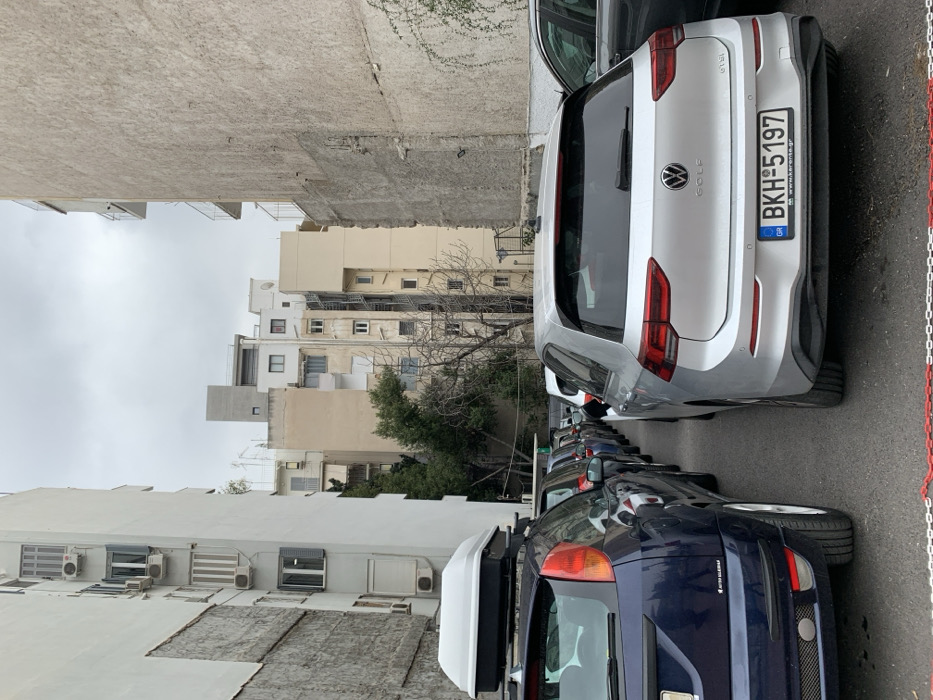
The image depicts an urban street scene under an overcast sky, likely during the daytime. The perspective is from slightly above, looking down a street where several cars are parked in a row on the right side.

In the foreground and mid-ground, a silver Volkswagen Golf is prominently parked, seen from its rear. Its license plate, clearly visible, reads "GR BKH 5197" and also includes small text "www.karampinas.gr," indicating a Greek registration. The car also features the Volkswagen logo, the word "GOLF," and "GT I.D." on its tailgate. Directly behind the Golf, a dark blue car with a white roof cargo box is parked, also viewed from the rear. Faint text "AUTO" is visible on its side near the rear wheel arch. A long line of other parked cars extends further down the street. The curb on the far right is painted with alternating red and white stripes.

To the left of the parked cars, a mix of multi-story residential or commercial buildings rises, characterized by numerous windows, balconies, and external air conditioning units on their facades. Some buildings appear older with textured walls, while others are a more modern, lighter color. Bare trees are scattered between the buildings and the street. On the far right, a tall, plain concrete or stucco wall stands, with some greenery growing on its upper edge. No people are visible in the scene. The overall impression is a typical street in a city like Athens, Greece, given the license plate and architectural style.

The image depicts an urban street scene under an overcast sky, likely during the daytime. The perspective is from slightly above, looking down a street where several cars are parked in a row on the right side. In the foreground and mid-ground, a silver Volkswagen Golf is prominently parked, seen from its rear. Its license plate, clearly visible, reads "GR BKH 5197" and also includes small text "www.karampinas.gr," indicating a Greek registration. The car also features the Volkswagen logo, the word "GOLF," and "GT I.D." on its tailgate. Directly behind the Golf, a dark blue car with a white roof cargo box is parked, also viewed from the rear. Faint text "AUTO" is visible on its side near the rear wheel arch. A long line of other parked cars extends further down the street. The curb on the far right is painted with alternating red and white stripes. To the left of the parked cars, a mix of multi-story residential or commercial buildings rises, characterized by numerous windows, balconies, and external air conditioning units on their facades. Some buildings appear older with textured walls, while others are a more modern, lighter color. Bare trees are scattered between the buildings and the street. On the far right, a tall, plain concrete or stucco wall stands, with some greenery growing on its upper edge. No people are visible in the scene. The overall impression is a typical street in a city like Athens, Greece, given the license plate and architectural style.

Athina
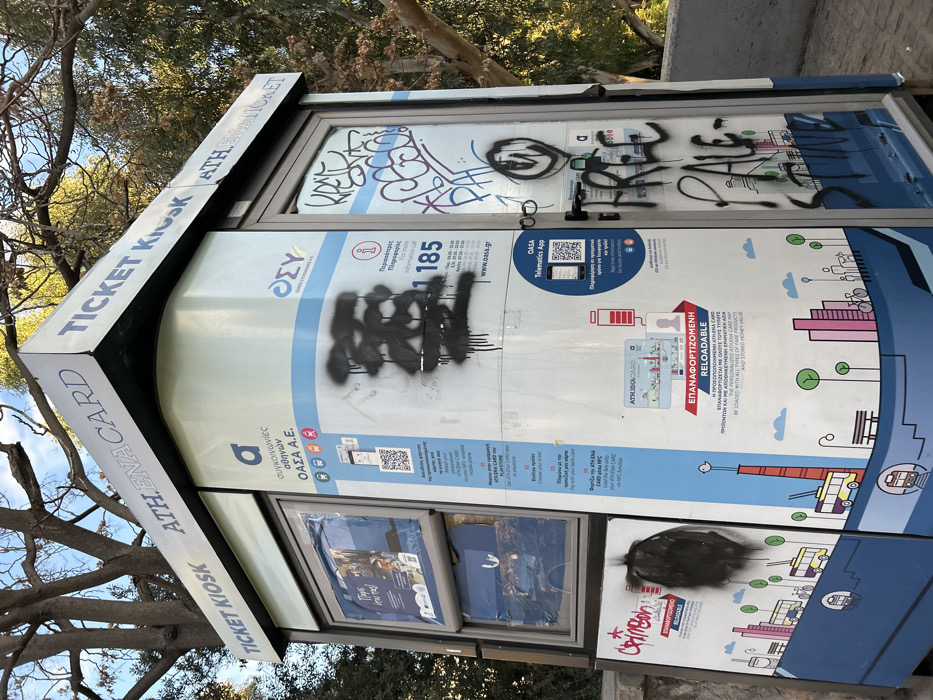
A public transport ticket kiosk, identifiable by "TICKET KIOSK" and "ATHENA TICKET" signage, stands outdoors in Athens, Greece, under clear, sunny daylight. The kiosk is heavily vandalized with extensive black and some purple spray paint graffiti covering its screens and panels. Despite the graffiti, its light blue and white design with illustrations of a city skyline, buses, and trains is still visible.

The kiosk is designed for users to purchase and reload Athena Cards, Athens' public transport cards. Visible text includes "ATHENA CARD", "ΕΠΑΝΑΦΟΡΤΙΖΟΜΕΝΗ RELOADABLE" (meaning "Reloadable"), and instructions in both Greek and English about how to use and recharge the card. Contact information such as a phone number "1 185" for inquiries, the website "www.oasa.gr", and QR codes for the "OASA Telematics App" are also visible. Company names "συγκοινωνίες αθηνών" (Transport of Athens), "ΟΑΣΑ Α.Ε." (OASA S.A.), and "ΟΣΥ" are present on the panels.

No people are seen interacting with the kiosk. Trees are visible in the background, suggesting an urban outdoor setting, possibly near a park or street. The graffiti significantly obscures much of the intended informational text and visual elements of the machine.

A public transport ticket kiosk, identifiable by "TICKET KIOSK" and "ATHENA TICKET" signage, stands outdoors in Athens, Greece, under clear, sunny daylight. The kiosk is heavily vandalized with extensive black and some purple spray paint graffiti covering its screens and panels. Despite the graffiti, its light blue and white design with illustrations of a city skyline, buses, and trains is still visible. The kiosk is designed for users to purchase and reload Athena Cards, Athens' public transport cards. Visible text includes "ATHENA CARD", "ΕΠΑΝΑΦΟΡΤΙΖΟΜΕΝΗ RELOADABLE" (meaning "Reloadable"), and instructions in both Greek and English about how to use and recharge the card. Contact information such as a phone number "1 185" for inquiries, the website "www.oasa.gr", and QR codes for the "OASA Telematics App" are also visible. Company names "συγκοινωνίες αθηνών" (Transport of Athens), "ΟΑΣΑ Α.Ε." (OASA S.A.), and "ΟΣΥ" are present on the panels. No people are seen interacting with the kiosk. Trees are visible in the background, suggesting an urban outdoor setting, possibly near a park or street. The graffiti significantly obscures much of the intended informational text and visual elements of the machine.

Athina
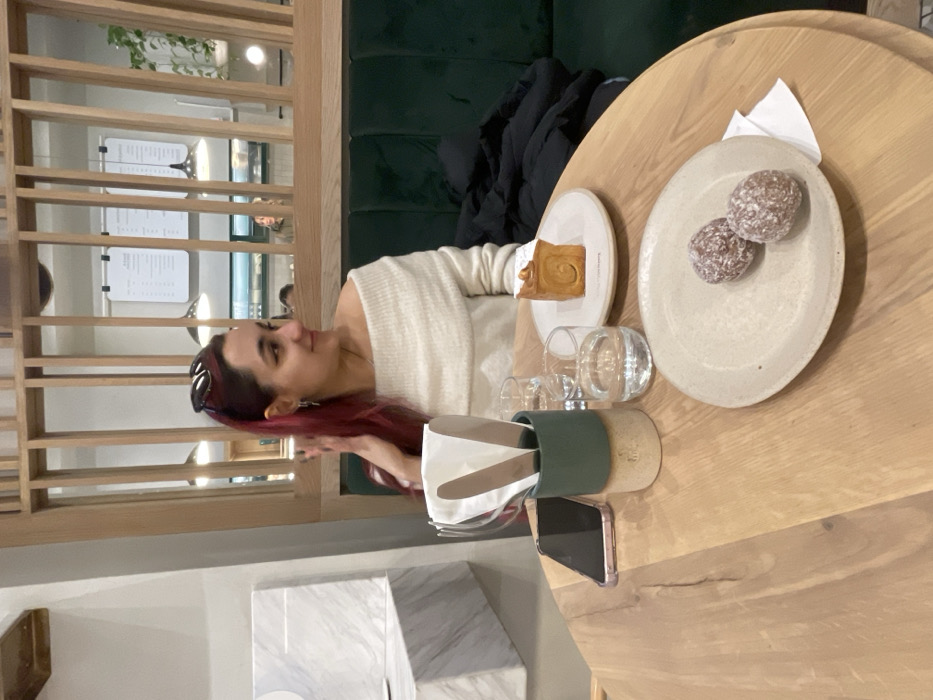
A medium shot captures a woman sitting at a light-colored wooden table in what appears to be a cafe or restaurant in Athina, Greece. The woman, with dark red hair and sunglasses pushed onto her head, is wearing a light-colored, off-the-shoulder sweater. She looks towards her left (viewer's right) with a neutral expression, her right arm resting on the table.

On the table in front of her are several items: two round, off-white ceramic plates, one holding a piece of golden-brown cake (possibly a Swiss roll) dusted with powdered sugar, and the other holding two dark, spherical treats, likely energy balls or truffles, coated in a granular substance. Two clear drinking glasses, one appearing to contain water, are also present. A green and beige container, possibly a napkin holder, is on the table, along with a smartphone with a metallic back. A crumpled white napkin sits beneath one of the plates.

The woman is seated on a dark green upholstered booth. In the background, a light wooden slat partition separates the dining area from another section. Beyond the partition, white boards displaying unreadable text (likely menus) are visible, along with glimpses of a counter and other blurred figures. Green plants are positioned above the partition, and a grey marble-patterned tissue box can be seen on an adjacent table to the left. The overall lighting is soft, suggesting a relaxed indoor atmosphere.

A medium shot captures a woman sitting at a light-colored wooden table in what appears to be a cafe or restaurant in Athina, Greece. The woman, with dark red hair and sunglasses pushed onto her head, is wearing a light-colored, off-the-shoulder sweater. She looks towards her left (viewer's right) with a neutral expression, her right arm resting on the table. On the table in front of her are several items: two round, off-white ceramic plates, one holding a piece of golden-brown cake (possibly a Swiss roll) dusted with powdered sugar, and the other holding two dark, spherical treats, likely energy balls or truffles, coated in a granular substance. Two clear drinking glasses, one appearing to contain water, are also present. A green and beige container, possibly a napkin holder, is on the table, along with a smartphone with a metallic back. A crumpled white napkin sits beneath one of the plates. The woman is seated on a dark green upholstered booth. In the background, a light wooden slat partition separates the dining area from another section. Beyond the partition, white boards displaying unreadable text (likely menus) are visible, along with glimpses of a counter and other blurred figures. Green plants are positioned above the partition, and a grey marble-patterned tissue box can be seen on an adjacent table to the left. The overall lighting is soft, suggesting a relaxed indoor atmosphere.

Athina
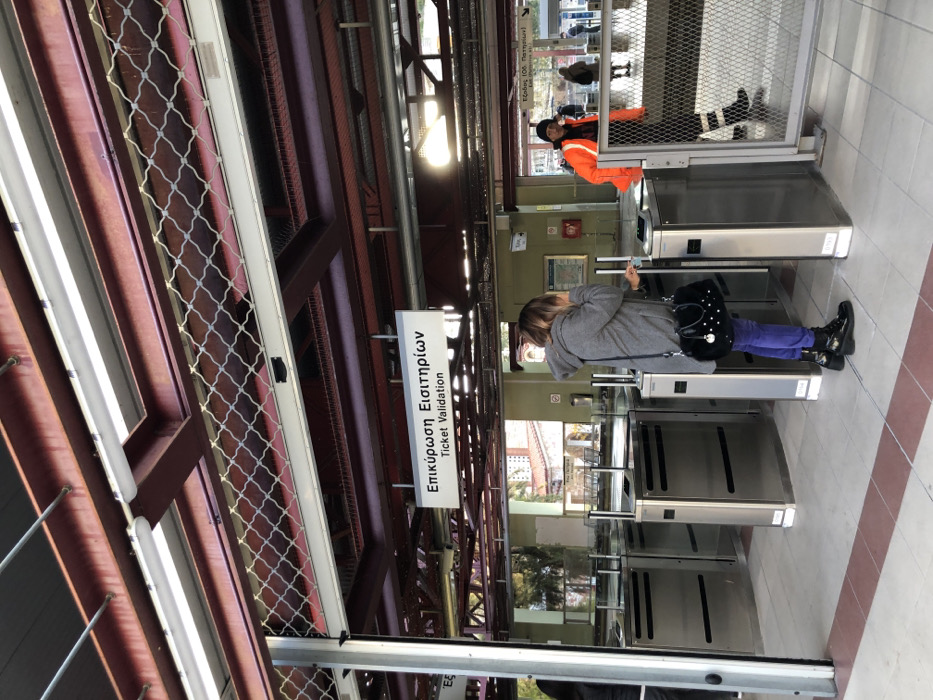
The image captures a scene at a transit station, likely a metro or train platform, in Athina, Greece, given the visible text. The shot is oriented vertically, showing the ceiling structure and floor.

In the mid-ground, a person with blonde hair, wearing a grey hooded jacket, blue trousers, and black boots, stands before a silver ticket validation turnstile. They are in the process of using the machine, holding an object (possibly a ticket or card) up to the reader. A black handbag with white embellishments hangs from their shoulder. Behind them, several identical turnstiles are visible.

To the right and slightly behind the turnstiles, another person in a bright orange high-visibility jacket and a dark cap is seen through a metal grate barrier, possibly an attendant or another passenger.

A white sign hangs above the turnstiles, displaying text in both Greek and English: "Επικύρωση Εισιτηρίων" and "Ticket Validation."

The setting features exposed red-brown metal beams and supports, along with fluorescent lighting fixtures on the ceiling. A metal mesh fence runs along the left side of the frame. The floor is tiled in light grey and reddish-brown patterns. Bright natural light streams in from the background, indicating it is daytime. In the background, beyond the station infrastructure, outdoor elements like greenery and parts of buildings are visible.

The image captures a scene at a transit station, likely a metro or train platform, in Athina, Greece, given the visible text. The shot is oriented vertically, showing the ceiling structure and floor. In the mid-ground, a person with blonde hair, wearing a grey hooded jacket, blue trousers, and black boots, stands before a silver ticket validation turnstile. They are in the process of using the machine, holding an object (possibly a ticket or card) up to the reader. A black handbag with white embellishments hangs from their shoulder. Behind them, several identical turnstiles are visible. To the right and slightly behind the turnstiles, another person in a bright orange high-visibility jacket and a dark cap is seen through a metal grate barrier, possibly an attendant or another passenger. A white sign hangs above the turnstiles, displaying text in both Greek and English: "Επικύρωση Εισιτηρίων" and "Ticket Validation." The setting features exposed red-brown metal beams and supports, along with fluorescent lighting fixtures on the ceiling. A metal mesh fence runs along the left side of the frame. The floor is tiled in light grey and reddish-brown patterns. Bright natural light streams in from the background, indicating it is daytime. In the background, beyond the station infrastructure, outdoor elements like greenery and parts of buildings are visible.

Athina
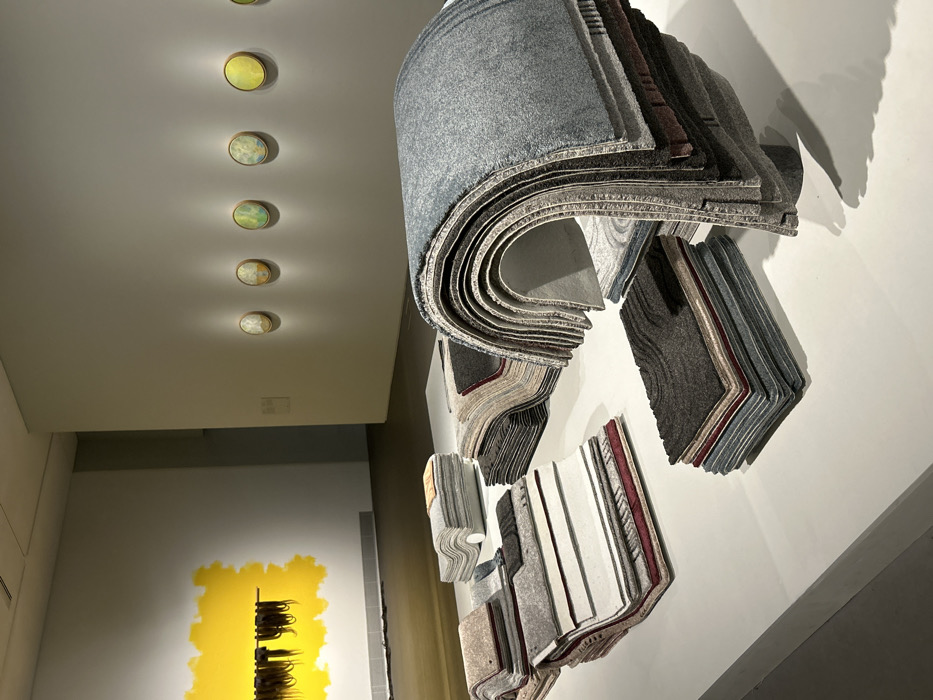
This image captures an interior view of an art gallery or exhibition space in Athina, Greece, showcasing multiple contemporary art installations. The scene is dominated by a striking three-dimensional textile sculpture mounted on the right-hand wall, composed of numerous folded and layered fabric or carpet samples. These samples vary in color, predominantly shades of grey, blue-grey, and dark grey, with some featuring accents of red or brown along their edges. They are arranged in an abstract, flowing manner, creating curves, stacks, and protruding forms that cast subtle shadows on the white wall.

To the left, a series of six circular, illuminated wall-mounted art pieces or sconces are evenly spaced vertically on a light-colored wall. Each disc exhibits a unique, mottled, or iridescent surface texture, displaying a palette of yellows, greens, and whites, glowing softly.

In the background, a large, vibrant yellow abstract painting or mural covers a section of a distant white wall. In front of this yellow backdrop, a dark, sculptural element with distinct vertical lines or spikes stands, suggesting another artwork. The overall environment is minimalist and well-lit, emphasizing the textures and forms of the displayed art. No people or visible text are present in the image.

This image captures an interior view of an art gallery or exhibition space in Athina, Greece, showcasing multiple contemporary art installations. The scene is dominated by a striking three-dimensional textile sculpture mounted on the right-hand wall, composed of numerous folded and layered fabric or carpet samples. These samples vary in color, predominantly shades of grey, blue-grey, and dark grey, with some featuring accents of red or brown along their edges. They are arranged in an abstract, flowing manner, creating curves, stacks, and protruding forms that cast subtle shadows on the white wall. To the left, a series of six circular, illuminated wall-mounted art pieces or sconces are evenly spaced vertically on a light-colored wall. Each disc exhibits a unique, mottled, or iridescent surface texture, displaying a palette of yellows, greens, and whites, glowing softly. In the background, a large, vibrant yellow abstract painting or mural covers a section of a distant white wall. In front of this yellow backdrop, a dark, sculptural element with distinct vertical lines or spikes stands, suggesting another artwork. The overall environment is minimalist and well-lit, emphasizing the textures and forms of the displayed art. No people or visible text are present in the image.

Athina
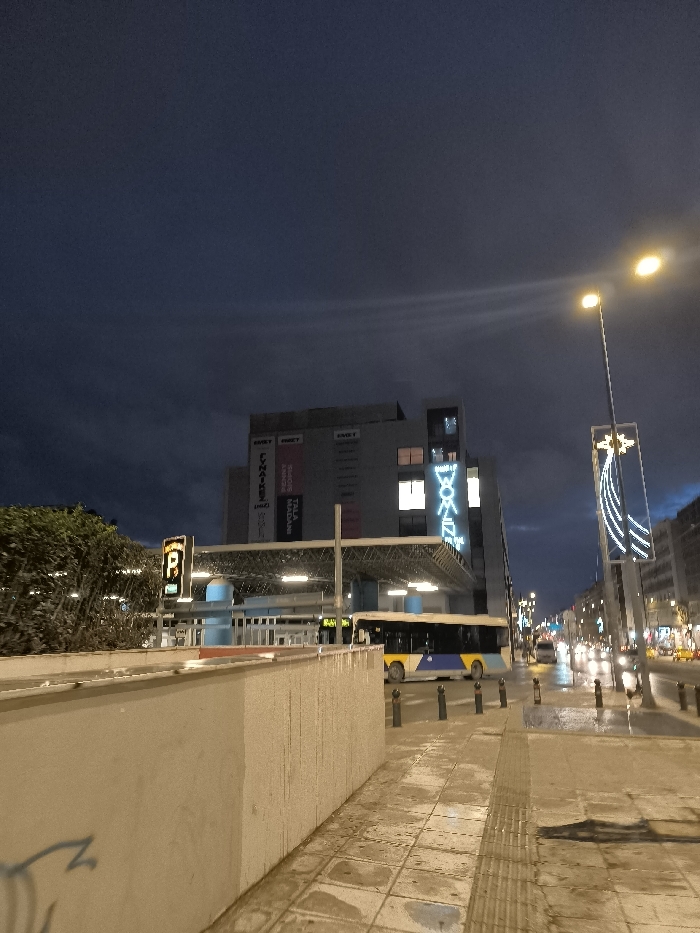
This image captures an urban street scene at dusk or night in Athina, Greece, under a dark, overcast sky with subtle cloud patterns. The ground appears wet, suggesting recent rain.

In the foreground, a light-colored concrete barrier runs along the bottom left, alongside a section of dense green foliage. Above these, a yellow-illuminated "P" parking sign is visible. The foreground sidewalk on the right is paved with square tiles and features several dark bollards lining its edge.

In the midground, a blue and yellow public bus, partially displaying "040" as its route number, is stopped or moving slowly on the street. Across the street, a large, modern building dominates the background. This multi-story structure features various signs on its facade, including "EMOT" repeated several times, "WOMEN," "TALA," and "MADAM." A prominent, brightly illuminated vertical sign on the building's corner clearly reads "VOILA" or "YOGA."

Further down the street to the right, multiple streetlights emit a warm orange glow, illuminating the wet road surface. Distant vehicle headlights and taillights indicate ongoing traffic. A tall, slender vertical sign featuring an abstract, star-like illuminated design stands on the right side of the street, adding to the city's evening glow. The scene conveys a calm, contemporary urban setting.

This image captures an urban street scene at dusk or night in Athina, Greece, under a dark, overcast sky with subtle cloud patterns. The ground appears wet, suggesting recent rain. In the foreground, a light-colored concrete barrier runs along the bottom left, alongside a section of dense green foliage. Above these, a yellow-illuminated "P" parking sign is visible. The foreground sidewalk on the right is paved with square tiles and features several dark bollards lining its edge. In the midground, a blue and yellow public bus, partially displaying "040" as its route number, is stopped or moving slowly on the street. Across the street, a large, modern building dominates the background. This multi-story structure features various signs on its facade, including "EMOT" repeated several times, "WOMEN," "TALA," and "MADAM." A prominent, brightly illuminated vertical sign on the building's corner clearly reads "VOILA" or "YOGA." Further down the street to the right, multiple streetlights emit a warm orange glow, illuminating the wet road surface. Distant vehicle headlights and taillights indicate ongoing traffic. A tall, slender vertical sign featuring an abstract, star-like illuminated design stands on the right side of the street, adding to the city's evening glow. The scene conveys a calm, contemporary urban setting.

Athina
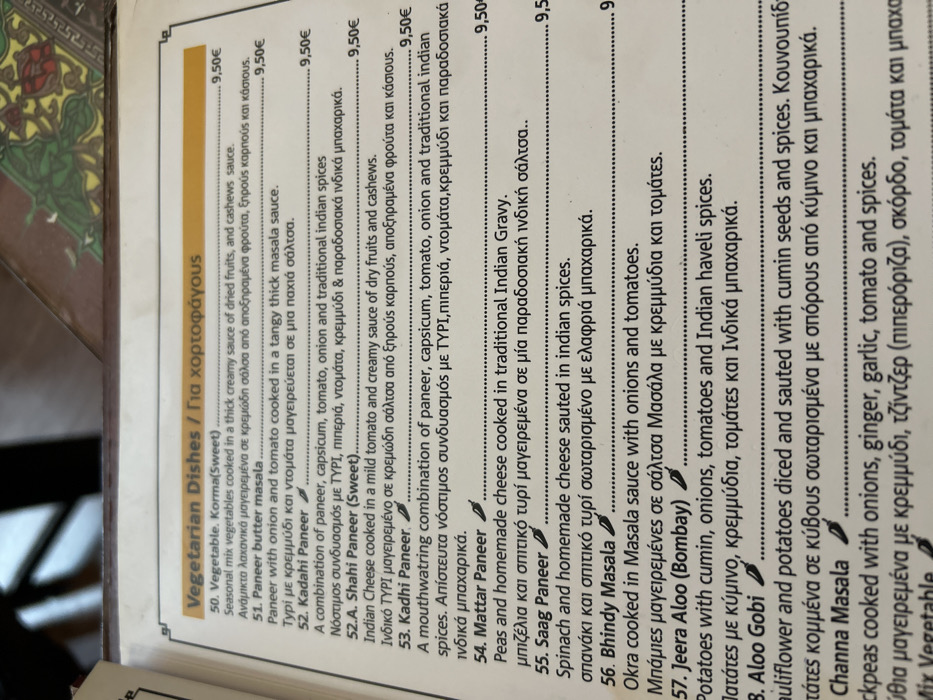
The image displays a close-up of a laminated menu page, specifically featuring the "Vegetarian Dishes" section, titled in both English and Greek ("Για χορτοφάγους"). The menu lists several Indian vegetarian dishes, each with a numerical identifier, English name, a brief English description, a Greek description, and a price, typically 9,50€.

Visible dishes include:
*   50. Vegetable Korma (Sweet): Mixed vegetables in a creamy sauce with dried fruits and cashews (9,50€).
*   51. Paneer butter masala: Paneer with onion and tomato in a tangy thick masala sauce (9,50€).
*   52. Kadahi Paneer: A combination of paneer, capsicum, tomato, onion, and traditional Indian spices (9,50€). A small chili icon is next to its name.
*   52.A. Shahi Paneer (Sweet): Indian cheese in a mild tomato and creamy sauce with dry fruits and cashews (9,50€).
*   53. Kadhi Paneer: Described as a "mouthwatering combination" of paneer, capsicum, tomato, onion, and traditional Indian spices (9,50€). This also has a chili icon.
*   54. Mattar Paneer: Peas and homemade cheese in traditional Indian Gravy (9,50€, partially visible).
*   55. Saag Paneer: Spinach and homemade cheese sautéed in Indian spices (9,50€, partially visible).
*   56. Bhindy Masala: Okra cooked in Masala sauce with onions and tomatoes (9,50€, partially visible). This item has a chili icon.
*   57. Jeera Aloo (Bombay): Potatoes with cumin, onions, tomatoes, and Indian haveli spices (price not fully visible). This item has a chili icon.
*   58. Aloo Gobi: Cauliflower and potatoes diced and sautéed with cumin seeds and spices (price not fully visible). This item has a chili icon.
*   Channa Masala: Chickpeas cooked with onions, ginger, garlic, tomato, and spices (price not fully visible). This item has a chili icon.
*   Mix Vegetable: Partially visible description.

The prices are aligned to the right with dotted lines leading from the dish description. The background beyond the menu is blurred, showing a dark, possibly wooden, surface and a decorative pattern on the left side of the menu. No people or specific location cues other than the menu itself are visible.

The image displays a close-up of a laminated menu page, specifically featuring the "Vegetarian Dishes" section, titled in both English and Greek ("Για χορτοφάγους"). The menu lists several Indian vegetarian dishes, each with a numerical identifier, English name, a brief English description, a Greek description, and a price, typically 9,50€. Visible dishes include: * 50. Vegetable Korma (Sweet): Mixed vegetables in a creamy sauce with dried fruits and cashews (9,50€). * 51. Paneer butter masala: Paneer with onion and tomato in a tangy thick masala sauce (9,50€). * 52. Kadahi Paneer: A combination of paneer, capsicum, tomato, onion, and traditional Indian spices (9,50€). A small chili icon is next to its name. * 52.A. Shahi Paneer (Sweet): Indian cheese in a mild tomato and creamy sauce with dry fruits and cashews (9,50€). * 53. Kadhi Paneer: Described as a "mouthwatering combination" of paneer, capsicum, tomato, onion, and traditional Indian spices (9,50€). This also has a chili icon. * 54. Mattar Paneer: Peas and homemade cheese in traditional Indian Gravy (9,50€, partially visible). * 55. Saag Paneer: Spinach and homemade cheese sautéed in Indian spices (9,50€, partially visible). * 56. Bhindy Masala: Okra cooked in Masala sauce with onions and tomatoes (9,50€, partially visible). This item has a chili icon. * 57. Jeera Aloo (Bombay): Potatoes with cumin, onions, tomatoes, and Indian haveli spices (price not fully visible). This item has a chili icon. * 58. Aloo Gobi: Cauliflower and potatoes diced and sautéed with cumin seeds and spices (price not fully visible). This item has a chili icon. * Channa Masala: Chickpeas cooked with onions, ginger, garlic, tomato, and spices (price not fully visible). This item has a chili icon. * Mix Vegetable: Partially visible description. The prices are aligned to the right with dotted lines leading from the dish description. The background beyond the menu is blurred, showing a dark, possibly wooden, surface and a decorative pattern on the left side of the menu. No people or specific location cues other than the menu itself are visible.

Athina
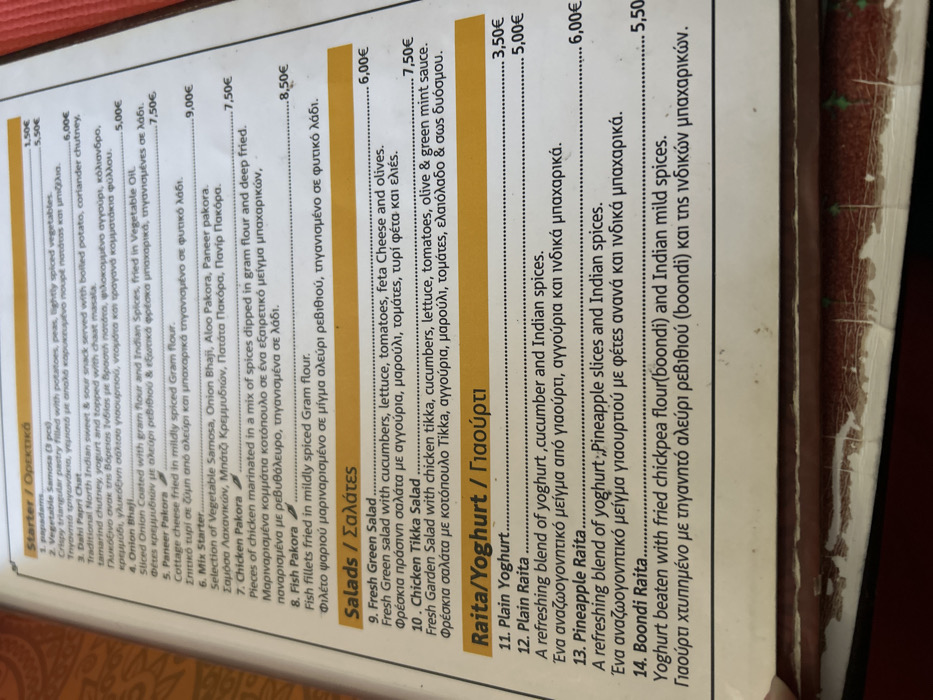
The image displays a slightly worn, brightly lit menu from a restaurant, likely in Athina, Greece, as indicated by the bilingual text in English and Greek. The menu presents Indian cuisine, categorized into "Starter / Oρεκτικά," "Salads / Σαλάτες," and "Raita/Yoghurt / Γιαούρτι."

Visible food items include appetizers like Papadams, Vegetable Samosa, Dahi Papri Chat, Onion Bhaji, Paneer Pakora, Mix Starter, Chicken Pakora, and Fish Pakora. Salads offered are Fresh Green Salad and Chicken Tikka Salad. The "Raita/Yoghurt" section lists Plain Yoghurt, Plain Raita, Pineapple Raita, and Boondi Raita. Each item has a detailed description in both English and Greek, outlining ingredients and preparation (e.g., "Crispy triangular pastry filled with potatoes, peas, lightly spiced vegetables" for Samosa).

Prices are clearly displayed in Euros next to each item, ranging from 1.50€ for Papadams to 9.00€ for the Mix Starter. The right and bottom edges of the menu show signs of wear and tear, suggesting frequent handling. No people or specific time of day are discernible.

The image displays a slightly worn, brightly lit menu from a restaurant, likely in Athina, Greece, as indicated by the bilingual text in English and Greek. The menu presents Indian cuisine, categorized into "Starter / Oρεκτικά," "Salads / Σαλάτες," and "Raita/Yoghurt / Γιαούρτι." Visible food items include appetizers like Papadams, Vegetable Samosa, Dahi Papri Chat, Onion Bhaji, Paneer Pakora, Mix Starter, Chicken Pakora, and Fish Pakora. Salads offered are Fresh Green Salad and Chicken Tikka Salad. The "Raita/Yoghurt" section lists Plain Yoghurt, Plain Raita, Pineapple Raita, and Boondi Raita. Each item has a detailed description in both English and Greek, outlining ingredients and preparation (e.g., "Crispy triangular pastry filled with potatoes, peas, lightly spiced vegetables" for Samosa). Prices are clearly displayed in Euros next to each item, ranging from 1.50€ for Papadams to 9.00€ for the Mix Starter. The right and bottom edges of the menu show signs of wear and tear, suggesting frequent handling. No people or specific time of day are discernible.

Athina
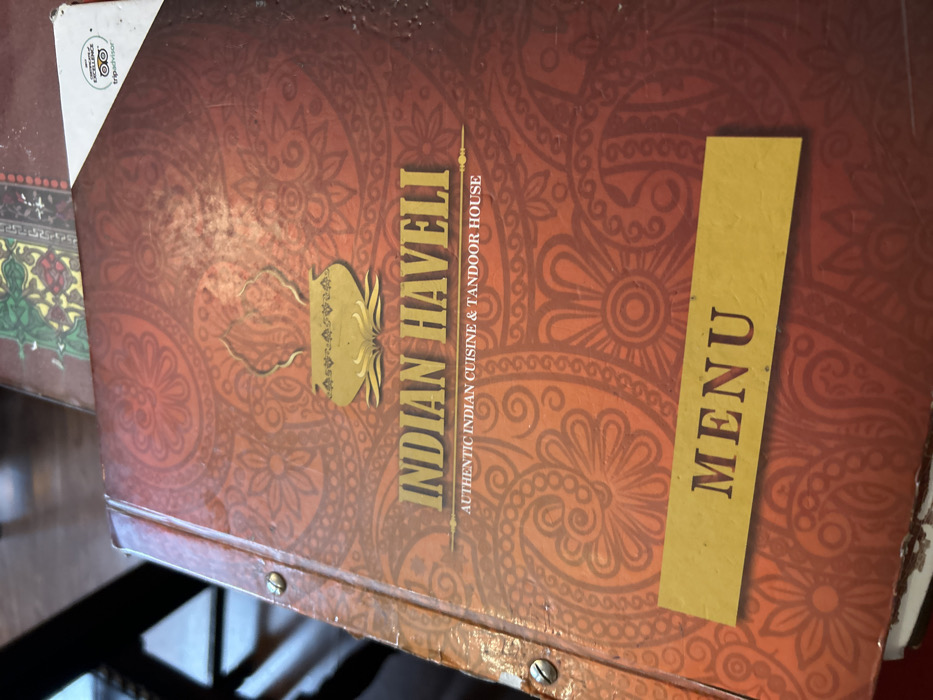
The image displays the cover of a menu for an Indian restaurant named "Indian Haveli," located in Athina, Greece. The menu cover features a rich reddish-brown or orange background adorned with intricate, stylized patterns reminiscent of traditional Indian design, possibly paisley or floral motifs.

Prominently featured in the center of the cover, below the restaurant's name, is a golden illustration of what appears to be a pot or vase with flowing decorative elements. The restaurant's name, "INDIAN HAVELI," is spelled out in large, golden, ornate capital letters running vertically down the cover. Below this, in smaller golden text, it reads "AUTHENTIC INDIAN CUISINE & TANDOOR HOUSE," indicating the type of food served.

A yellow rectangular strip is affixed vertically to the right side of the menu cover, with the word "MENU" printed in dark capital letters. In the top left corner, a white triangular sticker is partially visible, featuring a Tripadvisor logo with the text "TRAVELLERS' CHOICE" and "EXCELLENCE," suggesting a positive rating or award for the restaurant.

The menu cover appears well-used, showing some scuffs, marks, and wear, particularly on the surface and edges. The binding along the bottom edge is visible, secured by two small, metallic screws. The overall aesthetic suggests a focus on traditional Indian cultural elements for the restaurant's branding. The menu is likely resting on a surface, awaiting a customer.

The image displays the cover of a menu for an Indian restaurant named "Indian Haveli," located in Athina, Greece. The menu cover features a rich reddish-brown or orange background adorned with intricate, stylized patterns reminiscent of traditional Indian design, possibly paisley or floral motifs. Prominently featured in the center of the cover, below the restaurant's name, is a golden illustration of what appears to be a pot or vase with flowing decorative elements. The restaurant's name, "INDIAN HAVELI," is spelled out in large, golden, ornate capital letters running vertically down the cover. Below this, in smaller golden text, it reads "AUTHENTIC INDIAN CUISINE & TANDOOR HOUSE," indicating the type of food served. A yellow rectangular strip is affixed vertically to the right side of the menu cover, with the word "MENU" printed in dark capital letters. In the top left corner, a white triangular sticker is partially visible, featuring a Tripadvisor logo with the text "TRAVELLERS' CHOICE" and "EXCELLENCE," suggesting a positive rating or award for the restaurant. The menu cover appears well-used, showing some scuffs, marks, and wear, particularly on the surface and edges. The binding along the bottom edge is visible, secured by two small, metallic screws. The overall aesthetic suggests a focus on traditional Indian cultural elements for the restaurant's branding. The menu is likely resting on a surface, awaiting a customer.

Athina
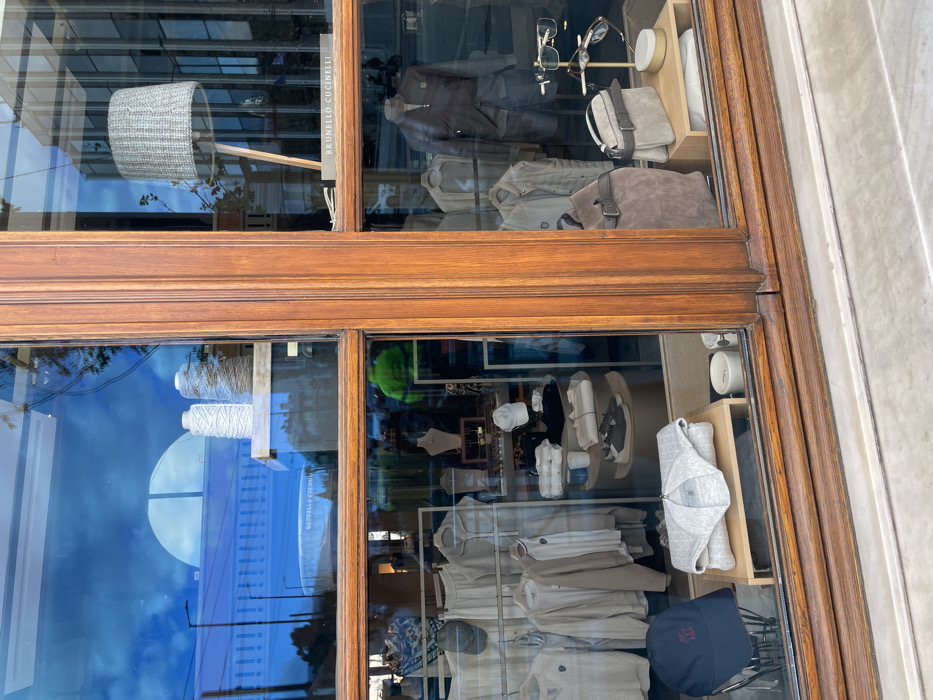
The image captures a luxury retail shop window in Athina, Greece, displaying items from the brand "BRUNELLO CUCINELLI," which is visible on a tag within the display. The photograph is oriented 90 degrees counter-clockwise; when viewed upright, the window is framed by rich, dark wooden panels.

The display is divided into sections. The top-right pane (when upright) features mannequins dressed in sophisticated outerwear, including jackets and trousers in muted, neutral tones like brown and beige. Accompanying these are accessories such as sunglasses on a delicate stand and small, light-colored bags. In the top-left pane, a distinctive decorative lamp with a textured, woven lampshade on a wooden base adds a touch of interior design to the storefront.

The bottom-right pane showcases meticulously folded clothing items, primarily shirts and knitwear, also in a palette of cream, beige, and light grey. Among these are smaller accessories, including a dark blue hat with a subtle logo and what appear to be jewelry pieces on display stands. The bottom-left pane features two large spools of white or off-white yarn or thread, hinting at the quality of materials or the craft behind the garments.

Throughout the glass panes, there are prominent reflections of the bright blue sky, clouds, and surrounding buildings, indicating it is daytime. The heavy wooden frame suggests a classic and elegant architectural style for the storefront. The overall impression is one of understated luxury, focusing on natural materials and a refined aesthetic.

The image captures a luxury retail shop window in Athina, Greece, displaying items from the brand "BRUNELLO CUCINELLI," which is visible on a tag within the display. The photograph is oriented 90 degrees counter-clockwise; when viewed upright, the window is framed by rich, dark wooden panels. The display is divided into sections. The top-right pane (when upright) features mannequins dressed in sophisticated outerwear, including jackets and trousers in muted, neutral tones like brown and beige. Accompanying these are accessories such as sunglasses on a delicate stand and small, light-colored bags. In the top-left pane, a distinctive decorative lamp with a textured, woven lampshade on a wooden base adds a touch of interior design to the storefront. The bottom-right pane showcases meticulously folded clothing items, primarily shirts and knitwear, also in a palette of cream, beige, and light grey. Among these are smaller accessories, including a dark blue hat with a subtle logo and what appear to be jewelry pieces on display stands. The bottom-left pane features two large spools of white or off-white yarn or thread, hinting at the quality of materials or the craft behind the garments. Throughout the glass panes, there are prominent reflections of the bright blue sky, clouds, and surrounding buildings, indicating it is daytime. The heavy wooden frame suggests a classic and elegant architectural style for the storefront. The overall impression is one of understated luxury, focusing on natural materials and a refined aesthetic.

Athina
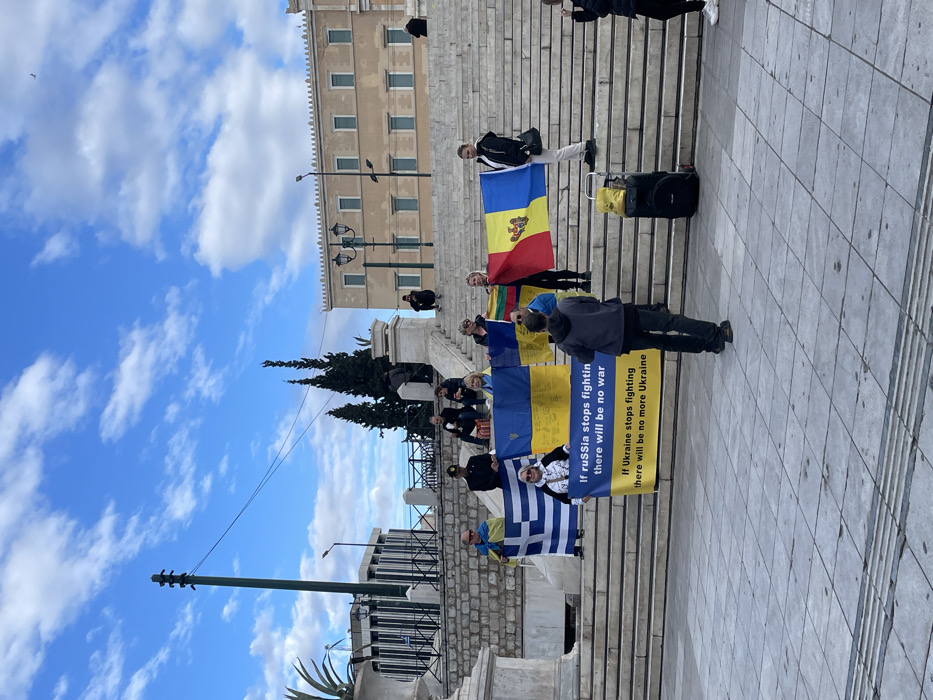
The image shows an outdoor protest or demonstration taking place during the daytime under a bright, partly cloudy blue sky. A group of people are gathered on a wide set of stone steps leading up to a grand, light-colored building, identifiable as a significant public structure in Athens, Greece, likely the Hellenic Parliament in Syntagma Square.

The subjects include men and women of varying ages. They are holding national flags, specifically those of Ukraine (blue and yellow), Moldova (blue, yellow, and red with an eagle), Lithuania (yellow, green, and red), and Greece (blue and white with a cross).

A prominent banner is displayed horizontally in the foreground, held by several individuals. The banner contains text in English, separated into two distinct messages. The left side of the banner reads: "If ruSSia stops fightin there will be no war". The right side of the banner states: "If Ukraine stops fighting there will be no more Ukraine". To the right of the banner, a black speaker on a trolley is visible.

The scene captures an act of public expression, likely related to the conflict in Ukraine, emphasizing calls for peace and the stakes involved. The weather is clear and bright.

The image shows an outdoor protest or demonstration taking place during the daytime under a bright, partly cloudy blue sky. A group of people are gathered on a wide set of stone steps leading up to a grand, light-colored building, identifiable as a significant public structure in Athens, Greece, likely the Hellenic Parliament in Syntagma Square. The subjects include men and women of varying ages. They are holding national flags, specifically those of Ukraine (blue and yellow), Moldova (blue, yellow, and red with an eagle), Lithuania (yellow, green, and red), and Greece (blue and white with a cross). A prominent banner is displayed horizontally in the foreground, held by several individuals. The banner contains text in English, separated into two distinct messages. The left side of the banner reads: "If ruSSia stops fightin there will be no war". The right side of the banner states: "If Ukraine stops fighting there will be no more Ukraine". To the right of the banner, a black speaker on a trolley is visible. The scene captures an act of public expression, likely related to the conflict in Ukraine, emphasizing calls for peace and the stakes involved. The weather is clear and bright.

Athina
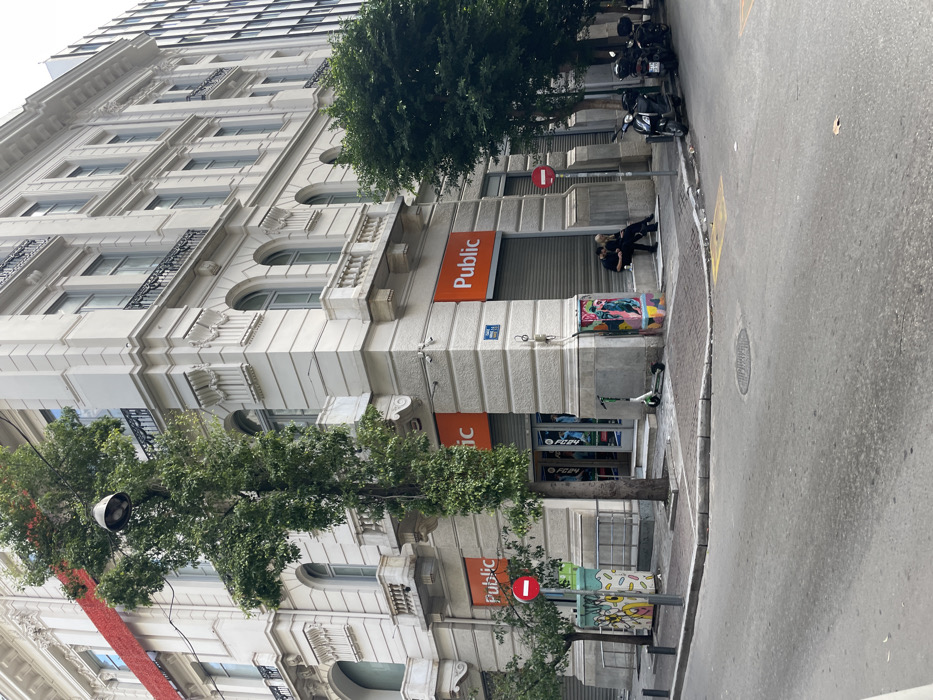
This image captures a street scene in Athens, Greece, focusing on a multi-story building with classical architectural elements. The building features light-colored stone or stucco, ornate balconies with wrought-iron railings, and arched windows on its upper floors. Behind it, a more modern structure with a grid of windows is partially visible.

The ground floor of the main building houses commercial establishments. Prominently displayed are bright orange signs with the word "Public" in white lettering, indicating a retail store. Below one of these signs, another store entrance features the text "FG84". The store appears to be closed or have its shutters down on the main section, but the "FG84" section shows a glass entrance.

On the sidewalk in front of the "Public" store, two individuals are seated on a low ledge or steps. Several motorcycles and scooters are parked further down the street on the sidewalk. A green electric scooter is also parked near the entrance of the "FG84" store. A red circular traffic sign with a white horizontal bar, typically signifying "No Entry" or "Do Not Enter," is mounted on a pole near the sidewalk. Two utility boxes or large bollards on the sidewalk are covered in colorful graffiti.

Green trees are planted along the sidewalk, their foliage partially obscuring parts of the building facade. The street itself is paved with asphalt, featuring yellow lines and a visible manhole cover. The sky appears overcast, suggesting a cloudy day or soft lighting conditions without direct sun. The overall scene depicts a quiet urban environment during daytime.

This image captures a street scene in Athens, Greece, focusing on a multi-story building with classical architectural elements. The building features light-colored stone or stucco, ornate balconies with wrought-iron railings, and arched windows on its upper floors. Behind it, a more modern structure with a grid of windows is partially visible. The ground floor of the main building houses commercial establishments. Prominently displayed are bright orange signs with the word "Public" in white lettering, indicating a retail store. Below one of these signs, another store entrance features the text "FG84". The store appears to be closed or have its shutters down on the main section, but the "FG84" section shows a glass entrance. On the sidewalk in front of the "Public" store, two individuals are seated on a low ledge or steps. Several motorcycles and scooters are parked further down the street on the sidewalk. A green electric scooter is also parked near the entrance of the "FG84" store. A red circular traffic sign with a white horizontal bar, typically signifying "No Entry" or "Do Not Enter," is mounted on a pole near the sidewalk. Two utility boxes or large bollards on the sidewalk are covered in colorful graffiti. Green trees are planted along the sidewalk, their foliage partially obscuring parts of the building facade. The street itself is paved with asphalt, featuring yellow lines and a visible manhole cover. The sky appears overcast, suggesting a cloudy day or soft lighting conditions without direct sun. The overall scene depicts a quiet urban environment during daytime.

Athina
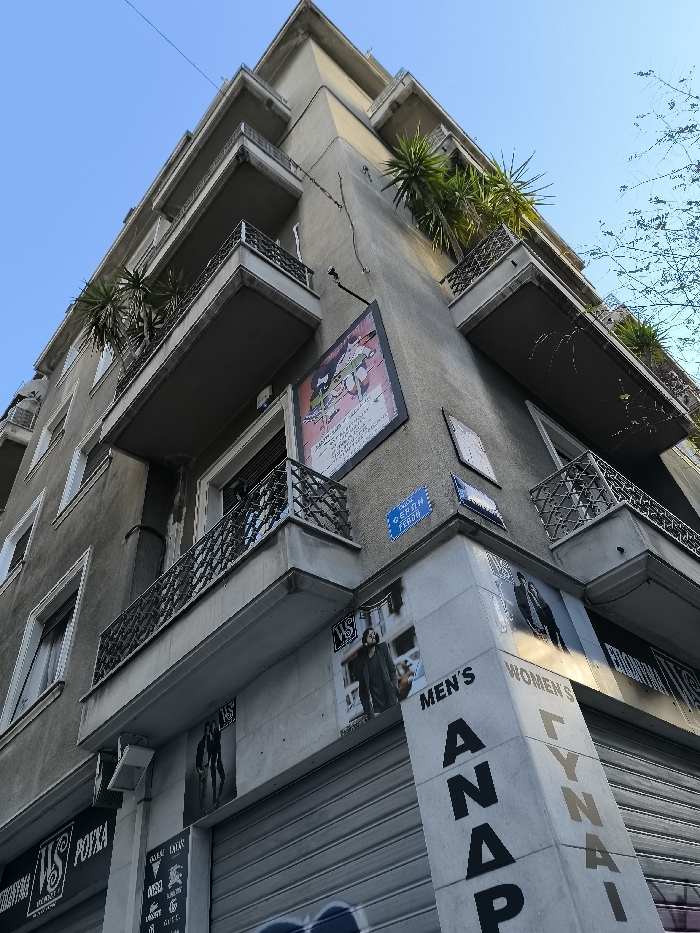
An upward-angled shot captures the corner of a multi-story building in Athina, Greece, under a clear blue sky. The building appears to be made of concrete, showing some signs of age and wear, including a vertical crack on its facade. Numerous balconies with metal railings extend from the building, some adorned with potted palm-like plants.

The lower levels feature commercial storefronts, currently closed with metal roller shutters. The corner of the building is covered with large posters advertising clothing, featuring models. Vertical text on the building's corner reads "MEN'S" and "WOMEN'S," alongside Greek letters that spell out "ANAP" and "ΓΥΝΑΙ" (likely part of 'ΓΥΝΑΙΚΩΝ' - women's). On the far left, another store's shutter has "VS POKA" signage, and a partially visible poster lists luxury brand names such as "DOLCE & GABBANA," "BURBERRY," "GUCCI," and "KENZO."

Higher up, a prominent blue street sign reads "ΟΔΟΣ ΓΕΡΟΝ. ΦΩΚΑ" (Geron. Foka Street). Above this, a large framed poster with colorful, stylized artwork and unreadable text is affixed to the building, suggesting a cultural or event advertisement. The bright daylight indicates a daytime scene.

An upward-angled shot captures the corner of a multi-story building in Athina, Greece, under a clear blue sky. The building appears to be made of concrete, showing some signs of age and wear, including a vertical crack on its facade. Numerous balconies with metal railings extend from the building, some adorned with potted palm-like plants. The lower levels feature commercial storefronts, currently closed with metal roller shutters. The corner of the building is covered with large posters advertising clothing, featuring models. Vertical text on the building's corner reads "MEN'S" and "WOMEN'S," alongside Greek letters that spell out "ANAP" and "ΓΥΝΑΙ" (likely part of 'ΓΥΝΑΙΚΩΝ' - women's). On the far left, another store's shutter has "VS POKA" signage, and a partially visible poster lists luxury brand names such as "DOLCE & GABBANA," "BURBERRY," "GUCCI," and "KENZO." Higher up, a prominent blue street sign reads "ΟΔΟΣ ΓΕΡΟΝ. ΦΩΚΑ" (Geron. Foka Street). Above this, a large framed poster with colorful, stylized artwork and unreadable text is affixed to the building, suggesting a cultural or event advertisement. The bright daylight indicates a daytime scene.

Athina
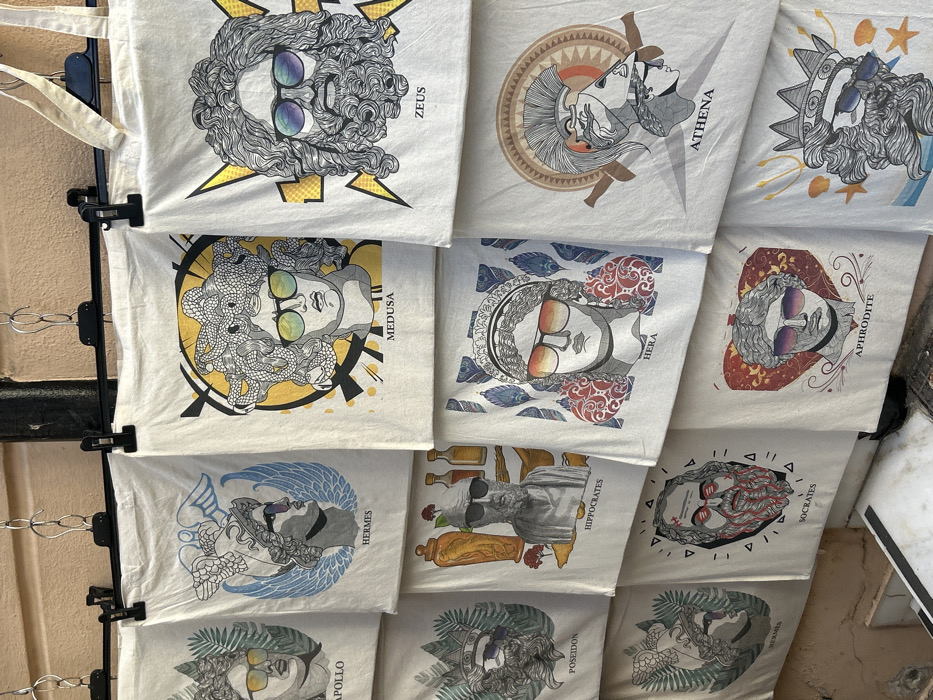
The image displays a vibrant collection of white canvas tote bags, likely merchandise for sale, hanging from a black metal rack. The scene appears to be an outdoor or semi-outdoor market stall or shop in Athina, Greece.

Each bag features a stylized, often humorous, illustration of a Greek mythological figure or historical personality. A notable detail is that many of these ancient figures are depicted wearing modern, reflective sunglasses, blending classical imagery with contemporary pop-art aesthetics. The bags are arranged in overlapping rows, showcasing a variety of designs.

Identifiable figures include "ZEUS," depicted with lightning bolts; "MEDUSA," with her characteristic snake hair and a yellow circular background; "ATHENA," shown in profile with a helmet; "HERA," surrounded by floral and feather motifs; "APHRODITE," with ornate red and purple patterns; "HERMES," featuring blue winged elements; "HIPPOCRATES," appearing as an older, bearded figure with bottles; "SOCRATES," also an aged, bearded figure; "POSEIDON," with sea-themed elements; and "APOLLO," partially visible. The illustrations use varied color palettes for backgrounds and accents, making each design distinct.

The display rack has hooks or chains from which the bags are suspended. The background is a plain, light-colored wall, possibly beige or off-white. The lighting suggests it is daytime. The merchandise offers a playful take on ancient Greek culture, appealing to tourists.

The image displays a vibrant collection of white canvas tote bags, likely merchandise for sale, hanging from a black metal rack. The scene appears to be an outdoor or semi-outdoor market stall or shop in Athina, Greece. Each bag features a stylized, often humorous, illustration of a Greek mythological figure or historical personality. A notable detail is that many of these ancient figures are depicted wearing modern, reflective sunglasses, blending classical imagery with contemporary pop-art aesthetics. The bags are arranged in overlapping rows, showcasing a variety of designs. Identifiable figures include "ZEUS," depicted with lightning bolts; "MEDUSA," with her characteristic snake hair and a yellow circular background; "ATHENA," shown in profile with a helmet; "HERA," surrounded by floral and feather motifs; "APHRODITE," with ornate red and purple patterns; "HERMES," featuring blue winged elements; "HIPPOCRATES," appearing as an older, bearded figure with bottles; "SOCRATES," also an aged, bearded figure; "POSEIDON," with sea-themed elements; and "APOLLO," partially visible. The illustrations use varied color palettes for backgrounds and accents, making each design distinct. The display rack has hooks or chains from which the bags are suspended. The background is a plain, light-colored wall, possibly beige or off-white. The lighting suggests it is daytime. The merchandise offers a playful take on ancient Greek culture, appealing to tourists.

Athina
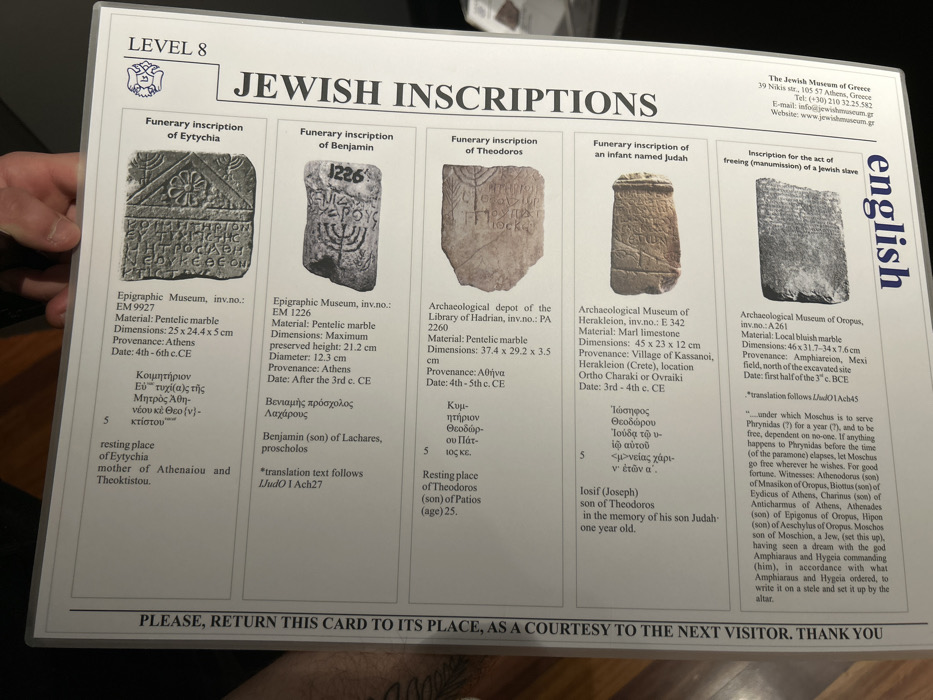
The image displays a laminated white educational card or information sheet held by a person's hands, with their fingers partially visible on the left side of the card. The card is titled "JEWISH INSCRIPTIONS" at the top center, with "LEVEL 8" and a stylized menorah logo in the top left corner. On the far right side, the word "english" is printed vertically, indicating the language of the content.

At the top right of the card, contact information for "The Jewish Museum of Greece" is provided, including the address (39 Nikis str., 105 57 Athens, Greece), phone number ((+30) 210 32.25.582), email (info@jewishmuseum.gr), and website (www.jewishmuseum.gr).

The main body of the card is divided into five vertical columns, each dedicated to a specific Jewish inscription. Each column features a black-and-white photograph of the inscription stone, followed by detailed information and an English translation.

1.  **Funerary inscription of Eytychia:**
    *   **Image:** A rectangular stone slab with a carved floral rosette motif within a triangular pediment at the top, and Greek text below it.
    *   **Details:** Epigraphic Museum, inv.no.: EM 9927; Material: Pentelic marble; Dimensions: 25 x 24.4 x 5 cm; Provenance: Athens; Date: 4th-6th c. CE.
    *   **Greek Text:** "Κοιμητήριον Εὐτυχί(α)ς τῆς Μητρός Ἀθη- νέου κέ Θεο(ν)- κτίστου".
    *   **English Translation:** "resting place of Eytychia mother of Athenaiou and Theoktistou."

2.  **Funerary inscription of Benjamin:**
    *   **Image:** An irregularly shaped stone slab featuring carved Greek text and a menorah symbol at the bottom. The number "1226" is visible in the upper left corner of the stone.
    *   **Details:** Epigraphic Museum, inv.no.: EM 1226; Material: Pentelic marble; Dimensions: Maximum preserved height: 21.2 cm, Diameter: 12.3 cm; Provenance: Athens; Date: After the 3rd c. CE.
    *   **Greek Text:** "Βενιαμής πρόσχολος Λαχάρους".
    *   **English Translation:** "Benjamin (son) of Lachares, proscholos".
    *   **Note:** "*translation text follows IJudo I Ach27".

3.  **Funerary inscription of Theodoros:**
    *   **Image:** A rectangular stone slab with carved Greek text and a menorah symbol at the top.
    *   **Details:** Archaeological depot of the Library of Hadrian, inv.no.: PA 2260; Material: Pentelic marble; Dimensions: 37.4 x 29.2 x 3.5 cm; Provenance: Αθήνα; Date: 4th-5th c. CE.
    *   **Greek Text:** "Κυμητήριον Θεοδώρ-ου Πάτ-τος κει".
    *   **English Translation:** "Resting place of Theodoros (son) of Patios (age) 25."

4.  **Funerary inscription of an infant named Judah:**
    *   **Image:** A small, rounded stone object, possibly a funerary urn, with carved text and a menorah symbol at the top.
    *   **Details:** Archaeological Museum of Herakleion, inv.no.: E 342; Material: Marl limestone; Dimensions: 45 x 23 x 12 cm; Provenance: Village of Kassanoi, Herakleion (Crete), location Ortho Charaki or Ovraiki; Date: 3rd-4th c. CE.
    *   **Greek Text:** "Ἰώσηφος Θεοδώρου Ἰούδα τῷ υἱῷ αὐτοῦ <μνείας χάρι-ν' ἐτῶν α΄."
    *   **English Translation:** "Iosif (Joseph) son of Theodoros in the memory of his son Judah one year old."

5.  **Inscription for the act of freeing (manumission) of a Jewish slave:**
    *   **Image:** A rectangular stone slab densely covered with carved Greek text.
    *   **Details:** Archaeological Museum of Oropus, inv.no.: A261; Material: Local bluish marble; Dimensions: 46 x 31.7-34 x 7.6 cm; Provenance: Amphiareion, Mexi field, north of the excavated site; Date: first half of the 3rd c. BCE.
    *   **Note:** "*translation follows JudO1Ach45".
    *   **English Translation:** "under which Moschus is to serve Phrynidas (?) for a year (?), and to be free, dependent on no-one. If anything happens to Phrynidas before the time (of the paramone) elapses, let Moschus go free wherever he wishes. For good fortune. Witnesses: Athenodorus (son) of Mnasikon of Oropus, Biottus (son) of Eydicus of Athens, Charinus (son) of Anticharmus of Athens, Athenades (son) of Epigonus of Oropus, Hipon (son) of Aeschylus of Oropus. Moschos son of Moschion, a Jew, (set this up), having seen a dream with the god Amphiaraus and Hygeia commanding (him), in accordance with what Amphiaraus and Hygeia ordered, to write it on a stele and set it up by the altar."

At the bottom of the card, a message reads: "PLEASE, RETURN THIS CARD TO ITS PLACE, AS A COURTESY TO THE NEXT VISITOR. THANK YOU". The background behind the card is blurred and indistinct, suggesting an indoor setting.

The image displays a laminated white educational card or information sheet held by a person's hands, with their fingers partially visible on the left side of the card. The card is titled "JEWISH INSCRIPTIONS" at the top center, with "LEVEL 8" and a stylized menorah logo in the top left corner. On the far right side, the word "english" is printed vertically, indicating the language of the content. At the top right of the card, contact information for "The Jewish Museum of Greece" is provided, including the address (39 Nikis str., 105 57 Athens, Greece), phone number ((+30) 210 32.25.582), email (info@jewishmuseum.gr), and website (www.jewishmuseum.gr). The main body of the card is divided into five vertical columns, each dedicated to a specific Jewish inscription. Each column features a black-and-white photograph of the inscription stone, followed by detailed information and an English translation. 1. **Funerary inscription of Eytychia:** * **Image:** A rectangular stone slab with a carved floral rosette motif within a triangular pediment at the top, and Greek text below it. * **Details:** Epigraphic Museum, inv.no.: EM 9927; Material: Pentelic marble; Dimensions: 25 x 24.4 x 5 cm; Provenance: Athens; Date: 4th-6th c. CE. * **Greek Text:** "Κοιμητήριον Εὐτυχί(α)ς τῆς Μητρός Ἀθη- νέου κέ Θεο(ν)- κτίστου". * **English Translation:** "resting place of Eytychia mother of Athenaiou and Theoktistou." 2. **Funerary inscription of Benjamin:** * **Image:** An irregularly shaped stone slab featuring carved Greek text and a menorah symbol at the bottom. The number "1226" is visible in the upper left corner of the stone. * **Details:** Epigraphic Museum, inv.no.: EM 1226; Material: Pentelic marble; Dimensions: Maximum preserved height: 21.2 cm, Diameter: 12.3 cm; Provenance: Athens; Date: After the 3rd c. CE. * **Greek Text:** "Βενιαμής πρόσχολος Λαχάρους". * **English Translation:** "Benjamin (son) of Lachares, proscholos". * **Note:** "*translation text follows IJudo I Ach27". 3. **Funerary inscription of Theodoros:** * **Image:** A rectangular stone slab with carved Greek text and a menorah symbol at the top. * **Details:** Archaeological depot of the Library of Hadrian, inv.no.: PA 2260; Material: Pentelic marble; Dimensions: 37.4 x 29.2 x 3.5 cm; Provenance: Αθήνα; Date: 4th-5th c. CE. * **Greek Text:** "Κυμητήριον Θεοδώρ-ου Πάτ-τος κει". * **English Translation:** "Resting place of Theodoros (son) of Patios (age) 25." 4. **Funerary inscription of an infant named Judah:** * **Image:** A small, rounded stone object, possibly a funerary urn, with carved text and a menorah symbol at the top. * **Details:** Archaeological Museum of Herakleion, inv.no.: E 342; Material: Marl limestone; Dimensions: 45 x 23 x 12 cm; Provenance: Village of Kassanoi, Herakleion (Crete), location Ortho Charaki or Ovraiki; Date: 3rd-4th c. CE. * **Greek Text:** "Ἰώσηφος Θεοδώρου Ἰούδα τῷ υἱῷ αὐτοῦ <μνείας χάρι-ν' ἐτῶν α΄." * **English Translation:** "Iosif (Joseph) son of Theodoros in the memory of his son Judah one year old." 5. **Inscription for the act of freeing (manumission) of a Jewish slave:** * **Image:** A rectangular stone slab densely covered with carved Greek text. * **Details:** Archaeological Museum of Oropus, inv.no.: A261; Material: Local bluish marble; Dimensions: 46 x 31.7-34 x 7.6 cm; Provenance: Amphiareion, Mexi field, north of the excavated site; Date: first half of the 3rd c. BCE. * **Note:** "*translation follows JudO1Ach45". * **English Translation:** "under which Moschus is to serve Phrynidas (?) for a year (?), and to be free, dependent on no-one. If anything happens to Phrynidas before the time (of the paramone) elapses, let Moschus go free wherever he wishes. For good fortune. Witnesses: Athenodorus (son) of Mnasikon of Oropus, Biottus (son) of Eydicus of Athens, Charinus (son) of Anticharmus of Athens, Athenades (son) of Epigonus of Oropus, Hipon (son) of Aeschylus of Oropus. Moschos son of Moschion, a Jew, (set this up), having seen a dream with the god Amphiaraus and Hygeia commanding (him), in accordance with what Amphiaraus and Hygeia ordered, to write it on a stele and set it up by the altar." At the bottom of the card, a message reads: "PLEASE, RETURN THIS CARD TO ITS PLACE, AS A COURTESY TO THE NEXT VISITOR. THANK YOU". The background behind the card is blurred and indistinct, suggesting an indoor setting.

Athina
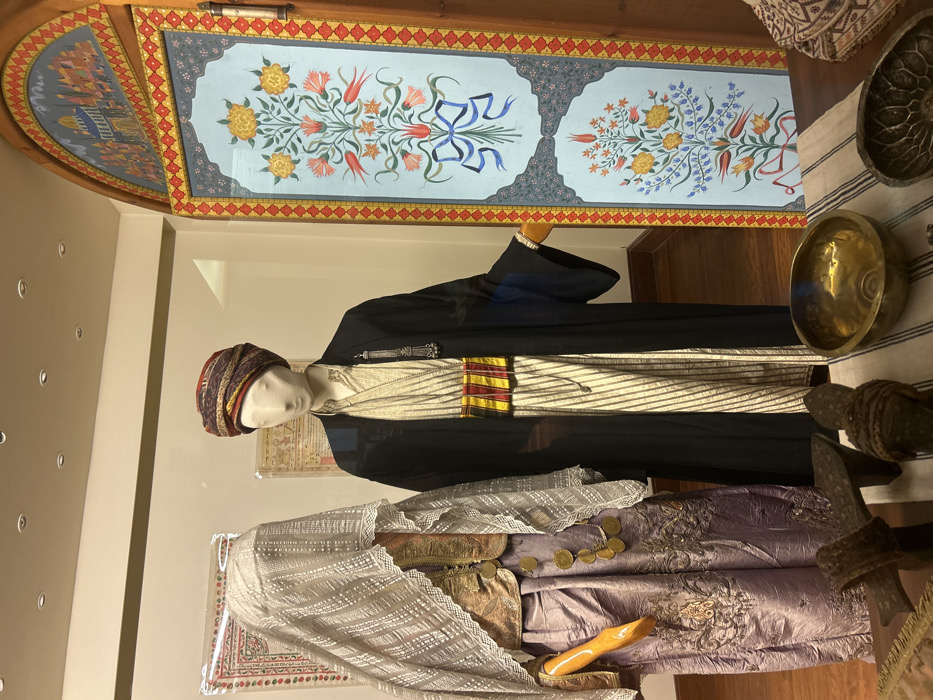
This media file captures a static display of traditional garments and artifacts, likely within a museum or cultural exhibition in Athina, Greece. The scene features two mannequins dressed in elaborate attire, set against a backdrop of decorative art and other traditional items.

The mannequin on the left, appearing male, wears a dark, possibly black, long-sleeved robe. Underneath, a light-colored, vertically striped garment is visible, cinched at the waist with a sash featuring horizontal red and yellow stripes. A decorative silver-toned brooch or clasp is pinned to the chest. Its head is covered with a richly patterned, multi-colored turban or head wrap in shades of maroon, gold, and blue.

The mannequin on the right, appearing female, is dressed in a flowing, light purple or lavender gown or robe. The garment is adorned with intricate embroidery and several gold-colored coins are visible across its front. A delicate, light-colored head covering or shawl, possibly made of lace or finely embroidered fabric, drapes over her head and shoulders. A wooden, arm-like element is visible near her waist.

Above the mannequins, a highly decorative wooden panel or ceiling section is prominent. It features hand-painted floral motifs on a light blue background, including yellow roses, red and orange tulips, and blue ribbon-like elements. This central design is bordered by an elaborate pattern of red diamonds and gold accents. Another smaller, semicircular painted panel with architectural motifs is partially visible on the left.

To the right of the mannequins, a display surface holds a brass bowl, a striped woven textile that resembles a rug or tablecloth, and a dark, intricately textured object. The background walls are light-colored, and recessed ceiling lights illuminate the display. No discernible text is visible.

This media file captures a static display of traditional garments and artifacts, likely within a museum or cultural exhibition in Athina, Greece. The scene features two mannequins dressed in elaborate attire, set against a backdrop of decorative art and other traditional items. The mannequin on the left, appearing male, wears a dark, possibly black, long-sleeved robe. Underneath, a light-colored, vertically striped garment is visible, cinched at the waist with a sash featuring horizontal red and yellow stripes. A decorative silver-toned brooch or clasp is pinned to the chest. Its head is covered with a richly patterned, multi-colored turban or head wrap in shades of maroon, gold, and blue. The mannequin on the right, appearing female, is dressed in a flowing, light purple or lavender gown or robe. The garment is adorned with intricate embroidery and several gold-colored coins are visible across its front. A delicate, light-colored head covering or shawl, possibly made of lace or finely embroidered fabric, drapes over her head and shoulders. A wooden, arm-like element is visible near her waist. Above the mannequins, a highly decorative wooden panel or ceiling section is prominent. It features hand-painted floral motifs on a light blue background, including yellow roses, red and orange tulips, and blue ribbon-like elements. This central design is bordered by an elaborate pattern of red diamonds and gold accents. Another smaller, semicircular painted panel with architectural motifs is partially visible on the left. To the right of the mannequins, a display surface holds a brass bowl, a striped woven textile that resembles a rug or tablecloth, and a dark, intricately textured object. The background walls are light-colored, and recessed ceiling lights illuminate the display. No discernible text is visible.

Athina
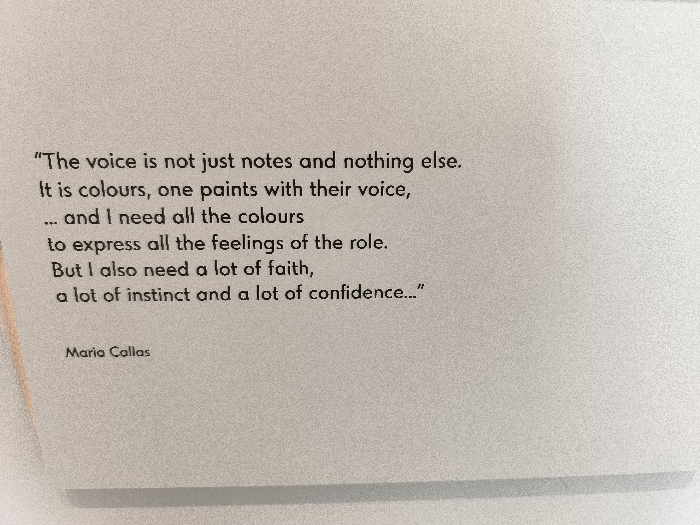
The image presents a close-up view of a page, likely from a book or a printout, displaying a quote attributed to the opera singer Maria Callas. The page is light-colored, possibly white or a very pale grey, and shows a fine, speckled texture. A subtle warm, brownish-orange edge is visible along the left side, suggesting the page might be slightly curved or part of an open book.

The central feature is a block of text printed in a dark, legible sans-serif font. The quote reads:
"The voice is not just notes and nothing else.
It is colours, one paints with their voice,
... and I need all the colours
to express all the feelings of the role.
But I also need a lot of faith,
a lot of instinct and a lot of confidence..."

Below this inspirational text, the name "Maria Callas" is clearly printed as the author of the quote. No individuals or specific external objects are visible, and there are no direct cues within the image to indicate a particular time of day or weather conditions. The focus is entirely on the printed words and the texture of the page.

The image presents a close-up view of a page, likely from a book or a printout, displaying a quote attributed to the opera singer Maria Callas. The page is light-colored, possibly white or a very pale grey, and shows a fine, speckled texture. A subtle warm, brownish-orange edge is visible along the left side, suggesting the page might be slightly curved or part of an open book. The central feature is a block of text printed in a dark, legible sans-serif font. The quote reads: "The voice is not just notes and nothing else. It is colours, one paints with their voice, ... and I need all the colours to express all the feelings of the role. But I also need a lot of faith, a lot of instinct and a lot of confidence..." Below this inspirational text, the name "Maria Callas" is clearly printed as the author of the quote. No individuals or specific external objects are visible, and there are no direct cues within the image to indicate a particular time of day or weather conditions. The focus is entirely on the printed words and the texture of the page.

Athina
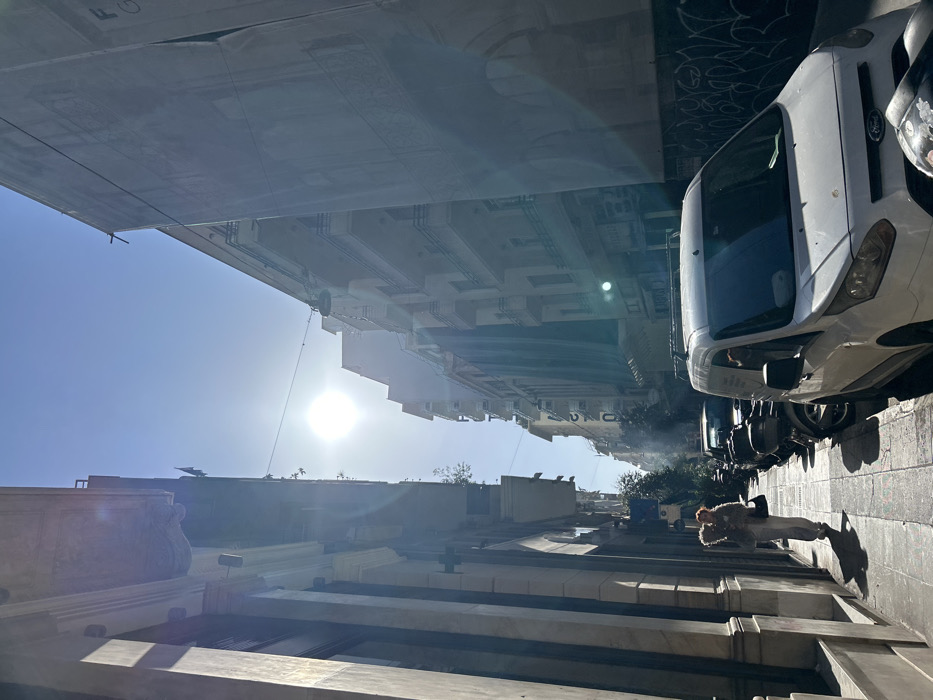
This media file captures a sunny street scene in Athens, Greece, presented with a vertical orientation (sky at the top, street at the bottom). The clear blue sky is dominated by a brilliant sun, indicating midday or early afternoon with strong, distinct shadows cast by the buildings and a person.

The street is lined with multi-story buildings on both sides, featuring architectural details like cornices and structured facades typical of urban Greek architecture. A large, light-colored canopy or scaffolding structure extends over part of the street from one of the buildings, casting additional shade.

Along the right side of the street, several vehicles are parked parallel to the curb. A prominent white van with a partially visible "FIAT" logo on its front grille is in the foreground, followed by other cars and possibly scooters. One individual is seen walking on the sidewalk on the right side of the street, moving away from the camera. They are dressed in light-colored clothing and appear to be carrying a bag. The strong sunlight creates long, sharp shadows across the pavement. The overall impression is a vibrant urban environment under clear, bright weather.

This media file captures a sunny street scene in Athens, Greece, presented with a vertical orientation (sky at the top, street at the bottom). The clear blue sky is dominated by a brilliant sun, indicating midday or early afternoon with strong, distinct shadows cast by the buildings and a person. The street is lined with multi-story buildings on both sides, featuring architectural details like cornices and structured facades typical of urban Greek architecture. A large, light-colored canopy or scaffolding structure extends over part of the street from one of the buildings, casting additional shade. Along the right side of the street, several vehicles are parked parallel to the curb. A prominent white van with a partially visible "FIAT" logo on its front grille is in the foreground, followed by other cars and possibly scooters. One individual is seen walking on the sidewalk on the right side of the street, moving away from the camera. They are dressed in light-colored clothing and appear to be carrying a bag. The strong sunlight creates long, sharp shadows across the pavement. The overall impression is a vibrant urban environment under clear, bright weather.

Athina
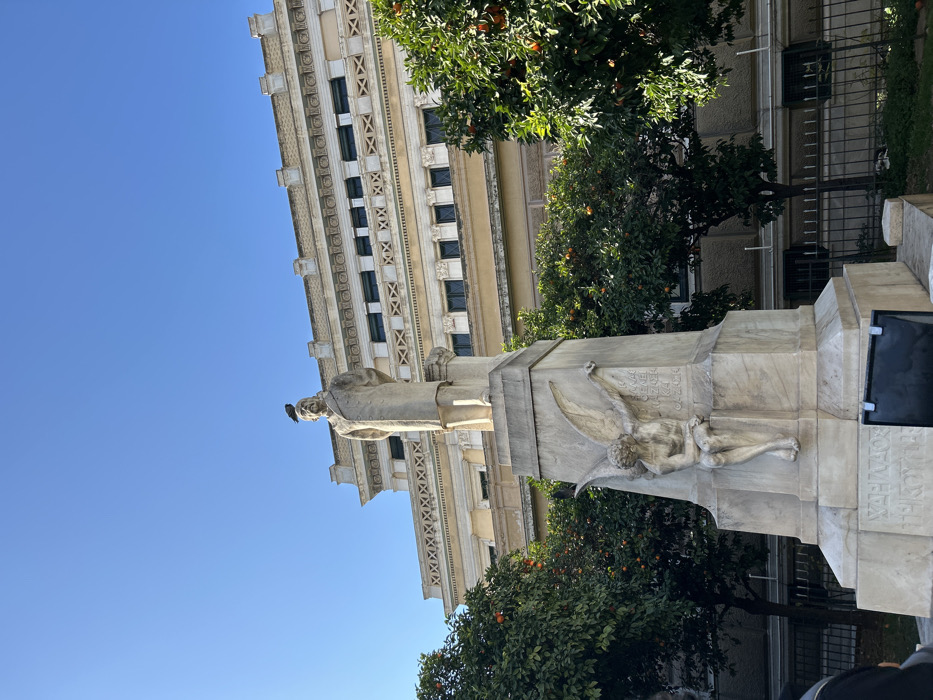
The image displays a prominent stone monument set against a clear, bright blue sky in what is identified as Athina, Greece. The central feature is a tall statue of a standing male figure, depicted in historical attire including a long coat or cloak, with a visible beard. A small, dark bird is perched on the head of this main statue.

The monument's base is elaborately carved, featuring a relief sculpture of a winged figure on one side. This figure, possibly an angel or mythological being, is shown in a reclining position, appearing to be in distress or struggle with one arm raised. Adjacent to and below the winged figure, sections of carved text in Greek script are visible on the monument's base, though the words are not entirely decipherable.

In the background, a substantial multi-story building rises, characterized by a detailed facade with numerous regularly spaced windows and classical architectural elements, such as cornices and textured panels. Lush orange trees, bearing visible fruit, are strategically placed around the monument and in front of the building, providing a natural accent to the urban setting.

The scene is captured on a sunny day, indicated by the strong illumination and the vibrant blue of the sky. The overall impression is that of a historical or cultural landmark within a city park or public square.

The image displays a prominent stone monument set against a clear, bright blue sky in what is identified as Athina, Greece. The central feature is a tall statue of a standing male figure, depicted in historical attire including a long coat or cloak, with a visible beard. A small, dark bird is perched on the head of this main statue. The monument's base is elaborately carved, featuring a relief sculpture of a winged figure on one side. This figure, possibly an angel or mythological being, is shown in a reclining position, appearing to be in distress or struggle with one arm raised. Adjacent to and below the winged figure, sections of carved text in Greek script are visible on the monument's base, though the words are not entirely decipherable. In the background, a substantial multi-story building rises, characterized by a detailed facade with numerous regularly spaced windows and classical architectural elements, such as cornices and textured panels. Lush orange trees, bearing visible fruit, are strategically placed around the monument and in front of the building, providing a natural accent to the urban setting. The scene is captured on a sunny day, indicated by the strong illumination and the vibrant blue of the sky. The overall impression is that of a historical or cultural landmark within a city park or public square.

Athina
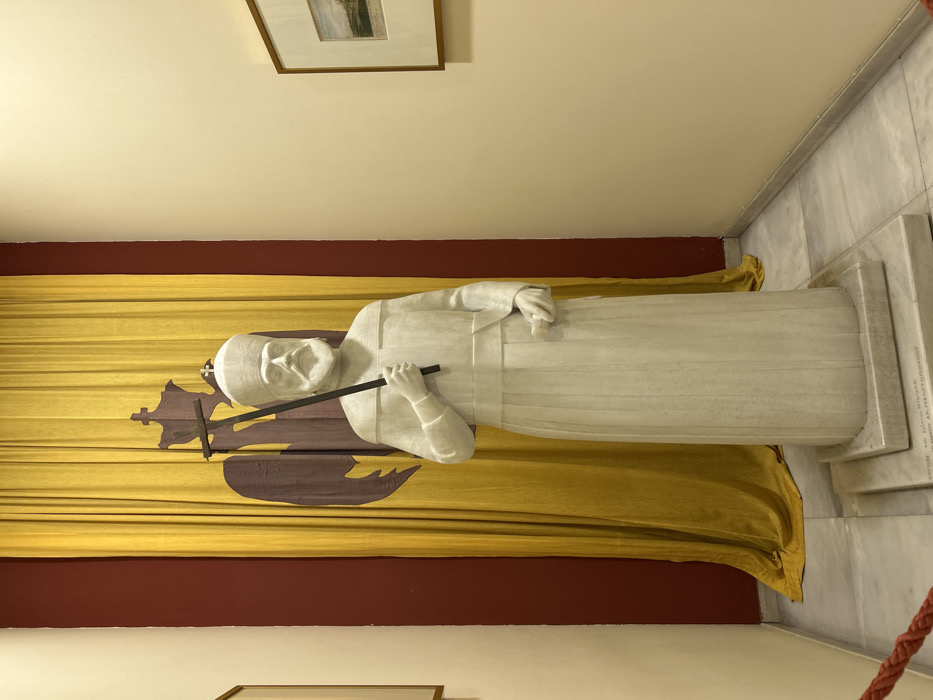
A white marble, full-length statue of a male figure is prominently displayed indoors. The figure, possibly a king or dignitary, is depicted recumbent, wearing a long robe, a head covering, and holding a staff or cross in his hands. The statue rests on a multi-tiered marble plinth. Behind the statue is a richly draped yellow fabric, adorned with a large, dark, heraldic symbol resembling a double-headed eagle or similar crest, in a brown or maroon hue. Below this fabric, there's a maroon wall section, and above, a plain cream-colored wall with a framed picture in the upper left. The area to the right of the statue features light-colored marble tiling on both the wall and floor.

The scene takes place in what appears to be a museum, royal tomb, or historical hall, given the formal presentation and material choices. The location is further specified by text on the statue's plinth, which reads in Greek: "ΓΕΩΡΓΙΟΣ Α'. ΒΑΣΙΛΕΥΣ ΤΩΝ ΕΛΛΗΝΩΝ" (George I. King of the Hellenes), followed by the dates "1845 - 1913". This identifies the subject as King George I of Greece. The context provided indicates the location is Athina, Greece. No specific activity is occurring; it's a static display for historical commemoration or reverence. The lighting suggests an indoor setting, likely with artificial illumination. The overall tone is solemn and historical.

A white marble, full-length statue of a male figure is prominently displayed indoors. The figure, possibly a king or dignitary, is depicted recumbent, wearing a long robe, a head covering, and holding a staff or cross in his hands. The statue rests on a multi-tiered marble plinth. Behind the statue is a richly draped yellow fabric, adorned with a large, dark, heraldic symbol resembling a double-headed eagle or similar crest, in a brown or maroon hue. Below this fabric, there's a maroon wall section, and above, a plain cream-colored wall with a framed picture in the upper left. The area to the right of the statue features light-colored marble tiling on both the wall and floor. The scene takes place in what appears to be a museum, royal tomb, or historical hall, given the formal presentation and material choices. The location is further specified by text on the statue's plinth, which reads in Greek: "ΓΕΩΡΓΙΟΣ Α'. ΒΑΣΙΛΕΥΣ ΤΩΝ ΕΛΛΗΝΩΝ" (George I. King of the Hellenes), followed by the dates "1845 - 1913". This identifies the subject as King George I of Greece. The context provided indicates the location is Athina, Greece. No specific activity is occurring; it's a static display for historical commemoration or reverence. The lighting suggests an indoor setting, likely with artificial illumination. The overall tone is solemn and historical.

Athina