Datça, Turkey
30 memories from Datça, Turkey
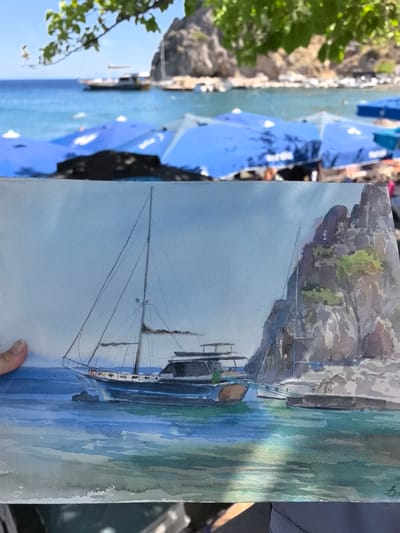
A watercolor painting depicts a serene harbor scene with two sailboats anchored near a rocky island. The foreground of the painting features the sailboats in calm, turquoise waters, with the larger sailboat prominently displaying its mast and rigging. The rocky island, rendered in muted tones with touches of green vegetation, rises majestically in the background. The sky above is a pale blue, suggesting a clear, sunny day. The painting is held by a hand in the lower left corner. The real-world background of the photograph shows a beach with numerous blue umbrellas, the sea with distant boats, and green foliage hanging from a branch in the upper left. This scene is likely located in Datça, Turkey, a region known for its beautiful coastline and natural harbors.
Datça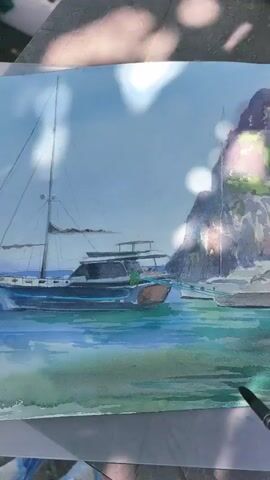
A watercolor painting of a bay with boats and a cliff is shown. The painting is on a table outdoors. There are shadows of leaves on the painting and the table.
Datça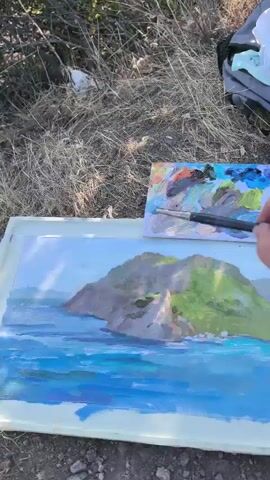
A close-up shot shows a person painting a landscape outdoors. The painting depicts a body of water with waves in the foreground and a green and rocky cliff in the background. The artist is using a brush to add details to the water. A palette with various colors is also visible near the painting. The environment appears to be dry and grassy, suggesting a natural setting. The camera angle is overhead, focusing on the painting and the artist's hand.
Datça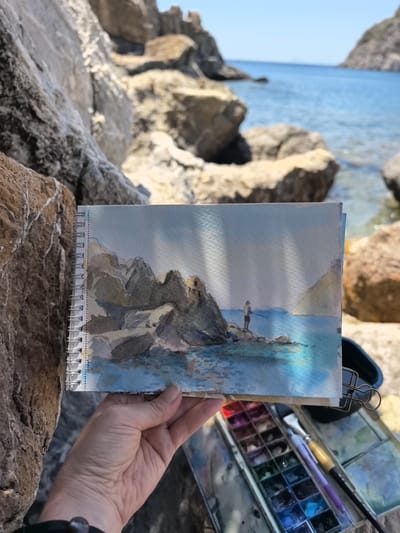
In the foreground, a person's hand holds a spiral-bound sketchbook open to a watercolor painting. The painting depicts a rocky coastline with a person fishing in the blue sea. Behind the sketchbook, a watercolor paint set and brushes are visible. The background shows the natural environment of Datça, Turkey, with large rock formations and the clear blue sea. The scene appears to be a plein-air painting session.
Datça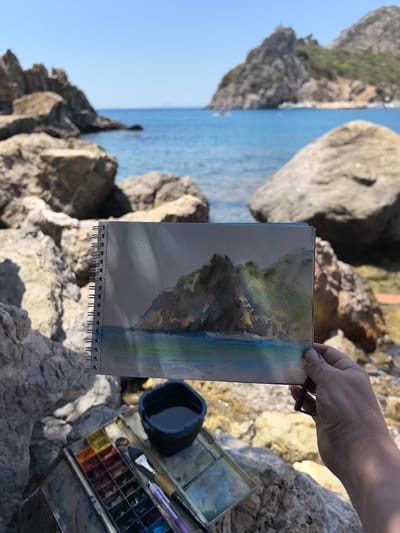
A hand holds a spiral-bound sketchbook with a watercolor painting of a rocky coastline and blue water. The painting depicts a sunlit, rugged cliff face with patches of green vegetation and the sea below. To the left of the sketchbook is a watercolor paint palette with various colors, two paintbrushes, and a black container filled with water, all resting on a rocky surface. The background is a blurred view of a rocky shoreline and the Mediterranean Sea under a clear blue sky, with distant mountains and a few boats visible. The scene is set in the city of Datça, Turkey, a coastal town known for its natural beauty and historical sites.
Datça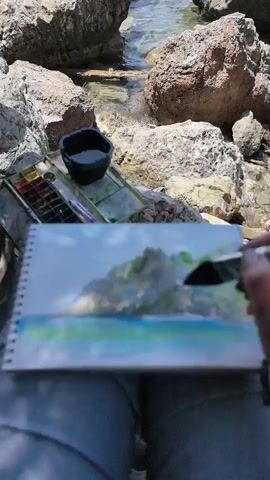
A person is sitting on the rocks by the sea, painting a watercolor. The painting is of the sea and a rocky island. The person is holding a brush and painting on a sketchbook. There is a watercolor palette and a cup of water next to the sketchbook. The sea is blue and the rocks are brown and gray. The sky is blue.
Datça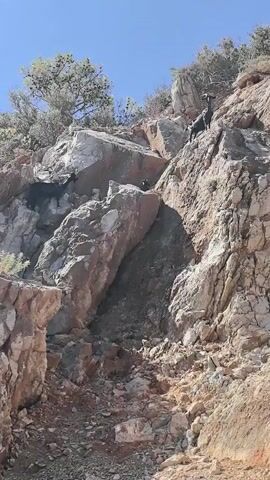
The video shows several black goats navigating a steep, rocky hillside under a clear blue sky. The terrain is characterized by large boulders and loose scree, with sparse vegetation clinging to the slopes. One goat is visible perched precariously near the top of the frame, while others are seen moving across the rocks at various levels. The goats appear agile and accustomed to the challenging environment, demonstrating their climbing abilities.
Datça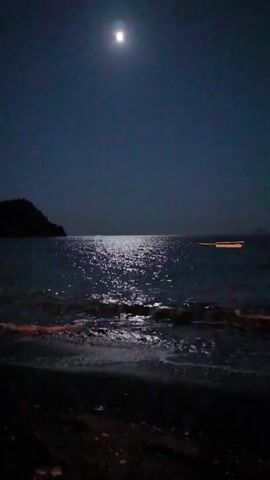
The video shows a nighttime beach scene. The moon is visible in the dark blue sky, casting a shimmering reflection on the ocean. Gentle waves are breaking on the dark sand shore. A small boat is anchored in the distance. A dark, hilly landmass is visible on the left horizon.
Datça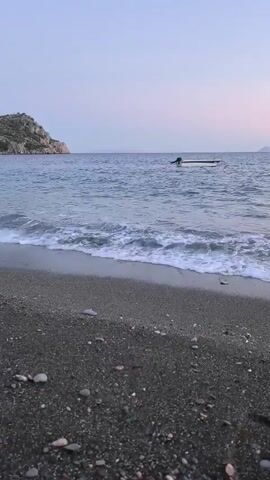
The video shows a beach with dark sand and pebbles in the foreground. Gentle waves with white foam are rolling onto the shore. In the background, the blue sea stretches out towards a rocky island on the left and a hazy horizon on the right. A small white boat with an outboard motor is anchored in the water, slightly off-center to the right. The sky is a soft, pale gradient of purple and pink, suggesting either sunrise or sunset. The overall scene is tranquil and natural.
Datça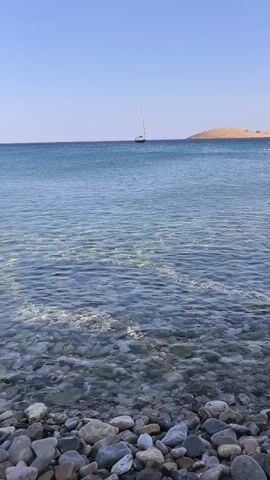
A sailboat is anchored in clear turquoise water near a pebble beach. The sky is a bright, cloudless blue.
Datça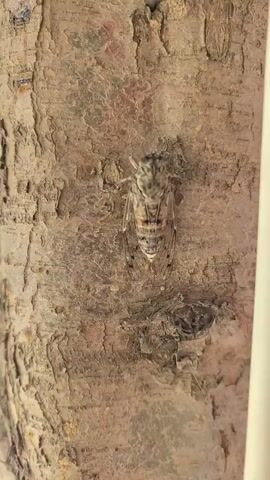
The video shows a close-up view of a cicada on a tree trunk. The cicada is light brown and gray with dark markings on its body and wings. It is positioned vertically on the rough, textured bark of the tree. The camera is focused on the cicada, and the background is blurred. The video is short and appears to be a still shot with very slight movement.
Datça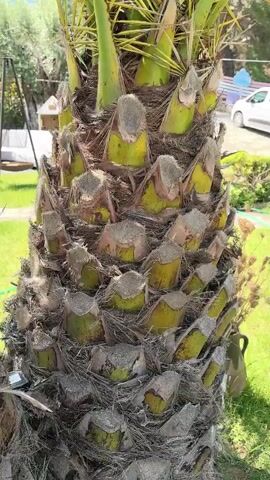
The video begins with a close-up of a palm tree trunk, showing its fibrous texture and remnants of old fronds. The camera then pans to the right, revealing a bright, sunny outdoor scene. A white van and a white SUV are parked on a dirt path. In the background, there is lush green grass, trees, and a building with a white roof and a porch. Pink bougainvillea flowers are visible on the roofline. A white stork is perched on the edge of the roof. The overall impression is of a peaceful, possibly tropical or Mediterranean setting.
Datça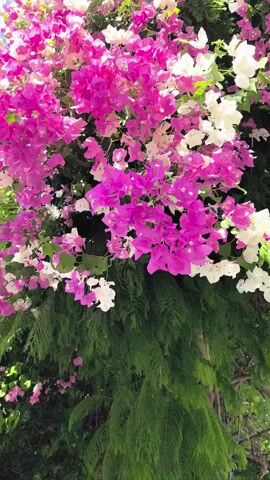
The video shows a close-up view of bougainvillea flowers. The flowers are a mix of vibrant pink and white, with some green leaves and foliage visible. The camera pans slowly across the blooms, highlighting their delicate structure and abundant growth. The lighting suggests it is daytime, possibly outdoors with natural sunlight. There are no people or objects other than the plants visible in the frame. The overall impression is one of natural beauty and lushness.
Datça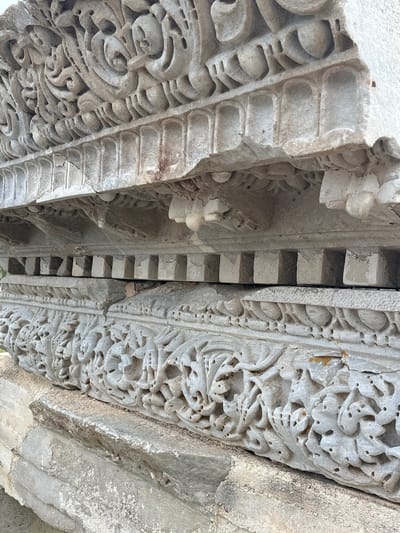
This close-up image captures an intricate section of carved stone architecture, likely part of an ancient or historical structure. The primary subjects are the detailed carvings themselves, with no people visible. The scene appears to be an exterior or partially enclosed space, bathed in bright, natural daylight, suggesting it is daytime. The image shows three distinct vertical sections of carved stone. On the left, a panel features a repetitive pattern of interconnected, rounded, and elongated shapes, possibly stylized leaves or scrolls, with small rectangular indentations. The central section consists of a series of raised, rectangular blocks arranged in a stepped, interlocking manner, forming a deep recess or joint between the two larger carved elements. The rightmost panel showcases highly ornate and dense carvings, characterized by swirling, organic forms, intricate vegetal or floral motifs, and numerous small holes or depressions that add to their three-dimensional quality. The stone itself is light-colored, possibly limestone or marble, and shows signs of significant age and weathering. There are visible cracks, chips, and areas of discoloration, including brownish-yellowish stains, hinting at prolonged exposure to the elements. The texture of the stone appears somewhat coarse. The perspective is angled upwards, emphasizing the depth and complexity of the overhead or vertical architectural decorations. No specific activity or event is taking place. There is no visible text. Given the context of Datça, Turkey, these carvings likely represent a style from a historical period prevalent in the region, such as Byzantine, Ottoman, or ancient Greek/Roman influences.
Datça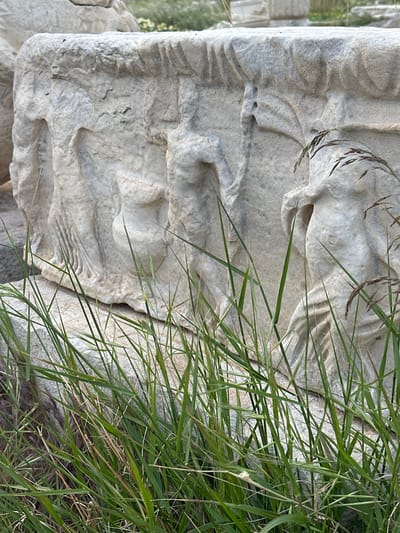
The image captures a detailed section of an ancient stone relief, likely a frieze or sarcophagus, viewed at a vertical orientation. The relief is carved from light-colored stone, possibly marble, and displays intricate figural depictions. In the upper central part of the relief, partially obscured by green grass, a figure or creature with distinct outlines is visible, possibly with an uplifted limb or head. Below this, a more prominent human-like figure is carved, showing defined musculature or drapery around its body, seemingly in motion or engaged in an act. Its form suggests a dynamic pose, perhaps reaching or struggling. Further to the left and bottom, additional carved elements of the relief are visible, including flowing lines that could represent fabric or natural forms, indicating a complex narrative or mythological scene. A significant portion of the image, particularly the right and top sections, is covered by vibrant green grass and some feathery seed heads, suggesting the relief is situated outdoors and partially overgrown. The texture of the stone shows signs of age and weathering, with subtle erosion and natural patination over its surface. The setting appears to be an archaeological site or a ruin in Datça, Turkey, given the context. The lighting suggests it is daytime, with soft shadows indicating a clear sky. There is no visible text on the relief. The scene itself is static, presenting a moment frozen in time from an ancient story or event.
Datça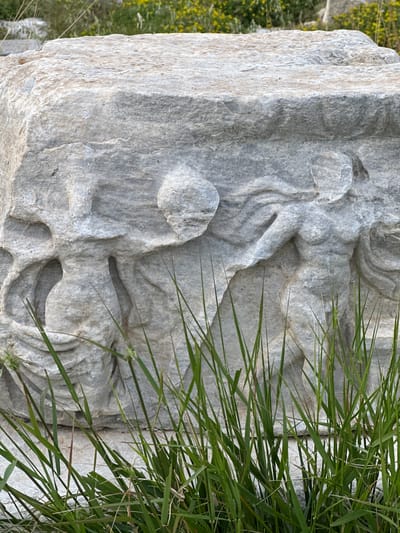
This close-up image captures a weathered, light-grey marble or limestone block, likely an ancient architectural element or sculptural relief, situated outdoors in Datça, Turkey. The stone block is adorned with intricate carvings in low relief, depicting stylized human or anthropomorphic figures. The figures are heavily eroded and partially obscured by centuries of exposure. One can discern the general outlines of bodies, possibly torsos, limbs, and flowing drapery, suggesting dynamic poses or narrative scenes. For instance, in the upper-central part of the main image, a larger figure appears with gracefully curved forms, while another, smaller rounded element is visible below it. The details of facial features or specific actions are lost due to the significant wear and tear on the stone surface. Vibrant green grass grows densely along the right side of the stone, partially overlapping and contrasting with the ancient carving. The background is softly blurred, revealing hints of other green foliage and scattered yellow wildflowers, indicative of a natural, possibly overgrown, archaeological site. The scene is illuminated by bright, even daylight, suggesting it is midday or early afternoon, with no harsh shadows obscuring the weathered textures. No visible text is present on the stone or elsewhere in the frame. The image conveys a sense of history, the persistence of ancient art, and its gradual integration back into the natural landscape.
Datça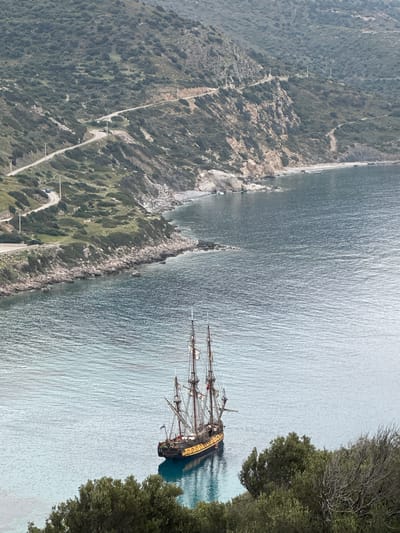
A high-angle, aerial view of a scenic coastal landscape in Datça, Turkey, currently displayed with a 90-degree clockwise rotation. When viewed upright, the image features a three-masted sailing ship anchored near a rocky coastline. The ship, likely a tall ship or a replica, has a dark hull with distinctive yellow ornamentation along its upper deck. Its sails are furled, and intricate rigging is visible. On its stern, the word "EUROPA" is visible, along with a blue and white flag. The ship rests in clear, calm turquoise water close to a rugged, rocky shore that transitions into a steep, vegetated hillside. The hillside is covered in dense green Mediterranean flora, with sparser trees closer to the water's edge. A narrow, winding road, possibly unpaved or lightly paved, traverses the hillside, following the contours of the land. Several utility poles are spaced along this road. A dark-colored car is visible on the road in the mid-ground. The water surface shows ripples and reflections, indicating calm conditions under bright daylight. The overall impression is one of a serene and natural coastal environment, possibly a bay or cove, with a historic vessel as a central point of interest. There are no visible people or discernible activity on board the ship or along the coastline, suggesting a tranquil moment.
Datça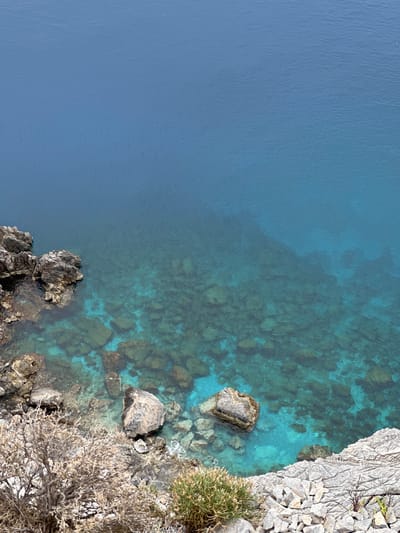
The image presents an elevated view of a tranquil coastal scene in Datça, Turkey. The majority of the frame, spanning the left and central areas, is dominated by the calm, blue waters of the sea. The water on the far left appears a uniform, deep, and opaque blue, suggesting significant depth. Moving towards the right, the water becomes progressively clearer and lighter, transitioning into a vibrant turquoise. Through this translucent water, the rocky seabed is clearly visible, revealing numerous formations, boulders, and pebbles in shades of brown, grey, and green. On the right side of the image, a rugged, light-colored rocky coastline descends into the sea. This shoreline is characterized by jagged rock formations and scattered stones. Several large, dark rocks are positioned along the water's edge, some partially submerged and appearing to have marine growth. Sparse, hardy vegetation, including small green bushes and drier, gnarled shrubs, clings to the rocky terrain on the right. The scene is bathed in bright, natural daylight, indicative of a clear, sunny day. No human activity or visible text is present. The overall atmosphere is one of natural beauty and serenity.
Datça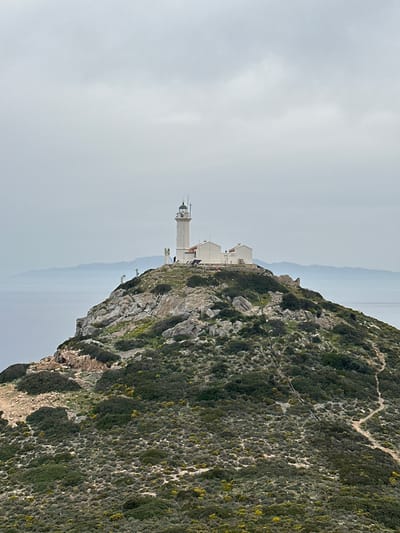
The horizontally oriented image depicts a white lighthouse complex situated on a rugged, vegetated cliff overlooking a calm sea in Datça, Turkey. The prominent lighthouse, featuring a lantern room and an antenna array, stands alongside several white, low-rise buildings on the cliff edge. The right side and foreground of the scene are dominated by the steep, rocky cliff, densely covered with green and yellow scrub vegetation. Exposed grey rock formations are visible throughout the terrain, with faint paths or trails winding through the greenery. Beyond the cliff, a tranquil body of water extends into the distance, meeting a hazy, mountainous horizon line. The sky is uniformly light grey and overcast, blending with the distant sea and contributing to the muted color palette of the scene. The weather appears cloudy or misty, diffusing the light. No people or discernible activities are present in the image. The scene conveys a sense of rugged natural beauty and isolation, characteristic of a coastal landmark. There is no visible text.
Datça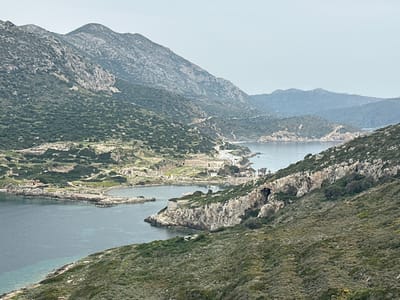
This panoramic image presents a sweeping view of a rugged, mountainous coastal landscape, dominated by the serene waters of a bay or inlet and the extensive ruins of an ancient city. Rolling hills, covered in sparse, scrubby green vegetation and dotted with grey rocky outcrops, rise on either side of the calm, blue-green sea, which appears clearer near the shores. Further mountain ranges recede into the distance under a pale, hazy sky, suggesting an overcast day or atmospheric diffusion. At the center of the composition, a prominent peninsula juts into the water, hosting the substantial remains of an ancient settlement. Numerous stone foundations, walls, and structures are clearly visible, with what appears to be a large, possibly circular or semi-circular, ancient public building like a theatre or odeon. The layout of the ruins indicates two distinct harbor areas, strategically located for ancient maritime activities. Sections of ancient stonework, including what looks like a fortified wall, can be seen along the rocky coastlines. A winding road is also discernible in the mountainous terrain, suggesting accessibility to the area. The time of day is daylight, but the diffused light from the hazy sky prevents strong shadows, contributing to a muted color palette. No people or active events are depicted, lending a sense of timelessness and historical depth to the scene. Given the context of Datça, Turkey, the site is almost certainly the ancient city of Knidos, renowned for its two harbors and archaeological significance. The image conveys a sense of peaceful grandeur and the enduring legacy of an ancient civilization amidst natural beauty. No visible text is present in the image.
Datça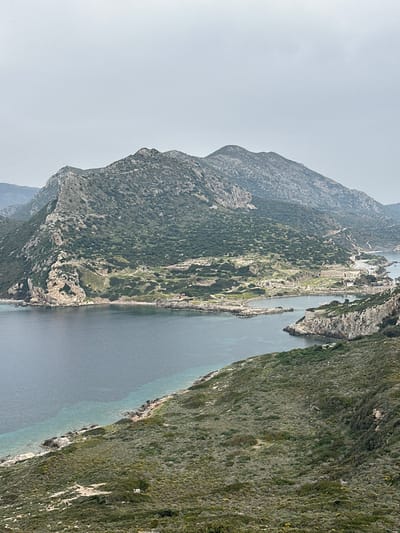
This panoramic image, taken in Datça, Turkey, captures a rugged coastal landscape under a hazy sky. The scene is dominated by a large, steep mountain range stretching across the left side of the frame, from the background towards the midground. Its slopes are densely covered with dark green vegetation, indicating a lush but rocky terrain. A calm body of water, likely a bay or a strait, occupies the center and right side of the view. The water displays varying shades of blue and gray, with lighter, turquoise tones closer to the shoreline, suggesting shallow areas. Along the base of the left mountain range, a narrow strip of land extends into the water. This strip hosts a small settlement, characterized by a cluster of light-colored buildings and visible roads, possibly including a small port or dock area. Another heavily vegetated hillside, similar in appearance to the distant mountains but closer to the foreground, frames the right side of the image, sloping down towards the water's edge. The sky is a soft, light gray, indicative of an overcast day or atmospheric haze, which diffuses the sunlight and creates a serene, somewhat muted light across the landscape. There are no people or specific activities visible, emphasizing the natural beauty and tranquility of the scene. No discernible text is present in the image. The time of day appears to be daytime, with soft lighting.
Datça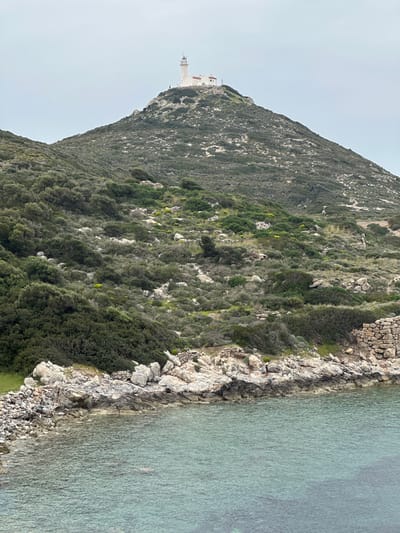
This image captures a serene coastal landscape in Datça, Turkey, featuring a verdant, rocky hillside descending to a clear, turquoise sea under an overcast sky. The main subject is a large, steep hill or mountain, densely covered in various shades of green, scrubby vegetation, interspersed with exposed grey and white rock formations. Towards the summit of the hill, a prominent white building complex, resembling a lighthouse or a small chapel, stands out against the muted sky. It features a distinctive tower and other white structures adjacent to it. The base of the hill meets the water with a rugged, rocky shoreline. This coastline consists of a mix of large, jagged rocks and smaller pebbles, with patches of green grass and resilient plants growing among the stones. The sea, occupying the right side of the frame, is remarkably clear and calm, revealing a beautiful light turquoise hue. The clarity of the water suggests a shallow depth near the shore. The surface shows gentle ripples, indicating minimal wind. There are no people or specific activities depicted in the photograph. The scene is a natural landscape, peaceful and undisturbed. The soft, diffused lighting, resulting from the overcast sky, suggests it is daytime, possibly morning or afternoon. There is no visible text in the image. The overall impression is one of natural beauty and tranquility in a Mediterranean coastal environment.
Datça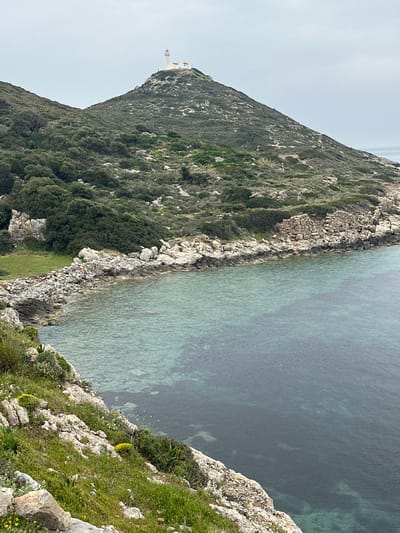
The image captures a serene coastal landscape, likely viewed from a clifftop under an overcast sky. A large, verdant hill dominates the left side of the frame, its slopes densely covered with green vegetation, including trees, bushes, and scrub, interspersed with exposed grey rock formations. Perched atop the distant peak of this hill is a distinct white building, possibly a lighthouse or a small observation post, standing out against the light grey sky. To the right, the calm, clear sea stretches towards the horizon. Near the shoreline, the water exhibits a striking aquamarine hue, indicating shallow depths and allowing the rocky seabed to be visible. Further out, the water deepens to a darker, more opaque blue. The transition between land and sea is marked by a rugged, rocky coastline composed of light-colored stones and boulders, forming a natural boundary. In the immediate foreground, a rocky cliff edge, covered with patches of vibrant green grass and scattered small yellow wildflowers, provides a natural frame to the scene. The sky above is uniformly light grey, suggesting an overcast day with soft, diffused lighting, contributing to the tranquil atmosphere. There are no visible people or specific activities taking place, and no discernible text is present. The scene conveys the rugged and pristine beauty of the Datça coastline in Turkey.
Datça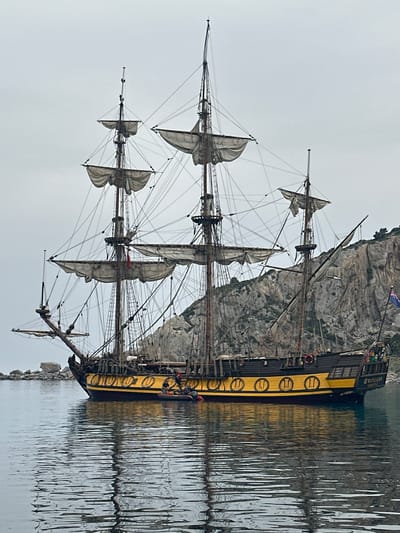
The image features a majestic multi-masted sailing ship, reminiscent of a historical tall ship or galleon, calmly floating on water against a backdrop of a rugged, light gray rocky cliff face. The ship's hull is predominantly dark, but it is accentuated by a striking yellow stripe that runs along its side. This yellow stripe is adorned with several dark, circular emblems, many of which clearly display the Roman numeral "II". The vessel boasts at least three prominent masts, each fitted with numerous furled sails and an intricate network of ropes and rigging. Several small human figures are discernible on the ship's deck, particularly near the stern, and possibly among the rigging. The calm water in the foreground creates distinct reflections of both the ship's hull and the textured cliff face. The sky above is uniformly overcast and light gray, casting a soft, diffused light over the entire scene. A small flag, possibly a Union Jack or similar, can be seen flying near the ship's stern, atop one of its masts. Faintly visible on the ship's stern, above a row of windows, is the text "MARTELLOO". The scene suggests the ship is either anchored or docked close to the shore in a bay or harbor. The peaceful coastal setting, with its dramatic cliff, aligns with locations such as Datça, Turkey, as provided in the context. The ship appears to be either a well-maintained historical vessel or a meticulously crafted replica.
Datça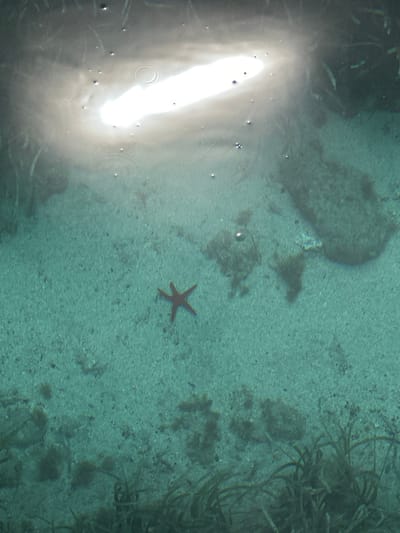
This overhead shot captures a serene underwater scene in a shallow coastal area. The primary subject is a reddish-brown starfish, clearly visible on the sandy seabed, positioned slightly to the right of the image center. The seabed itself is a light, somewhat muted green-blue, indicative of clear water and a sandy bottom. Scattered across the sand are small rocks and patches of darker material, possibly algae or small clusters of seagrass, particularly denser along the right edge of the frame. The water is remarkably clear, allowing for a good view of the bottom. A prominent feature is the intense, bright reflection of sunlight on the water's surface in the upper left quadrant, creating a strong glare. This reflection also reveals small ripples and several air bubbles floating on or just beneath the surface. The overall impression is one of calm, shallow waters under bright sunlight. There are no people or visible text in the image. Given the context, this scene is likely from the coastal waters of Datça, Turkey.
Datça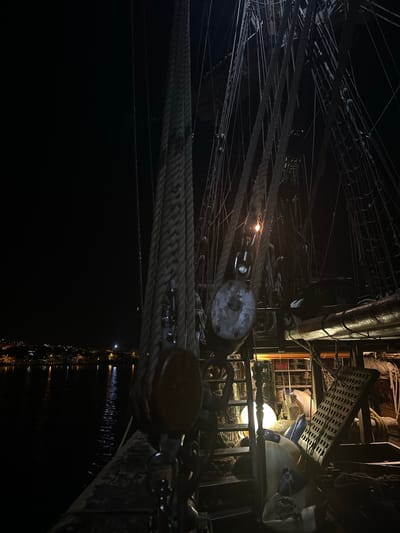
The image depicts the rigging of a tall ship at night, likely the "Çamlık" docked in Datça, Turkey. The photograph is taken from a low angle, looking upward into the complex network of ropes and spars. Two prominent wooden blocks are visible in the foreground, with thick ropes running through them. Above, a tangle of thinner ropes and lines fills the frame, partially illuminated by a light source further up the mast. To the right, the ship's structure is visible, with metal grates and other equipment in view. The water reflects some of the surrounding city lights.
Datça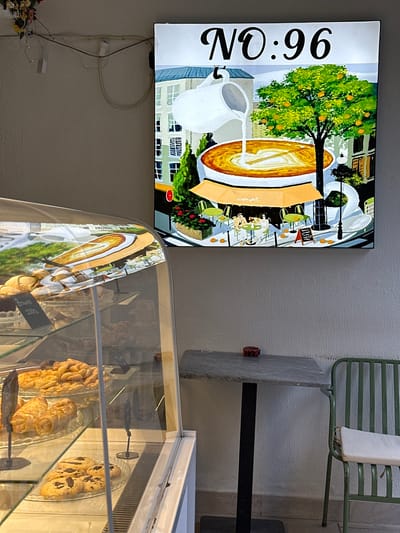
The image captures an indoor scene in Datça, Turkey, featuring a bakery or cafe. A brightly lit sign or artwork is on the wall, displaying a stylized image of a cafe scene with the number "No.96". The scene includes a painting of a coffee cup and pitcher. Below the sign is a glass display case containing various baked goods, including pastries, cookies, and other treats. A small sign is visible in front of one of the trays of baked goods. A metal table and a green metal chair are also visible. Wires run from the sign down the wall. Flowers are displayed near the bottom left of the frame. The reflection of the sign on the display case.
Datça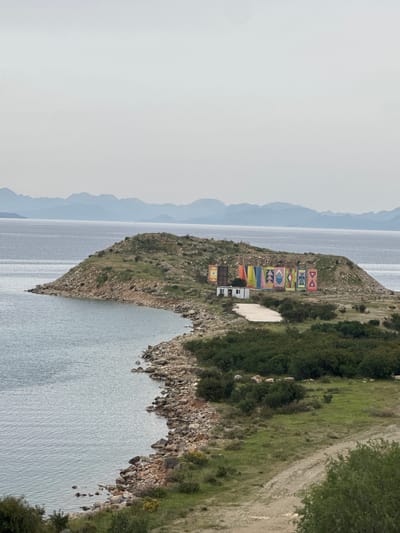
The image shows an aerial, sideways view of a promontory extending into the sea, likely taken in Datça, Turkey. The landscape is dominated by the shoreline, with the clear water stretching into the distance where hazy mountains fade into the sky. The promontory itself is covered in sparse vegetation, dirt, and rocks. At the end of the promontory, closest to the viewer, is a series of eight brightly painted panels displaying various symbols. Behind the panels are a few small white buildings. A dirt path runs along the top of the promontory on the right side of the image, bordering the vegetation. The sky is overcast, contributing to the muted color palette.
Datça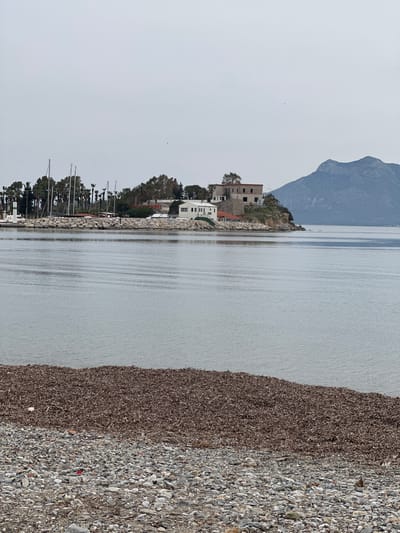
The image depicts a view from the waterfront in Datça, Turkey. A pebble beach lines the right side of the frame, with a darker band of seaweed separating it from the grey water. On the opposite shore, there is a rocky outcrop with vegetation and several white buildings. A hill rises in the background. The water is calm, with subtle ripples. Along the left edge of the frame, there are trees and the masts of sailboats are visible. The sky is overcast and grey. A single bird is visible in the sky.
Datça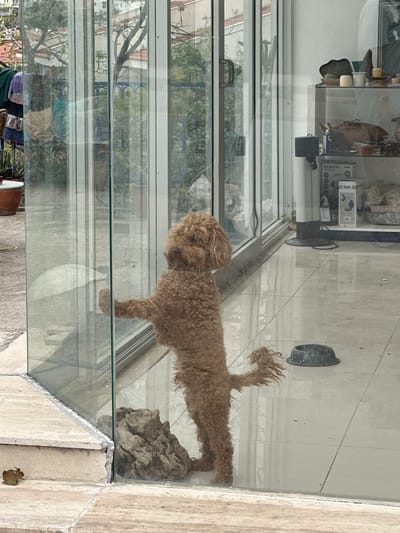
A medium-sized, brown poodle stands on a light-colored tiled surface, partially enclosed by glass panes. The dog's tail is raised. The location, inferred from the surrounding environment, is Datça, Turkey. The glass panels reflect an external view of trees and buildings. Through the glass, other objects and a dog bowl are visible.
Datça