CM:

ATTN

Get the app

Pedda Kammavaripalli, India

30 memories from Pedda Kammavaripalli, India

A group of South Asian men celebrate a birthday outdoors in the evening.  The video opens with three men in front of a motorcycle, on the seat of which sits a cake with a lit sparkler candle.  The man in the middle of the frame is wearing a white shirt and smiling, preparing to cut the cake.  The other men around him are singing, and another man in the background is taking a video.  As the camera pans and the video continues, the frame fills with five young men. The birthday cake is out of focus. The men stand on a street and clap.

A group of South Asian men celebrate a birthday outdoors in the evening. The video opens with three men in front of a motorcycle, on the seat of which sits a cake with a lit sparkler candle. The man in the middle of the frame is wearing a white shirt and smiling, preparing to cut the cake. The other men around him are singing, and another man in the background is taking a video. As the camera pans and the video continues, the frame fills with five young men. The birthday cake is out of focus. The men stand on a street and clap.

Pedda Kammavaripalli
Looking up from the base of a coconut palm in Pedda Kammavaripalli, India, the image captures the textured trunk, radiating fronds, and heavy clusters of green coconuts. The tree's central stalk rises vertically, displaying a rough, segmented bark pattern. The fronds extend outwards, creating a dense, layered canopy against the bright sky. Green coconuts are densely packed and hang in bunches, appearing heavy and ripe. The angle provides a foreshortened perspective, emphasizing the height and density of the palm.

Looking up from the base of a coconut palm in Pedda Kammavaripalli, India, the image captures the textured trunk, radiating fronds, and heavy clusters of green coconuts. The tree's central stalk rises vertically, displaying a rough, segmented bark pattern. The fronds extend outwards, creating a dense, layered canopy against the bright sky. Green coconuts are densely packed and hang in bunches, appearing heavy and ripe. The angle provides a foreshortened perspective, emphasizing the height and density of the palm.

Pedda Kammavaripalli
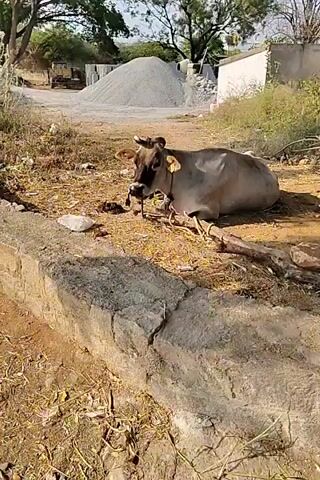
The video shows a grey cow with a black muzzle lying down on the ground. The cow has yellow ear tags and a black rope attached to its nose. The ground is covered with dry grass and straw. In the background, there is a pile of gravel, a building, and trees. The camera moves closer to the cow's face.

The video shows a grey cow with a black muzzle lying down on the ground. The cow has yellow ear tags and a black rope attached to its nose. The ground is covered with dry grass and straw. In the background, there is a pile of gravel, a building, and trees. The camera moves closer to the cow's face.

Pedda Kammavaripalli
The image depicts a rural scene in Pedda Kammavaripalli, India, with a focus on the natural environment and livestock. The foreground is dominated by trees, their branches spreading across the frame. Beneath the trees, a dark-colored cow stands partially obscured. To the right, a portion of a brown cow is visible. The ground is covered in dry vegetation and dirt, with scattered stones. In the background, sparse vegetation and dry underbrush are visible, along with bits of discarded plastic. The light suggests a sunny day with shadows cast by the trees.

The image depicts a rural scene in Pedda Kammavaripalli, India, with a focus on the natural environment and livestock. The foreground is dominated by trees, their branches spreading across the frame. Beneath the trees, a dark-colored cow stands partially obscured. To the right, a portion of a brown cow is visible. The ground is covered in dry vegetation and dirt, with scattered stones. In the background, sparse vegetation and dry underbrush are visible, along with bits of discarded plastic. The light suggests a sunny day with shadows cast by the trees.

Pedda Kammavaripalli
A partially peeled red banana is held in someone's hand. The banana peel is a reddish-brown color. The fruit inside is yellow and creamy. A person is partially visible in the background, wearing a maroon shirt. The background includes a room with a cabinet. The image appears to have been taken indoors. The location is unknown.

A partially peeled red banana is held in someone's hand. The banana peel is a reddish-brown color. The fruit inside is yellow and creamy. A person is partially visible in the background, wearing a maroon shirt. The background includes a room with a cabinet. The image appears to have been taken indoors. The location is unknown.

Pedda Kammavaripalli
On a dark blue textured surface, a light-colored wooden tray with a black border holds a tea set. The set includes three cups filled with a light-colored beverage and one cup with a red beverage. A circular teapot lid with a grey-blue floral design and a brown center sits in the middle of the tray. The scene appears to be in a domestic setting. There is no indication of it being located in Pedda Kammavaripalli, India. There are no people in the image.

On a dark blue textured surface, a light-colored wooden tray with a black border holds a tea set. The set includes three cups filled with a light-colored beverage and one cup with a red beverage. A circular teapot lid with a grey-blue floral design and a brown center sits in the middle of the tray. The scene appears to be in a domestic setting. There is no indication of it being located in Pedda Kammavaripalli, India. There are no people in the image.

Pedda Kammavaripalli
The image shows a nighttime scene in Pedda Kammavaripalli, India. A man sits on a low concrete structure on the right side of the image, looking at a mobile phone. The background is a street lined with multi-story buildings, varying in color. Overhead, a dense network of electrical wires stretches across the sky. A group of children are visible near a blue doorway of a building at the end of the street. There is debris and trash scattered on the street near the man. The overall lighting is dim with light sources from streetlights and buildings.

The image shows a nighttime scene in Pedda Kammavaripalli, India. A man sits on a low concrete structure on the right side of the image, looking at a mobile phone. The background is a street lined with multi-story buildings, varying in color. Overhead, a dense network of electrical wires stretches across the sky. A group of children are visible near a blue doorway of a building at the end of the street. There is debris and trash scattered on the street near the man. The overall lighting is dim with light sources from streetlights and buildings.

Pedda Kammavaripalli
The scene shows an elderly man lying on a concrete step in what appears to be a courtyard or porch adjacent to a building. The man is wearing a white striped shirt and appears to be resting, with a colorful patterned cloth under his head. He is fair-skinned with grey hair. The step he's lying on is painted in blue hues.

The building is vibrantly painted in shades of green and blue, with elements of yellow and peach. The architecture is multi-level, featuring staircases and intricate railings. An open doorway provides a glimpse into the interior of the building, revealing a television, shelves, and furniture, suggesting a living space. The interior is illuminated with what seems like artificial lighting.

Outside the door, various items are visible, including plant pots, brooms, and pipes, adding to the cluttered and domestic atmosphere. The overall impression is of a lived-in space, with a focus on the man taking a rest in the immediate foreground.

The location is Pedda Kammavaripalli, India, based on the geo-tag.

The scene shows an elderly man lying on a concrete step in what appears to be a courtyard or porch adjacent to a building. The man is wearing a white striped shirt and appears to be resting, with a colorful patterned cloth under his head. He is fair-skinned with grey hair. The step he's lying on is painted in blue hues. The building is vibrantly painted in shades of green and blue, with elements of yellow and peach. The architecture is multi-level, featuring staircases and intricate railings. An open doorway provides a glimpse into the interior of the building, revealing a television, shelves, and furniture, suggesting a living space. The interior is illuminated with what seems like artificial lighting. Outside the door, various items are visible, including plant pots, brooms, and pipes, adding to the cluttered and domestic atmosphere. The overall impression is of a lived-in space, with a focus on the man taking a rest in the immediate foreground. The location is Pedda Kammavaripalli, India, based on the geo-tag.

Pedda Kammavaripalli
The scene depicts a tabletop arrangement in Pedda Kammavaripalli, India. A light-colored, possibly white, tiled surface serves as the base, partially covered by a dark blue waffle-weave textured towel. In the upper left quadrant, a dark green bottle, marked with "380ML" and graduations at 100, 150, and 200, stands upright, containing a green liquid. A rectangular bamboo serving tray with a dark perimeter and three parallel grooved channels occupies the central right area of the frame. On this tray, two small, dark-rimmed bowls with white interiors contain a vibrant green, foamy liquid. A human hand, positioned in the foreground from the bottom right, holds a third identical bowl, also filled with the green, foamy liquid. The hand's thumb is visible on the left side of the cup, and fingers wrap around the right side. The overall presentation suggests a beverage, likely matcha tea, is prepared and ready for consumption.

The scene depicts a tabletop arrangement in Pedda Kammavaripalli, India. A light-colored, possibly white, tiled surface serves as the base, partially covered by a dark blue waffle-weave textured towel. In the upper left quadrant, a dark green bottle, marked with "380ML" and graduations at 100, 150, and 200, stands upright, containing a green liquid. A rectangular bamboo serving tray with a dark perimeter and three parallel grooved channels occupies the central right area of the frame. On this tray, two small, dark-rimmed bowls with white interiors contain a vibrant green, foamy liquid. A human hand, positioned in the foreground from the bottom right, holds a third identical bowl, also filled with the green, foamy liquid. The hand's thumb is visible on the left side of the cup, and fingers wrap around the right side. The overall presentation suggests a beverage, likely matcha tea, is prepared and ready for consumption.

Pedda Kammavaripalli
The image displays a decorated, partially open entrance gate in Pedda Kammavaripalli, India. The primary subject is a two-panel metal gate, painted light blue, with a weathered, off-white concrete wall serving as its left support. A banana plant stem, featuring several large green leaves, is tied vertically to the left gate post and adjacent wall. A garland of green leaves is draped across the upper horizontal bar of the gate, connecting to gold-painted finials that line the gate's top edge. The gate panels are adorned with multiple yellow, five-petal flower motifs affixed to the vertical bars and integrated into the ornate scrollwork on the lower sections. The left gate panel is ajar, and a locking mechanism is visible on the right panel. The background consists of a clear, bright blue sky, with palm tree foliage visible above the right side of the gate. The ground in the foreground is a light-colored paved surface, showing shadows cast by the gate. The wall exhibits signs of aging, including dark stains and peeling paint/plaster.

The image displays a decorated, partially open entrance gate in Pedda Kammavaripalli, India. The primary subject is a two-panel metal gate, painted light blue, with a weathered, off-white concrete wall serving as its left support. A banana plant stem, featuring several large green leaves, is tied vertically to the left gate post and adjacent wall. A garland of green leaves is draped across the upper horizontal bar of the gate, connecting to gold-painted finials that line the gate's top edge. The gate panels are adorned with multiple yellow, five-petal flower motifs affixed to the vertical bars and integrated into the ornate scrollwork on the lower sections. The left gate panel is ajar, and a locking mechanism is visible on the right panel. The background consists of a clear, bright blue sky, with palm tree foliage visible above the right side of the gate. The ground in the foreground is a light-colored paved surface, showing shadows cast by the gate. The wall exhibits signs of aging, including dark stains and peeling paint/plaster.

Pedda Kammavaripalli
This image depicts the exterior front of a residential building in Pedda Kammavaripalli, India, captured during daylight hours. The scene is dominated by a cream-colored wall featuring a main entrance, windows, and utility installations.

In the foreground, a detailed, colorful rangoli (kolam) pattern is drawn on a light grey concrete surface. The design incorporates white outlines of peacocks, flowers, and geometric shapes, filled with dots of blue, green, yellow, orange, red, and purple. Three concrete steps lead up to a raised entrance platform; the top two steps are covered with dark green/grey stone.

The main entrance consists of a partially open white retractable metal security gate. Behind it, a blue wooden door is visible, mostly obscured by a blue patterned curtain hanging internally. Green leaves and a few yellow flowers are draped decoratively over the top of the main door frame/security gate. A white metal handrail is affixed to the right side of the steps. Above the main door, on the wall, are a light fixture and two small framed images, likely religious deities.

To the left of the entrance, a "VOLTAS by TATA Product" air conditioning outdoor unit is mounted on the cream-colored wall, with its fan visible. Black electrical conduits connect to it. Below the AC unit is an open blue-framed window with a concentric circle design. A green string, possibly a clothesline, stretches across an opening to the far left. A bundle of natural-fiber brooms leans in a recessed corner to the left of the entrance platform. Two weathered, cylindrical objects stand vertically against the wall in a corner near the brooms.

To the right of the main door, another similar blue-framed window, closed, is present. A yellow circular sticker marked "MSC. 13018" is affixed to the wall below a black electrical box. Further right, a rectangular sign displays the number "152". Below this, a network of grey PVC pipes runs horizontally along the base of the wall. Faint, indecipherable handwritten text is visible on the wall above the "152" sign. No individuals are present in the image.

This image depicts the exterior front of a residential building in Pedda Kammavaripalli, India, captured during daylight hours. The scene is dominated by a cream-colored wall featuring a main entrance, windows, and utility installations. In the foreground, a detailed, colorful rangoli (kolam) pattern is drawn on a light grey concrete surface. The design incorporates white outlines of peacocks, flowers, and geometric shapes, filled with dots of blue, green, yellow, orange, red, and purple. Three concrete steps lead up to a raised entrance platform; the top two steps are covered with dark green/grey stone. The main entrance consists of a partially open white retractable metal security gate. Behind it, a blue wooden door is visible, mostly obscured by a blue patterned curtain hanging internally. Green leaves and a few yellow flowers are draped decoratively over the top of the main door frame/security gate. A white metal handrail is affixed to the right side of the steps. Above the main door, on the wall, are a light fixture and two small framed images, likely religious deities. To the left of the entrance, a "VOLTAS by TATA Product" air conditioning outdoor unit is mounted on the cream-colored wall, with its fan visible. Black electrical conduits connect to it. Below the AC unit is an open blue-framed window with a concentric circle design. A green string, possibly a clothesline, stretches across an opening to the far left. A bundle of natural-fiber brooms leans in a recessed corner to the left of the entrance platform. Two weathered, cylindrical objects stand vertically against the wall in a corner near the brooms. To the right of the main door, another similar blue-framed window, closed, is present. A yellow circular sticker marked "MSC. 13018" is affixed to the wall below a black electrical box. Further right, a rectangular sign displays the number "152". Below this, a network of grey PVC pipes runs horizontally along the base of the wall. Faint, indecipherable handwritten text is visible on the wall above the "152" sign. No individuals are present in the image.

Pedda Kammavaripalli
This image depicts an outdoor scene in front of a residential structure in Pedda Kammavaripalli, India.

A light-skinned, possibly concrete, building with signs of weathering and irregular plasterwork occupies the left side of the frame. An open, barred window is visible on the left wall. A blue mop leans against this wall near the bottom left corner. Adjacent to the building, a set of concrete steps leads up to an elevated entrance. The steps are worn, with chipping paint and exposed concrete.

On the elevated concrete platform, a light brown dog is curled up and resting, positioned behind a blue metal railing that acts as a banister. To the right of the dog, a woman with dark hair, wearing a patterned garment, is seated on the platform, looking towards the right side of the frame. Her right arm is visible. Behind her, the doorway is partially obscured by a patterned fabric or screen. An electrical meter box and associated wiring are mounted on the wall to the left of the doorway. Above the entrance, a light bulb hangs from the ceiling, and a decorative object resembling an ornate metal vessel is suspended by chains.

To the right of the platform, a man with short dark hair, wearing a blue and white plaid shirt and brown trousers, stands facing generally to the right, with his head turned slightly left. His right hand is raised to his chest area. He appears to be speaking or observing something outside the frame to the right. Behind him, part of a light blue building with a dark brown door is visible, along with a reddish-brown brick wall.

At the bottom of the steps, directly in front of the platform, a pile of discarded items, including plastic bags, paper, and what appears to be vegetable waste, is accumulated. On the ground level to the right, a motorcycle's front section, including handlebars, a rearview mirror with a checkered pattern, and a red taillight reflector, is visible. The ground is a mix of dirt and concrete, showing a strong shadow cast from an unseen object or building. A colorful rangoli or kolam pattern is visible on the ground beneath the motorcycle's front wheel, extending towards the building.

This image depicts an outdoor scene in front of a residential structure in Pedda Kammavaripalli, India. A light-skinned, possibly concrete, building with signs of weathering and irregular plasterwork occupies the left side of the frame. An open, barred window is visible on the left wall. A blue mop leans against this wall near the bottom left corner. Adjacent to the building, a set of concrete steps leads up to an elevated entrance. The steps are worn, with chipping paint and exposed concrete. On the elevated concrete platform, a light brown dog is curled up and resting, positioned behind a blue metal railing that acts as a banister. To the right of the dog, a woman with dark hair, wearing a patterned garment, is seated on the platform, looking towards the right side of the frame. Her right arm is visible. Behind her, the doorway is partially obscured by a patterned fabric or screen. An electrical meter box and associated wiring are mounted on the wall to the left of the doorway. Above the entrance, a light bulb hangs from the ceiling, and a decorative object resembling an ornate metal vessel is suspended by chains. To the right of the platform, a man with short dark hair, wearing a blue and white plaid shirt and brown trousers, stands facing generally to the right, with his head turned slightly left. His right hand is raised to his chest area. He appears to be speaking or observing something outside the frame to the right. Behind him, part of a light blue building with a dark brown door is visible, along with a reddish-brown brick wall. At the bottom of the steps, directly in front of the platform, a pile of discarded items, including plastic bags, paper, and what appears to be vegetable waste, is accumulated. On the ground level to the right, a motorcycle's front section, including handlebars, a rearview mirror with a checkered pattern, and a red taillight reflector, is visible. The ground is a mix of dirt and concrete, showing a strong shadow cast from an unseen object or building. A colorful rangoli or kolam pattern is visible on the ground beneath the motorcycle's front wheel, extending towards the building.

Pedda Kammavaripalli
The image captures an outdoor ground-level scene in Pedda Kammavaripalli, India. The primary surface is a light grey concrete or cement floor, exhibiting varied staining, dirt, and scattered small red petals.

In the upper-left background, a rough, rusty-brown textured slab or surface leans against a light blue painted concrete base. A light blue pipe is partially visible near the base of this structure in the lower-left.

A cluster of approximately ten coconuts is positioned centrally and towards the lower-right. These coconuts exhibit varying states, from greenish-yellow with brown decay patches to fully brown and dried. Several of the coconuts possess distinct, dark circular perforations, indicative of being opened.

Adjacent to and partially supporting the coconuts are multiple irregularly shaped stones. Three larger stones, dark grey and exhibiting significant charring or black discoloration, are arranged on the concrete, consistent with use as a makeshift hearth or cooking supports. A smaller, lighter grey stone is also intermingled with the coconuts.

To the left of the coconut cluster, a crumpled, light-colored fabric with faint stripes rests on the concrete, partially obscuring a thin, light-brown wooden stick or splinter. Beneath the fabric, a section of a white and blue plastic bag or packaging, displaying legible text including "HOW TO USE" and "M 72 GRAMS," is visible on the concrete. The concrete beneath the charred stones and coconuts exhibits areas of dark grey and black discoloration, consistent with ash or residue from burning. No individuals are present in the scene.

The image captures an outdoor ground-level scene in Pedda Kammavaripalli, India. The primary surface is a light grey concrete or cement floor, exhibiting varied staining, dirt, and scattered small red petals. In the upper-left background, a rough, rusty-brown textured slab or surface leans against a light blue painted concrete base. A light blue pipe is partially visible near the base of this structure in the lower-left. A cluster of approximately ten coconuts is positioned centrally and towards the lower-right. These coconuts exhibit varying states, from greenish-yellow with brown decay patches to fully brown and dried. Several of the coconuts possess distinct, dark circular perforations, indicative of being opened. Adjacent to and partially supporting the coconuts are multiple irregularly shaped stones. Three larger stones, dark grey and exhibiting significant charring or black discoloration, are arranged on the concrete, consistent with use as a makeshift hearth or cooking supports. A smaller, lighter grey stone is also intermingled with the coconuts. To the left of the coconut cluster, a crumpled, light-colored fabric with faint stripes rests on the concrete, partially obscuring a thin, light-brown wooden stick or splinter. Beneath the fabric, a section of a white and blue plastic bag or packaging, displaying legible text including "HOW TO USE" and "M 72 GRAMS," is visible on the concrete. The concrete beneath the charred stones and coconuts exhibits areas of dark grey and black discoloration, consistent with ash or residue from burning. No individuals are present in the scene.

Pedda Kammavaripalli
The image displays a weathered, light-colored wall surface, specifically located in Pedda Kammavaripalli, India. The wall is constructed of a material resembling stucco or plaster, coated in an off-white or light beige paint. Significant deterioration is evident, characterized by extensive paint peeling, revealing patches of faded teal or greenish-blue undertone and a darker greyish substrate. Fine cracks traverse the surface, and dark, irregular stains, possibly dirt or mold, are visible, particularly along the bottom edge and within recessed areas.

Geometric patterns are carved or indented into the wall's surface. From left to right, the top section features a distinctive hooked shape, followed by three circular indentations of uniform size, and a partial, larger circular or curved shape on the far right. Below these, a row presents three prominent, vertically oriented, arched rectangular indentations, each tapering to a point at the top, reminiscent of Gothic or Islamic archways. To the right of the third archway, a smaller, curved indentation partially frames a rectangular recess. The bottom section of the wall features large 'X' shapes, formed by intersecting diagonal grooves. Two complete 'X' forms are visible, with a partial third 'X' on the far left. All carved elements exhibit shadowed edges, indicating their recessed nature and depth. No people, animate subjects, or explicit actions are present within the frame. The environment is implied as an exterior or interior space with significant exposure to elements, contributing to the wall's aged condition.

The image displays a weathered, light-colored wall surface, specifically located in Pedda Kammavaripalli, India. The wall is constructed of a material resembling stucco or plaster, coated in an off-white or light beige paint. Significant deterioration is evident, characterized by extensive paint peeling, revealing patches of faded teal or greenish-blue undertone and a darker greyish substrate. Fine cracks traverse the surface, and dark, irregular stains, possibly dirt or mold, are visible, particularly along the bottom edge and within recessed areas. Geometric patterns are carved or indented into the wall's surface. From left to right, the top section features a distinctive hooked shape, followed by three circular indentations of uniform size, and a partial, larger circular or curved shape on the far right. Below these, a row presents three prominent, vertically oriented, arched rectangular indentations, each tapering to a point at the top, reminiscent of Gothic or Islamic archways. To the right of the third archway, a smaller, curved indentation partially frames a rectangular recess. The bottom section of the wall features large 'X' shapes, formed by intersecting diagonal grooves. Two complete 'X' forms are visible, with a partial third 'X' on the far left. All carved elements exhibit shadowed edges, indicating their recessed nature and depth. No people, animate subjects, or explicit actions are present within the frame. The environment is implied as an exterior or interior space with significant exposure to elements, contributing to the wall's aged condition.

Pedda Kammavaripalli
The image depicts the entrance to a residence in Pedda Kammavaripalli, India. A young child, dressed in a yellow t-shirt and dark trousers, stands facing inwards within the open doorway, positioned between a patterned purple and beige curtain on the right and the interior of the home on the left. The doorway features a dark brown wooden frame with a vibrant yellow trim adorned with painted floral motifs along the bottom. A dark grey and red striped door mat lies on the worn concrete step directly outside the doorway.

To the left of the doorway, a set of concrete steps leads upwards, featuring a balustrade with prominent pink, ornate balusters and a grey handrail. The walls of the structure are painted a light grey, showing signs of wear and peeling paint, especially on the steps and lower sections. Above the steps and to the left of the door, a rectangular window with a dark brown wooden frame is fitted with white, intricate metal grilles. Above this window, a utility box, possibly an electrical meter or junction box, is mounted on the wall. A yellow sticker with "HSC 6708" is affixed below it. Further to the right of the window, near the door frame, a white light switch is visible, along with a yellow sticker displaying "103" and a QR code below it.

Overhead, a light-colored soffit or overhang is adorned with a trailing green vine with yellow-green leaves. Another section of the vine extends downwards near the window. On the upper landing, partially visible behind the balustrade, a white plastic bucket with a red handle and a green object are present. A white bucket with a pink lid is positioned under the upper part of the stairs. The overall scene suggests a lived-in residential environment with a mix of functional utility and decorative elements.

The image depicts the entrance to a residence in Pedda Kammavaripalli, India. A young child, dressed in a yellow t-shirt and dark trousers, stands facing inwards within the open doorway, positioned between a patterned purple and beige curtain on the right and the interior of the home on the left. The doorway features a dark brown wooden frame with a vibrant yellow trim adorned with painted floral motifs along the bottom. A dark grey and red striped door mat lies on the worn concrete step directly outside the doorway. To the left of the doorway, a set of concrete steps leads upwards, featuring a balustrade with prominent pink, ornate balusters and a grey handrail. The walls of the structure are painted a light grey, showing signs of wear and peeling paint, especially on the steps and lower sections. Above the steps and to the left of the door, a rectangular window with a dark brown wooden frame is fitted with white, intricate metal grilles. Above this window, a utility box, possibly an electrical meter or junction box, is mounted on the wall. A yellow sticker with "HSC 6708" is affixed below it. Further to the right of the window, near the door frame, a white light switch is visible, along with a yellow sticker displaying "103" and a QR code below it. Overhead, a light-colored soffit or overhang is adorned with a trailing green vine with yellow-green leaves. Another section of the vine extends downwards near the window. On the upper landing, partially visible behind the balustrade, a white plastic bucket with a red handle and a green object are present. A white bucket with a pink lid is positioned under the upper part of the stairs. The overall scene suggests a lived-in residential environment with a mix of functional utility and decorative elements.

Pedda Kammavaripalli
The image displays an upward view of a multi-story building facade in Pedda Kammavaripalli, India, against a clear blue sky. A concrete utility pole occupies the left side of the frame, laden with numerous black electrical and communication wires that crisscross the visual field. A yellow and white paper sign, bearing Telugu script and the number "95152007", is affixed to the pole.

The building's lower section features textured pale yellow walls. A central brown-painted area on the lower facade is vertically striped with three white lines. Two small, rectangular windows with black metal security grilles are observed within the pale yellow sections. Above this, a decorative pale yellow railing with diamond and rectangular openwork patterns is present.

A prominent, ornate tower-like structure, primarily white and pale yellow with arched openings and multiple tiers, extends upwards from the building's central section. The uppermost visible part of the building consists of a textured, weathered blue-green wall beneath a dark, possibly corrugated, roof edge. To the far left, a corrugated metal roof covered with blue material from an adjacent structure is partially visible. No individuals or specific actions are discernible within the frame.

The image displays an upward view of a multi-story building facade in Pedda Kammavaripalli, India, against a clear blue sky. A concrete utility pole occupies the left side of the frame, laden with numerous black electrical and communication wires that crisscross the visual field. A yellow and white paper sign, bearing Telugu script and the number "95152007", is affixed to the pole. The building's lower section features textured pale yellow walls. A central brown-painted area on the lower facade is vertically striped with three white lines. Two small, rectangular windows with black metal security grilles are observed within the pale yellow sections. Above this, a decorative pale yellow railing with diamond and rectangular openwork patterns is present. A prominent, ornate tower-like structure, primarily white and pale yellow with arched openings and multiple tiers, extends upwards from the building's central section. The uppermost visible part of the building consists of a textured, weathered blue-green wall beneath a dark, possibly corrugated, roof edge. To the far left, a corrugated metal roof covered with blue material from an adjacent structure is partially visible. No individuals or specific actions are discernible within the frame.

Pedda Kammavaripalli
The image displays a dark-furred bovine calf, specifically a water buffalo, resting on its left side on a concrete and dirt surface in Pedda Kammavaripalli, India. A green rope is secured around the calf's neck, tethering it to a rusty metal pole that extends vertically against a weathered concrete block wall. The calf's fur is primarily dark brown to black, with some lighter grayish fur observed on its lower body and legs. Scattered fresh green foliage is present on the ground near the calf's head, while dry plant stalks and debris are visible towards the right side of the frame. The concrete ground exhibits cracks and dark, wet stains. The concrete block wall behind the calf shows discoloration and signs of age. No human subjects are visible in the scene.

The image displays a dark-furred bovine calf, specifically a water buffalo, resting on its left side on a concrete and dirt surface in Pedda Kammavaripalli, India. A green rope is secured around the calf's neck, tethering it to a rusty metal pole that extends vertically against a weathered concrete block wall. The calf's fur is primarily dark brown to black, with some lighter grayish fur observed on its lower body and legs. Scattered fresh green foliage is present on the ground near the calf's head, while dry plant stalks and debris are visible towards the right side of the frame. The concrete ground exhibits cracks and dark, wet stains. The concrete block wall behind the calf shows discoloration and signs of age. No human subjects are visible in the scene.

Pedda Kammavaripalli
An adult woman is depicted in an outdoor residential area of Pedda Kammavaripalli, India, under clear, sunny conditions. The woman, barefoot, is shown in profile, facing right. She has dark skin, dark hair tied back, and wears a teal-colored blouse beneath a vibrant floral sari with red, orange, green, and teal patterns. She is adorned with a gold-colored bangle on her right wrist and a dark beaded necklace, with a small stud in her right nostril. Her left hand holds a yellow plastic dustpan containing a natural fiber broom.

The immediate ground is a cracked, light-colored concrete or paved surface, exhibiting distinct shadows. To the woman's right, a peach-colored house features a tiled base with a black and white geometric pattern, and purple stairs/railing with two ornate golden embellishments. A dark blue garment hangs over a structural pillar of the house. An arched entrance leads into a darker interior with a brown curtain, and exposed electrical wiring is visible overhead.

In the midground to the left, another faded peach-colored building has a small, dark window. Adjacent to this building, a pile of assorted refuse (plastic, paper) accumulates next to a rustic, two-wheeled cart. Above this structure, a large palm tree with visible coconuts stands against a bright blue sky. White PVC piping runs horizontally on the walls of both houses.

An adult woman is depicted in an outdoor residential area of Pedda Kammavaripalli, India, under clear, sunny conditions. The woman, barefoot, is shown in profile, facing right. She has dark skin, dark hair tied back, and wears a teal-colored blouse beneath a vibrant floral sari with red, orange, green, and teal patterns. She is adorned with a gold-colored bangle on her right wrist and a dark beaded necklace, with a small stud in her right nostril. Her left hand holds a yellow plastic dustpan containing a natural fiber broom. The immediate ground is a cracked, light-colored concrete or paved surface, exhibiting distinct shadows. To the woman's right, a peach-colored house features a tiled base with a black and white geometric pattern, and purple stairs/railing with two ornate golden embellishments. A dark blue garment hangs over a structural pillar of the house. An arched entrance leads into a darker interior with a brown curtain, and exposed electrical wiring is visible overhead. In the midground to the left, another faded peach-colored building has a small, dark window. Adjacent to this building, a pile of assorted refuse (plastic, paper) accumulates next to a rustic, two-wheeled cart. Above this structure, a large palm tree with visible coconuts stands against a bright blue sky. White PVC piping runs horizontally on the walls of both houses.

Pedda Kammavaripalli
This image depicts a narrow outdoor passage in Pedda Kammavaripalli, India, bordered by two buildings under a clear blue sky. The left wall is light-colored and textured, with an open wooden doorway revealing an elderly woman. She has white hair, wears a red and pink patterned saree, and holds a white cup in her right hand. An electrical meter, white piping, and utility signs ("HAC 5008" and "159") are mounted on the wall near her doorway. Stacked against the wall are various items, including a blue bag, a white floral-patterned bag, a white sack, a red plastic stool, a blue plastic stool, two orange plastic buckets, and several green plastic baskets.

The right wall is constructed of exposed reddish-brown brick, featuring two recessed shelf-like niches. These niches contain shoes, bags, and miscellaneous items, with a light green cloth draped from the lower shelf. Leaning against this brick wall is a red and grey mountain-style bicycle with a black seat, black tires, and a rear fender. The ground consists of dark grey stone slabs interspersed with lighter concrete, displaying several white chalk geometric patterns (kolam/rangoli) on the lower steps and sections of dampness. Overhead, utility wires are visible against the bright sky.

This image depicts a narrow outdoor passage in Pedda Kammavaripalli, India, bordered by two buildings under a clear blue sky. The left wall is light-colored and textured, with an open wooden doorway revealing an elderly woman. She has white hair, wears a red and pink patterned saree, and holds a white cup in her right hand. An electrical meter, white piping, and utility signs ("HAC 5008" and "159") are mounted on the wall near her doorway. Stacked against the wall are various items, including a blue bag, a white floral-patterned bag, a white sack, a red plastic stool, a blue plastic stool, two orange plastic buckets, and several green plastic baskets. The right wall is constructed of exposed reddish-brown brick, featuring two recessed shelf-like niches. These niches contain shoes, bags, and miscellaneous items, with a light green cloth draped from the lower shelf. Leaning against this brick wall is a red and grey mountain-style bicycle with a black seat, black tires, and a rear fender. The ground consists of dark grey stone slabs interspersed with lighter concrete, displaying several white chalk geometric patterns (kolam/rangoli) on the lower steps and sections of dampness. Overhead, utility wires are visible against the bright sky.

Pedda Kammavaripalli
A vertically oriented, sculpted relief is centrally affixed to a textured peach-colored wall in Pedda Kammavaripalli, India. The ornamental relief, approximately flame-shaped, features stylized floral and scrollwork motifs. Its primary color is pastel green, highlighting detailed leaf-like forms. A large, pink, multi-petal flower is positioned centrally, with two smaller pink flowers situated near the bottom. A solid purple, ribbed, vessel-like base supports the green structure. The surrounding wall surface exhibits minor irregularities and a matte finish. No people, actions, or other objects are visible.

A vertically oriented, sculpted relief is centrally affixed to a textured peach-colored wall in Pedda Kammavaripalli, India. The ornamental relief, approximately flame-shaped, features stylized floral and scrollwork motifs. Its primary color is pastel green, highlighting detailed leaf-like forms. A large, pink, multi-petal flower is positioned centrally, with two smaller pink flowers situated near the bottom. A solid purple, ribbed, vessel-like base supports the green structure. The surrounding wall surface exhibits minor irregularities and a matte finish. No people, actions, or other objects are visible.

Pedda Kammavaripalli
A full-length, front-facing image shows an adult Indian woman standing in a sunlit doorway in Pedda Kammavaripalli, India. The woman, appearing to be in her mid-forties, wears a light peach-colored striped saree with blue accents and small blue circular motifs, draped over a matching short-sleeved blouse. She has red bangles on both wrists, a small red bindi on her forehead, and a subtle smile. Her dark hair is pulled back.

To her left, a white textured wall features a light blue window covered by a geometric pattern grill. Above and partially obscuring the window, a multi-colored banner advertises "Hatsun Daily" dairy products, including Lassi and Buttermilk, with product images, Telugu text, and "MRP ₹12" visible.

The doorway is framed by a bright yellow outer border and a blue inner frame. Above the blue frame, an ornate teal and red metal grill is visible, beneath which a marigold garland hangs. Inside the doorway, a motorcycle or scooter is mostly covered by a silver tarpaulin, with a stack of white papers resting on top. A yellow fabric is visible near the top of the covered vehicle. A black tire and an exhaust pipe are partially visible beneath the cover, with a small wooden block on the dark concrete floor.

To the woman's right is a continuation of the white textured wall. The ground directly outside the doorway is light-colored concrete or packed earth, bordered by a yellow stripe at the base of the wall, with a faint white rangoli pattern visible. The scene is brightly lit by direct sunlight, casting distinct shadows.

A full-length, front-facing image shows an adult Indian woman standing in a sunlit doorway in Pedda Kammavaripalli, India. The woman, appearing to be in her mid-forties, wears a light peach-colored striped saree with blue accents and small blue circular motifs, draped over a matching short-sleeved blouse. She has red bangles on both wrists, a small red bindi on her forehead, and a subtle smile. Her dark hair is pulled back. To her left, a white textured wall features a light blue window covered by a geometric pattern grill. Above and partially obscuring the window, a multi-colored banner advertises "Hatsun Daily" dairy products, including Lassi and Buttermilk, with product images, Telugu text, and "MRP ₹12" visible. The doorway is framed by a bright yellow outer border and a blue inner frame. Above the blue frame, an ornate teal and red metal grill is visible, beneath which a marigold garland hangs. Inside the doorway, a motorcycle or scooter is mostly covered by a silver tarpaulin, with a stack of white papers resting on top. A yellow fabric is visible near the top of the covered vehicle. A black tire and an exhaust pipe are partially visible beneath the cover, with a small wooden block on the dark concrete floor. To the woman's right is a continuation of the white textured wall. The ground directly outside the doorway is light-colored concrete or packed earth, bordered by a yellow stripe at the base of the wall, with a faint white rangoli pattern visible. The scene is brightly lit by direct sunlight, casting distinct shadows.

Pedda Kammavaripalli
The scene depicts an outdoor residential area in Pedda Kammavaripalli, India, under clear daylight. A large, conical pile of sandy-brown aggregate rests on a concrete and dirt ground surface in the foreground, positioned against a building wall.

To the left, a two-story building features a weathered, dark teal facade with extensive peeling paint and an upper window secured by a wrought-iron grill. Its roof structure consists of blue-trimmed corrugated metal with an additional blue railing visible above. Directly in front of this building is a closed, dark teal double gate constructed of ornate wrought iron, adorned with golden finials and decorative swan-shaped motifs.

To the right of the gate, a building wall exhibits a pale lavender exterior with visible cracks and areas of paint loss. A white PVC downspout runs vertically along this wall, connecting to a horizontal pipe near the base of the sand pile. A white potted plant with dark reddish-green foliage sits on a concrete ledge protruding from this wall, adjacent to the gate.

On the ground directly in front of the gate, a colorful Rangoli design is present, featuring purple and white outlines filled with yellow and orange floral elements. Portions of the ground appear damp, and strong shadows are cast across the lower foreground. Above the structures, a clear blue sky is visible. No individuals, actions, or interactions are observed.

The scene depicts an outdoor residential area in Pedda Kammavaripalli, India, under clear daylight. A large, conical pile of sandy-brown aggregate rests on a concrete and dirt ground surface in the foreground, positioned against a building wall. To the left, a two-story building features a weathered, dark teal facade with extensive peeling paint and an upper window secured by a wrought-iron grill. Its roof structure consists of blue-trimmed corrugated metal with an additional blue railing visible above. Directly in front of this building is a closed, dark teal double gate constructed of ornate wrought iron, adorned with golden finials and decorative swan-shaped motifs. To the right of the gate, a building wall exhibits a pale lavender exterior with visible cracks and areas of paint loss. A white PVC downspout runs vertically along this wall, connecting to a horizontal pipe near the base of the sand pile. A white potted plant with dark reddish-green foliage sits on a concrete ledge protruding from this wall, adjacent to the gate. On the ground directly in front of the gate, a colorful Rangoli design is present, featuring purple and white outlines filled with yellow and orange floral elements. Portions of the ground appear damp, and strong shadows are cast across the lower foreground. Above the structures, a clear blue sky is visible. No individuals, actions, or interactions are observed.

Pedda Kammavaripalli
The image depicts a street scene in Pedda Kammavaripalli, India, under clear daylight with strong shadows. A young girl, approximately 5-7 years old, stands slightly right of center on an uneven, gravelly street surface. She wears a patterned light green two-piece outfit and light-colored flip-flops, with her dark hair in two pigtails. In her left hand, she holds a translucent yellow plastic bag. She is looking directly towards the viewer.

To her left, a white-painted building with a flat roof and exposed dark wooden ceiling joists features a blue "Mother Dairy" sign above a window with a blue grate. Adjacent to this, a shop entrance is partially open, revealing a blue rolling shutter above shelves stocked with various packaged goods. A yellow painted curb runs along the base of this building. The ground in front of the shop shows white chalk-like markings. Further left, another blue-grated window and a small section of a motorcycle are visible.

To the girl's right, a plain, dark green textured wall stands, with a distinct triangular shadow cast across its upper portion. The ground beneath the girl and extending into the foreground is cracked and features several darker, wet patches, including a narrow puddle in a crack extending towards the upper right. The sky overhead is clear blue.

The image depicts a street scene in Pedda Kammavaripalli, India, under clear daylight with strong shadows. A young girl, approximately 5-7 years old, stands slightly right of center on an uneven, gravelly street surface. She wears a patterned light green two-piece outfit and light-colored flip-flops, with her dark hair in two pigtails. In her left hand, she holds a translucent yellow plastic bag. She is looking directly towards the viewer. To her left, a white-painted building with a flat roof and exposed dark wooden ceiling joists features a blue "Mother Dairy" sign above a window with a blue grate. Adjacent to this, a shop entrance is partially open, revealing a blue rolling shutter above shelves stocked with various packaged goods. A yellow painted curb runs along the base of this building. The ground in front of the shop shows white chalk-like markings. Further left, another blue-grated window and a small section of a motorcycle are visible. To the girl's right, a plain, dark green textured wall stands, with a distinct triangular shadow cast across its upper portion. The ground beneath the girl and extending into the foreground is cracked and features several darker, wet patches, including a narrow puddle in a crack extending towards the upper right. The sky overhead is clear blue.

Pedda Kammavaripalli
A young girl stands on a cracked concrete surface in front of a building in Pedda Kammavaripalli, India. She is positioned slightly right of center, facing the camera directly, wearing a textured, light green two-piece outfit and pink flip-flops. Her dark hair is styled in two pigtails, and a red mark is visible on her forehead. She holds a yellow plastic bag with both hands in front of her midsection.

Behind the girl, the building features a white painted facade with blue accents around openings. To her right, a shop window with blue metal grating displays an assortment of packaged goods, including food items and household products, on interior shelves. Two PhonePe QR code payment signs are clearly visible within the shop display. To her left, a blue metal gate with a geometric pattern is partially open, revealing a dark interior space. A marigold garland hangs above this gate. A yellow painted curb or raised platform runs along the base of the building, separating the storefront from the ground. Faint white chalk-like patterns are visible on the concrete near the curb. The ground shows patches of discoloration and distinct shadows from overhead objects and the girl herself, indicating bright sun exposure.

A young girl stands on a cracked concrete surface in front of a building in Pedda Kammavaripalli, India. She is positioned slightly right of center, facing the camera directly, wearing a textured, light green two-piece outfit and pink flip-flops. Her dark hair is styled in two pigtails, and a red mark is visible on her forehead. She holds a yellow plastic bag with both hands in front of her midsection. Behind the girl, the building features a white painted facade with blue accents around openings. To her right, a shop window with blue metal grating displays an assortment of packaged goods, including food items and household products, on interior shelves. Two PhonePe QR code payment signs are clearly visible within the shop display. To her left, a blue metal gate with a geometric pattern is partially open, revealing a dark interior space. A marigold garland hangs above this gate. A yellow painted curb or raised platform runs along the base of the building, separating the storefront from the ground. Faint white chalk-like patterns are visible on the concrete near the curb. The ground shows patches of discoloration and distinct shadows from overhead objects and the girl herself, indicating bright sun exposure.

Pedda Kammavaripalli
The image depicts a sunlit residential street or alleyway in Pedda Kammavaripalli, India. In the immediate foreground, a light brown dog lies on a concrete surface to the left, near concrete steps and two pairs of sandals. To the right, three young men stand and interact; the man on the right is observing a smartphone. They wear collared shirts (blue and white plaid, light-colored long-sleeved, and light blue patterned, respectively) and dark pants. The street, a mix of concrete and compacted dirt, extends into the background, flanked by various multi-story residential buildings in shades of light blue, cream, and green, featuring windows with grills, balconies, and flat roofs. A prominent utility pole with numerous tangled overhead electrical and communication wires, along with an attached street light, stands centrally. Further down the street, near a light blue metal gate, four additional individuals (two women in traditional attire, one seated, and two men) are visible. A black scooter is parked adjacent to the gate. Yellow water tanks are visible on distant rooftops. The sky is clear and blue, and strong sunlight casts distinct shadows across the scene.

The image depicts a sunlit residential street or alleyway in Pedda Kammavaripalli, India. In the immediate foreground, a light brown dog lies on a concrete surface to the left, near concrete steps and two pairs of sandals. To the right, three young men stand and interact; the man on the right is observing a smartphone. They wear collared shirts (blue and white plaid, light-colored long-sleeved, and light blue patterned, respectively) and dark pants. The street, a mix of concrete and compacted dirt, extends into the background, flanked by various multi-story residential buildings in shades of light blue, cream, and green, featuring windows with grills, balconies, and flat roofs. A prominent utility pole with numerous tangled overhead electrical and communication wires, along with an attached street light, stands centrally. Further down the street, near a light blue metal gate, four additional individuals (two women in traditional attire, one seated, and two men) are visible. A black scooter is parked adjacent to the gate. Yellow water tanks are visible on distant rooftops. The sky is clear and blue, and strong sunlight casts distinct shadows across the scene.

Pedda Kammavaripalli
An adult female stands on a concrete path in front of a white-painted building in Pedda Kammavaripalli, India, under direct sunlight. She is positioned slightly to the right of the frame's center, facing the viewer with a smile. She wears a lime green sari with blue and gold borders and dark sandals, and has a red bindi on her forehead. Her right hand holds a small white, crumpled object.

The building behind her features a textured white facade with a yellow painted base. To the left, a blue-framed doorway with an intricate metal grille is adorned with an orange flower garland. Above this, a circular blue and white "MOTHER DAIRY maa jaisi" sign is mounted. Further left, a partial view of a parked dark-colored motorcycle is visible next to a brown cardboard box labeled "Rocket." To the right of the woman, a storefront is visible with a partially raised blue roll-down shutter, revealing shelves stocked with numerous packaged items. A QR code sticker is affixed inside the storefront. A second blue-framed window/doorway with a grille is present to the left of the storefront. A poster with text in a local language (likely Telugu) is affixed to the wall between the two doorways. The path shows cracks and discoloration, with white chalk-like patterns on the ground near the building. Shadows are cast by the woman and the building, indicating bright overhead sunlight.

An adult female stands on a concrete path in front of a white-painted building in Pedda Kammavaripalli, India, under direct sunlight. She is positioned slightly to the right of the frame's center, facing the viewer with a smile. She wears a lime green sari with blue and gold borders and dark sandals, and has a red bindi on her forehead. Her right hand holds a small white, crumpled object. The building behind her features a textured white facade with a yellow painted base. To the left, a blue-framed doorway with an intricate metal grille is adorned with an orange flower garland. Above this, a circular blue and white "MOTHER DAIRY maa jaisi" sign is mounted. Further left, a partial view of a parked dark-colored motorcycle is visible next to a brown cardboard box labeled "Rocket." To the right of the woman, a storefront is visible with a partially raised blue roll-down shutter, revealing shelves stocked with numerous packaged items. A QR code sticker is affixed inside the storefront. A second blue-framed window/doorway with a grille is present to the left of the storefront. A poster with text in a local language (likely Telugu) is affixed to the wall between the two doorways. The path shows cracks and discoloration, with white chalk-like patterns on the ground near the building. Shadows are cast by the woman and the building, indicating bright overhead sunlight.

Pedda Kammavaripalli
The image displays an outdoor or semi-outdoor domestic area in Pedda Kammavaripalli, India, under direct daylight. A grey, conical, ribbed plant pot, containing soil, a small green plant, and scattered yellow and red flower petals, is centrally positioned on a patterned tiled floor. The pot rests on a smaller, cylindrical stand. An incense stick protrudes from the soil. On the tiled floor, a multi-colored Kolam (Rangoli) design, created with white, yellow, and red powder, surrounds a small, lit brass oil lamp. Yellow flower petals are scattered around the lamp and Kolam. The tiled floor features a black, white, and grey geometric star-like pattern. To the right, a dark brown wooden frame with a mesh screen is visible, suggesting a door or window. Behind the plant pot, the wall is covered with rough-textured, rectangular stone-patterned tiles in shades of brown and grey. To the left, the tiled area transitions to a coarser, light brown stucco wall and a darker, rough ground surface. On this rough ground, a short section of a white PVC pipe lies horizontally, beside a translucent square plastic container. A circular grey stone object with a central bore hole is partially visible in the lower left corner. A vertical greenish-blue object is partially visible on the far right edge of the frame. No individuals are present.

The image displays an outdoor or semi-outdoor domestic area in Pedda Kammavaripalli, India, under direct daylight. A grey, conical, ribbed plant pot, containing soil, a small green plant, and scattered yellow and red flower petals, is centrally positioned on a patterned tiled floor. The pot rests on a smaller, cylindrical stand. An incense stick protrudes from the soil. On the tiled floor, a multi-colored Kolam (Rangoli) design, created with white, yellow, and red powder, surrounds a small, lit brass oil lamp. Yellow flower petals are scattered around the lamp and Kolam. The tiled floor features a black, white, and grey geometric star-like pattern. To the right, a dark brown wooden frame with a mesh screen is visible, suggesting a door or window. Behind the plant pot, the wall is covered with rough-textured, rectangular stone-patterned tiles in shades of brown and grey. To the left, the tiled area transitions to a coarser, light brown stucco wall and a darker, rough ground surface. On this rough ground, a short section of a white PVC pipe lies horizontally, beside a translucent square plastic container. A circular grey stone object with a central bore hole is partially visible in the lower left corner. A vertical greenish-blue object is partially visible on the far right edge of the frame. No individuals are present.

Pedda Kammavaripalli
An exterior scene in Pedda Kammavaripalli, India, displays a partially demolished or under-construction building. The left section features a light green wall with significant peeling paint and a large, irregular vertical opening revealing a darker green interior wall, a brown window frame, and a ceiling fan. A yellow and blue poster, marked "198" and "BSNL," is affixed to the green wall. A thin brown cable traverses the upper portion of this wall. Inside the opening, on a raised brick platform, are plastic bottles, a white bag, and a broom.

To the right, a detached brown wooden double door, decorated with multiple colorful stylized floral patterns in yellow, blue, red, and green, leans against an unfinished light grey concrete block wall. The door is secured by a silver bolt latch and has a silver handle on its left leaf. Above the door, a wooden lintel supports a red and yellow decorative metal grille, with labels "W-222" and "W-389" attached. The bottom right edge of the door is propped up by several rough grey concrete blocks.

On the ground, a large stack of light grey, coarse concrete blocks is piled against the base of the green wall. Additional scattered blocks lie on the dirt and sand ground, which also contains a red plastic wrapper and dry leaves. Yellowish sand or fine gravel is visible near the base of the concrete block wall. No individuals are present in the scene.

An exterior scene in Pedda Kammavaripalli, India, displays a partially demolished or under-construction building. The left section features a light green wall with significant peeling paint and a large, irregular vertical opening revealing a darker green interior wall, a brown window frame, and a ceiling fan. A yellow and blue poster, marked "198" and "BSNL," is affixed to the green wall. A thin brown cable traverses the upper portion of this wall. Inside the opening, on a raised brick platform, are plastic bottles, a white bag, and a broom. To the right, a detached brown wooden double door, decorated with multiple colorful stylized floral patterns in yellow, blue, red, and green, leans against an unfinished light grey concrete block wall. The door is secured by a silver bolt latch and has a silver handle on its left leaf. Above the door, a wooden lintel supports a red and yellow decorative metal grille, with labels "W-222" and "W-389" attached. The bottom right edge of the door is propped up by several rough grey concrete blocks. On the ground, a large stack of light grey, coarse concrete blocks is piled against the base of the green wall. Additional scattered blocks lie on the dirt and sand ground, which also contains a red plastic wrapper and dry leaves. Yellowish sand or fine gravel is visible near the base of the concrete block wall. No individuals are present in the scene.

Pedda Kammavaripalli
An outdoor scene in Pedda Kammavaripalli, India, depicts a construction or renovation site. A detached brown wooden double door frame, featuring an arched wrought-iron grille with yellow, red, and orange concentric rings, is propped upright. The door's panels are adorned with colorful, faded, painted designs in yellow, red, blue, and green, depicting flowers and geometric shapes. A silver-colored metal latch mechanism is visible on the right door panel. The door rests on several rough gray concrete blocks on the ground, leaning against two distinct wall structures.

To the left, a section of wall painted faded green-yellow exhibits significant peeling, revealing reddish-brown brickwork. An open doorway or large aperture in this wall exposes an interior cavity with exposed brick. On a narrow ledge within this opening, three rolls of material (one purple, two white with patterns) and a white plastic bag are visible. Below this, a stack of approximately 14-16 rectangular gray concrete blocks is neatly arranged. A natural fiber broom leans against the wall nearby.

To the right of the door, a wall constructed from gray concrete blocks, some textured and some with a smoother light gray finish, is visible. At the top of the door frame, a yellow sign with the inscription "2-322" is affixed. The ground in the foreground consists of dirt, with patches of fine yellow powder, possibly construction dust or cultural powder. Scattered small concrete fragments lie near the base of the door. Further to the right, a dark brown pot with yellow contents, possibly flowers or petals, sits on an elevated surface. No individuals are present in the scene. The area is brightly lit by daylight.

An outdoor scene in Pedda Kammavaripalli, India, depicts a construction or renovation site. A detached brown wooden double door frame, featuring an arched wrought-iron grille with yellow, red, and orange concentric rings, is propped upright. The door's panels are adorned with colorful, faded, painted designs in yellow, red, blue, and green, depicting flowers and geometric shapes. A silver-colored metal latch mechanism is visible on the right door panel. The door rests on several rough gray concrete blocks on the ground, leaning against two distinct wall structures. To the left, a section of wall painted faded green-yellow exhibits significant peeling, revealing reddish-brown brickwork. An open doorway or large aperture in this wall exposes an interior cavity with exposed brick. On a narrow ledge within this opening, three rolls of material (one purple, two white with patterns) and a white plastic bag are visible. Below this, a stack of approximately 14-16 rectangular gray concrete blocks is neatly arranged. A natural fiber broom leans against the wall nearby. To the right of the door, a wall constructed from gray concrete blocks, some textured and some with a smoother light gray finish, is visible. At the top of the door frame, a yellow sign with the inscription "2-322" is affixed. The ground in the foreground consists of dirt, with patches of fine yellow powder, possibly construction dust or cultural powder. Scattered small concrete fragments lie near the base of the door. Further to the right, a dark brown pot with yellow contents, possibly flowers or petals, sits on an elevated surface. No individuals are present in the scene. The area is brightly lit by daylight.

Pedda Kammavaripalli
A young child with a shaved head and a red bindi on her forehead stands on a set of weathered stairs in Pedda Kammavaripalli, India. She is dressed in a light-colored, patterned lace dress with short sleeves and white Crocs-style sandals adorned with charms, and a silver anklet on her left ankle. The child holds a yellow and green screwdriver-like tool in her right hand and a small, clear plastic bottle containing a granular substance in her left hand. She is looking downwards and slightly to her left. The immediate environment includes a faded pink wall to her right and behind her, displaying cracks and texture. A bright yellow wall is visible to her left. A horizontal light-colored pipe runs along the pink wall near the top. A prominent vertical orange-brown pipe or pillar is positioned in the foreground on the right side of the image. A diagonal orange-brown pipe, likely a handrail, is visible in the lower left foreground. The stairs feature peeling light blue-green paint over a reddish-brown, textured brick or tile pattern.

A young child with a shaved head and a red bindi on her forehead stands on a set of weathered stairs in Pedda Kammavaripalli, India. She is dressed in a light-colored, patterned lace dress with short sleeves and white Crocs-style sandals adorned with charms, and a silver anklet on her left ankle. The child holds a yellow and green screwdriver-like tool in her right hand and a small, clear plastic bottle containing a granular substance in her left hand. She is looking downwards and slightly to her left. The immediate environment includes a faded pink wall to her right and behind her, displaying cracks and texture. A bright yellow wall is visible to her left. A horizontal light-colored pipe runs along the pink wall near the top. A prominent vertical orange-brown pipe or pillar is positioned in the foreground on the right side of the image. A diagonal orange-brown pipe, likely a handrail, is visible in the lower left foreground. The stairs feature peeling light blue-green paint over a reddish-brown, textured brick or tile pattern.

Pedda Kammavaripalli