Pellafol, France
12 memories from Pellafol, France
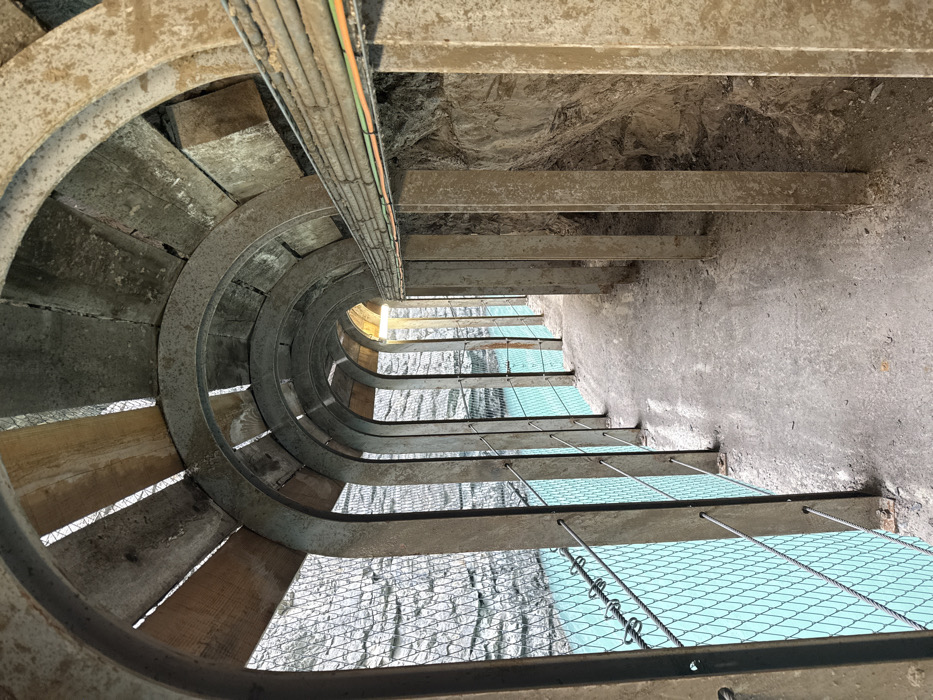
The image depicts a man-made pedestrian walkway or tunnel in Pellafol, France, built along a natural rock face and overlooking a body of water. The pathway extends longitudinally into the distance. On the left side of the concrete path, a protective barrier consisting of a vertical metal mesh fence and multiple horizontal wire ropes secures the walkway from an expansive body of vivid turquoise-blue water. Beyond the water, a grey rock wall, partially covered by a protective mesh, is visible. On the right side, a series of vertical concrete pillars support the overhead structure and abut a rugged, natural rock wall. A bundle of utility cables, including grey, green, and orange conduits, runs horizontally along the upper section of this right rock wall, affixed to the structure. The overhead structure comprises a repeating series of concrete arches, interspersed with sections of wooden planks and mesh, forming a semi-enclosed ceiling. The pathway floor is composed of rough, light-colored concrete. Natural light illuminates the scene, entering primarily from the left over the water and from a brighter opening or light source at the distant end of the walkway. No individuals are present within the frame. The structure exhibits signs of weathering and appears utilitarian.
Pellafol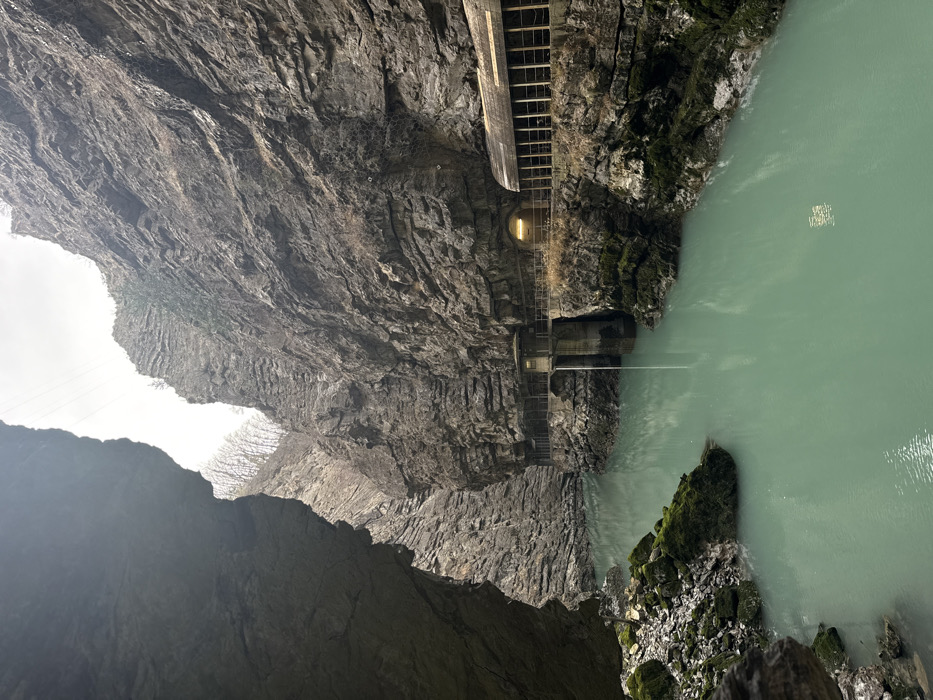
The image displays a deep, narrow gorge in Pellafol, France. A calm, light blue-green river flows between towering, steep-sided rock cliffs of layered grey stone. The sky above is overcast. On the left, a dark rock face dominates the foreground, with moss-covered rocks and debris at the water's edge. Along the right cliff face, a series of human-engineered structures are visible: a multi-level concrete platform with a vertical pipe extending into the water, a narrow path or walkway, and a warmly illuminated tunnel entrance. A wooden-slatted covered structure with a sloped roof extends outward from the tunnel mouth. Sparse vegetation, including bare trees and brush, clings to the upper parts of the cliffs. Overhead, power lines are present, traversing the gorge against the sky. No individuals, actions, or interactions are observed.
Pellafol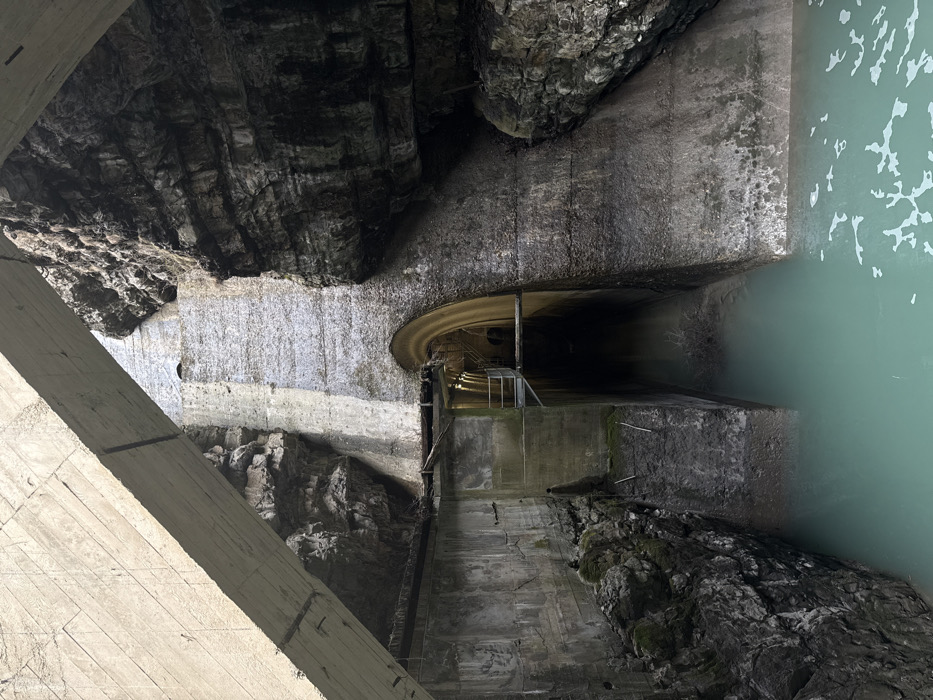
The image displays an engineered water control structure integrated into a natural rock gorge in Pellafol, France. A substantial, weathered concrete beam diagonally spans the upper left quadrant. Below this, a concrete channel contains light blue-green water in the foreground, flowing towards a dark, arched concrete tunnel entrance centrally positioned in the midground. Inside the tunnel entrance, an elevated concrete walkway with metal railings and illuminated by artificial lights is visible along the left interior wall. The water surface in the channel exhibits ripples and minor foam. Accumulations of dry branches and other debris are present at the waterline within the channel, immediately preceding the tunnel opening. The left side of the scene features a vertical concrete retaining wall partially merging with dark, moss-covered natural rock formations at its lower section. The right side is dominated by a dark, stratified natural rock face, into which the concrete arch structure is set. No individuals are present.
Pellafol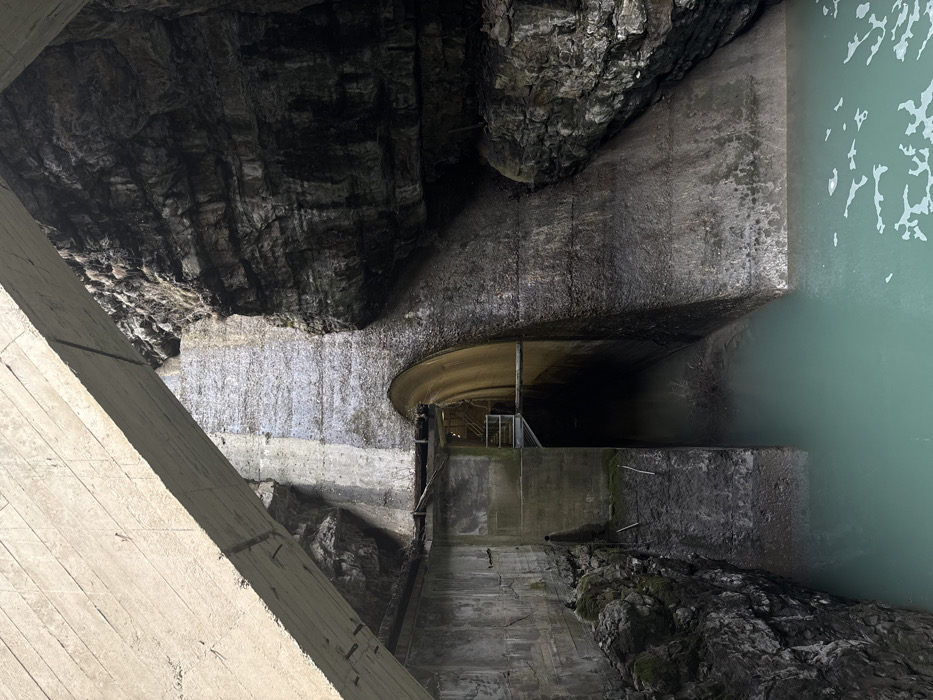
This image displays a concrete hydro-engineering structure situated within a natural rock gorge in Pellafol, France. A large, weathered concrete beam extends diagonally across the upper left portion of the frame. Below this, vertical concrete walls form a channel partially filled with still, turquoise-green water that occupies the lower half of the scene. On the right, a prominent arched concrete opening serves as the entrance to a dark, recessed tunnel. Inside this archway, an elevated metal walkway with handrails is visible, extending into the tunnel. The concrete surfaces exhibit extensive water staining, discoloration, and visible erosion. Natural, rugged rock formations with visible stratification flank both sides of the concrete structures, particularly prominent on the right. The overall environment is dimly lit, suggesting depth within the gorge. No individuals, animals, or active processes are visible.
Pellafol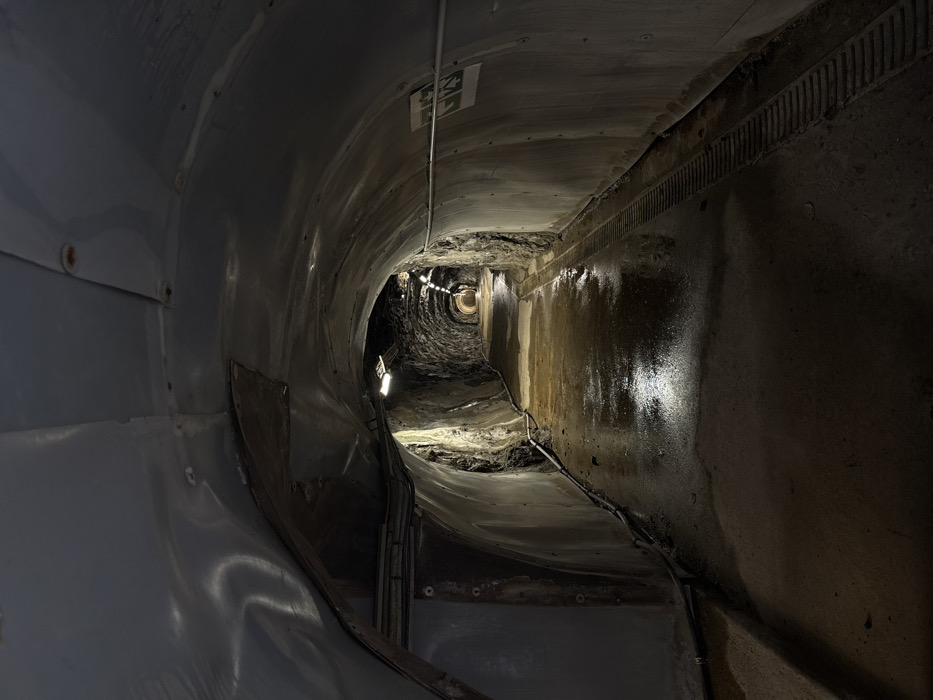
The scene depicts an unoccupied, dimly lit underground tunnel in Pellafol, France. The tunnel presents an arched profile, with sections of its ceiling and upper walls lined with corrugated metal and flat grey panels, showing signs of wear and rust on fasteners. The left wall transitions from a lined section to exposed, rough-hewn rock. Electrical conduits or pipes run horizontally along the lower portion of the left wall. The right wall features a white rectangular sign with green emergency pictograms. The concrete pathway forming the floor is visibly wet, with reflective puddles scattered throughout, particularly in the foreground and mid-ground. A continuous metal drainage grate runs along the right edge of the pathway. Multiple industrial-style light fixtures are installed overhead, casting pools of light and progressively diminishing illumination towards the tunnel's distant vanishing point. No individuals, vehicles, or active objects are present.
Pellafol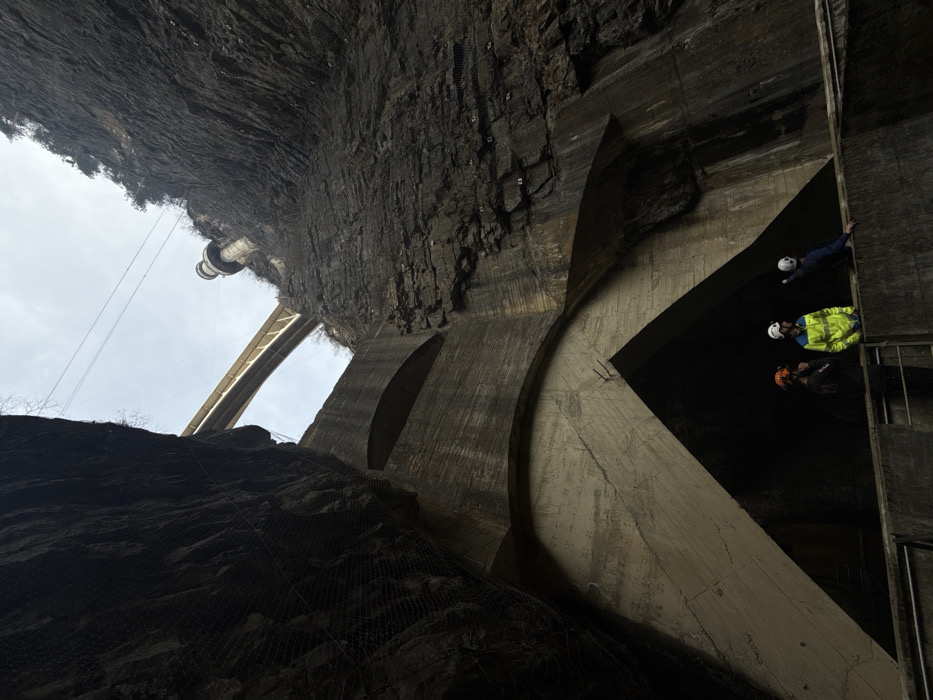
The image depicts a deep, narrow gorge in Pellafol, France, characterized by steep, dark rock walls and substantial concrete structures under an overcast sky. In the lower and mid-ground, a massive concrete wall features multiple arched openings. The largest, central opening forms a dark, triangular entry point, flanked by a lighter, curved concrete arch above it. Another, smaller horizontal arched opening is visible higher up on the main concrete wall. The concrete exhibits signs of age, including stains and visible formwork patterns. On the left rock wall, a dark mesh net system is installed for rockfall protection. Above the concrete structures and spanning the gorge, a light-colored arch bridge is visible against the grey sky. High on the right-hand rock face, a slender, cylindrical concrete tower with a rounded top protrudes upwards. Overhead, utility cables traverse the scene between the cliffs. On a concrete walkway or platform in the foreground, three individuals are present. All are wearing hard hats: one in orange, two in white. The leftmost person wears dark clothing. The central individual wears a bright yellow-green high-visibility jacket and dark pants. The rightmost person wears a blue jacket and dark pants, and is captured in the act of pointing with their right arm towards the right rock wall, while looking in that direction. The overall lighting is dim due to the depth of the gorge and the overcast conditions.
Pellafol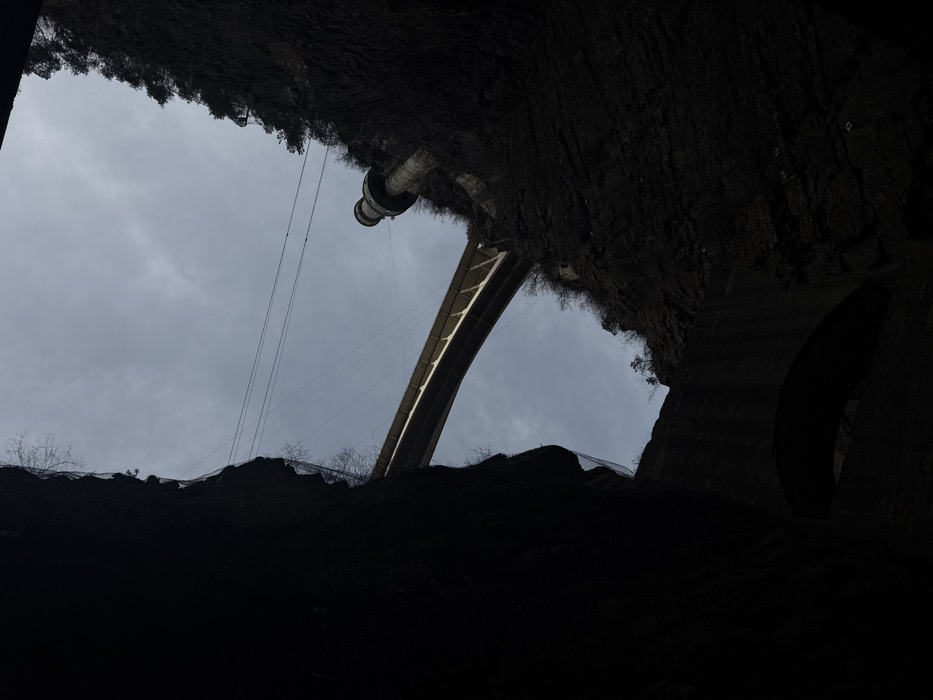
The image depicts a view looking upwards from the base of a deep, narrow gorge in Pellafol, France, under an overcast sky. Two towering, dark rock faces frame the scene, largely silhouetted, with some sparse vegetation visible along their upper edges. A modern, light-colored concrete arch bridge spans the gorge high overhead, its underside and supports visible against the sky. Below and to the left of this bridge, a section of a dark, older stone archway is visible, suggesting a lower passage or structure within the gorge. On the right side, a tall, cylindrical concrete tower structure, possibly an intake tower or part of a dam, rises from the gorge wall towards the main bridge level. Multiple thin cables or power lines traverse the gorge horizontally above the main bridge. Portions of the left rock face exhibit what appear to be protective netting or screens. No people, vehicles, or animals are visible.
Pellafol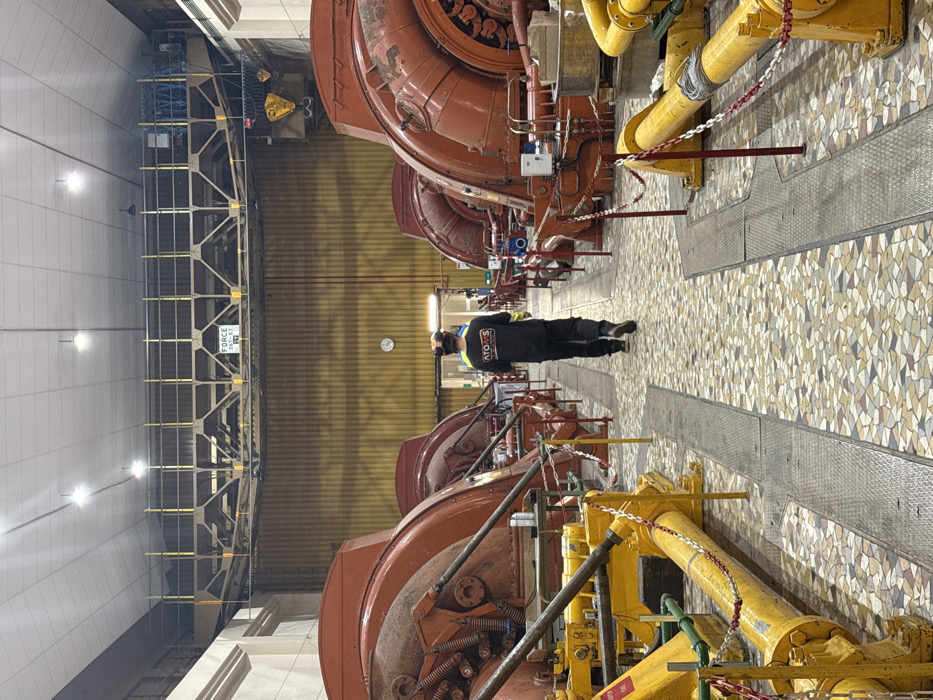
The image depicts the interior of a large industrial power generation facility in Pellafol, France. The scene features a long, high-ceilinged hall with two parallel rows of large, reddish-orange industrial machines, resembling turbines or generators, extending into the background. These machines display visible mechanical components, piping, and signs of wear and rust. A central walkway separates the machinery rows. The floor of this aisle is composed of a multicolored mosaic tile pattern, interrupted by two parallel recessed metal grate sections running lengthwise. In the immediate foreground, yellow-painted heavy industrial equipment is present on both sides of the walkway, partially demarcated by red posts and white and red safety chains. One individual, a male, is observed from behind, walking away from the viewer down the central aisle. He is wearing a dark, long-sleeved shirt with a yellow "ATOMS" logo on the back, dark trousers, and dark shoes. He is also wearing a yellow/orange hard hat or protective headwear. Above the machinery, a prominent metal truss structure or catwalk with railings spans the width of the room, near the ceiling. A yellow sign on this structure reads "FORCE MAX 10T." Overhead crane hooks are visible towards the upper right of the image, associated with this structure. A circular white clock with black numerals is mounted on the far wall, centered above the walkway. The walls are light brown and appear to have a corrugated or ribbed texture. The ceiling is white and equipped with multiple overhead light fixtures.
Pellafol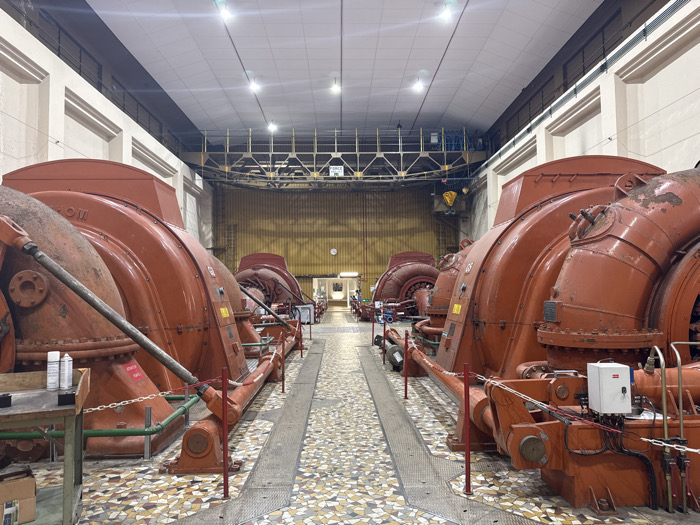
The image depicts the interior of an industrial power generation facility, likely a hydroelectric powerhouse, located in Pellafol, France. The scene is dominated by two parallel rows of large, rust-orange industrial machines, presumed to be turbines or generators, extending from the foreground into the background. Each machine features robust, curved metal casings with numerous bolted panels, pipes, and valves. The closest machine on the left has "THOM" visible on its casing, and a diagonal metal pipe runs across its front. The closest machine on the right features a small, white control box with red accents mounted on its side. A central aisle with a patterned mosaic tile floor, consisting of various earthy tones (brown, beige, orange, grey), separates the two rows of machinery. Metal grates or channels are embedded in the floor along the bases of the machines. Red metal posts with chains serve as safety barriers along the pathways adjacent to the machines. Various pipes, some painted green, are visible connecting to the machinery at ground level. The facility features light-colored, possibly cream-colored, walls with recessed paneling. The ceiling is flat and paneled, illuminated by multiple recessed artificial light fixtures that provide bright, even light throughout the space. Towards the back and upper section of the room, a yellow gantry crane structure is visible, along with elevated walkways or support beams. A doorway or opening is discernible in the back wall, at the end of the central aisle. No individuals are present in the scene, and no specific actions or interactions are depicted. The machinery shows signs of use, including some surface discoloration and minor rust. A dark workbench with several white spray cans and a cardboard box is visible in the extreme left foreground.
Pellafol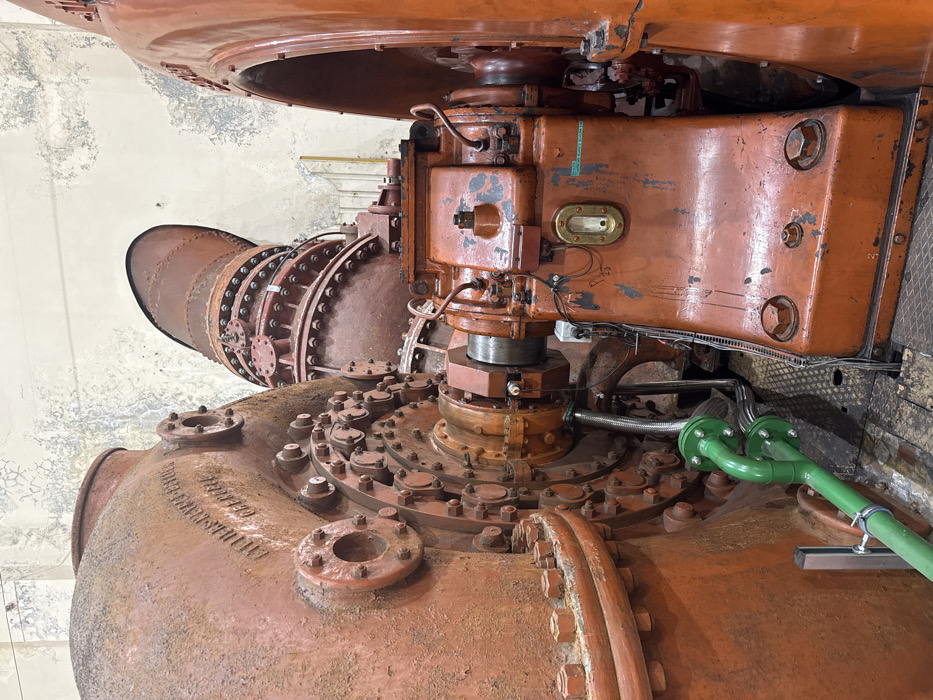
The image displays a close-up of heavy industrial machinery inside a facility located in Pellafol, France. Dominating the scene are several large, aged, reddish-orange metal structures. On the left, a massive, bulbous machine shows extensive oxidation and bears embossed text including "ATELIERS L'ALSTHOM GRENOBLE" and "30 000 GEORGES." This machine features numerous circular bolted flanges and a densely bolted central section. Connected to it by a robust coupling is a smaller, reddish-orange rectangular unit on the right, which has an oval-shaped sight glass or indicator and several wires and small pipes attached. Extending upwards from the central machinery towards the back is a large, reddish-brown, conical and heavily riveted structure. A bright green pipe, connected by two silver flexible corrugated hoses, runs from the lower-left foreground to the base of the left machine. The background consists of light-colored walls displaying significant signs of wear, cracking, and discoloration. The floor beneath the machinery is dark and appears to be a metallic industrial surface. No individuals are present.
Pellafol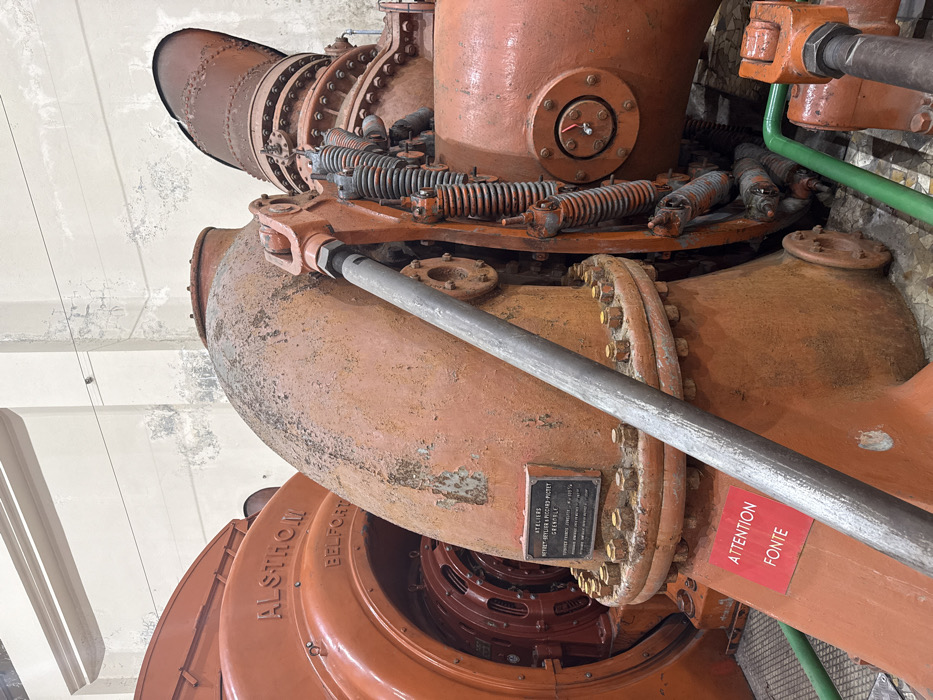
The image displays a detailed view of a large-scale industrial turbine and generator assembly, located within a hydroelectric power plant in Pellafol, France. The primary subject is a reddish-orange colored Francis turbine, manufactured by "ATELIERS NEYRET-BEYLIER & PICCARD-PICTET" in Grenoble in 1913, rated at 2000 CV, as indicated on a black metallic plaque affixed to its structure. This turbine connects to an "ALSTHOM BELFORT" generator, partially visible on the left. The machinery exhibits significant wear, corrosion, and peeling paint, suggesting age and prolonged operation or disuse. A prominent, thick, grey metal rod extends diagonally across the mid-ground, connected to the turbine structure via an orange clevis. To the right of this rod, a series of rusty coiled springs and linkages are integrated into the turbine's mechanism. A red warning sign with white text reading "ATTENTION FONTE" (Caution: Cast Iron) is affixed to the lower section of the turbine. A green pipe is visible along the bottom edge, connecting to other unseen components. The immediate environment consists of worn, light-colored walls with peeling paint and discoloration, typical of an industrial facility. Portions of a metal grate floor are visible on the left, with an unidentifiable floor surface to the right. No individuals are present in the scene.
Pellafol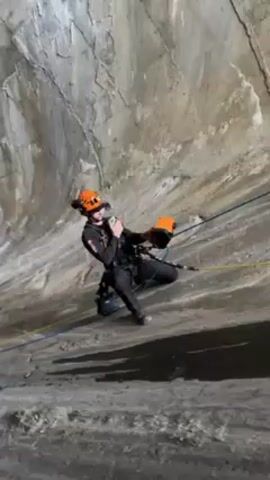
The video shows a man rappelling down the interior of a large, smooth, sloping concrete structure. The man is wearing a safety helmet with lights, a black jumpsuit, and a harness connected to blue and yellow ropes. He is holding what appears to be a measuring device and appears to be communicating with someone using a microphone attached to his helmet. The concrete slope has streaks and stains running downwards, suggesting the presence of moisture or previous water flow. At the top of the slope, there is an opening, likely the exit of the tunnel. The camera follows the man as he descends, maintaining a focus on his movements and the surrounding concrete environment.
Pellafol