Portomarín, Spain
9 memories from Portomarín, Spain
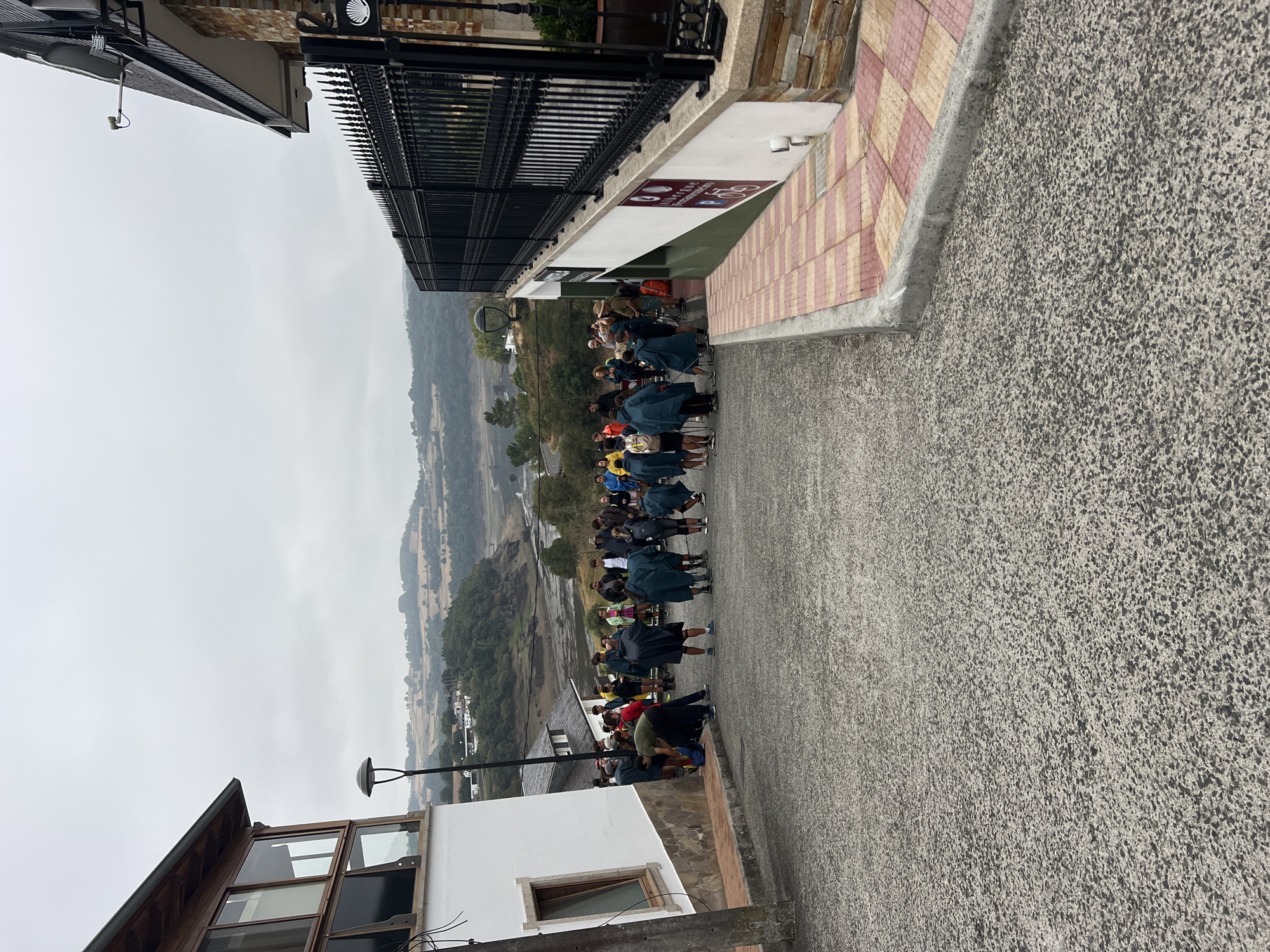
A group of people, many wearing rain ponchos, are gathered on a paved street in Portomarín, Spain. The street slopes downwards towards a body of water visible in the background, with rolling hills and a cloudy sky beyond. The buildings flanking the street are made of stone and white plaster. One building on the left has large windows, while the building on the right features a black metal fence and a sign that reads "Albergue". Some individuals appear to be preparing to leave, with backpacks and walking sticks visible. The overall atmosphere suggests a stop on a pilgrimage or hike, possibly due to inclement weather.
Portomarín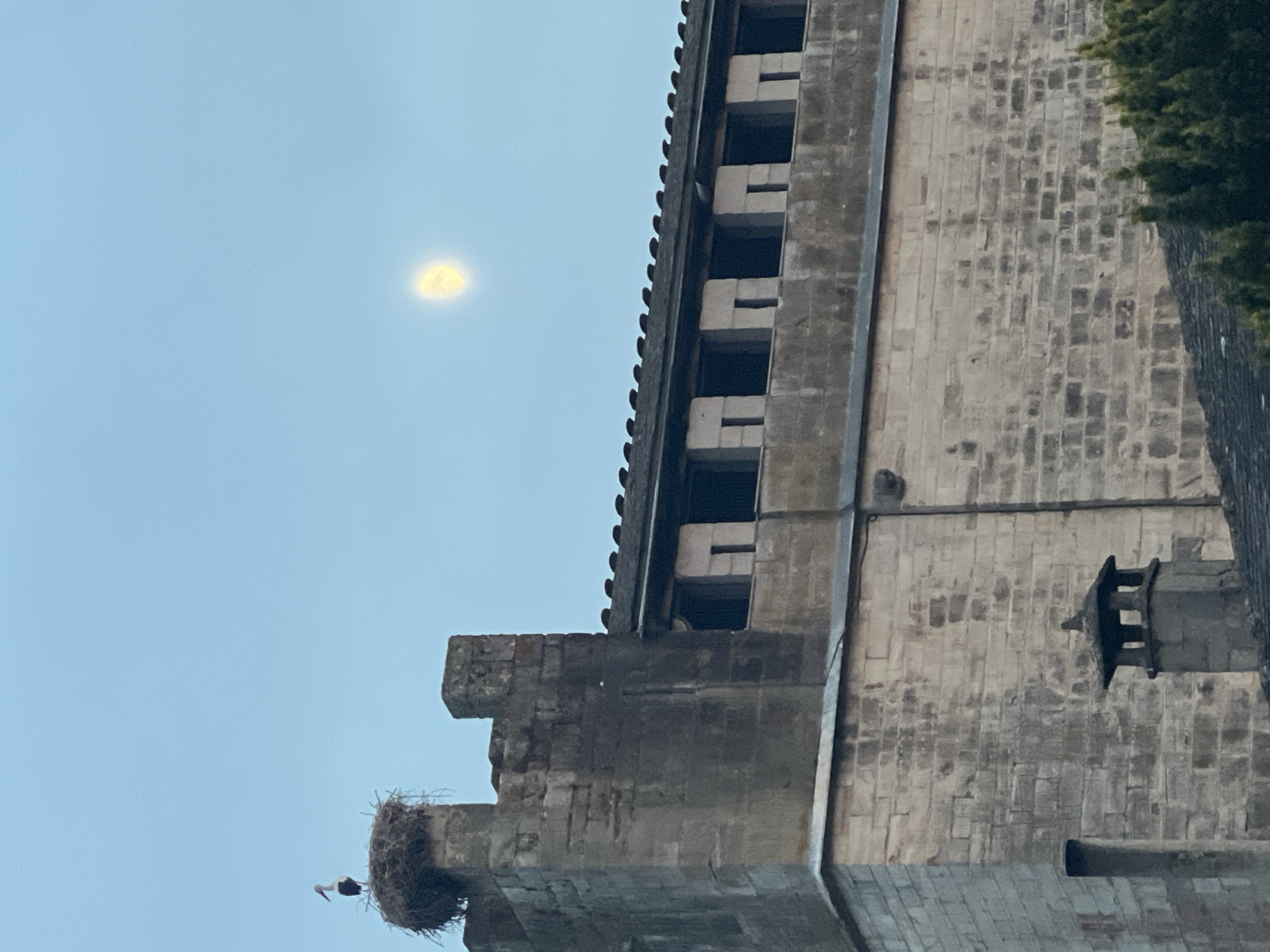
A stork stands on its nest atop a stone turret of a building in Portomarín, Spain. The stork, a white bird with black wingtips and a red beak, is the primary subject. The nest is made of twigs and branches. The building is constructed of large, rough-hewn stone blocks and features a crenellated roofline with square openings. In the background, the sky is a pale blue with a pale yellow crescent moon visible. The lower portion of the image shows a section of the building's wall, a chimney, and the dark green foliage of trees. The overall lighting suggests either early morning or late evening.
Portomarín
A man in a black jacket with red trim and black shorts stands on a paved walkway, looking at his phone. A brown and white dog lies on the ground in front of him. A young man in a black t-shirt and tan shorts stands further down the walkway, with his back to the camera. Cars are parked on a street behind them, and a red barrier is visible.
Portomarín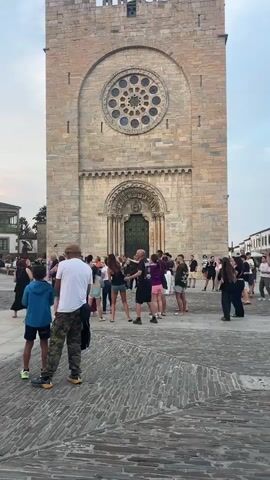
The video begins facing a large stone building with a rose window and an arched doorway. A crowd of people are gathered in a cobblestone plaza in front of the building. The camera pans slightly to the left, revealing more of the plaza and other buildings. A stage with musicians is visible in the background, with a sign that reads "DOMINGOS FOLCLORICOS DE PORTOMARIN." Several children are standing in the plaza, some watching the musicians, others looking towards the camera. The sky is overcast, suggesting it is either early morning or late afternoon. The overall atmosphere appears to be that of a community event or festival.
Portomarín
A brown and white border collie dog sits on a stone pavement, looking up at a man wearing a green hoodie and blue shorts. The man is reaching down to pet the dog. To the left, a person wearing a blue striped shirt sits on a stone ledge. To the right, the legs of two people are visible, one wearing red shoes. The environment appears to be an outdoor public space with stone paving and a stone wall in the background.
Portomarín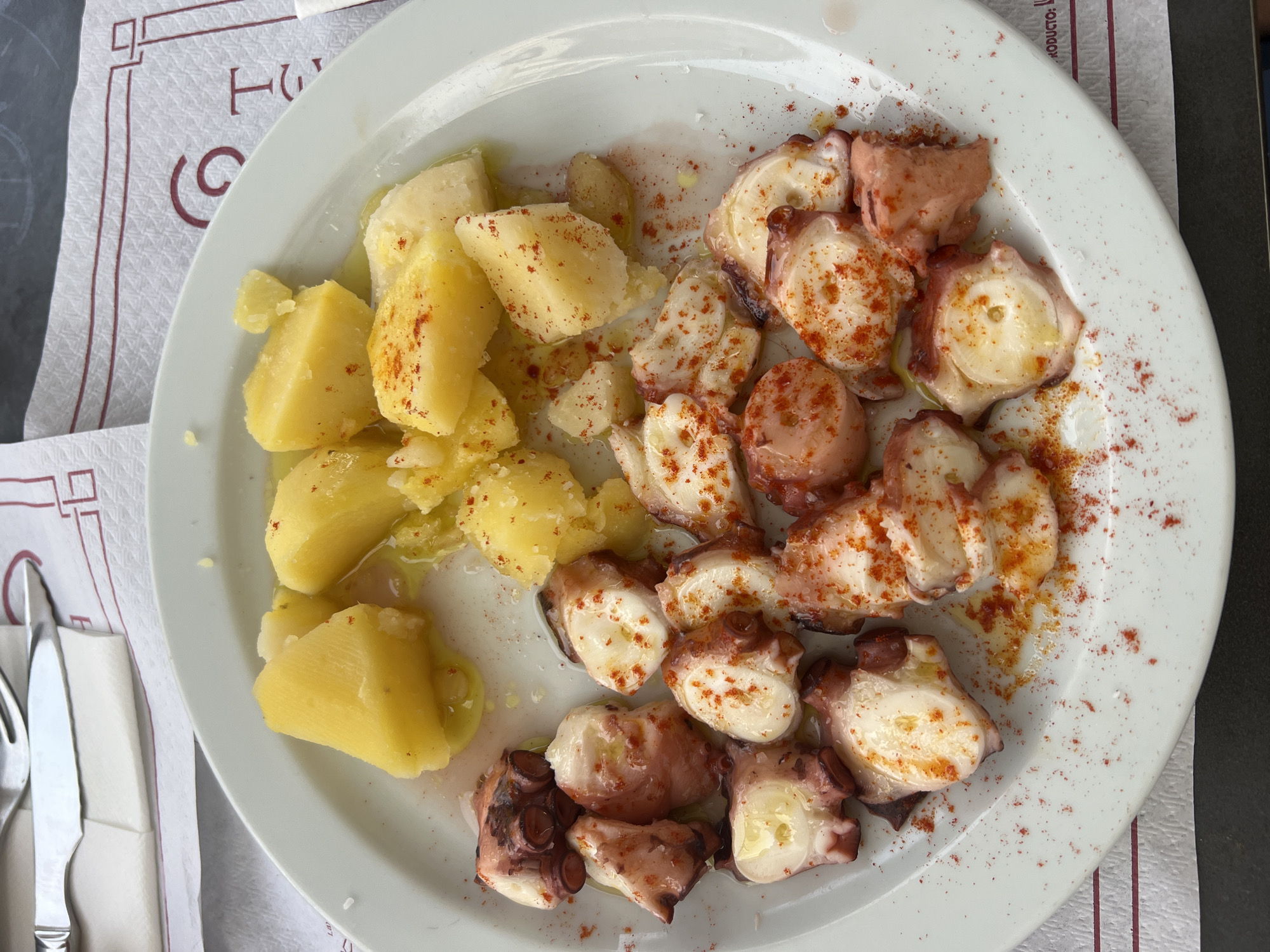
A white plate holds a serving of boiled potatoes and sliced octopus seasoned with paprika. The potatoes are cut into bite-sized pieces and are yellow in color. The octopus is sliced into sections, revealing its white flesh and reddish-purple skin. It is also sprinkled with paprika, some of which has created red speckles on the plate. The plate is on a table covered with a white placemat that has a red border and a stylized "H" and "C" in red lettering. A fork and knife are visible in the upper left corner of the image, resting on a folded white napkin. The lighting suggests an outdoor or well-lit indoor setting. The context provided suggests this scene is from Portomarín, Spain.
Portomarín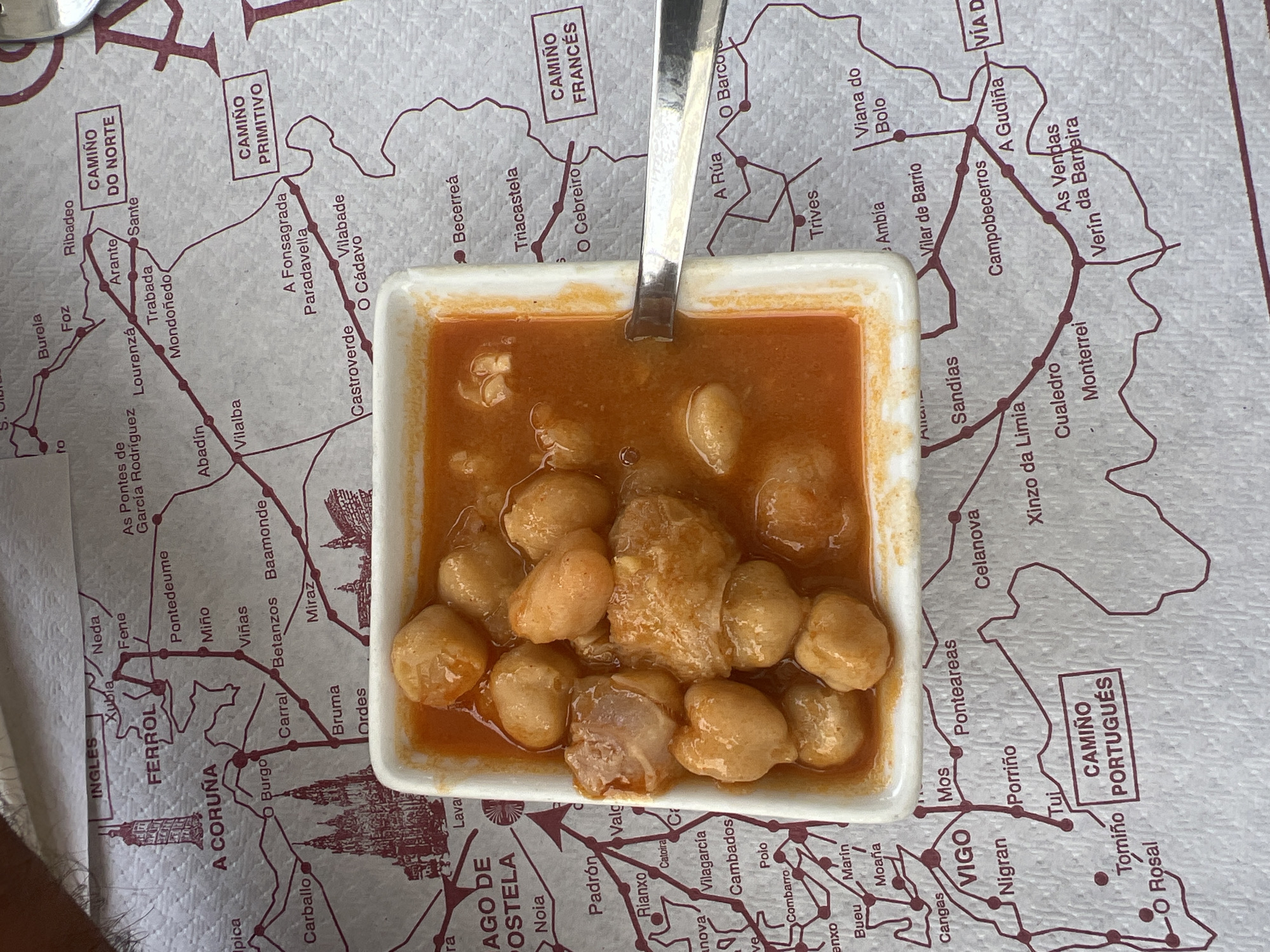
The image shows a close-up of a white square bowl filled with stewed chickpeas and chunks of meat, resting on a map. The map is printed on a white napkin or paper and depicts various routes, primarily focusing on the Camino de Santiago pilgrimage routes in Galicia, Spain. Prominent labels on the map include "A CORUÑA," "VIGO," "CAMIÑO PORTUGUÉS," "CAMIÑO DO NORTE," and "CAMIÑO PRIMITIVO." The stew appears to be a Spanish dish, possibly a local specialty. A silver fork is partially submerged in the stew, indicating that someone is about to eat or has been eating from the bowl. The background is out of focus, but hints at a table setting. The lighting suggests an indoor environment, likely a restaurant or cafe. The map is detailed, showing towns and cities like Ferrol, Santiago de Compostela, Arzúa, and O Cebreiro, along with geographical features. While Portomarín is a significant stop on the Camino Francés, it is not explicitly labeled in this particular cropped view of the map.
Portomarín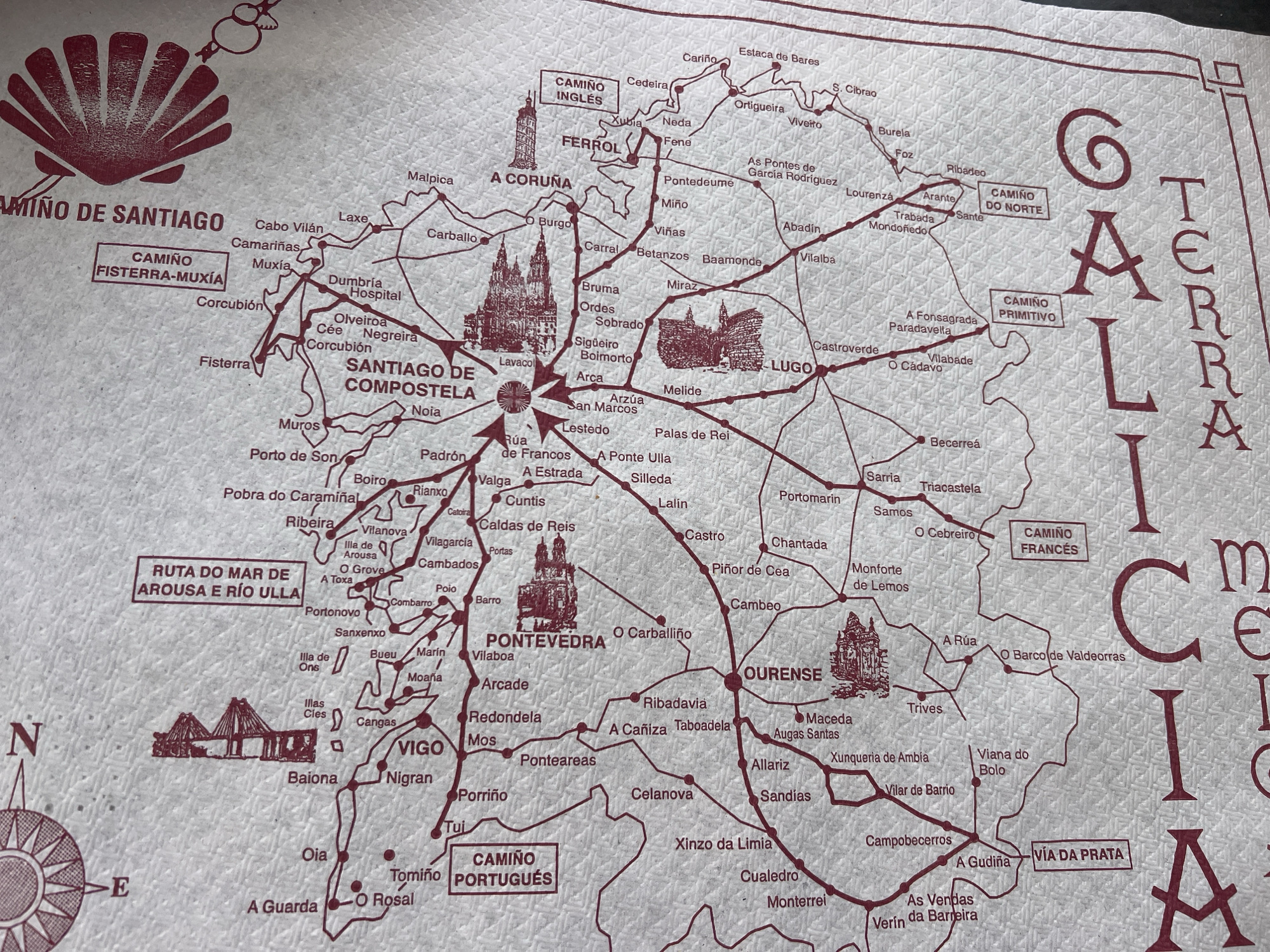
The image is a close-up, top-down view of a red, printed map on a white textured background, likely a napkin or paper placemat. The map depicts various pilgrimage routes in Galicia, Spain, with a prominent focus on the Camino de Santiago. Several towns and cities are labeled in a red, stylized font, including "SANTIAGO DE COMPOSTELA", "A CORUÑA", "LUGO", "OURENSE", "PONTEVEDRA", and "VIGO". The map shows a dense network of paths represented by thin red lines connecting these locations, with smaller dots indicating intermediate points. Some sections of the map are highlighted with text boxes. One such box on the left reads "RUTA DO MAR DE AROUSA E RIO ULLA" and another below it says "CAMIÑO PORTUGUÉS". On the right, there are boxes for "CAMIÑO INGLÉS", "CAMIÑO PRIMITIVO", and "CAMIÑO DO NORTE". The "CAMIÑO FRANCÉS" is also labeled near the bottom center. The image includes stylized illustrations of architectural landmarks, such as a bridge and a cathedral, superimposed on the map. The overall aesthetic is that of a souvenir or informational handout. Within the context of Portomarín, the map shows this city as a point along the "CAMIÑO FRANCÉS". It is indicated by a red dot and the label "Portomarín" positioned between "Chantada" and "Lugo" on the map. The specific location within Portomarín is not further detailed beyond its presence on the pilgrimage route.
Portomarín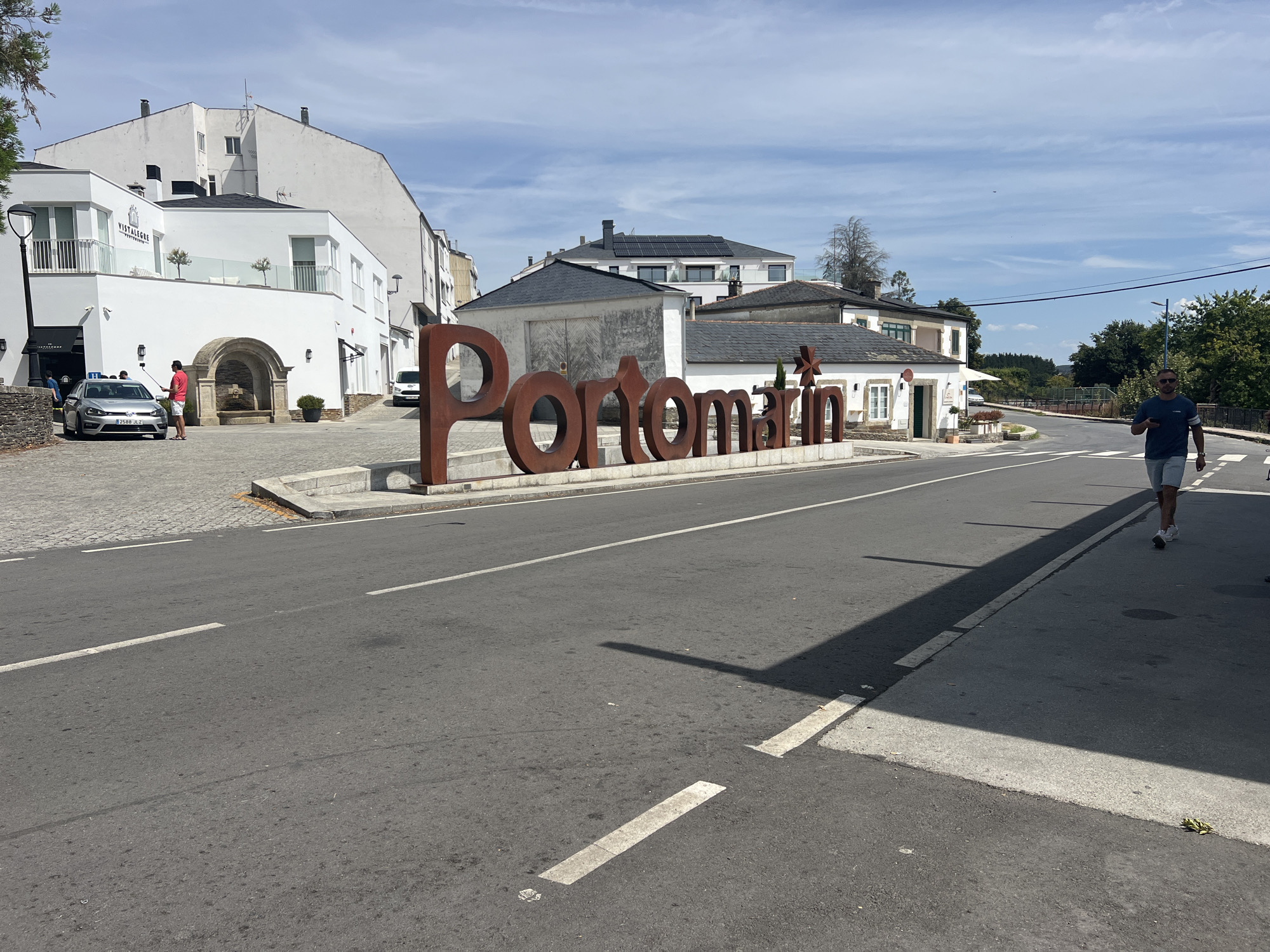
The image shows a street scene in Portomarín, Spain, with a large metal sculpture spelling out "Portomarín". In the foreground, a man wearing a dark blue t-shirt and light blue shorts walks on the sidewalk, holding a phone. The street has white lane markings. To the left of the sculpture are white buildings, one of which appears to be a hotel or restaurant with balconies and a distinctive arched entryway. A silver car is parked in front of this building, and a person in a red shirt is standing near it, holding a selfie stick. Further down the street, more buildings and trees are visible, with a bridge structure in the distance. The sky is blue with scattered clouds, and the overall impression is a sunny day in a town.
Portomarín