San José, Costa Rica
24 memories from San José, Costa Rica

This image shows a glass-topped table at Cafe Anka in San José, Costa Rica. On the table are coloring pages with a Matryoshka doll design, a small wooden bird, a napkin, a cup of colored pencils, and a menu. The menu is for "Cafe Anka Russian Cuisine." The table is set on a patio with brick flooring and a metal fence. A person's legs are visible in the lower part of the image, indicating they are seated at the table. The overall scene suggests a casual dining or activity experience at the cafe.
San José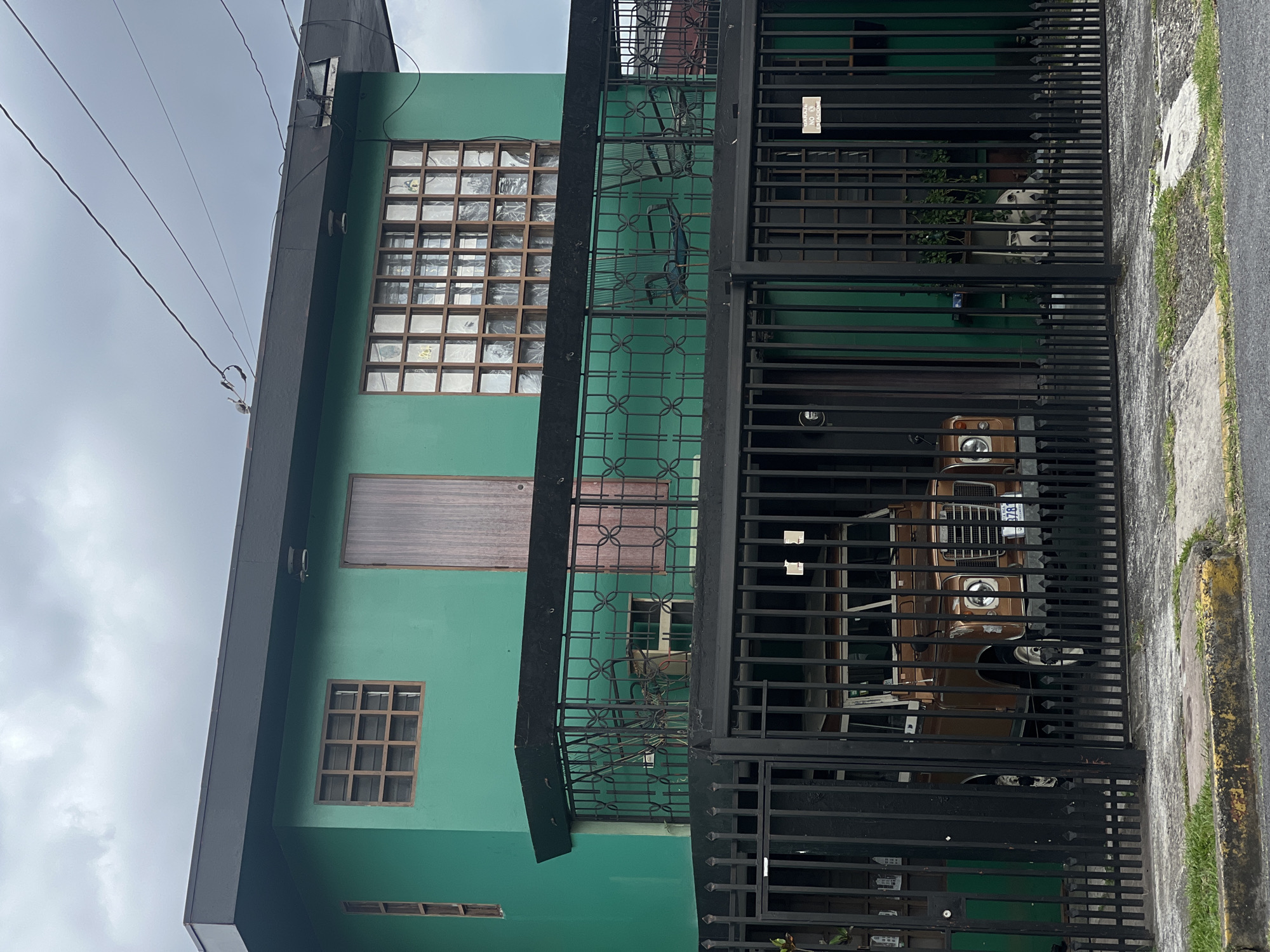
The image shows a two-story house painted bright green in San José, Costa Rica. The house has a dark flat roof. The upper floor has a large window with a grid of small panes and a wooden door. The lower floor is mostly obscured by a black metal fence, but a section of a vintage brown SUV is visible parked behind the fence. A second black metal fence is in front of the house, with a yellow and grey curb and a patch of grass in the foreground. Overhead, power lines are strung across a cloudy sky.
San José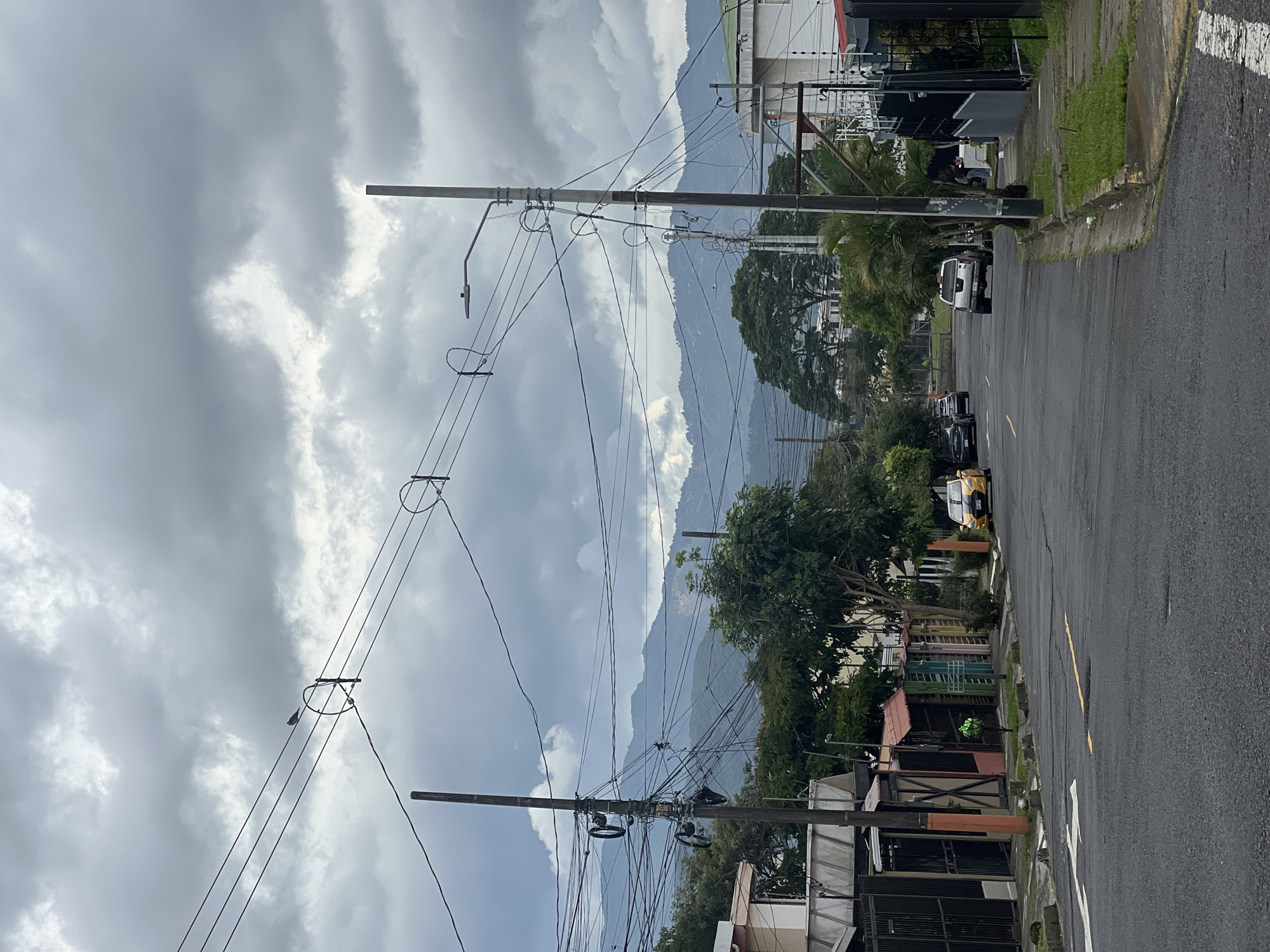
A street in San Jose, Costa Rica, is depicted on an overcast day. The road surface is asphalt, with yellow and white markings indicating lanes and direction. Several vehicles are visible on the road, including a yellow taxi, a white pickup truck, and other cars. Along the sides of the street are houses with various architectural styles, some with fences and gates. Utility poles with a complex network of electrical wires dominate the skyline. In the background, lush green trees and mountainous terrain are visible under a cloudy sky. A small bird is perched on a wire in the upper portion of the image. The overall impression is a residential street in a tropical urban environment, characterized by utility infrastructure and natural landscapes.
San José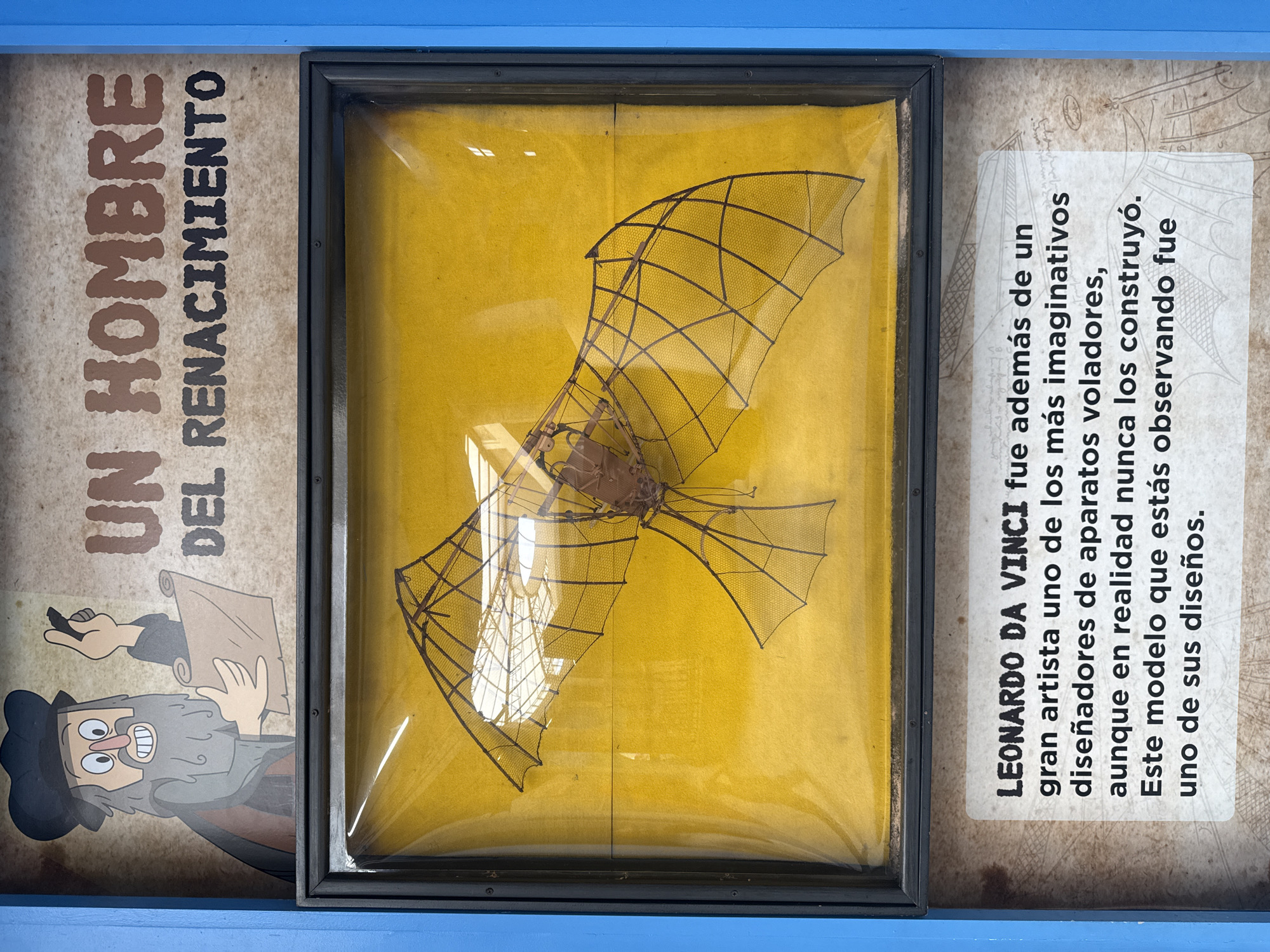
The image shows a display about Leonardo da Vinci, located in San José, Costa Rica. At the top, a cartoon illustration of Leonardo da Vinci holds a scroll and a quill. To his right, text reads "UN HOMBRE DEL RENACIMIENTO" (A Man of the Renaissance). Below this, a model of a flying machine with bat-like wings is displayed behind glass against a yellow background. The frame of the display is black. At the bottom, a white label provides text in Spanish about Leonardo da Vinci being an artist and inventor of flying machines, noting that this is a model of one of his designs. The background of this label features faint schematics. The overall display is mounted on a light brown textured surface, and a bright blue border is visible on the right side of the image.
San José
The video shows a model of an ornithopter, a flying machine that flaps its wings, suspended from the ceiling. The ornithopter is made of wood and fabric, with a wooden seat for the pilot. The wings are spread wide, and the entire structure is illuminated by natural light and artificial lighting. The background consists of a blue wall and a ceiling structure with red supports, suggesting an indoor environment like a museum or exhibition hall. The camera angle is looking upwards at the ornithopter.
San José
A white chicken is visible in the foreground, with its head lowered and beak near the ground, appearing to peck at something. The chicken's leg is also in focus, showing feathers and scaly skin. The ground is covered in small gray gravel and dried plant matter. The lighting suggests an outdoor setting.
San José
A close-up shot shows a goose behind a black wire fence. The goose has white and brown feathers, a large orange beak, and dark eyes. In the background, a red broom with a green handle is visible, along with other out-of-focus objects and foliage. The goose appears to be looking towards the camera.
San José
A close-up shot shows the head of a white goose looking through a black metal grate. The goose's eye is visible, and its pink beak is slightly open. The background is blurry, with hints of other birds and the ground. The lighting is overcast, and the overall mood is somewhat melancholic, as the goose appears to be confined.
San José
A close-up shot, behind a wire fence, shows the head and neck of a white goose. The goose's beak is open and its tongue is visible. The background is blurred but appears to be an outdoor setting with other birds.
San José
A video shows several geese in an outdoor enclosure. Two white geese with orange beaks are in the foreground, looking towards the camera. A black duck is in the background. The ground is covered with gravel and scattered feathers. A red rake is visible in the upper left corner. The enclosure appears to be made of wood and metal.
San José
A close-up shot pans across a light-pink sign with raised, dark pink lettering that reads "HISTORIA DEL CAFÉ". The letters are slightly blurred due to motion. The sign is mounted on a textured, light-colored wall. Below the sign, there is a green painted trim. The footage then shifts to show three framed black and white illustrations or comic panels hanging on the wall. The leftmost panel is partially visible. The middle panel depicts a cartoonish scene with stacked coins and a speech bubble. The rightmost panel shows a cartoonish depiction of a bus or vehicle with a smiling face. The illustrations are within a green frame.
San José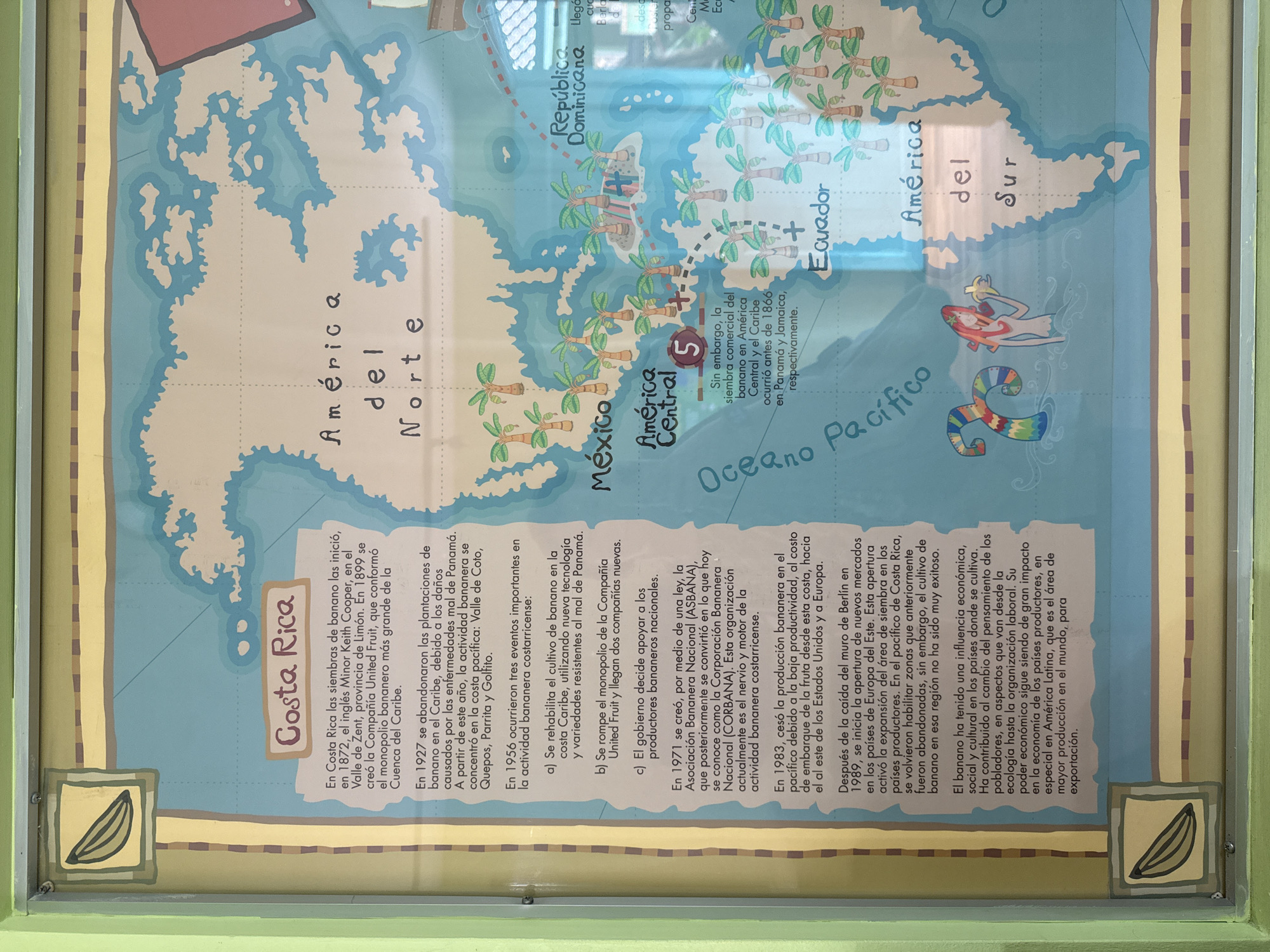
The image is a photograph of a colorful mural depicting a map of the Americas, with a focus on Costa Rica and its banana production history. The mural is mounted on a light blue wall, and the bottom of the frame shows a portion of a green frame surrounding the artwork. The mural itself is divided into sections with text boxes and illustrations. The main area of the mural displays a stylized map of North, Central, and South America, with islands and coastlines rendered in blue and white. Numerous palm trees are illustrated across various regions, particularly in Central America and South America, signifying banana cultivation. Text boxes in Spanish provide historical information about banana farming in Costa Rica, including dates, company names (United Fruit), and key events. Specific locations in Costa Rica mentioned are Zent, Valle de Zenta, Limón, Coto, Quepos, Parrita, and Golfito. The mural also includes decorative elements such as a stylized banana icon in the bottom left corner, a mermaid holding a banana in the Pacific Ocean section, and a rainbow-colored serpentine creature. Labels like "América del Norte," "México," "América Central," "República Dominicana," and "Ecuador" are present on the map. The text describes the introduction of banana cultivation in Costa Rica in 1872, the establishment of the United Fruit Company, diseases affecting plantations, the recovery and modernization of the industry, and the formation of the National Banana Association (ASBANA). It also mentions the impact of the fall of the Berlin Wall in 1989 on opening new markets and the significant economic, social, and cultural influence of banana production in Latin America. The photograph appears to be taken in San José, Costa Rica, based on the context of the mural's subject matter, which highlights the country's history and importance in banana cultivation. However, there are no explicit visual cues within the photograph itself (like street signs, architectural styles of the surrounding environment) that definitively pinpoint the location within San José or even confirm it is indoors or outdoors, other than it is framed by a green border, suggesting it might be a permanent display in a public space or building. The lighting suggests artificial illumination, common in indoor exhibition spaces.
San José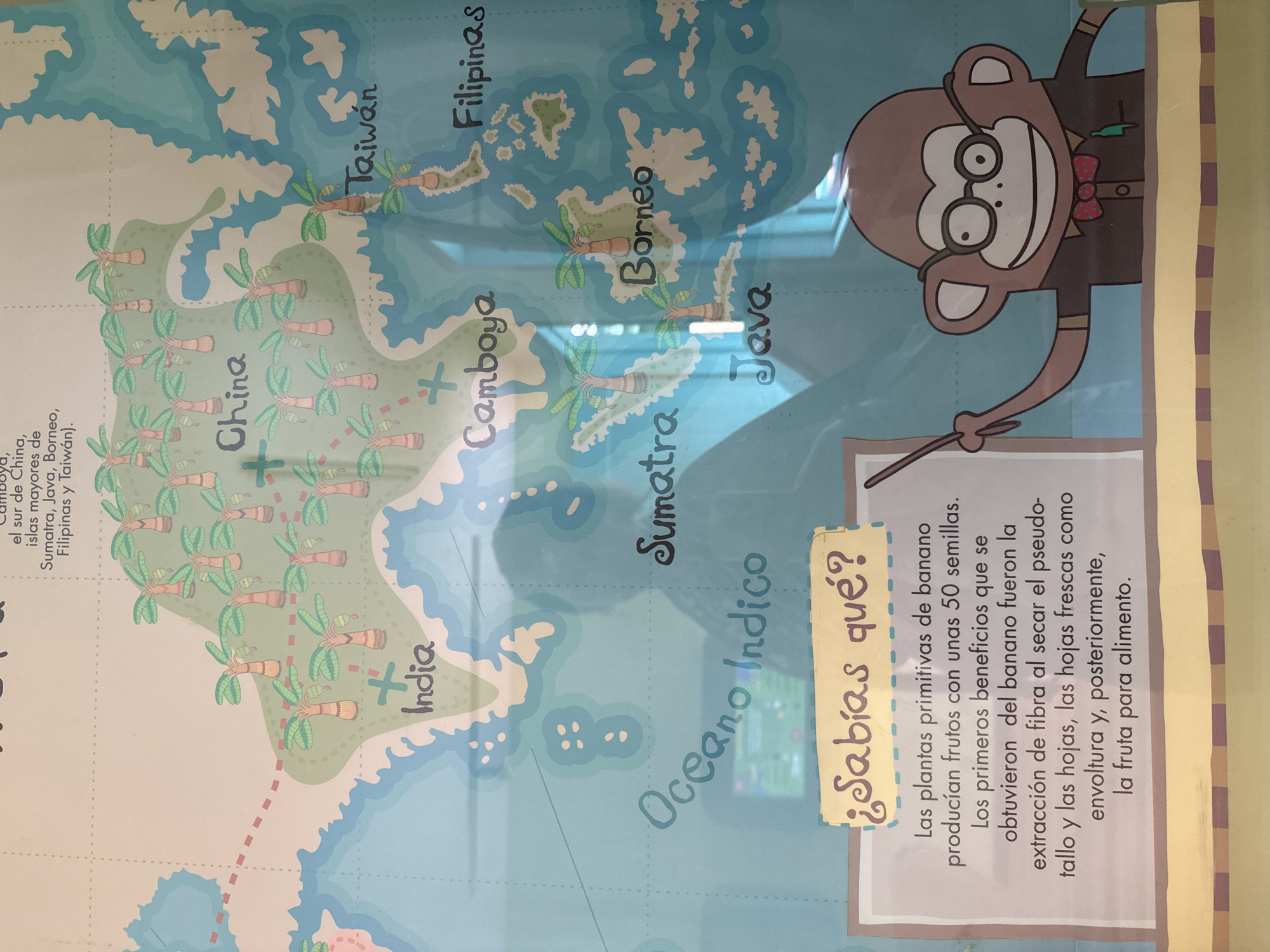
The image is a close-up shot of a colorful map illustrating the origins and spread of bananas. The map displays various locations in Southeast Asia and the Indian Ocean, with stylized palm trees indicating banana cultivation. Prominent labels include "India," "China," "Camboya," "Sumatra," "Borneo," "Java," "Taiwán," and "Filipinas." The "Oceano Indico" (Indian Ocean) is also labeled. In the foreground, a framed yellow banner contains a Spanish text titled "¿Sabías qué?" (Did you know?) followed by information about the primitive banana plants and their early uses. To the right of this banner, a cartoon monkey wearing glasses and a bow tie points at the text with a stick. The overall scene is bright and visually engaging, likely part of an educational display. There is no indication of the city of San José, Costa Rica, in this image.
San José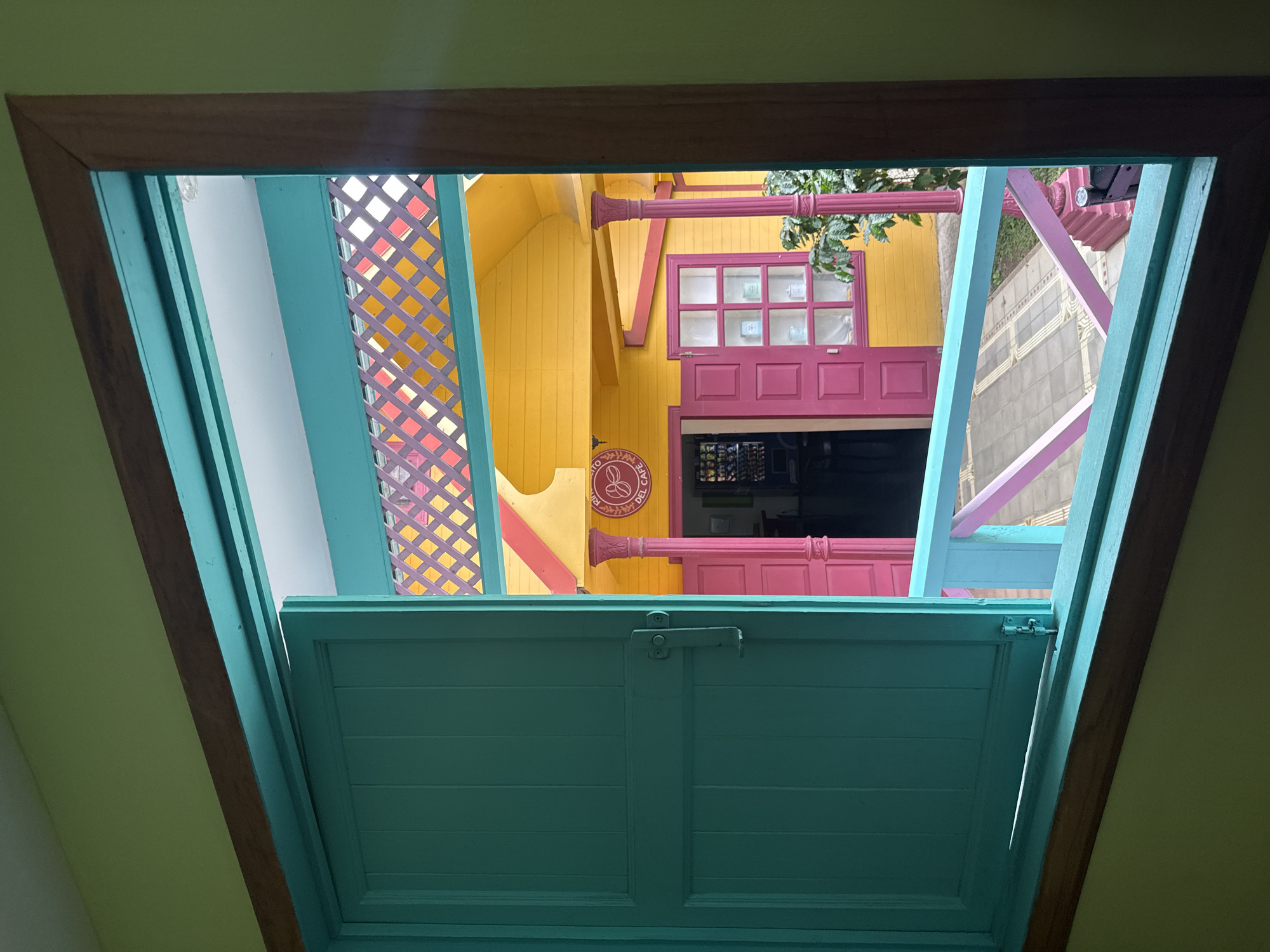
The image shows a view through an open window, looking out at a colorful building. The window frame is made of wood, with teal-colored shutters and trim. Outside, a yellow building with pink doors and window frames is visible. A sign that says "DEL CAFE" is on the building. The building has a colorful lattice roof in shades of pink, purple, and yellow. The scene appears to be in a tropical environment, with greenery visible. The image was taken in San Jose, Costa Rica, at a cafe.
San José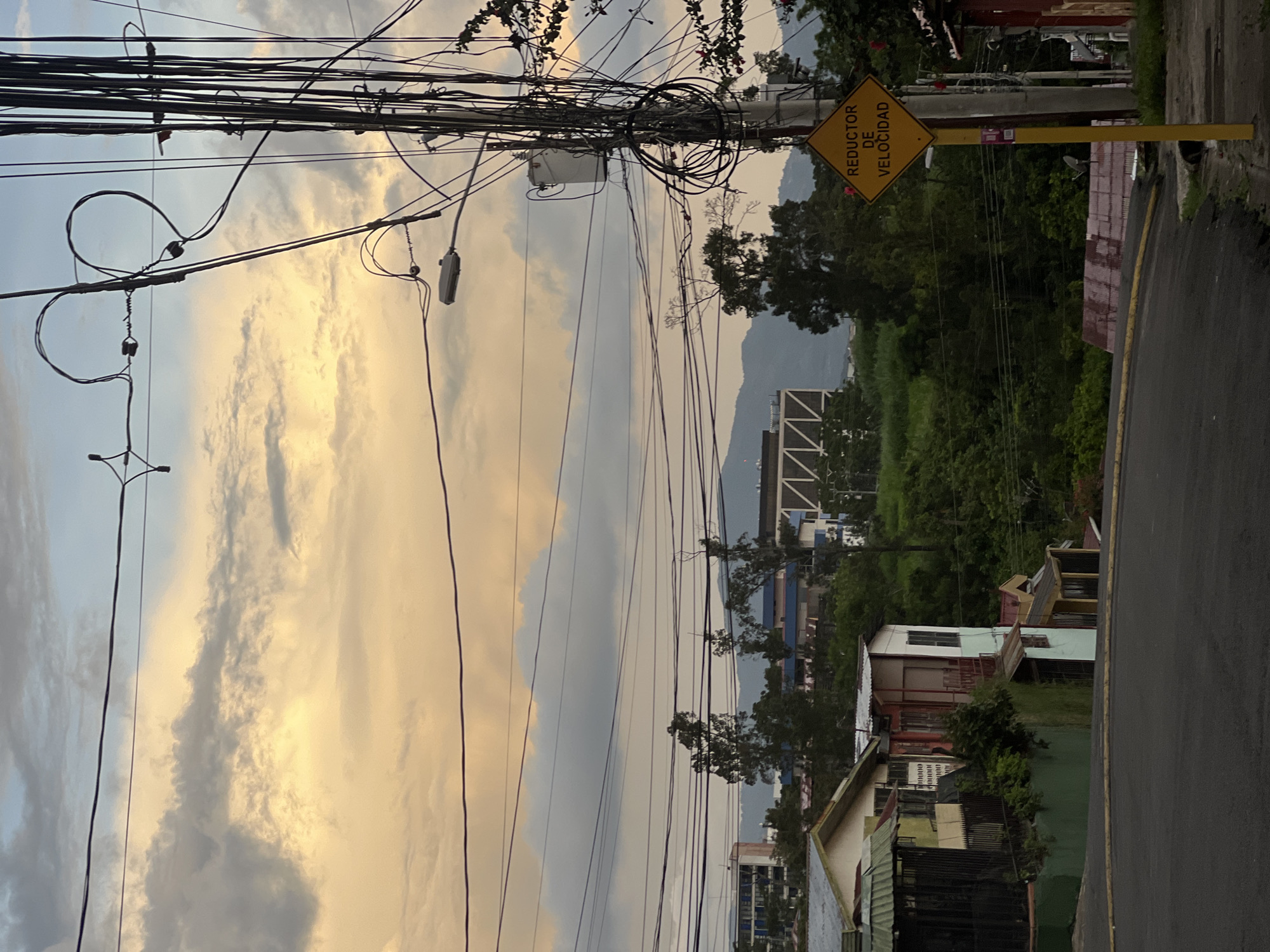
The image depicts a street scene in San José, Costa Rica, characterized by a tangle of electrical wires overhead. In the foreground, a paved road curves to the left, with a yellow speed bump warning sign mounted on a yellow post on the right side of the road. The sign reads "REDUCTOR DE VELOCIDAD," indicating a speed bump. Adjacent to the sign is a utility pole heavily laden with numerous electrical wires and a transformer. To the left of the road, a row of houses is visible. The houses are varied in color and architectural style, with some featuring metal roofs and fences. Lush green foliage surrounds the houses and covers the hillside behind them. In the background, several buildings, including what appears to be a multi-story structure with a white facade and a prominent lattice design, are set against a backdrop of rolling hills. The sky is partly cloudy, with streaks of soft yellow and orange light, suggesting either sunrise or sunset. The overall atmosphere is that of a residential area within a city, with a focus on the infrastructure of overhead power lines. No people are visible in the frame.
San José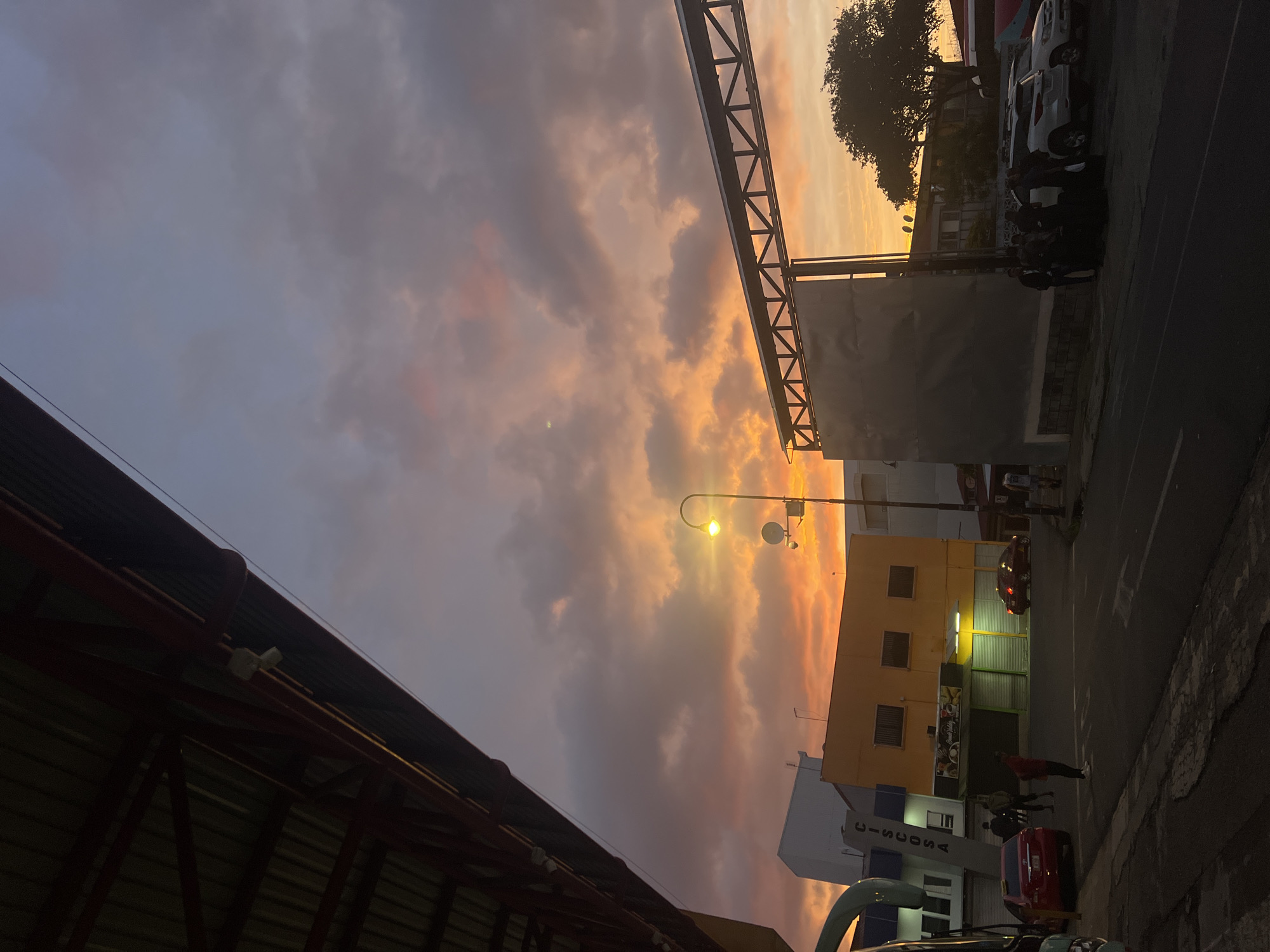
The image depicts a street scene at dusk in San José, Costa Rica. The sky is filled with dramatic clouds painted in hues of orange, pink, and purple, indicating a sunset. In the foreground, a dark, corrugated metal roof structure with visible rafters extends from the left side of the frame, casting a shadow over the street. A street lamp with a glowing yellow light is prominently positioned in the mid-ground. Several buildings are visible: on the left, a white building with a tilted, angular facade bears the vertical text "CISCOSA". Next to it is a bright yellow building with several windows and a closed storefront. Further to the right, a large, dark metallic structure with a triangular truss design is present, possibly part of an overpass or a large advertisement billboard. On the street, there are several parked cars, including a red sedan and a white SUV. A few people are present, some standing near the vehicles and buildings. One individual in a red shirt stands in the middle of the road. The street itself appears to be asphalt with visible lane markings. The overall impression is of an urban environment transitioning from day to night, with a striking natural sky as a backdrop.
San José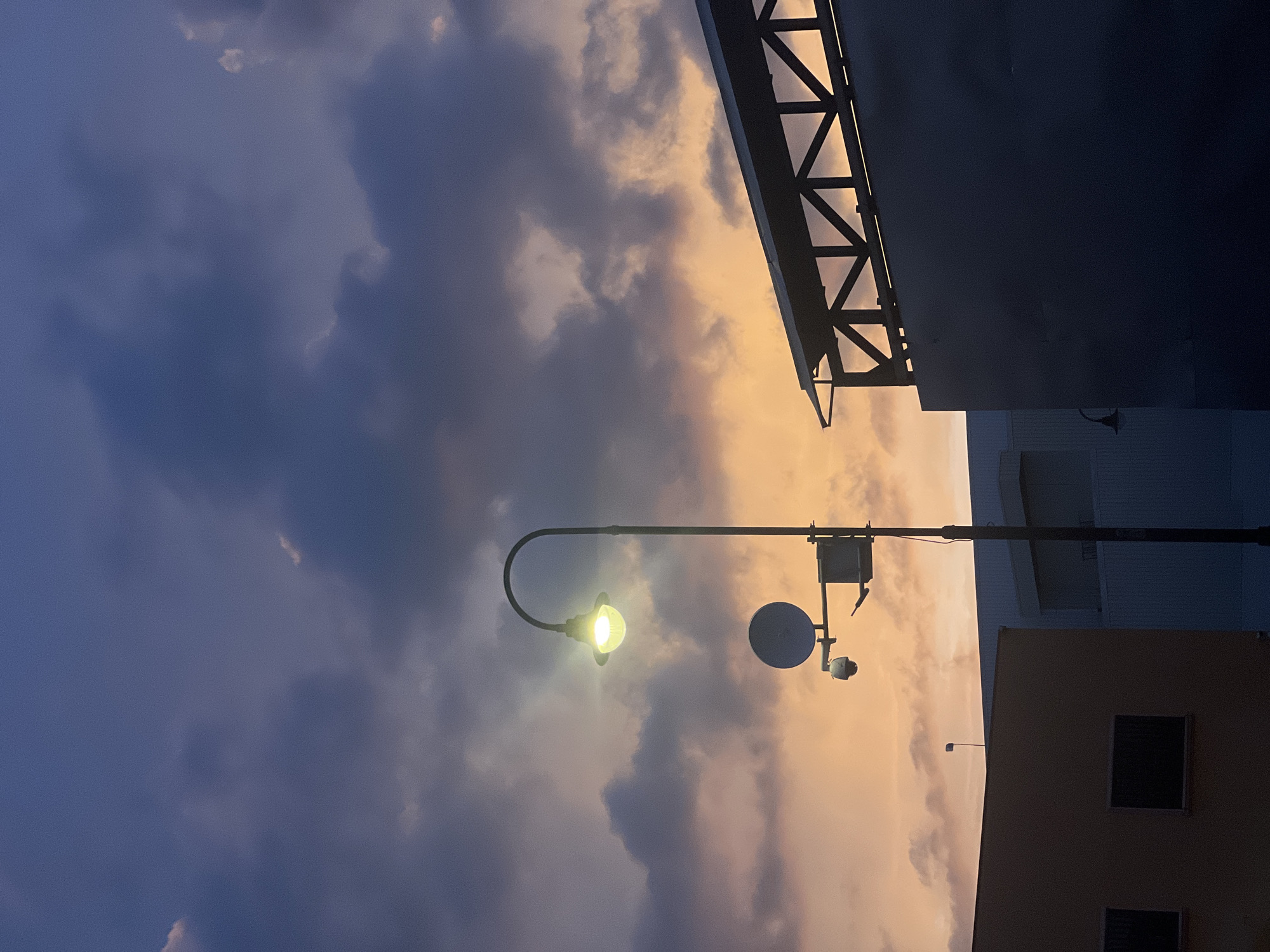
The image depicts an urban scene at dusk in San José, Costa Rica, characterized by a dramatic sky and architectural elements. Dominating the sky are dark, bruised clouds with streaks of orange and yellow light, suggesting the sun is low on the horizon. In the foreground, a tall, dark lamppost stands to the left of center, its curved arm supporting a glowing yellow lamp that illuminates the immediate surroundings. Attached to the lamppost at a lower point are a satellite dish and what appears to be a security camera. To the left of the lamppost, the upper portion of a muted orange building is visible, featuring two dark rectangular windows. To the right, the dark silhouette of another building rises, with a prominent triangular framework structure on its roof, casting a dark shadow. The overall impression is one of a twilight cityscape, with artificial light beginning to punctuate the fading natural light.
San José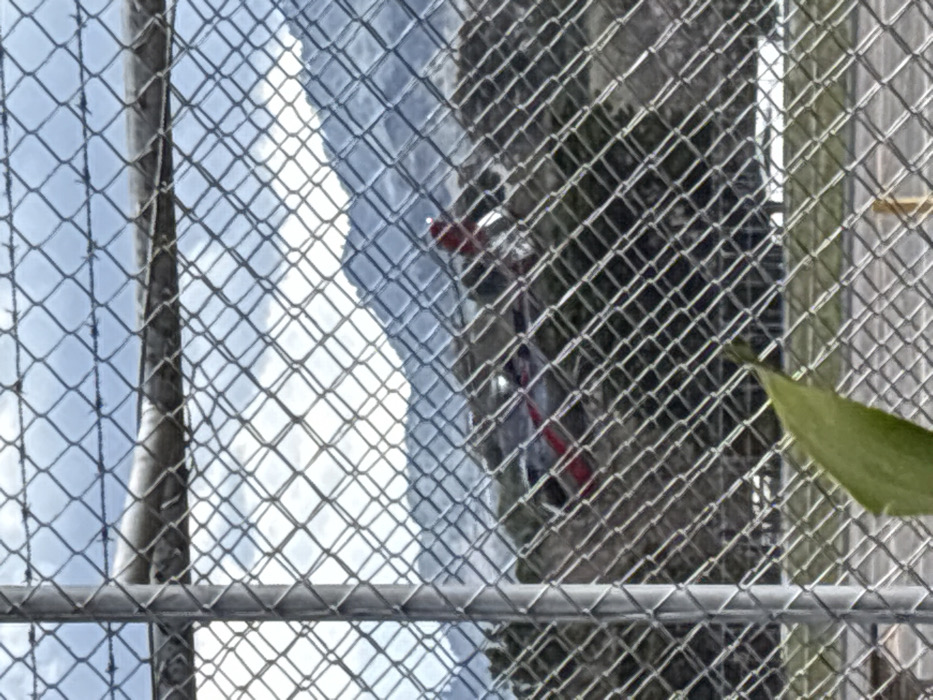
The scene presents an outdoor view through a chain-link fence, which occupies the immediate foreground, featuring a grey vertical support post on the left and a horizontal top rail. A green leaf is visible at the bottom left. In the mid-ground, a helicopter, predominantly dark-colored with prominent red markings on its tail section, rests on the ground within an open paved or grassy area. Beyond the helicopter, a line of trees precedes a series of distant, undulating mountains under a partly cloudy sky. No individuals are discernible. This setting is consistent with the perimeter of Tobías Bolaños International Airport in Pavas, San José, Costa Rica, facing the surrounding mountainous terrain of the Central Valley.
San José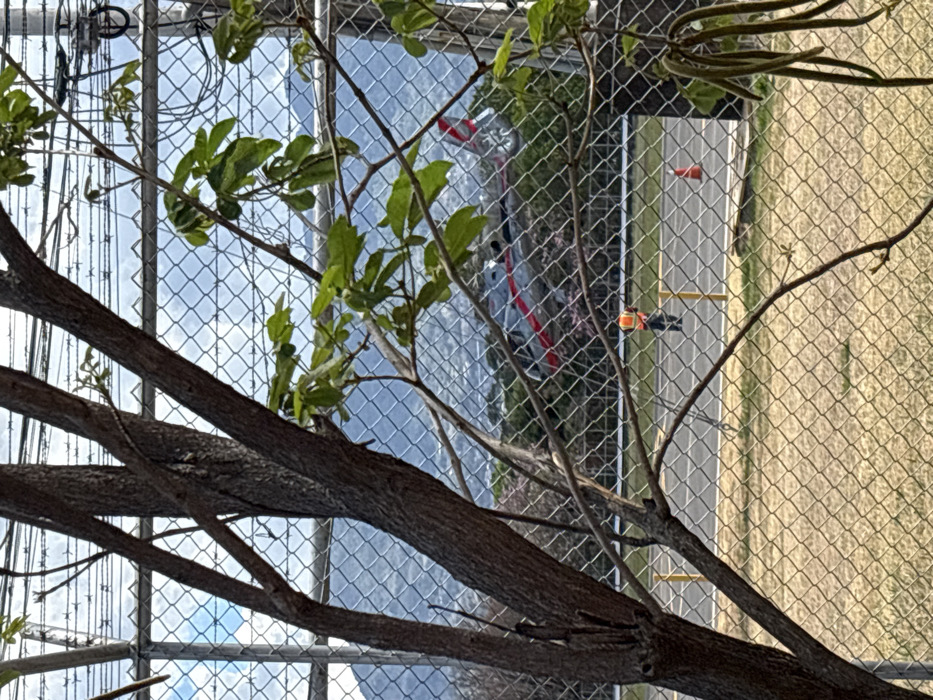
The image displays an outdoor scene, likely an airfield or helipad, located in San José, Costa Rica, viewed through a foreground chain-link fence topped with barbed wire. Branches and green foliage from a tree partially obstruct the view. In the midground, a silver or light grey helicopter with red stripe accents on its tail boom and vertical stabilizer is parked on a paved tarmac surface. One individual, wearing an orange high-visibility vest and dark attire, stands on the tarmac to the left of the helicopter, partially facing away from the viewer. Yellow ground markers and a single orange traffic cone are also visible on the paved surface. The immediate foreground features dry, light-colored ground. In the background, distant mountains are visible under a partly cloudy sky, with urban development discernible at their base.
San José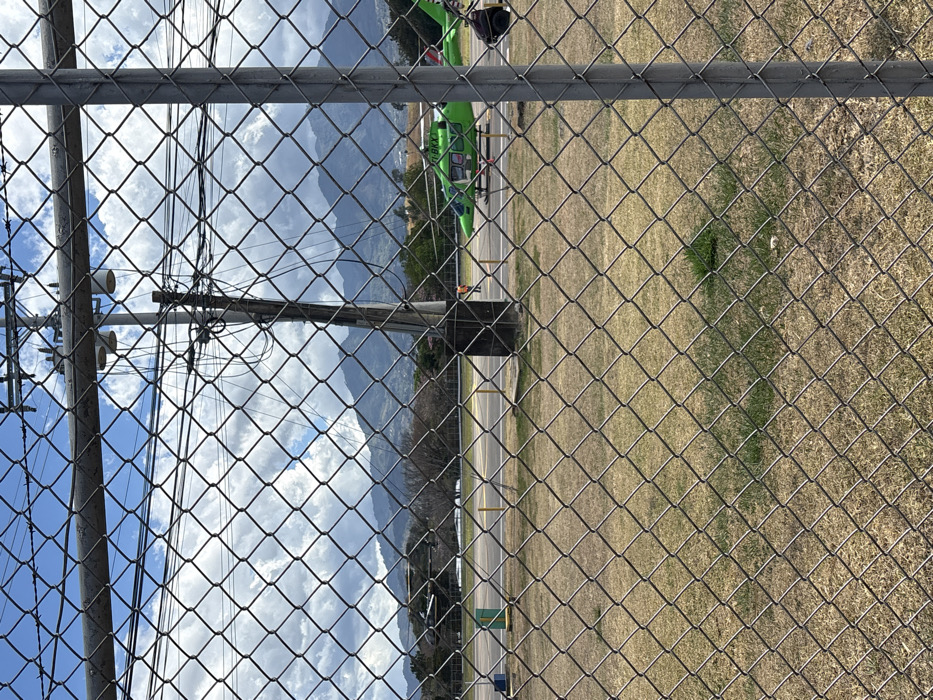
The scene is observed through a weathered chain-link fence, occupying the immediate foreground and lower-midground. The fence features diamond-patterned mesh and exhibits minor surface rust; a vertical metal post stands on the right. Beneath the fence, the ground is covered with dry, yellowish-brown grass, with some small patches of greener vegetation. Beyond the fence, a paved airfield or helipad extends across the midground. A bright green helicopter, identified by the registration "TI-BKXX" visible on its tail boom, rests stationary on this paved surface, with its nose directed towards the left of the frame. One individual, attired in an orange high-visibility vest, is walking on the paved area near the helicopter, moving from right to left. A second, partially obscured figure is present near the helicopter's tail assembly on the far right. The background features a distinct range of mountains under a partly cloudy sky, displaying interspersed patches of blue. A tall, dark utility pole laden with multiple electrical wires and insulators stands in the mid-right, positioned behind the fence. The scene depicts activity at an airfield, specifically Tobías Bolaños International Airport (Pavas Airport) in San José, Costa Rica.
San José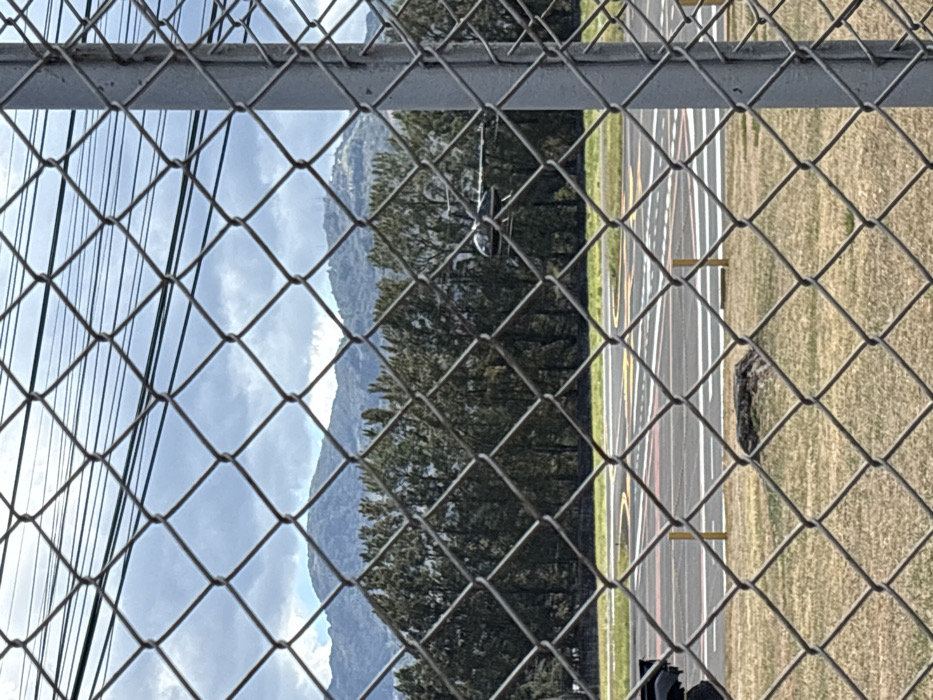
The image presents an outdoor scene viewed through a galvanized chain-link fence with a visible metal support post on the right. In the immediate foreground, a patch of dry, yellowish-brown grass covers the ground, featuring a dark, irregularly shaped object, possibly a tree stump or rock, in the lower-mid frame. Beyond the fence and grass, an asphalt paved surface is visible, marked with distinct aviation symbols including yellow, red, and white lines, dashed markings, and circular patterns, consistent with a helipad or small airstrip. Several yellow bollards or ground markers are also present on the paved area. A dark-colored helicopter, appearing black or very dark blue, is partially visible above this paved surface in the midground, with its cockpit, fuselage, and tail boom discernible. Its main rotor blades are slightly blurred, suggesting either motion or a shallow depth of field. A dense line of tall, dark green coniferous trees forms a natural barrier behind the airfield. In the background, a range of mountains stretches across the horizon, some densely forested, others appearing more rugged. One prominent mountain peak, visible towards the upper-right, is topped with several distinct radio or communication towers. The sky above is overcast, filled with various shades of grey and white clouds. Multiple dark power lines or utility cables run horizontally across the upper portion of the frame, behind the fence. This scene is located within the San José metropolitan area of Costa Rica, specifically at or adjacent to the Tobías Bolaños International Airport (SYQ) in Pavas, San José, consistent with the aviation infrastructure and the distinctive mountainous backdrop, including peaks with communication towers common to the Central Valley.
San José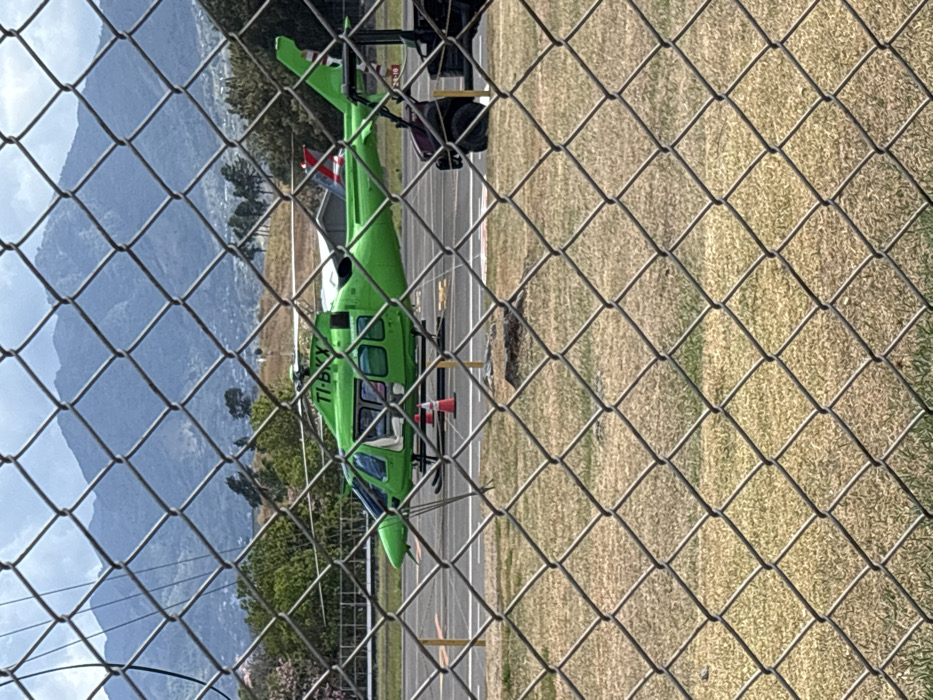
A bright lime-green helicopter, registered TI-BXX, is stationary on an asphalt helipad. Its main rotor blades are not in motion. The forward left cabin door of the helicopter is open. Two orange traffic cones are positioned on the asphalt near the helicopter's front landing skid. A dark-colored utility vehicle is partially visible, parked to the right and slightly behind the helicopter's tail. The helipad surface features yellow and white markings, including the numbers "24-10" faintly visible. The scene is viewed through a chain-link fence, which occupies the lower and central foreground. Beyond the fence, the ground consists of dry, yellowish-brown grass. The background features a line of green trees, some exhibiting pink blossoms, leading to a range of densely vegetated mountains under a partly cloudy sky. This location is identified as the Tobías Bolaños International Airport (MRPV) in Pavas, San José, Costa Rica.
San José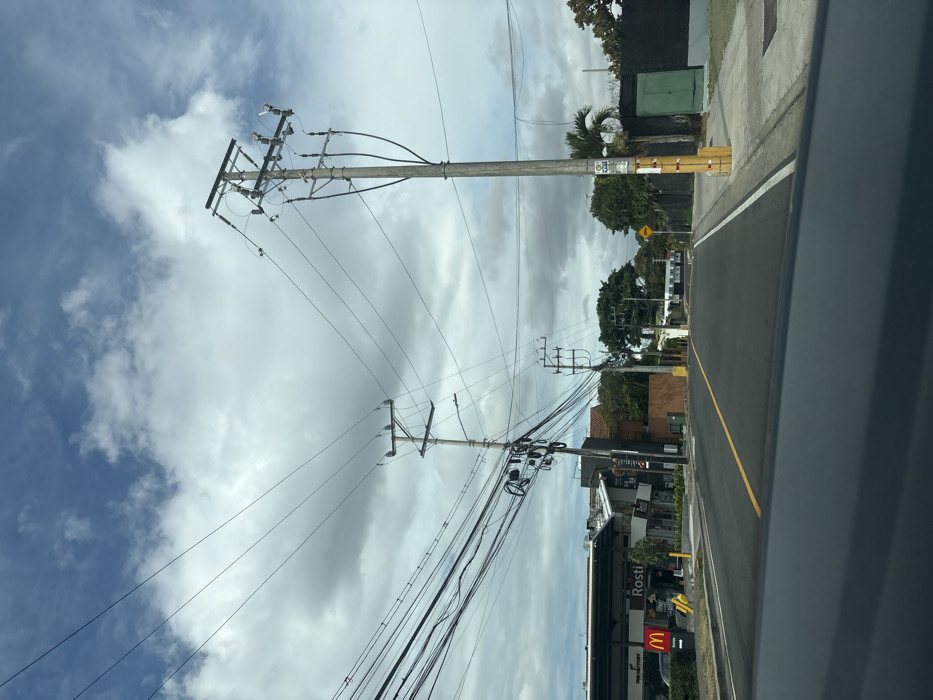
The image shows a view from a car looking down a paved road in San José, Costa Rica at the intersection of Avenida 10 and Calle 51. The road is empty, and there are power lines running overhead. The power lines are supported by several utility poles. The intersection is marked with yellow lines on the road and a yellow diamond-shaped sign on the left side. There are buildings and trees on either side of the road. The buildings are mostly single-story and have a commercial appearance. The sky is overcast with white clouds. The sun is shining. The image is taken from the perspective of a person sitting in a car.
San José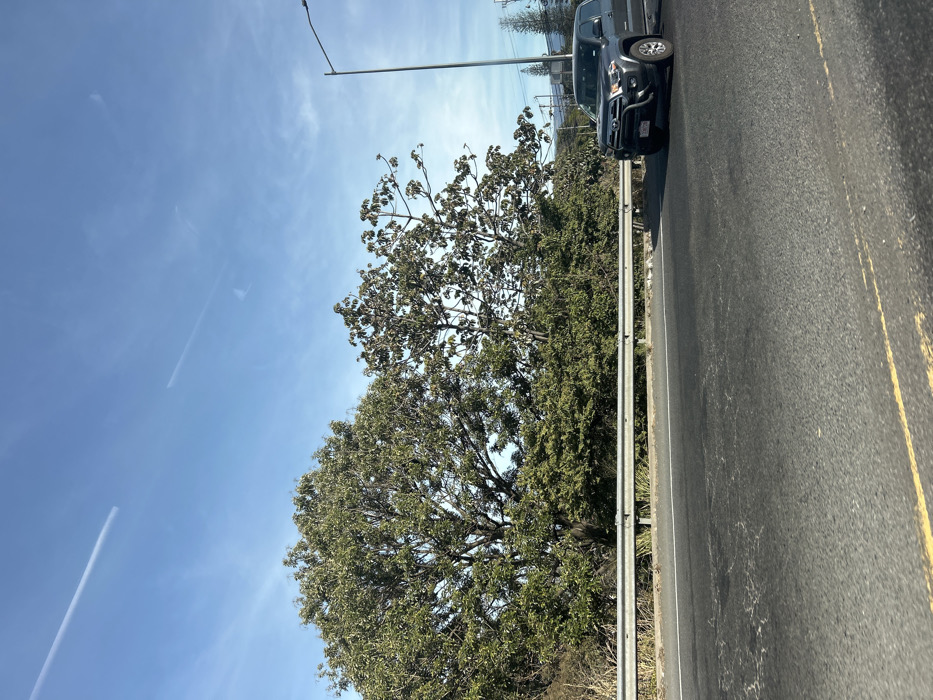
A gray pickup truck drives on a four-lane highway in San José, Costa Rica, located at latitude 9.996, longitude -84.269. The truck is traveling in the right lane and is almost completely in frame, facing towards the right. The truck is surrounded by greenery, including several large trees to the left of the roadway and smaller trees to the right. A streetlight with a single lightbulb is visible to the right of the truck, along with a smaller light post to the left. The road is paved and appears to have cracks in it. The sky is blue and mostly clear, with a few white contrails from airplanes.
San José