Ust'-Pyzas, Russia
30 memories from Ust'-Pyzas, Russia
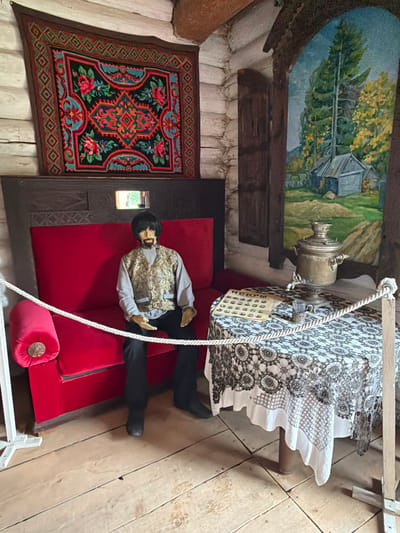
The image depicts a dimly lit interior scene, likely within a museum exhibit, showcasing a staged living room setting in what appears to be a traditional Russian izba (log house) in Ust'-Pyzas, Russia. A mannequin dressed in a light grey shirt and a patterned vest with black trousers is seated on a vibrant red couch. The mannequin has dark hair and a beard. To the right of the couch, a round table is draped with a white lace tablecloth featuring intricate circular patterns and a decorative border. On the table, a silver samovar, a small glass with a silver holder, and a stack of papers with Cyrillic text are visible. A painting depicting a rural landscape with trees and small houses hangs on the wall behind the table. Above the couch, a framed rug with a colorful floral and geometric design is mounted on the log wall. The walls themselves are constructed of rough-hewn logs. A white rope barrier, supported by simple wooden stands, separates the viewer from the exhibit. The floor is made of wooden planks. The overall impression is one of a preserved historical domestic interior.
Ust'-Pyzas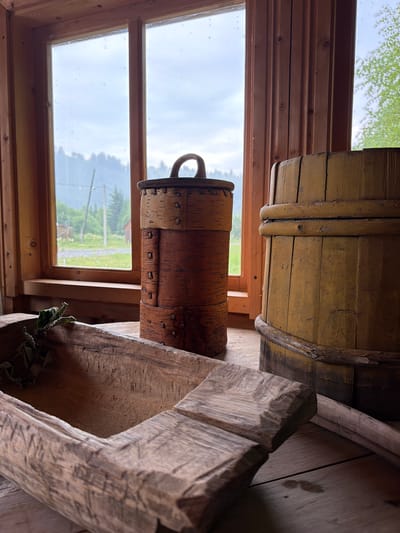
A still life composition is presented, featuring rustic wooden objects in an indoor setting with a view of the outdoors through a window. In the foreground, a weathered, trough-like wooden object is angled towards the viewer, its interior visible and containing a few dried green leaves. To the right of this trough, and slightly behind it, sits a cylindrical container made of birch bark with a dark lid featuring a wooden handle. Behind the birch bark container is a tall, cylindrical wooden barrel, painted yellow and showing signs of wear and tear with visible vertical planks and horizontal bands. The objects are arranged on a wooden surface, possibly a table or floor. The background consists of a wooden-framed window looking out onto a natural landscape. The window pane is slightly clouded or wet, obscuring some details of the view, which includes a treeline of coniferous trees, some distant buildings, and a sky that appears overcast. The interior framing of the window and the wall to its right are made of unfinished wood planks. The lighting is natural, coming from the window, and casts soft shadows. There are no people or animals visible in the scene. The overall impression is one of rustic simplicity and a connection to traditional craftsmanship. The image is believed to be taken in Ust'-Pyzas, Russia, given the context.
Ust'-Pyzas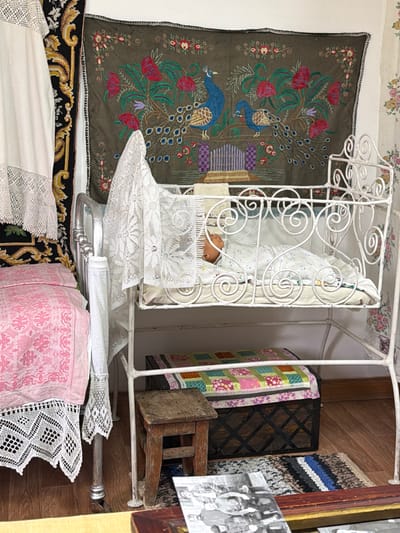
This image depicts an indoor scene that appears to be part of a museum exhibit in Ust'-Pyzas, Russia, showcasing traditional domestic life. The primary focus is a vintage white metal baby crib, ornately decorated with scrollwork. Inside the crib, a doll or baby is swaddled in a patterned blanket. The crib is draped with a delicate white lace cloth. Behind the crib, a large tapestry hangs on the wall, featuring an embroidered design of peacocks amidst floral motifs in shades of green, blue, red, and purple. To the left of the tapestry, a white fabric with lace trim is visible, along with another patterned textile. In front of the crib, a small wooden stool stands next to a dark wooden chest topped with a colorful quilted fabric. A small, woven rug is placed on the wooden floor in front of the chest. To the left of the crib, a bed is partially visible, covered with a pink textile featuring a delicate white pattern, and adorned with white lace trim at its base. The overall impression is one of a preserved domestic setting, likely intended to evoke a sense of nostalgia and cultural heritage.
Ust'-Pyzas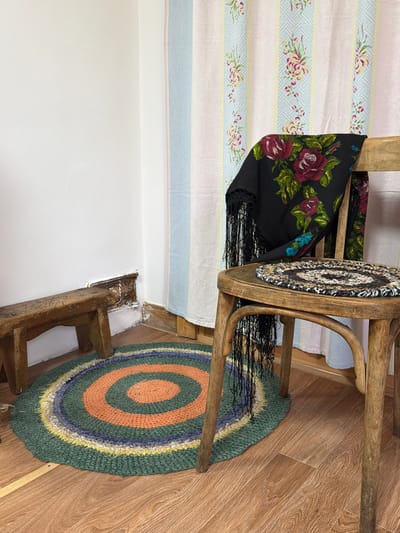
In a dimly lit room, likely in Ust'-Pyzas, Russia, a rustic wooden chair stands as the focal point. A black shawl with a vibrant floral pattern of red roses and green leaves is draped over its back. The shawl is edged with black fringe that hangs down. On the seat of the chair rests a small, circular braided rug, predominantly black and white with brown accents. Beside the chair, a simple wooden stool, worn and aged, is positioned near a wall. A circular rag rug with concentric rings of green, orange, purple, and yellow lies on the wooden floor. The wall behind the objects is painted white, and a set of pastel-colored curtains, featuring stripes and floral motifs, hangs to the right. The floor is made of wooden planks. The scene evokes a sense of traditional rural living.
Ust'-Pyzas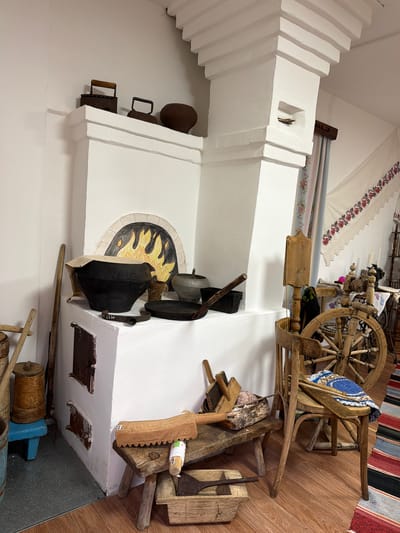
The image displays a rustic, indoor scene, likely a museum exhibit or a historical reenactment space, depicting traditional Russian village life. A large, white plaster stove dominates the center of the frame. On top of the stove, various antique household items are arranged, including two cast-iron clothes irons, a dark-colored pot, and a smaller metal pot. In front of the stove, on a raised platform, sits a large, black cast-iron cauldron covered with a piece of fabric. Next to it are smaller metal pots and a frying pan. The front of the stove has two dark metal doors, likely for the oven and ashpit, with one visible handle. Above these doors, an arched opening in the stove is decorated with a painted depiction of flames. To the left of the stove, several wooden objects are leaning against the wall, including long poles and a cylindrical wooden container with a lid, resting on a small blue stool. To the right of the stove, a rustic wooden spinning wheel with a large wheel is prominently featured. It is placed behind a wooden chair with a woven mat on its seat. A stack of wooden tools and materials, including a flax hackle and a basket containing yarn, rests on a low wooden bench in front of the chair. Below the bench, a wooden trough holds more tools, including a long-handled shovel. The floor is covered with polished wood, and a colorful striped rug runs along the right side of the frame. A white embroidered cloth with red floral patterns hangs on the wall in the background. The overall ambiance is one of historical preservation and cultural display. While the image is identified as being located in the city of Ust'-Pyzas, Russia, there are no people visible in the scene. The objects are static and arranged for display. The environment appears to be indoors, with artificial lighting.
Ust'-Pyzas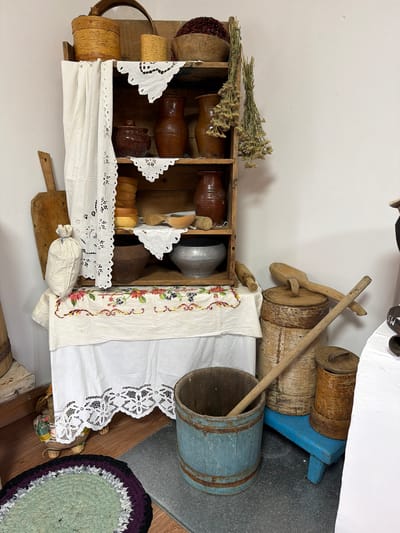
This is a forensic, matter-of-fact description of a staged domestic interior scene, likely in Ust'-Pyzas, Russia, depicting a collection of rustic, traditional household items. The scene is lit by ambient light, creating shadows that add depth to the objects. The central focus is a wooden shelving unit filled with various earthenware and wooden vessels. On the top shelf, a large wooden bowl contains dark red material, possibly dried berries or grain. Next to it are two birch bark containers, one larger than the other. A wooden-rimmed basket is positioned to the left. The shelves below are adorned with white lace-trimmed cloths. Earthenware jugs and pots of various sizes and shapes are displayed prominently, some with a glossy finish, others matte. There are also stacks of small wooden bowls and cups, and a larger metal pot on one of the lower shelves. A rolled-up white cloth hangs on the left side of the shelving unit, partially obscuring the view of some items. To the left of the shelving unit, a wooden paddle or board leans against the wall. In front of the shelving unit, a small white cloth bag is tied at the top. Below the shelving unit, a white embroidered tablecloth with floral and berry motifs is draped. On the floor in front of the shelving unit and to the right, several other items are arranged. A light blue wooden bucket with metal banding contains a long wooden pole. Behind this bucket are two larger wooden cylindrical containers, possibly butter churns or storage containers, with one having a wooden lid and a large wooden spoon resting on it. A small blue wooden stool supports one of these cylindrical containers. To the far right, a white surface, possibly a table or counter, is visible, with some dark objects on it. A circular rag rug in shades of green, purple, and black is situated on the floor to the lower left. The overall impression is one of a carefully curated display of historical or traditional household artifacts, evoking a sense of rural life. There are no people present in the scene, and no actions or interactions are depicted. The environment appears to be an indoor setting with a plain white wall in the background and wooden flooring.
Ust'-Pyzas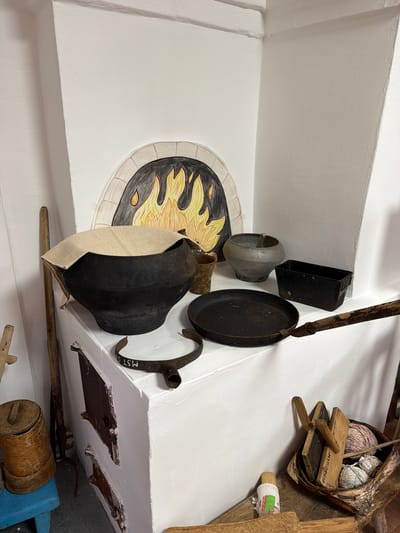
The image depicts a corner of a room with a white stove, likely a traditional Russian stove, against a white wall. The stove has a painted archway resembling a fire with flames. On top of the stove, there are several objects related to cooking and traditional crafts. A large, black, cast-iron pot, partially covered with a light-colored cloth, sits prominently in the foreground. To its right, there is a smaller, grey, metallic pot, and to the right of that, a black rectangular metal container. In front of the pots, a black frying pan with a wooden handle is placed on the stove's surface. A U-shaped metal clamp with white markings is also visible on the stove. To the left of the stove, a tall wooden stick leans against the wall. Below the stove, there are two rusty metal doors, suggesting an oven or ash compartment. To the far left, a small blue wooden stool holds a cylindrical wooden container with a lid. In the right foreground, a woven basket rests on a wooden surface. Inside the basket are several balls of yarn, various wooden tools, and what appears to be a bundle of natural fibers. A small doll-like object with a colorful fabric wrap is also present near the basket. The scene suggests a historical or ethnographic display, possibly in a museum or a preserved traditional home. The location is identified as Ust'-Pyzas, Russia. There are no people visible in the image. The lighting is even, illuminating the objects clearly. The overall impression is one of rustic simplicity and historical preservation.
Ust'-Pyzas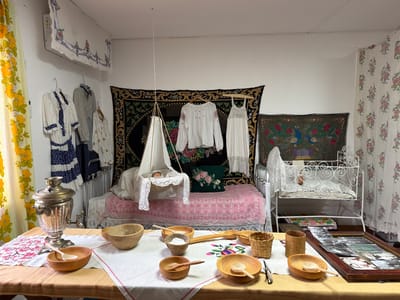
This image depicts an indoor display, likely in a museum or cultural center, showcasing elements of traditional life. The scene is set in a room with white walls and is filled with various objects. In the foreground, a table is covered with a light-colored tablecloth, adorned with embroidered patterns. On this table, there is a large, ornate samovar, several wooden bowls of varying sizes, and wooden spoons. To the right, a framed collection of old photographs is laid out. The background features a bed with a pink and white patterned bedspread. Suspended above the bed is a white bassinet with a doll or baby figure inside. Clothing items, including what appear to be traditional embroidered blouses and dresses, are hung on a rack and on hangers. Decorative tapestries with intricate designs, including one with peacocks, hang on the walls. A white metal crib with ornate detailing is positioned to the right of the bed. Floral patterned curtains are visible on the left and right sides of the room. The overall impression is that of a staged exhibit, possibly recreating a historical domestic setting. The image is not specific to Ust'-Pyzas, Russia, as no identifying markers are present within the frame to confirm its location.
Ust'-Pyzas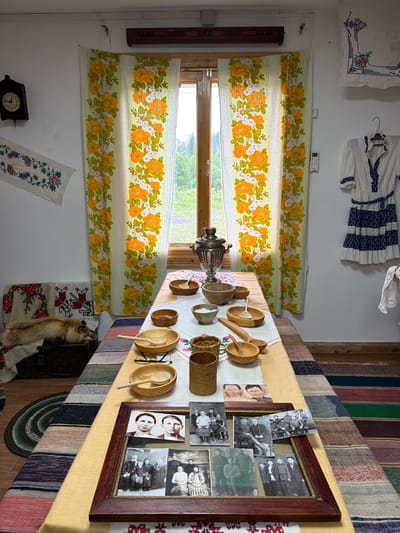
The image depicts an indoor scene, likely a room furnished in a traditional style. The room is decorated with floral curtains featuring orange and white flowers on a light green background, and several pieces of embroidered fabric. On the left wall, a black pendulum clock hangs, and below it, an embroidered runner is displayed. To the right of the window, a white and blue dress with ruffled detailing is hung on a hanger. In the center of the room, a long table is covered with a light-colored tablecloth. The table is set with various wooden bowls, some containing spoons, and a samovar. There are also several framed photographs on the table, showcasing groups of people in vintage attire, as well as individual portraits. On the left side of the room, near the window, a fox pelt is laid out on a chest, accompanied by embroidered cloths. The floor is covered with a striped rug. The overall impression is that of a culturally preserved space, possibly a museum exhibit or a well-maintained traditional home. The location is identified as Ust'-Pyzas, Russia, suggesting a cultural context related to that region.
Ust'-Pyzas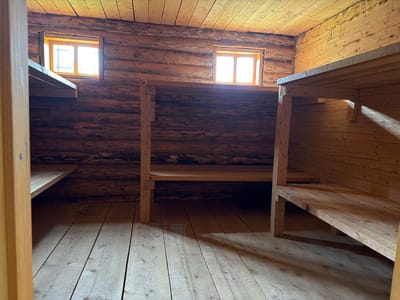
The image depicts the interior of a rustic wooden structure, likely a bunkhouse or sleeping quarters, with two small windows allowing natural light to enter. The walls are constructed from rough-hewn logs, giving the space a primitive and aged feel. The ceiling is also made of wooden planks, aligned horizontally. There are multiple levels of wooden bunks or shelves built into the structure, with visible supports and shelving. The floor is made of unfinished wooden planks laid side-by-side. The lighting suggests a daytime scene, with sunlight casting shadows across the floor and bunks. The overall impression is one of simple, functional accommodation, likely in a remote or historical setting. The provided context indicates this location is in Ust'-Pyzas, Russia.
Ust'-Pyzas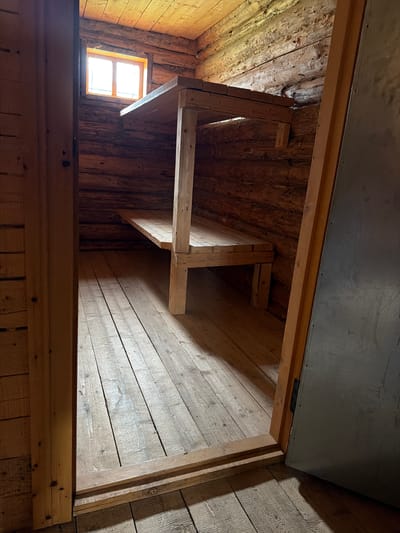
The image depicts the interior of a rustic wooden structure, likely a cabin or shelter, in Ust'-Pyzas, Russia. The walls and ceiling are constructed from rough-hewn logs, and the floor is made of wooden planks. A simple, multi-tiered wooden bunk bed system is the dominant feature within the space. Sunlight streams through a small, two-pane window positioned high on the left wall, illuminating the dust motes in the air and casting shadows. The entrance to the structure is visible on the right, with a dark, metallic door ajar, revealing a portion of the interior. The overall impression is one of a sparsely furnished, utilitarian dwelling, possibly used for basic accommodation in a remote or natural setting. There are no people or animals visible in the scene.
Ust'-Pyzas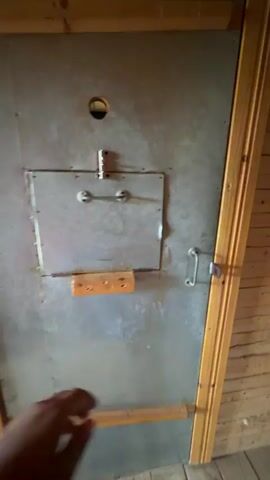
A person's hand in a red sleeve reaches for a hook latch on a door. The door opens to reveal a dimly lit, rustic cell with stone walls and a wooden floor and ceiling. A small, barred window is visible on the far wall, casting a faint orange glow into the room. Two metal bunks, suspended by chains, are attached to the wall.
Ust'-Pyzas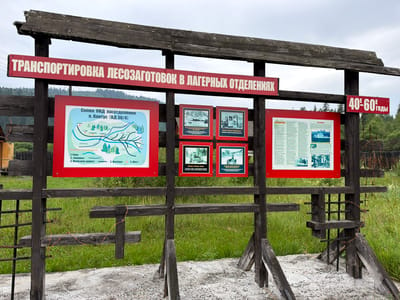
The image shows an outdoor informational display in Ust'-Pyzas, Russia. The display is mounted on a rustic wooden structure. The top sign, in red with white lettering, reads "ТРАНСПОРТИРОВКА ЛЕСОЗАГОТОВОК В ЛАГЕРНЫХ ОТДЕЛЕНИЯХ" which translates to "TRANSPORTATION OF LOGGING OPERATIONS IN CAMP SECTIONS". To the right of this sign is a smaller red sign with white numbers and text that reads "40-60 ГОДЫ", meaning "40s-60s YEARS". Below the main sign, there are several framed exhibits. The leftmost exhibit is a map with the title "Схема УЖД лесоотделения п. Кантус (ВД 30/4)" which translates to "Map of the Narrow-Gauge Railway of the logging section of Kantus village (WD 30/4)". This map shows rivers, forests, settlements, and railway lines. To the right of the map are three framed photographs. The first photograph shows a snowy landscape with a river. The second photograph shows a narrow-gauge train locomotive. The third photograph shows people working in a snowy environment. The display is set against a backdrop of green grass and trees, with a cloudy sky overhead. The wooden structure itself appears aged and weathered. Barbed wire is loosely wrapped around some of the wooden supports, adding to the rugged and possibly historical context of the display. The ground in front of the display is covered with gravel and some concrete. The scene suggests a historical or educational exhibit related to logging in the region.
Ust'-Pyzas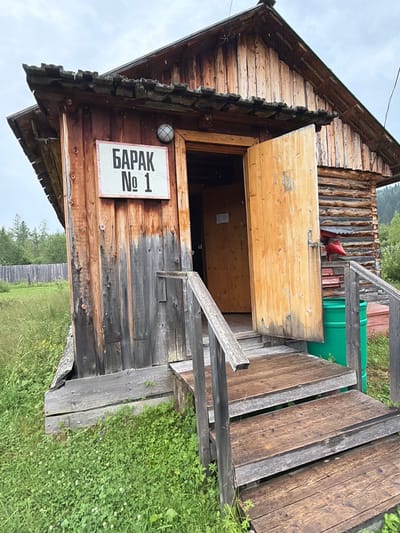
A weathered wooden building, identified by a sign as "БАРАК № 1" (Barak No. 1), stands prominently. The building is constructed from logs and planks, with a dark, aged appearance. An open wooden door reveals a dark interior, suggesting it might be a dwelling or a utility structure. A wooden staircase leads up to the entrance, and a green barrel sits to the right of the stairs. The surrounding environment is characterized by lush green grass, clover, and some wildflowers, indicating a rural or natural setting. In the background, a wooden fence and trees are visible, hinting at the location being on the outskirts of a settlement. The sky is overcast with visible raindrops, suggesting recent or ongoing rain. The scene appears to be in the village of Ust'-Pyzas, Russia, given the context of the request, implying a remote, possibly rustic, and sparsely populated area.
Ust'-Pyzas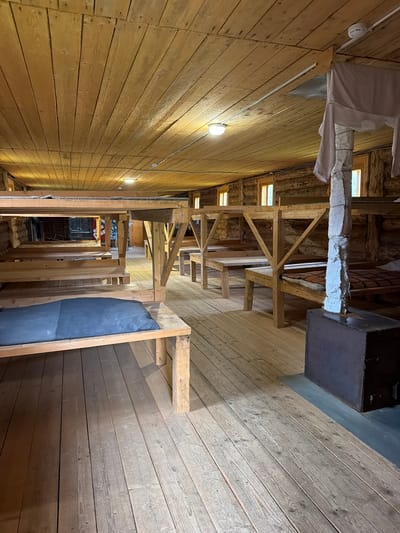
The image shows the interior of a rustic wooden dormitory located in Ust'-Pyzas, Russia. The room is furnished with multiple wooden bunk beds and single beds, some with mattresses and bedding. The walls and ceiling are constructed from natural wood planks. There are small windows letting in natural light. In the foreground, a dark blue mattress lies on a lower bunk. To the right, a dark, rectangular object, possibly a storage chest or heater, stands near a pillar covered with fabric. The flooring is made of weathered wooden planks. The overall impression is of a simple, communal living space with a strong emphasis on natural materials.
Ust'-Pyzas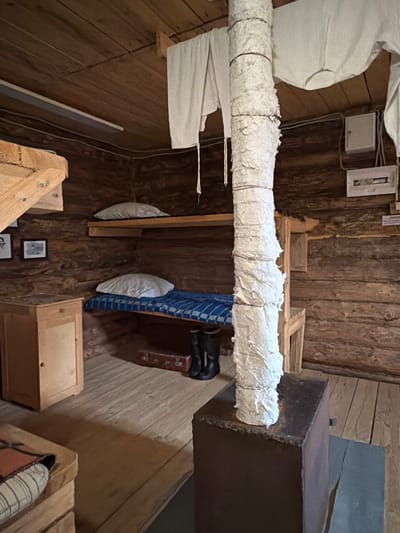
The image depicts the interior of a rustic wooden room, likely a cabin or dwelling in Ust'-Pyzas, Russia. The room is sparsely furnished, suggesting a functional living space rather than a display of luxury. The walls and ceiling are constructed from rough-hewn logs, giving the space a natural and aged appearance. Dominating the scene are bunk beds, indicating shared living quarters. The lower bunk is made up with a blue and white checkered mattress and a white pillow. On the floor beneath the lower bunk, a brown suitcase and a pair of black boots are placed, suggesting recent occupancy or preparation for travel. The upper bunk, also with a white pillow, is simpler in its arrangement. White fabric, possibly clothing or linens, is hung from the ceiling to the right of a central, vertically oriented pipe. This pipe is wrapped in what appears to be insulating material, secured by thin wires. To the left of the bunks, a small, light-colored wooden cabinet stands with a single drawer and a door, implying storage space. Above the cabinet, two framed pictures are hung on the log wall, adding a personal touch to the otherwise spartan environment. The floor is made of wooden planks. In the foreground, partially visible, is a low wooden structure with a patterned cushion, possibly another seating or sleeping surface. A dark metal object, potentially a stove or furnace, is positioned in the right foreground, with the insulated pipe rising from it. Electrical outlets and a distribution box are visible on the log wall in the background, indicating some degree of modern utility within the rustic setting. The overall impression is one of a simple, practical living space, possibly in a remote or historical context.
Ust'-Pyzas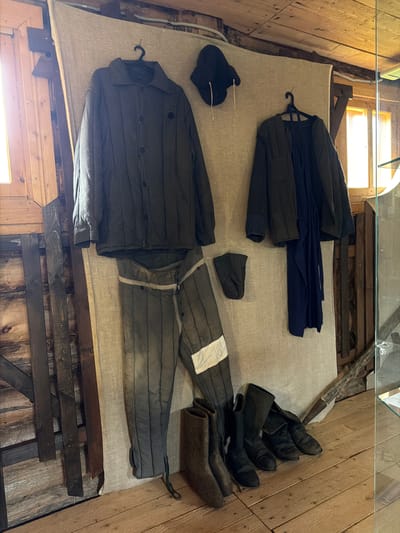
The image depicts a display of historical workwear, likely in a museum setting, located in Ust'-Pyzas, Russia. The clothing items, consisting of a quilted jacket, trousers with white banding, a dark hat, and several pairs of boots, are arranged on a draped fabric backdrop against a wooden wall. The garments are displayed on hangers or laid out on the floor. The environment suggests an indoor space with wooden walls and flooring, illuminated by natural light from windows. The display appears to be part of a cultural exhibition documenting the region's history or occupational traditions.
Ust'-Pyzas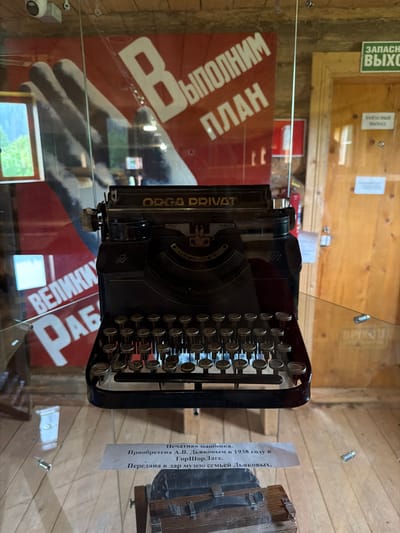
A vintage black typewriter is displayed on a glass shelf in a museum. The typewriter has a metal frame, black keys with Cyrillic lettering, and a carriage return lever. Behind the typewriter, a red banner with white lettering and a large gray hand graphic is visible. The text on the banner appears to be in Russian. To the right of the typewriter, a wooden door with a sign reading "ЗАПАСН. ВЫХОД" (Emergency Exit) is visible. The floor beneath the display is made of light-colored wood planks. A small descriptive plaque is placed in front of the typewriter, also on the glass shelf. The plaque contains Russian text. The overall environment suggests an indoor exhibition space with rustic wooden walls.
Ust'-Pyzas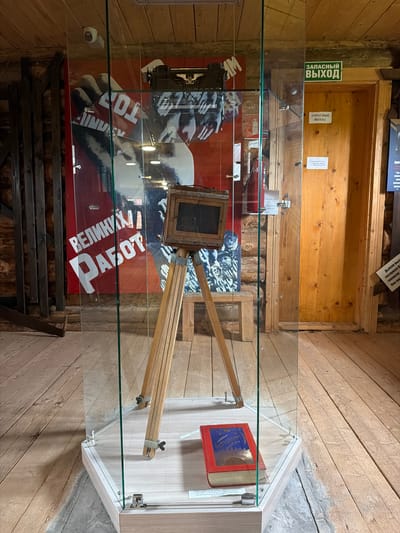
The image shows an indoor exhibit, likely a museum or historical display, featuring a vintage camera on a tripod encased in a glass display case. The camera is a wooden bellows camera with a lens. A red book with gold lettering and a blue insert is placed on the base of the display case. Behind the display case, a large red poster with white lettering and images of hands and faces is visible. To the right of the poster and display case, there is a wooden door with two signs above it, one green and one white, both reading "ЗАПАСНЫЙ ВЫХОД" (Emergency Exit). The surrounding environment consists of wooden walls, a wooden ceiling with visible beams, and a wooden floor. The overall impression is of a rustic, potentially historical setting. The location is identified as Ust'-Pyzas, Russia.
Ust'-Pyzas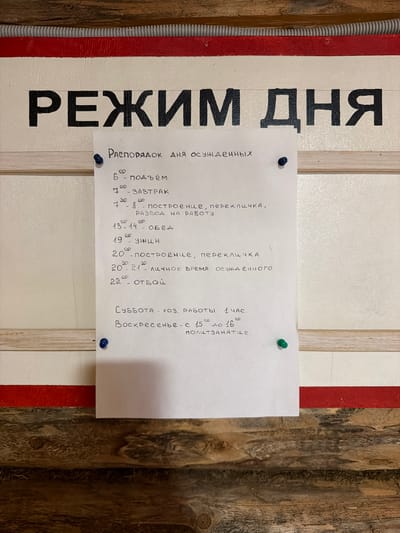
The image shows a handwritten schedule pinned to a white board with a red stripe at the top. The schedule is written in Russian. Large black letters at the top of the board spell out "РЕЖИМ ДНЯ," which translates to "Daily Schedule." Below this, a smaller heading reads "Распорядок дня осужденных," meaning "Schedule for the condemned." The schedule details the daily routine: * **6:00** - подъём (wake-up) * **7:00** - ЗАВТРАК (breakfast) * **7:30 - 8:00** - ПОСТРОЕНИЕ, ПЕРЕКЛИЧКА, РАЗВОД НА РАБОТУ (assembly, roll call, dispatch to work) * **13:00 - 14:00** - ОБЕД (lunch) * **19:00** - УЖИН (dinner) * **20:00** - ПОСТРОЕНИЕ, ПЕРЕКЛИЧКА (assembly, roll call) * **20:30 - 21:00** - ЛИЧНОЕ ВРЕМЯ ОСУЖДЕННОГО (personal time for the condemned) * **22:00** - ОТБОЙ (lights out) The schedule also includes weekend hours: * **Суббота** - хоз. работы 1 час. (Saturday - 1 hour of housekeeping duties.) * **Воскресенье** - с 15:00 до 16:00 - ползанятие. (Sunday - from 15:00 to 16:00 - half-session, likely referring to a period of activity or instruction.) The overall environment appears to be utilitarian, with the wooden background suggesting an interior space that might be a facility or institution. The presence of pushpins indicates the schedule is intentionally displayed for viewing. The context implies this is a schedule within a correctional facility or a similar institution for individuals who are "condemned" or "convicted." There are no people visible in the image. The scene is static. The location is specified as Ust'-Pyzas, Russia, which is a known location for correctional facilities.
Ust'-Pyzas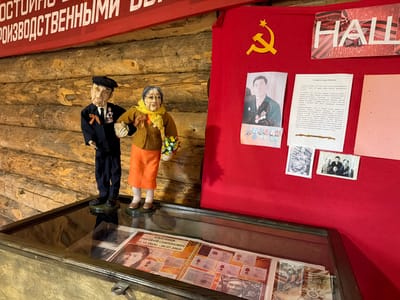
The image depicts a museum display case containing a collection of historical documents and photographs. Two life-sized mannequins of an elderly couple, dressed in period clothing and adorned with medals, stand in front of a wooden wall. The male mannequin wears a dark suit and a black cap, while the female mannequin is in a brown jacket and an orange skirt, holding a bouquet of flowers. Behind the mannequins, a red banner with Soviet imagery, including a hammer and sickle, is displayed. Several framed documents and photographs are pinned to the red banner. The display case in the foreground showcases open books with more documents, photographs, and medals. The overall scene appears to be an exhibit dedicated to commemorating individuals and events from Soviet history, possibly in the city of Ust'-Pyzas, Russia, given the context of the provided information.
Ust'-Pyzas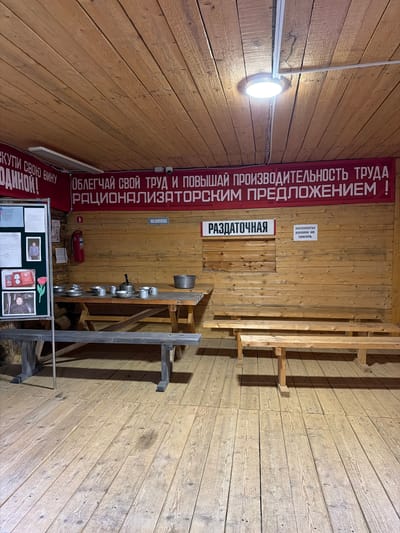
The image shows the interior of a rustic, wooden room, possibly a canteen or communal dining area in Ust'-Pyzas, Russia. A large red banner with white Cyrillic text stretches across the upper portion of the wall, reading "Облегчай свой труд и повышай производительность труда рационализаторским предложением!" (Make your work easier and increase labor productivity with a rationalization proposal!). To the left, another banner with red text on a lighter background says "КУПИ СВОЮ ВИНУ ОДИННОЙ!" (Buy your wine, single!). In the center of the room, a long wooden table is set with numerous metal pots, pans, and cups, suggesting it's a serving area. A large metal kettle sits prominently on the table. To the right of the table, two wooden benches are positioned against the wall. A sign above the benches reads "РАЗДАТОЧНАЯ" (Serving area). Another small sign to the right of this one states "Экспонаты руками не трогать" (Do not touch exhibits with your hands). On the left side of the image, a display board is set up with framed photographs and documents. A red fire extinguisher is mounted on the wall behind the table, near the display board. The room is illuminated by a ceiling light fixture. The walls and ceiling are constructed from wooden planks, contributing to the rustic aesthetic. The floor is also made of wooden planks. The overall impression is of a simple, functional space, likely part of a historical or industrial site. There are no people visible in the image.
Ust'-Pyzas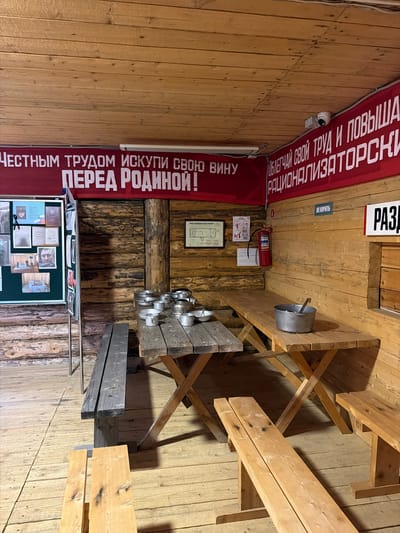
The image depicts an indoor scene, likely a museum or historical exhibit, with rustic wooden walls and ceiling. A prominent red banner stretches across the top, bearing white text in Russian. To the left, a display board features photographs and documents. In the center, wooden tables and benches are set up, with several metal pots and utensils on the tables. A fire extinguisher is mounted on the wall to the right, near a sign with Russian text. The overall atmosphere suggests a historical setting related to work or military life. The location is specified as Ust'-Pyzas, Russia. This detail is crucial for contextualizing the historical significance of the exhibit. Given the imagery and the text on the banner, the exhibit likely pertains to Soviet-era history, possibly related to labor camps, industrialization, or wartime experiences. The rustic wooden construction and the utilitarian furnishings are consistent with representations of such historical periods in rural or remote regions of Russia. The presence of what appears to be personal photographs and documents on the display board suggests an attempt to humanize the historical narrative. The metalware on the tables could represent communal dining or basic provisions typical of the era being depicted. The fire extinguisher and the "Do Not Smoke" sign are standard safety features in public spaces, but their placement within this historical exhibit adds to the sense of realism.
Ust'-Pyzas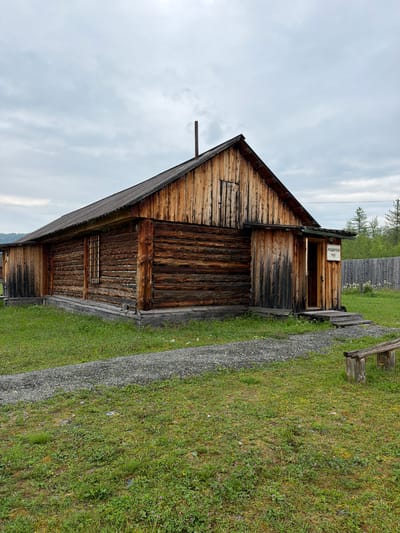
The image shows a wooden building with a dark metal roof in Ust'-Pyzas, Russia. The building is constructed from logs and has a pitched roof. There is a small, open doorway on the right side of the building with a wooden porch and steps leading up to it. A sign with Cyrillic writing is visible above the doorway. The building is surrounded by green grass and a gravel path. In the background, there is a wooden fence and trees. A rustic wooden bench is situated in the foreground to the right. The sky is overcast.
Ust'-Pyzas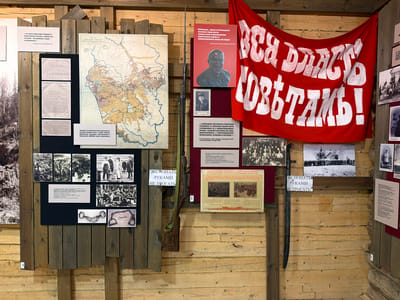
This image shows a museum exhibit in Ust'-Pyzas, Russia, featuring historical artifacts and documents related to the Russian Revolution and Civil War. The exhibit is displayed on a wooden wall, with various items mounted at different heights. In the upper left, a white sign with black text reads "Ц. ... ПО ТРАКТУ МНОГО ИДЕТЬ БРОДЯТЬ И ПРОЛЕТАРНЕВЪ БОСЬКЪ И ПОЛЬЗК ИЗЪ ССЫЛКМЫ - НЕСОГЛАСИЕМЪ И ДАКО ИЗГОТОВЛЕНИЙ." Below this is a black board with three documents. The top document is titled "УСТАВЪ," followed by smaller text. The second document is also titled "УСТАВЪ" with more text. The third document is smaller and appears to be a typed letter. To the right of these documents is a large, faded map titled "КАРТА ТОМСКОЙ ГУБЕРНИИ." The map depicts geographical features and colored regions, likely representing administrative divisions or resources. Below the map is a sign with text in black. Dominating the upper right portion of the image is a large red banner with white Cyrillic lettering. The text appears to be a revolutionary slogan. Below the banner, a dark rectangular plaque displays a bust of a man and a smaller portrait of a person in uniform. A long, wooden rifle, possibly a Mosin-Nagant, leans against the wall vertically in the center of the exhibit, its green strap visible. To the right of the rifle, a dark curved sword is mounted diagonally. Below the rifle and to the left, a black board contains several black and white photographs arranged in a grid. The top row has three images, and the bottom row has one larger image. Below these photos are two metallic objects: a set of handcuffs and a key with a chain. To the right of the rifle and sword, there is another display. At the top is a black and white photograph of a group of people standing in front of a building. Below this are two more photographs. One shows a group of people in a snowy landscape, and the other shows a single person in uniform. Further to the right, a red board has a title in large Cyrillic letters: "КАК И ПОЧЕМУ ПОБЕДИЛА СОВЕТСКАЯ СТРАНА ИНТЕРВЕНЦИЮ И КОНТРРЕВОЛЮЦИЮ В РОССИИ." Below this title are two more black and white images depicting scenes of conflict or gathering. Several smaller white signs with black text are placed throughout the exhibit. One sign, positioned between the rifle and the red board,
Ust'-Pyzas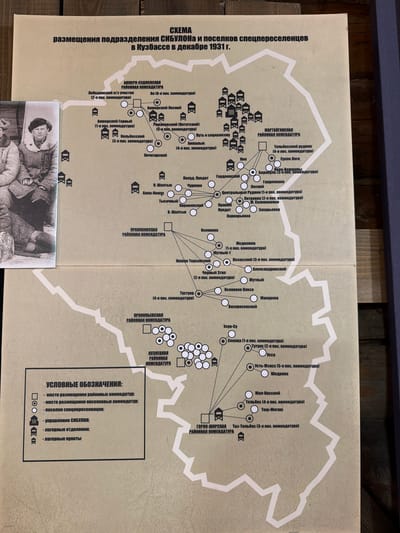
The image displays a schematic map titled "SKEMA razmeshcheniya podrazdeleniya SIBULONA i poselkov spetspereeselets v Kuzbasse v dekabre 1931 g." (Scheme of deployment of SIBULON units and settlements of special settlers in the Kuzbass in December 1931). The map illustrates various locations, likely settlements or work camps, connected by lines and marked with different symbols. These symbols are explained in a legend box on the bottom left, indicating: "mesto razmeshcheniya rayonnykh komendatur" (location of district commandant's offices), "mesto razmeshcheniya poselkovykh komendatur" (location of settlement commandant's offices), "poselki spetspereeselets" (settlements of special settlers), "upravleniye SIBULON" (SIBULON administration), "lagernyye otdeleniya" (camp departments), and "lagernyye punkty" (camp points). Several district commandant's offices are labeled, including Anzhero-Sudzhenskaya, Mariinskaya, Krasnoyarskaya, Prokopyevskaya, and Kuznetskaya. Numerous settlements are also identified by name and number of commandant's office, such as Nyakhomovaya, Putevaya, Tyazhelaya, and Sharypopovo. The map uses circles for settlements and squares for commandant's offices, with smaller circles within larger ones possibly indicating sub-divisions. The lines suggest logistical or administrative connections. The overall context is related to the administrative and settlement structure of SIBULON (likely a Soviet agency involved in resettlement or labor camps) in the Kuzbass region of Russia in 1931. The city of Ust'-Pyzas is not explicitly mentioned on the map, but the map covers a region within the broader Kuzbass area.
Ust'-Pyzas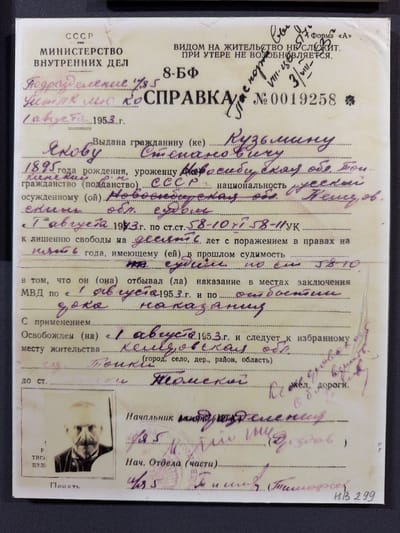
The image is a scan of a Soviet internal passport, likely issued in the 1950s. The document is predominantly text with some handwritten entries. The top section has official stamps and seals, including "CCCP" and "МИНИСТЕРСТВО ВНУТРЕННИХ ДЕЛ". There is a small black and white photograph of an elderly man with a mustache and a goatee, wearing a dark suit and a medal. His left hand is visible, resting on the bottom edge of the frame. The handwritten text appears to be personal details and legal information related to the passport holder. Some legible entries include: "1895 года рождения", "уроженцу (кой)", "гражданство (подданство) СССР", and information about criminal proceedings and imprisonment. There are also sections for the holder's place of residence and release details. A key piece of handwritten information is "месту жительства ... kemi, ob." (place of residence ... Kemi, ob.) and "до ст. ... Torcкu ... Toмcku" (to station ... Tocki ... Tomsk). This suggests that the individual was released and possibly relocating to or from the region of Tomsk, Russia. The city of Ust'-Pyzas is not explicitly mentioned in the visible text.
Ust'-Pyzas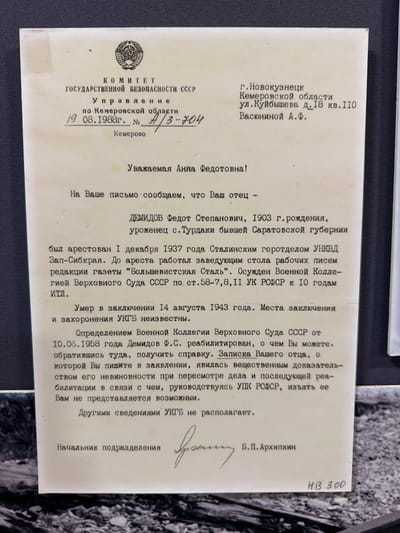
The image is a document with a letterhead from the Committee for State Security USSR, Administration for Kemerovo Oblast. The letter is dated 19.08.1988 and is addressed to "Dear Anna Fedotovna". The body of the letter discusses the arrest and fate of her father, Demidov Fedot Stepanovich, born in 1903. It states he was arrested on December 1, 1937, by the Stalin City Department of NKVD and worked as a clerk in the editorial office of the newspaper "Bol'shevistskaya Stal'". He was sentenced by the Military Collegium of the Supreme Court of the USSR to 10 years. He died in confinement on August 14, 1943, and his place of burial is unknown to the KGB. The letter further states that an official determination by the Military Collegium of the Supreme Court of the USSR on June 10, 1958, rehabilitated Demidov F.S., but obtaining a certificate and a note from his father, which is considered substantial evidence, is not possible. The document is signed by the Head of Department, B.P. Arkhipkin. The location mentioned, Ust'-Pyzas, Russia, is not explicitly present in the document itself. The bottom right corner has handwritten text "HB 300".
Ust'-Pyzas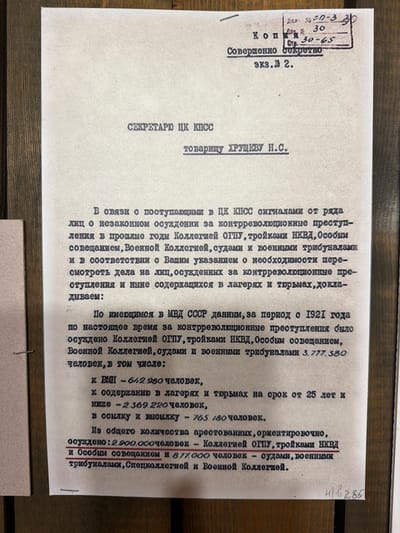
The image shows a document with Russian text. The document appears to be a formal letter or report, with a stamp at the top right corner and a handwritten number at the bottom right. The text discusses criminal convictions and the legal system in the Soviet Union. There is no information in the image that relates to the city of Ust'-Pyzas, Russia. The document itself is the sole subject of the image, presented against a wooden background.
Ust'-Pyzas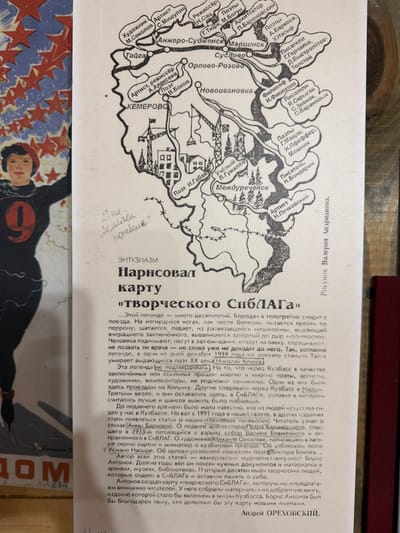
The image contains a map with text, likely a newspaper clipping, displaying a hand-drawn map of a region in Russia. The map highlights various cities and towns, including "Анжеро-Судженск", "Мариинск", "Тайга", "КЕМЕРОВО", "Новоивановка", "Межреченск", and "Суслово". Locations are labeled with professions like "Художник", "Артист", "Режиссёр", "Поэт", "Философ", and "Писатель", followed by names. Some areas are depicted with industrial elements like cranes. The text describes a "карту «творческого СибЛАГа»" (map of the "creative SibLAGa"). The clipping also mentions "Кузбасс", "СибЛАГ", and specific dates like "1939 года". There is also a handwritten inscription at the top left corner which appears to be in Russian. The lower right corner of the clipping has a byline that reads "Рисунок Валерия Андрианова." (Drawing by Valery Andrianov). The overall setting is a printed document with handwritten additions. The image does not depict the city of Ust'-Pyzas.
Ust'-Pyzas