
Stake attention in this memory
physics
Hooke's Law
spectroscopy
diatomic molecule
vibrational motion
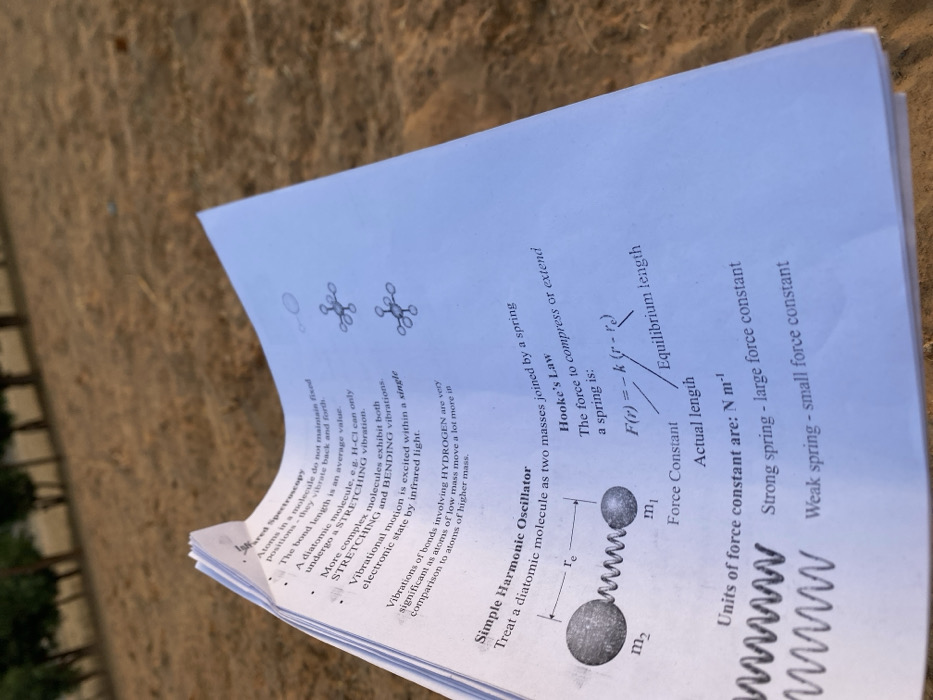
The image displays a page explaining infrared spectroscopy and simple harmonic oscillators. It states that atoms in a molecule vibrate, and a diatomic molecule can only undergo stretching vibrations. More complex molecules exhibit both stretching and bending vibrations. Vibrational motion is excited by infrared light, and vibrations involving hydrogen are significant due to the low mass of hydrogen. A simple harmonic oscillator treats a diatomic molecule as two masses joined by a spring, following Hooke's Law: F(r) = -k(r-rₑ). The units of the force constant are N/m, and it illustrates strong and weak springs as representing large and small force constants.
Loading AttnAds…
transactions
revenues
stakers
Earliest
Latest
Highest stake
No transactions found