Sign in
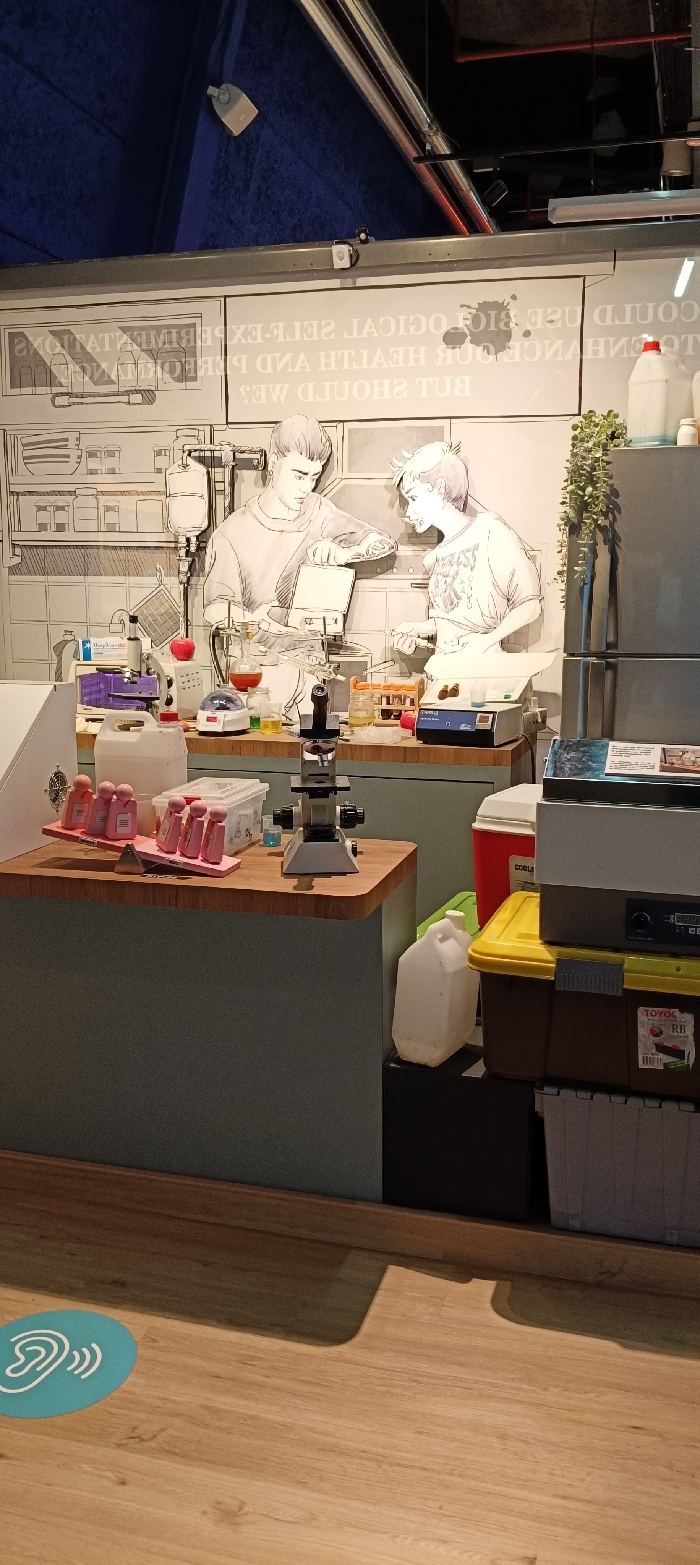
This image depicts an interior exhibit at the ArtScience Museum in Singapore, specifically designed as a faux laboratory setting.

The background features a large black-and-white line-art mural on a white wall, illustrating two stylized individuals, a male and a female, both with visible tattoos, engaged in scientific activities within a laboratory environment. Inverted text at the top of the mural reads "BIOLOGICAL SELF-EX...", "OUR HEALTH AND PERS...", and "BUT SHOULD WE?."

In the foreground, a light wood-toned counter rests on a light blue-grey cabinet base. On the counter, from left to right, a large white plastic carboy with a pink cap is present, followed by a pink tiered display holding five small, human-shaped pink bottles. A clear plastic container is positioned behind them. A black microscope is centrally placed, with a small beaker containing blue liquid to its left. Various laboratory glassware, including beakers with red, yellow, and green liquids, and test tube racks with multiple test tubes, are arranged alongside analytical instruments, one featuring small vials and a red apple. To the far right of the counter, a potted green plant with cascading leaves and a white plastic bottle with a red cap are visible next to a grey cabinet structure.

The light wood laminate floor displays a circular light blue decal with a white ear symbol and radiating sound waves in the lower-left corner, indicating an audio interaction point. To the right of the counter, a vertical stack of storage containers includes a red cooler with a white lid, a yellow plastic bin, a brown plastic bin with a red label, and a grey plastic bin at the base. A white plastic jerry can is positioned on a dark surface in front of the stack. Overhead, dark blue fabric or acoustic panels are visible, along with exposed structural beams and industrial-style lighting fixtures.
FM-uHS2K2

Jul 13, 2025

Singapore, Singapore

Stake attention in this memory

Curiosity
Intrigue
Thoughtfulness
Scientific
Inquisitive

This image depicts an interior exhibit at the ArtScience Museum in Singapore, specifically designed as a faux laboratory setting. The background features a large black-and-white line-art mural on a white wall, illustrating two stylized individuals, a male and a female, both with visible tattoos, engaged in scientific activities within a laboratory environment. Inverted text at the top of the mural reads "BIOLOGICAL SELF-EX...", "OUR HEALTH AND PERS...", and "BUT SHOULD WE?." In the foreground, a light wood-toned counter rests on a light blue-grey cabinet base. On the counter, from left to right, a large white plastic carboy with a pink cap is present, followed by a pink tiered display holding five small, human-shaped pink bottles. A clear plastic container is positioned behind them. A black microscope is centrally placed, with a small beaker containing blue liquid to its left. Various laboratory glassware, including beakers with red, yellow, and green liquids, and test tube racks with multiple test tubes, are arranged alongside analytical instruments, one featuring small vials and a red apple. To the far right of the counter, a potted green plant with cascading leaves and a white plastic bottle with a red cap are visible next to a grey cabinet structure. The light wood laminate floor displays a circular light blue decal with a white ear symbol and radiating sound waves in the lower-left corner, indicating an audio interaction point. To the right of the counter, a vertical stack of storage containers includes a red cooler with a white lid, a yellow plastic bin, a brown plastic bin with a red label, and a grey plastic bin at the base. A white plastic jerry can is positioned on a dark surface in front of the stack. Overhead, dark blue fabric or acoustic panels are visible, along with exposed structural beams and industrial-style lighting fixtures.

transactions
revenues
stakers
Earliest
Latest
Highest stake

No transactions found

More from this user

More from Singapore

FM-uHS2K2

Jul 13, 2025

Singapore, Singapore

Licensed under Creative Commons Attribution 4.0 International License. You are free to share and adapt this content with proper attribution.