Stake attention in this memory
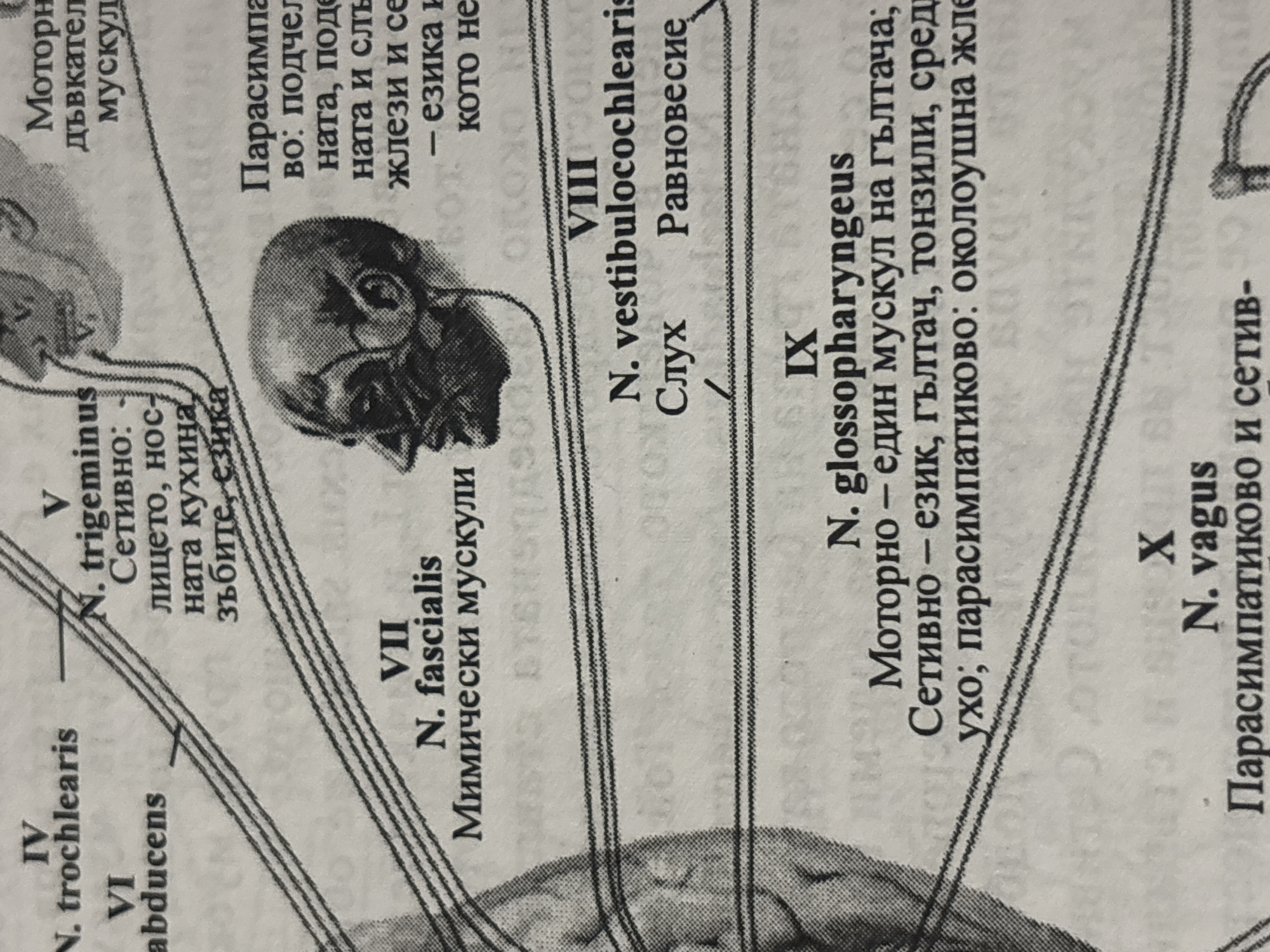
This media file displays a page from an anatomical or medical textbook, rotated approximately 90 degrees counter-clockwise. The page illustrates cranial nerves with a stylized diagram of a human head and brainstem, showing neural pathways as lines. The text, written in Bulgarian, details various cranial nerves by their Roman numeral and Latin names, followed by descriptions of their functions (motor, sensory, parasympathetic) and associated body parts. Visible text includes: * **N. trochlearis (IV)** and **N. abducens (VI)**, listed by name. * **N. trigeminus (V):** Described as having sensory functions for the face, nasal cavity, teeth, and tongue. Motor functions are noted for the muscles of mastication (дъвкателни мускули). * **N. fascialis (VII):** Controls facial muscles (мимически мускули). Parasympathetic functions for the submandibular, sublingual, and lacrimal glands, and sensory (taste) for the tongue and soft palate are also attributed to this nerve. * **N. vestibulocochlearis (VIII):** Associated with hearing (Слух) and balance (Равновесие). * **N. glossopharyngeus (IX):** Its motor function involves one muscle of the pharynx. Sensory functions include the tongue, pharynx, tonsils, and middle ear. Parasympathetic innervation is described for the parotid gland (околоушна жлеза). * **N. vagus (X):** Listed as having parasympathetic and sensory functions, with the rest of the description cut off. The image is a black and white print, showing typical textbook diagram style. The overall context is educational, likely from a Bulgarian source, given the language.
Symbol
44577
Volume
504
Creator
+$0.00
Revenue
+$0.00
TVL
$0.02
Loading AttnAds…
More from this user
More from Pleven