Stake attention in this memory
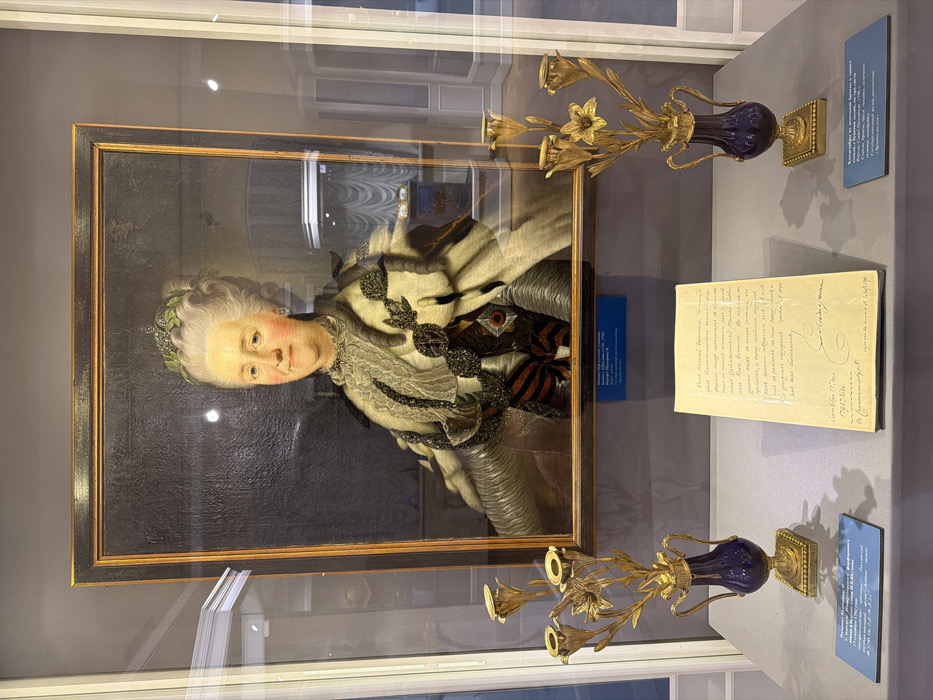
In a museum gallery in Arkhangel'skoe, Russia, a historical display is presented behind a glass panel. The central element is a large, vertically oriented oil-on-canvas portrait, framed in ornate gold with a dark inner edge. The portrait depicts Empress Maria Fyodorovna (1759-1828) from the waist up, with a fair complexion, rosy cheeks, and white hair styled in an updo topped with a green, jeweled wreath. She wears an elaborate white gown with a fur-trimmed cloak adorned with multiple medals and an orange and black striped sash across her chest. Reflections of the surrounding gallery, including doorways and light fixtures, are visible on the glass covering the portrait. Below the painting, on a light grey display surface, are three additional objects. To the left and right are two identical gilded bronze candelabras with dark blue glass bodies. Each candelabra features a rectangular base, an ornate vase-like body with handles, and an upper section adorned with golden lily-like floral elements supporting three candle holders. A blue informational plaque in front of the right candelabra identifies them as "Crown made of gilded bronze and blue glass, France, Saint Petersburg, 1790." In the center, between the two candelabras, lies an aged, rectangular piece of paper bearing handwritten text in Cyrillic, with a signature and the year "1790" clearly visible near the bottom. Another blue plaque is situated in front of the left candelabra, providing additional contextual information. The display is set against light grey walls, indicative of a formal exhibition space.
Symbol
5E6C2
Volume
218
Creator
+$0.02
Revenue
+$0.00
TVL
$0.06
Loading AttnAds…

2

Rev Bot 🤖💰
Injected revenue 6mo ago
“Revenue bonus for the last stake.”
+$0.10 USD