
Sign in
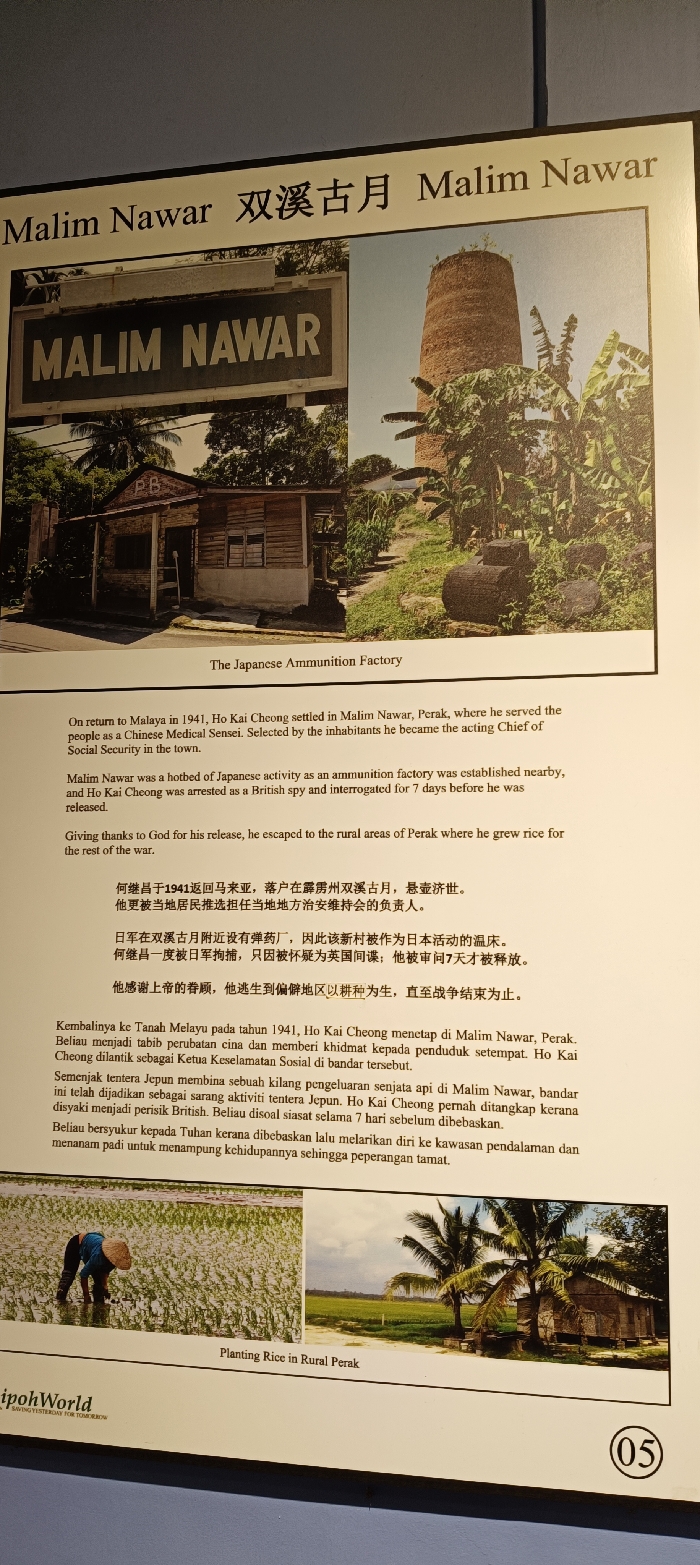
The image displays an informational panel, likely from a museum or historical exhibition, providing details about a location called Malim Nawar. The panel is structured with a title at the top, followed by two main historical photographs, then three blocks of text in different languages, and finally two smaller photographs at the bottom. The top header of the panel reads "Malim Nawar 双溪古月 Malim Nawar" in English and Chinese characters. Below the header, two photographs illustrate the historical context. The left photograph shows a rustic, single-story wooden building with a corrugated roof, situated in a somewhat overgrown area. A sign above the building clearly reads "MALIM NAWAR". The right photograph depicts a tall, brick, cylindrical structure, possibly an old kiln or chimney, partially covered in green vegetation, set against a bright sky. Surrounding the structure are various lush green plants and trees, including banana plants. A caption below these two main images identifies them as "The Japanese Ammunition Factory". Beneath these images, three distinct text blocks present the same historical narrative in English, Chinese, and Malay, respectively. The English text block describes Ho Kai Cheong's return to Malaya in 1941, his settlement in Malim Nawar, Perak, where he served as a Chinese Medical Sensei and became the acting Chief of Social Security. It further explains that Malim Nawar was a site of significant Japanese activity due to an ammunition factory, leading to Ho Kai Cheong's arrest as a suspected British spy and his interrogation for seven days before his release. The text concludes by stating that he escaped to rural areas of Perak to grow rice for the remainder of the war, giving thanks to God for his release. The Chinese text block, mirroring the English, details "何继昌" (Ho Kai Cheong)'s return to Malaysia in 1941, his settlement in "霹雳州双溪古月" (Malim Nawar, Perak), where he practiced medicine and was chosen by locals to lead social security. It mentions the Japanese establishing an ammunition factory near Malim Nawar, making it a hub for Japanese activities. Ho Kai Cheong was arrested by the Japanese military, suspected of being a British spy, and released after seven days of interrogation. He then thanked God for his release and moved to remote areas to farm until the war ended. The Malay text block provides the same narrative: "Kembalinya ke Tanah Melayu pada tahun 1941, Ho Kai Cheong menetap di Malim Nawar, Perak. Beliau menjadi tabib perubatan cina dan memberi khidmat kepada penduduk setempat. Ho Kai Cheong dilantik sebagai Ketua Keselamatan Sosial di bandar tersebut. Semenjak tentera Jepun membina sebuah kilang pengeluaran senjata api di Malim Nawar, bandar ini telah dijadikan sebagai sarang aktiviti tentera Jepun. Ho Kai Cheong pernah ditangkap kerana disyaki menjadi perisik British. Beliau disoal siasat selama 7 hari sebelum dibebaskan. Beliau bersyukur kepada Tuhan kerana dibebaskan lalu melarikan diri ke kawasan pendalaman dan menanam padi untuk menampung kehidupannya sehingga peperangan tamat." Finally, at the bottom of the panel, two smaller photographs are displayed side-by-side. The left one shows a person, wearing a conical straw hat, bent over in a flooded rice paddy, actively engaged in planting or working with young rice shoots. The right photograph features a simple, rustic wooden house with a sloping roof, surrounded by tall palm trees, situated next to a wide, green field under a partially cloudy sky. A caption below these two images reads "Planting Rice in Rural Perak". In the bottom left corner of the panel, the logo "ipohWorld" with the tagline "SAVING YESTERDAY FOR TOMORROW" is visible. In the bottom right corner, the number "05" is circled.The image displays an informational board from a historical exhibition or museum. The top section of the board features the title "Malim Nawar 双溪古月 Malim Nawar", presented in both English and Chinese characters. Below the title, two historical photographs are shown. The left photograph captures a rustic, single-story wooden building with a corrugated metal roof, typical of older rural structures. A clear sign above the building reads "MALIM NAWAR". The surrounding area appears to be overgrown with trees and foliage. The right photograph depicts a tall, weathered brick structure, possibly an old kiln or chimney, partially covered in green vegetation, set against a bright, slightly cloudy sky. Lush tropical plants, including banana trees, grow around its base. A caption beneath these two images states, "The Japanese Ammunition Factory". The middle section of the board contains three blocks of text, presenting the same historical account in English, Chinese, and Malay, respectively. The English text block narrates the story of Ho Kai Cheong, who returned to Malaya in 1941 and settled in Malim Nawar, Perak. He served as a Chinese Medical Sensei and was appointed acting Chief of Social Security by the inhabitants. The text highlights Malim Nawar as a center of Japanese activity due to a nearby ammunition factory. Ho Kai Cheong was subsequently arrested as a suspected British spy, interrogated for seven days, and then released. Following his release, he escaped to rural areas of Perak, where he cultivated rice for the remainder of the war, giving thanks for his freedom. The Chinese and Malay text blocks provide translations of this same narrative, detailing Ho Kai Cheong's experiences in Malim Nawar, his encounters with the Japanese military, his arrest and release, and his subsequent life cultivating rice in rural Perak. The bottom section of the board features two more photographs related to rural life. The left image shows an individual wearing a traditional conical straw hat, bent over in a flooded rice paddy, actively engaged in planting or tending to young rice shoots. The right image displays a small, simple wooden house with a metal roof, nestled among tall palm trees, situated alongside a wide, green field under a bright, somewhat cloudy sky. A caption beneath these two images reads, "Planting Rice in Rural Perak". In the bottom left corner of the board, the "ipohWorld" logo is visible, accompanied by the tagline "SAVING YESTERDAY FOR TOMORROW". In the bottom right corner, a circled number "05" is present, likely indicating
FM-uHS2K2

Feb 4, 2026

Ipoh, Malaysia

Stake attention in this memory

historical site
Malim Nawar
ammunition factory
World War II
rural Perak

The image displays an informational panel, likely from a museum or historical exhibition, providing details about a location called Malim Nawar. The panel is structured with a title at the top, followed by two main historical photographs, then three blocks of text in different languages, and finally two smaller photographs at the bottom. The top header of the panel reads "Malim Nawar 双溪古月 Malim Nawar" in English and Chinese characters. Below the header, two photographs illustrate the historical context. The left photograph shows a rustic, single-story wooden building with a corrugated roof, situated in a somewhat overgrown area. A sign above the building clearly reads "MALIM NAWAR". The right photograph depicts a tall, brick, cylindrical structure, possibly an old kiln or chimney, partially covered in green vegetation, set against a bright sky. Surrounding the structure are various lush green plants and trees, including banana plants. A caption below these two main images identifies them as "The Japanese Ammunition Factory". Beneath these images, three distinct text blocks present the same historical narrative in English, Chinese, and Malay, respectively. The English text block describes Ho Kai Cheong's return to Malaya in 1941, his settlement in Malim Nawar, Perak, where he served as a Chinese Medical Sensei and became the acting Chief of Social Security. It further explains that Malim Nawar was a site of significant Japanese activity due to an ammunition factory, leading to Ho Kai Cheong's arrest as a suspected British spy and his interrogation for seven days before his release. The text concludes by stating that he escaped to rural areas of Perak to grow rice for the remainder of the war, giving thanks to God for his release. The Chinese text block, mirroring the English, details "何继昌" (Ho Kai Cheong)'s return to Malaysia in 1941, his settlement in "霹雳州双溪古月" (Malim Nawar, Perak), where he practiced medicine and was chosen by locals to lead social security. It mentions the Japanese establishing an ammunition factory near Malim Nawar, making it a hub for Japanese activities. Ho Kai Cheong was arrested by the Japanese military, suspected of being a British spy, and released after seven days of interrogation. He then thanked God for his release and moved to remote areas to farm until the war ended. The Malay text block provides the same narrative: "Kembalinya ke Tanah Melayu pada tahun 1941, Ho Kai Cheong menetap di Malim Nawar, Perak. Beliau menjadi tabib perubatan cina dan memberi khidmat kepada penduduk setempat. Ho Kai Cheong dilantik sebagai Ketua Keselamatan Sosial di bandar tersebut. Semenjak tentera Jepun membina sebuah kilang pengeluaran senjata api di Malim Nawar, bandar ini telah dijadikan sebagai sarang aktiviti tentera Jepun. Ho Kai Cheong pernah ditangkap kerana disyaki menjadi perisik British. Beliau disoal siasat selama 7 hari sebelum dibebaskan. Beliau bersyukur kepada Tuhan kerana dibebaskan lalu melarikan diri ke kawasan pendalaman dan menanam padi untuk menampung kehidupannya sehingga peperangan tamat." Finally, at the bottom of the panel, two smaller photographs are displayed side-by-side. The left one shows a person, wearing a conical straw hat, bent over in a flooded rice paddy, actively engaged in planting or working with young rice shoots. The right photograph features a simple, rustic wooden house with a sloping roof, surrounded by tall palm trees, situated next to a wide, green field under a partially cloudy sky. A caption below these two images reads "Planting Rice in Rural Perak". In the bottom left corner of the panel, the logo "ipohWorld" with the tagline "SAVING YESTERDAY FOR TOMORROW" is visible. In the bottom right corner, the number "05" is circled.The image displays an informational board from a historical exhibition or museum. The top section of the board features the title "Malim Nawar 双溪古月 Malim Nawar", presented in both English and Chinese characters. Below the title, two historical photographs are shown. The left photograph captures a rustic, single-story wooden building with a corrugated metal roof, typical of older rural structures. A clear sign above the building reads "MALIM NAWAR". The surrounding area appears to be overgrown with trees and foliage. The right photograph depicts a tall, weathered brick structure, possibly an old kiln or chimney, partially covered in green vegetation, set against a bright, slightly cloudy sky. Lush tropical plants, including banana trees, grow around its base. A caption beneath these two images states, "The Japanese Ammunition Factory". The middle section of the board contains three blocks of text, presenting the same historical account in English, Chinese, and Malay, respectively. The English text block narrates the story of Ho Kai Cheong, who returned to Malaya in 1941 and settled in Malim Nawar, Perak. He served as a Chinese Medical Sensei and was appointed acting Chief of Social Security by the inhabitants. The text highlights Malim Nawar as a center of Japanese activity due to a nearby ammunition factory. Ho Kai Cheong was subsequently arrested as a suspected British spy, interrogated for seven days, and then released. Following his release, he escaped to rural areas of Perak, where he cultivated rice for the remainder of the war, giving thanks for his freedom. The Chinese and Malay text blocks provide translations of this same narrative, detailing Ho Kai Cheong's experiences in Malim Nawar, his encounters with the Japanese military, his arrest and release, and his subsequent life cultivating rice in rural Perak. The bottom section of the board features two more photographs related to rural life. The left image shows an individual wearing a traditional conical straw hat, bent over in a flooded rice paddy, actively engaged in planting or tending to young rice shoots. The right image displays a small, simple wooden house with a metal roof, nestled among tall palm trees, situated alongside a wide, green field under a bright, somewhat cloudy sky. A caption beneath these two images reads, "Planting Rice in Rural Perak". In the bottom left corner of the board, the "ipohWorld" logo is visible, accompanied by the tagline "SAVING YESTERDAY FOR TOMORROW". In the bottom right corner, a circled number "05" is present, likely indicating

transactions
revenues
stakers
Earliest
Latest
Highest stake

No transactions found

More from this user

More from Ipoh

FM-uHS2K2

Feb 4, 2026

Ipoh, Malaysia

Licensed under Creative Commons Attribution 4.0 International License. You are free to share and adapt this content with proper attribution.