
Sign in
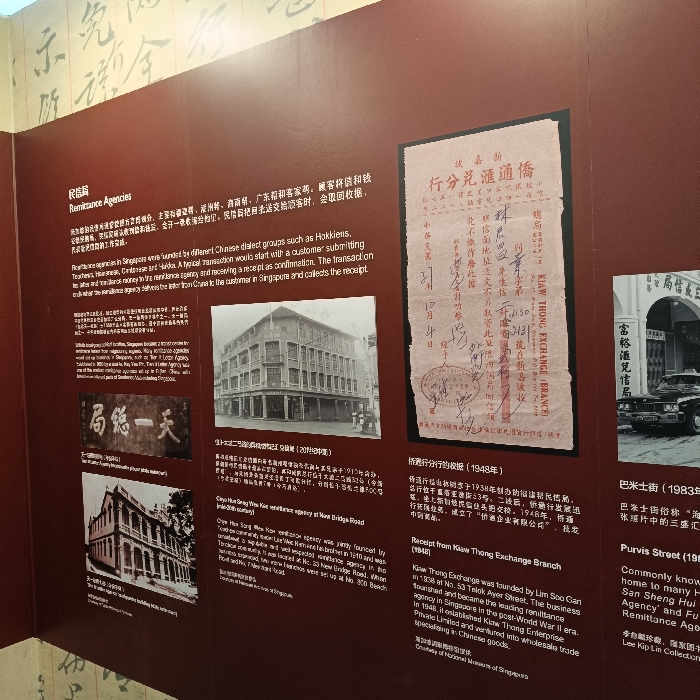
This museum exhibit wall displays historical information and artifacts related to "Remittance Agencies" (民信局) in Singapore. The central panel, titled "Remittance Agencies," explains in both English and Chinese how these agencies, founded by different Chinese dialect groups such as Hokkiens, Teochews, Cantonese, and Hakkas, facilitated money and letter transfers from China to immigrants in Singapore, involving receipts for confirmation.

Below this main text are two black-and-white photographs of buildings. One depicts the "Caya Hor Siang Wee Kee remittance agency at New Bridge Road," noted to have been founded in 1910. Another image shows a different old building (possibly 20th century). An old signboard with the Chinese characters "局總一天" (Ju Zong Yi Tian) is also visible.

To the right, a prominent display features a "Receipt from Kiaw Thong Exchange Branch (1948)" (侨汇通侨行分行的收据 (1948年)). The accompanying text details that Kiaw Thong Exchange was founded by Lim Soo Gan in 1938 at 53 Telok Ayer Street, flourishing after World War II, and established Kiaw Thong Enterprise Private Limited in 1948 to venture into wholesale trade of Chinese goods. The receipt itself bears "KIAW THONG EXCHANGE (BRANCH)" and specific Chinese text and dates.

Further to the right, a panel discusses "Purvis Street (1983)" (巴米士街(1983年)), describing it as commonly known as "Money Changer Street" and home to many remittance agencies like "San Sheng Hui Agency" and "Fu Remittance Agency." A photograph from 1983, from the Lee Kip Lin Collections, shows an old shopfront on Purvis Street with vehicles parked in front. The exhibit is well-lit, typical of an indoor museum setting.
FM-uHS2K2

Jan 29, 2025

Singapore, Singapore

Stake attention in this memory

This museum exhibit wall displays historical information and artifacts related to "Remittance Agencies" (民信局) in Singapore. The central panel, titled "Remittance Agencies," explains in both English and Chinese how these agencies, founded by different Chinese dialect groups such as Hokkiens, Teochews, Cantonese, and Hakkas, facilitated money and letter transfers from China to immigrants in Singapore, involving receipts for confirmation. Below this main text are two black-and-white photographs of buildings. One depicts the "Caya Hor Siang Wee Kee remittance agency at New Bridge Road," noted to have been founded in 1910. Another image shows a different old building (possibly 20th century). An old signboard with the Chinese characters "局總一天" (Ju Zong Yi Tian) is also visible. To the right, a prominent display features a "Receipt from Kiaw Thong Exchange Branch (1948)" (侨汇通侨行分行的收据 (1948年)). The accompanying text details that Kiaw Thong Exchange was founded by Lim Soo Gan in 1938 at 53 Telok Ayer Street, flourishing after World War II, and established Kiaw Thong Enterprise Private Limited in 1948 to venture into wholesale trade of Chinese goods. The receipt itself bears "KIAW THONG EXCHANGE (BRANCH)" and specific Chinese text and dates. Further to the right, a panel discusses "Purvis Street (1983)" (巴米士街(1983年)), describing it as commonly known as "Money Changer Street" and home to many remittance agencies like "San Sheng Hui Agency" and "Fu Remittance Agency." A photograph from 1983, from the Lee Kip Lin Collections, shows an old shopfront on Purvis Street with vehicles parked in front. The exhibit is well-lit, typical of an indoor museum setting.

transactions
revenues
stakers
Earliest
Latest
Highest stake

No transactions found

More from this user

More from Singapore

FM-uHS2K2

Jan 29, 2025

Singapore, Singapore

Licensed under Creative Commons Attribution 4.0 International License. You are free to share and adapt this content with proper attribution.