Stake attention in this memory
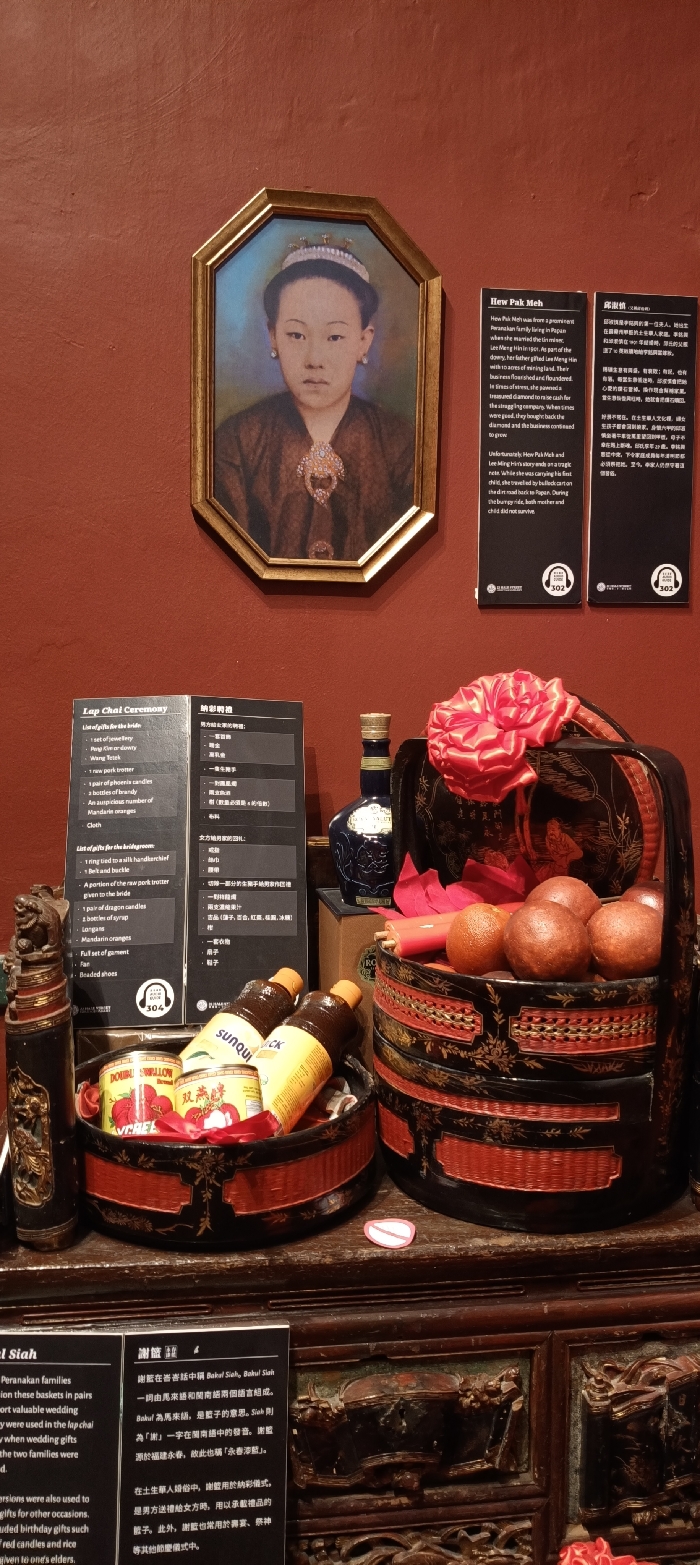
The image captures an indoor museum or exhibition display, predominantly featuring Peranakan cultural artifacts against a reddish-brown wall. At the upper center, a framed portrait of a woman hangs on the wall. The portrait is octagonal with a gold-colored frame. The woman, possibly of Peranakan ethnicity, has a light complexion and dark hair styled with a decorative headdress resembling a tiara or crown. She wears pearl earrings and a traditional dark-colored top adorned with an ornate, jeweled brooch at the collar. To the right of the portrait, two black information panels are displayed. The left panel, titled "Hew Pak Meh," provides text in English, describing her as a member of a prominent Peranakan family who married a tin miner, Lee Meng Hin, in 1908. It details her father's dowry of mining land, their business fortunes, and her act of pawning a treasured diamond during financial hardship. The text concludes with the tragic story of her and her unborn child's death during the Japanese Occupation while traveling by bullock cart. The right panel displays the same information in Chinese (titled "蘇佩媚"). Both panels have a headphones icon and the number "302" at the bottom, indicating an audio guide point. Below these wall displays, on a dark, ornately carved wooden table, two large, stacked baskets are presented. These are likely "Bakul Siah" (謝籃), traditional Peranakan wedding baskets, elaborately decorated with black lacquer, red accents, and gold intricate patterns. The basket on the left holds two bottles with yellow labels, one clearly visible as "SUNQUICK," and two canned goods, one marked "DOUBLE SWALLOW" (双燕) with an image of mangosteens. The basket on the right contains several round, brownish-orange fruits, possibly mandarin oranges, along with some red paper or fabric and what appear to be red candles. A large, red ribbon bow adorns the top of this right-hand basket. Behind the baskets, a dark blue bottle, possibly of liquor, is visible. A dark, carved wooden element stands to the far left of the baskets. On the wooden table, between the baskets, there is a small, white circular sticker with a red circle and a diagonal line, typically signifying "do not touch" or prohibition. Below the baskets, another set of information panels is displayed on the table. The left panel, titled "Lap Chai Ceremony," lists in English the traditional gifts exchanged between the bride and groom, including jewelry, dowry, various food items (like raw pork trotter, mandarin oranges), candles (phoenix for bride, dragon for groom), brandy, syrup, and clothing items. The right panel, titled "Bakul Siah / 謝籃," explains the origin and meaning of the baskets, combining Malay ("bakul" for basket) and Hokkien ("siah" for thank you). It details their use in Peranakan wedding customs for carrying gifts from the groom's family to the bride's, and for other festive occasions such as birthday celebrations and offerings. Both panels also include Chinese translations of the text. A headphones icon and the number "304" are visible at the bottom of these panels.
No transactions found