Sign in
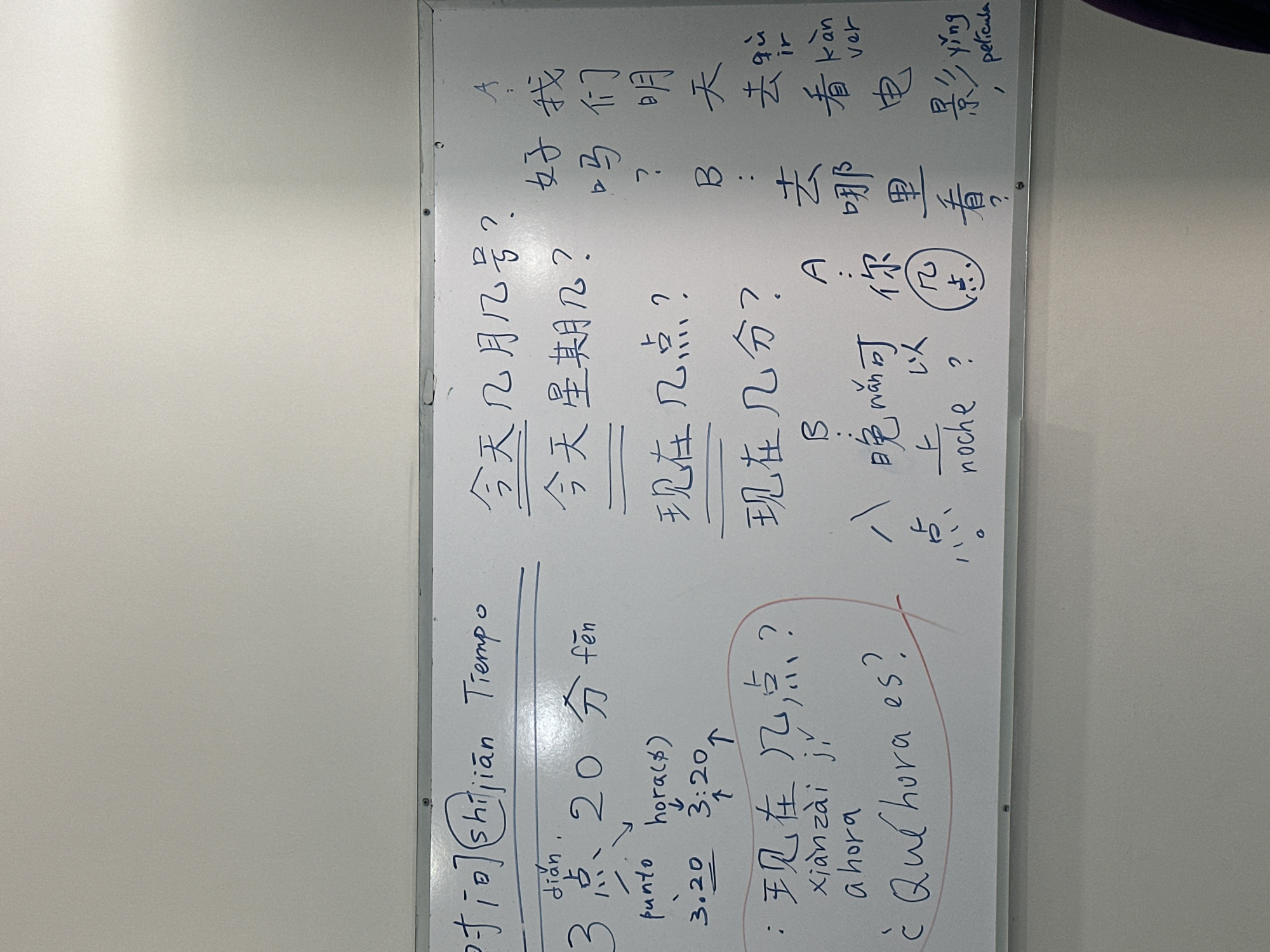
The image displays a whiteboard filled with handwritten notes in Chinese, accompanied by Pinyin, Spanish, and English annotations. The whiteboard is the main subject, presented in a portrait orientation.

On the left side, the topic "时间 (shíjiān) Tiempo" (Time) is written. Underneath, an example of telling time, "3点20分 fēn" (3 o'clock 20 minutes), is shown with annotations like "dian" (o'clock), "punto" (point), "hora($)" (hour), and numerical formats "3.20" and "3/20". A question, "现在几点? (xiàn zài jí diǎn)" (What time is it now?), is also present, with its Spanish translation "a hora ¿Qué hora es?" (now, What time is it?).

The right side of the whiteboard features several questions related to dates and time: "今天几月几号?" (What is the date today?), "今天星期几?" (What day of the week is today?), "现在几点?" (What time is it now?), and "现在几分?" (How many minutes is it now?).

Below these questions, there's a short dialogue labeled A and B.
A asks: "好 我们明天去看电影, 好 吗?" (How about we go watch a movie tomorrow, okay?), with annotations `ir` (go), `kan ver` (watch), and `ying pelicula` (movie).
B responds: "去 哪 里 看?" (Where do we go to watch?).
A then says: "你 几点" (You what time...), implying "At what time?".
B replies: "八 晚 nǎn" (Eight, evening), with "noche ?" (night?) annotated, followed by a separate question "可以?" (Is it okay?).

The board appears to be used in a language learning context, likely for teaching Chinese vocabulary and sentence structures related to time, dates, and making plans, with supporting translations for Spanish speakers. The handwriting is clear, suggesting it's from an instructor or for instructional purposes.
giny riccio

Apr 23, 2026, 5:19 PM

San Bernardino Tlaxcalancingo, Mexico

Stake attention in this memory

learning
academic
educational
planning
curiosity

The image displays a whiteboard filled with handwritten notes in Chinese, accompanied by Pinyin, Spanish, and English annotations. The whiteboard is the main subject, presented in a portrait orientation. On the left side, the topic "时间 (shíjiān) Tiempo" (Time) is written. Underneath, an example of telling time, "3点20分 fēn" (3 o'clock 20 minutes), is shown with annotations like "dian" (o'clock), "punto" (point), "hora($)" (hour), and numerical formats "3.20" and "3/20". A question, "现在几点? (xiàn zài jí diǎn)" (What time is it now?), is also present, with its Spanish translation "a hora ¿Qué hora es?" (now, What time is it?). The right side of the whiteboard features several questions related to dates and time: "今天几月几号?" (What is the date today?), "今天星期几?" (What day of the week is today?), "现在几点?" (What time is it now?), and "现在几分?" (How many minutes is it now?). Below these questions, there's a short dialogue labeled A and B. A asks: "好 我们明天去看电影, 好 吗?" (How about we go watch a movie tomorrow, okay?), with annotations `ir` (go), `kan ver` (watch), and `ying pelicula` (movie). B responds: "去 哪 里 看?" (Where do we go to watch?). A then says: "你 几点" (You what time...), implying "At what time?". B replies: "八 晚 nǎn" (Eight, evening), with "noche ?" (night?) annotated, followed by a separate question "可以?" (Is it okay?). The board appears to be used in a language learning context, likely for teaching Chinese vocabulary and sentence structures related to time, dates, and making plans, with supporting translations for Spanish speakers. The handwriting is clear, suggesting it's from an instructor or for instructional purposes.

Loading AttnAds…

transactions
revenues
stakers
Earliest
Latest
Highest stake

No transactions found

More from this user

More from San Bernardino Tlaxcalancingo

giny riccio

Apr 23, 2026, 5:19 PM

San Bernardino Tlaxcalancingo, Mexico

Licensed under Creative Commons Attribution 4.0 International License. You are free to share and adapt this content with proper attribution.