Ronda, Spain
30 memories from Ronda, Spain
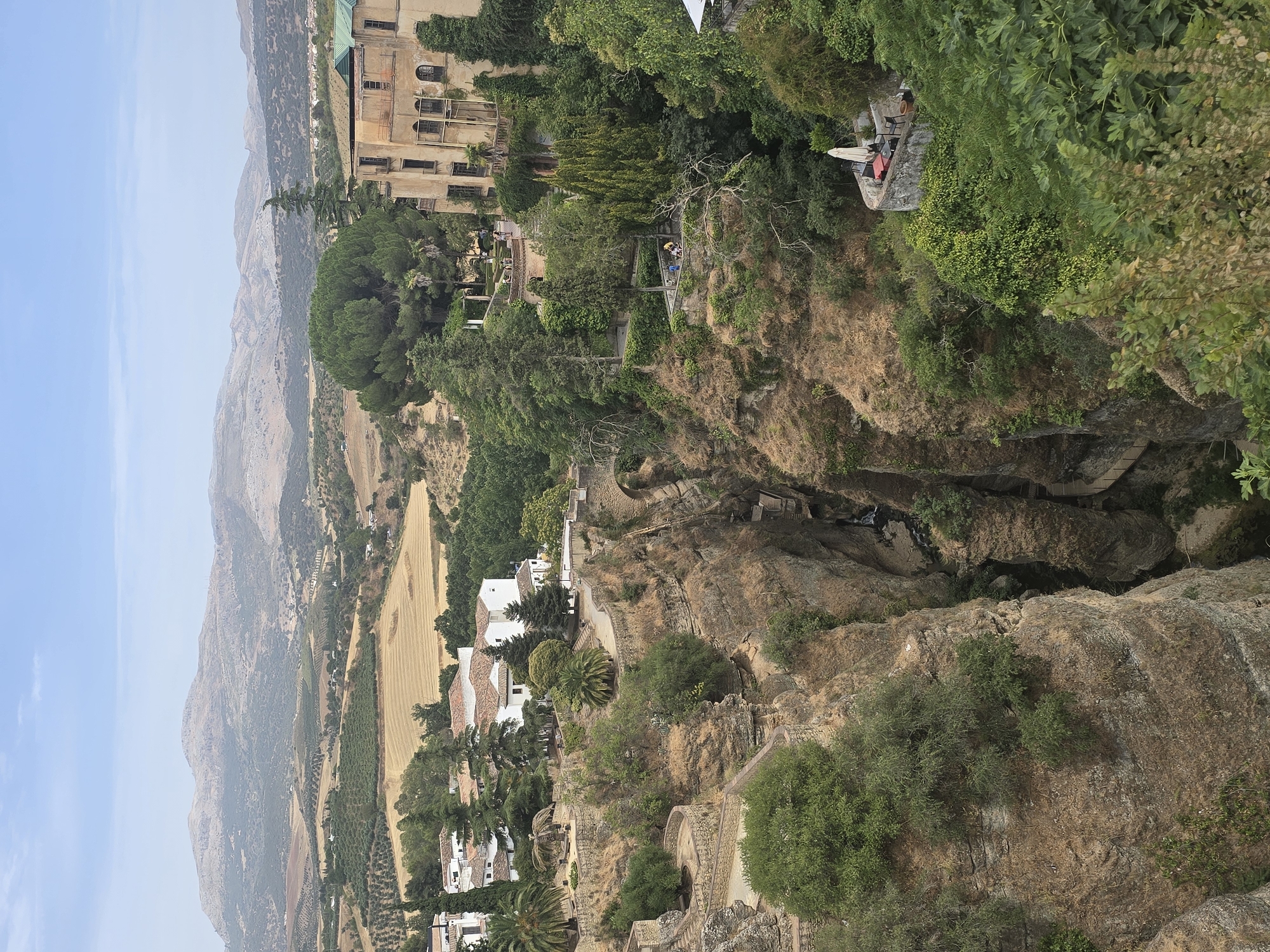
This is a high-angle, wide shot of the El Tajo gorge and Puente Nuevo bridge in Ronda, Spain. The gorge is a deep chasm with sheer, rocky sides that are partially covered with vegetation. The Puente Nuevo, a stone arch bridge, spans the gorge, connecting the old and new towns of Ronda. Buildings and terraced gardens are visible on the edges of the gorge. In the background, a vast, undulating landscape of agricultural fields, olive groves, and distant mountains under a hazy, blue sky. The scene appears tranquil and scenic, with no overt signs of distress.
Ronda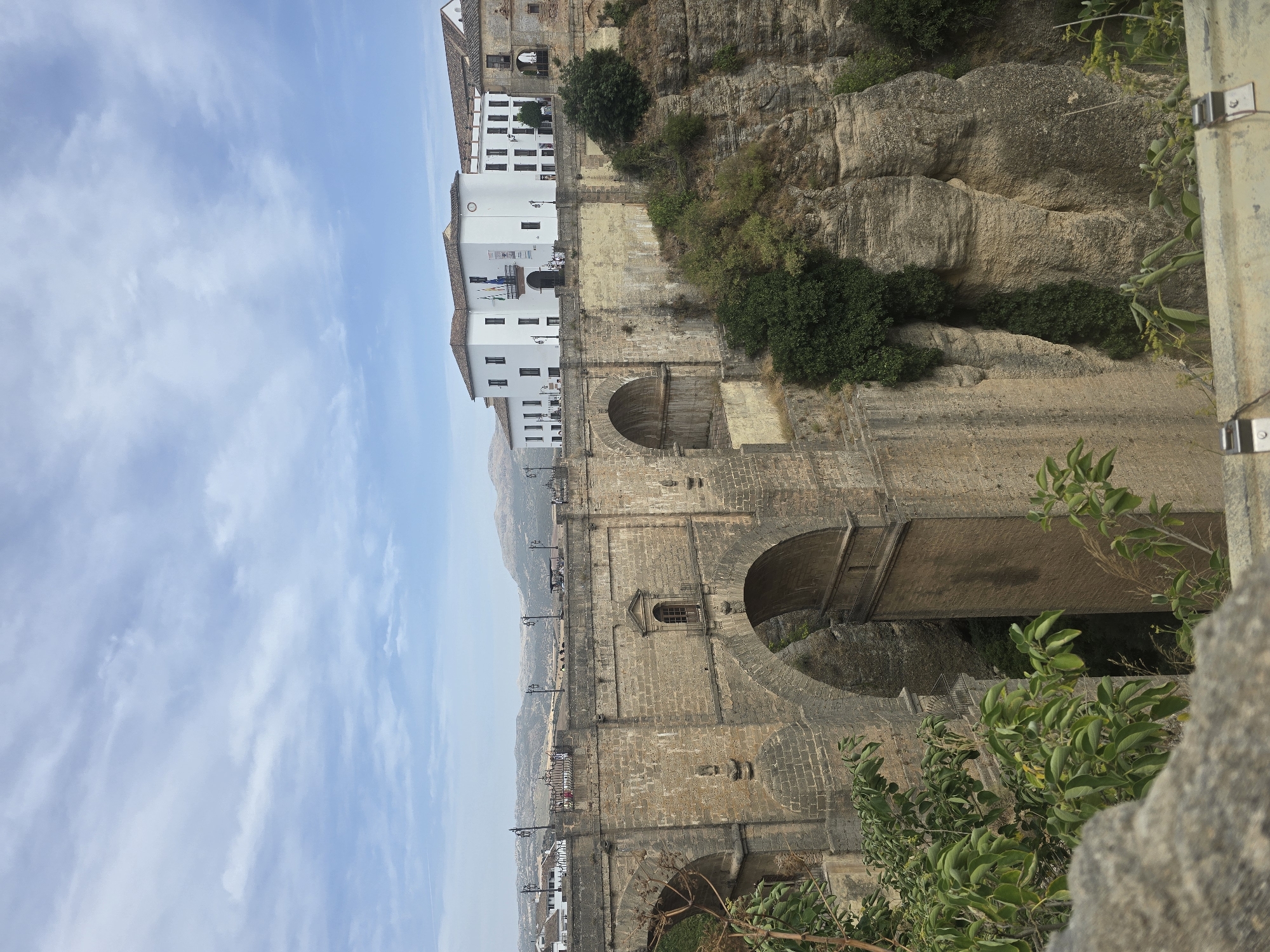
This image captures the Puente Nuevo (New Bridge) in Ronda, Spain, a city perched dramatically on the El Tajo gorge. The bridge, a monumental stone structure, features a large central arch and smaller arches. The rough-hewn stone of the bridge and the rugged, rocky cliffs beneath it are prominent. White buildings with tiled roofs are visible on the edge of the gorge, above the bridge, with flags flying from one of them. Lush green vegetation, including trees and vines, grows on the sides of the gorge and around the bridge, contrasting with the arid landscape in the distance. The sky above is a light blue with scattered white clouds. The foreground shows a stone wall and some green foliage, suggesting the vantage point of the photograph. No people are clearly visible in the image. The scene depicts a historic architectural marvel integrated into a dramatic natural landscape.
Ronda
The video shows a scenic overlook at sunset, with a railing in the foreground and a vast valley stretching out below. The sun is setting on the horizon, casting a warm glow over the landscape. The valley is dotted with trees, fields, and buildings, and a winding road can be seen in the distance. The camera pans slowly across the scene, capturing the beauty of the sunset and the surrounding countryside. The overall mood is peaceful and serene.
Ronda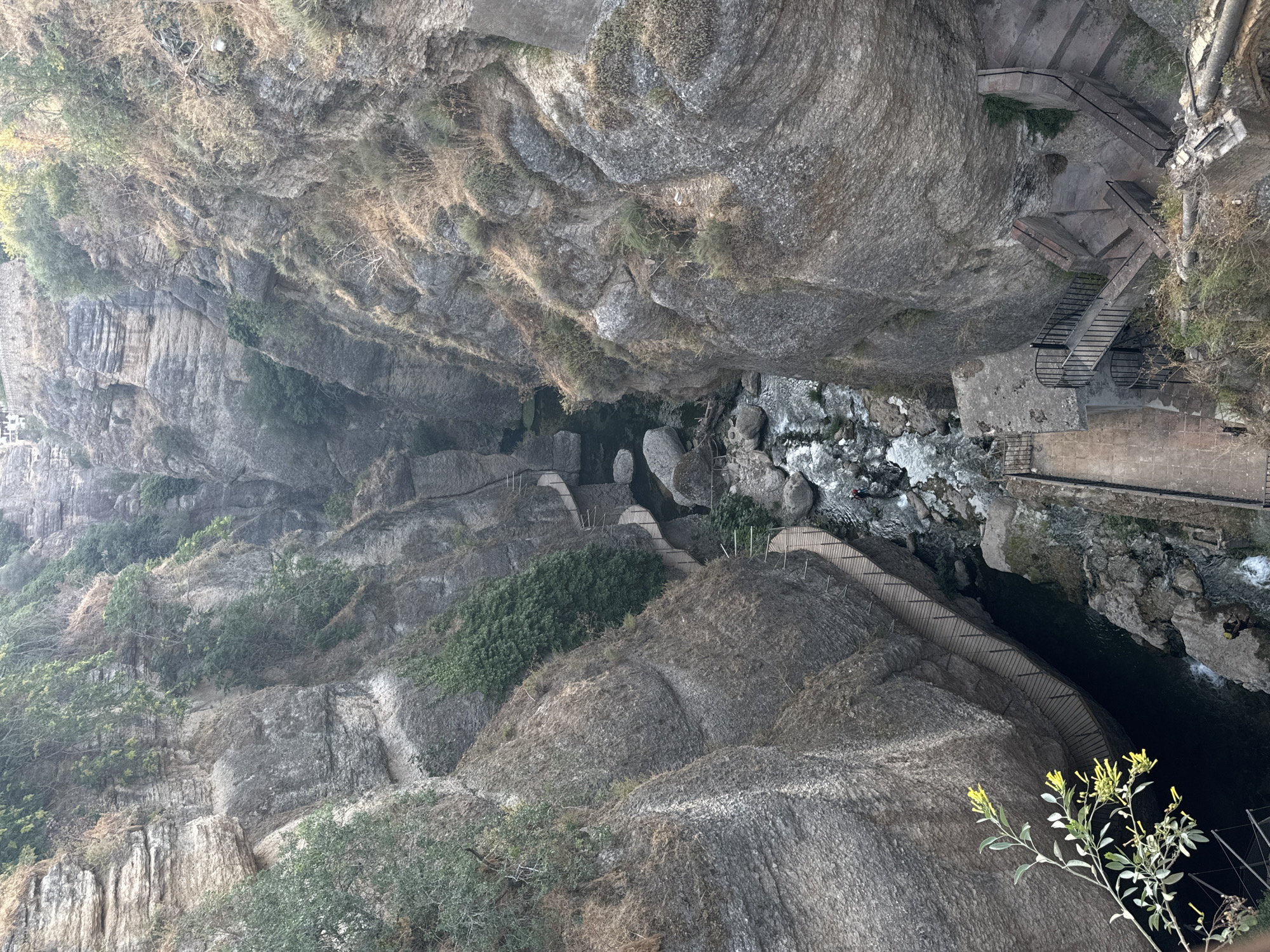
This media file captures a steep, natural landscape with man-made elements designed for accessibility. The primary subject is a dramatic cliff face and a deep gorge, with a dark, flowing body of water at its base. A series of long, winding staircases with metal railings are built into the side of the cliff, allowing passage down into the gorge. Some sections of the stairs appear to be constructed from wood, while others are stone. Sparse vegetation, including dry grasses and some green bushes, clings to the rocky surfaces, indicating a somewhat arid or rugged environment. In the upper portion of the image, there is a glimpse of a structured area, possibly a building or pathway, with stone steps and railings, suggesting human presence and development in the vicinity. Further down the gorge, the water is visible, with some rocky outcrops and small waterfalls creating a dynamic scene. A single, yellow-flowering plant is prominently featured in the foreground on the right, adding a splash of color to the otherwise muted tones of the rock and vegetation. The perspective is from a high vantage point, looking down into the gorge. The lighting suggests it is daytime, with shadows indicating the sun's position. The overall impression is one of a dramatic natural wonder with human intervention to create access and allow visitors to explore its depths. The scene evokes a sense of scale and the raw power of nature. There is no visible text in the media file. The location context provided (Ronda, Spain) is consistent with the characteristic features of the Puente Nuevo bridge and its surrounding gorge.
Ronda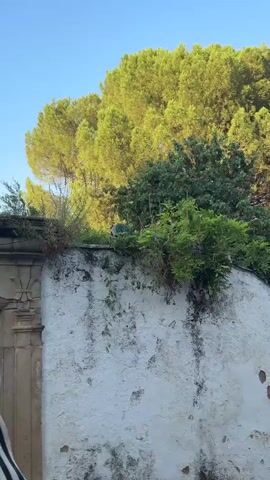
This video captures a peacock perched on a white, textured wall covered in moss and vines. The peacock, a vibrant blue and green, is the central subject. Behind the wall, lush green trees and foliage create a natural backdrop. The lighting suggests it is daytime, with sunlight dappling through the leaves. The scene appears to be outdoors in a natural or semi-natural setting. The peacock is stationary for most of the video, looking down and occasionally shifting its weight. There are no people or other animals visible. Two green signs with white text are partially visible on the wall in the lower right portion of the frame, but the text is too small to read clearly. The setting could be a garden, park, or an area with a mix of architecture and greenery. The overall mood is peaceful and serene, highlighting the beauty of the peacock in its natural environment. The location context of Ronda, Spain, might suggest an Andalusian garden or courtyard setting.
Ronda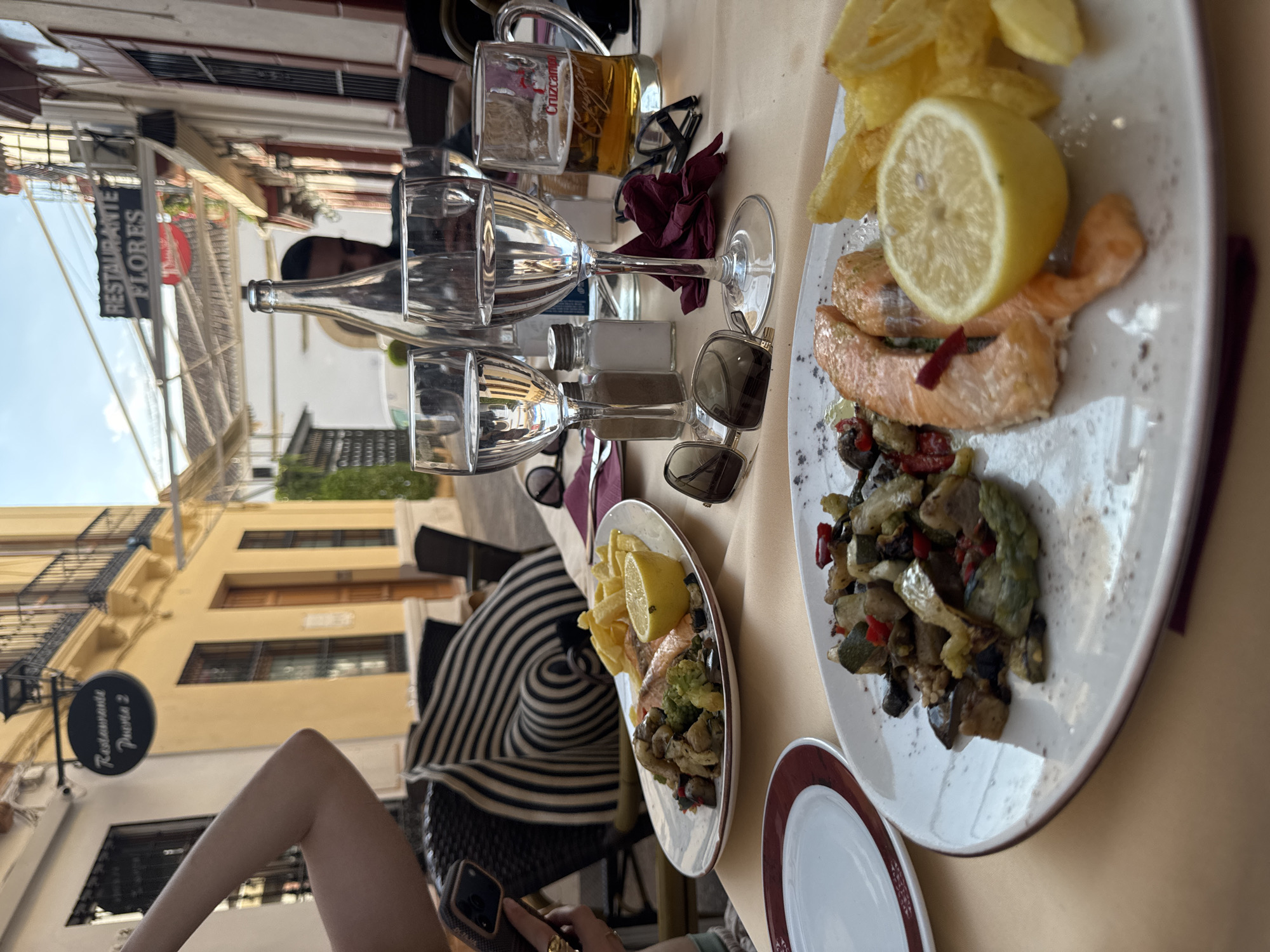
An outdoor dining scene is captured at street level in Ronda, Spain. The focus is on a table laden with food and drinks. In the foreground, two plates are visible. The plate on the left contains a serving of salmon with french fries and a lemon wedge, alongside a medley of roasted vegetables including eggplant, zucchini, and bell peppers. The plate on the right, partially visible, also holds roasted vegetables. Two wine glasses, one filled with water and another with an amber beverage that appears to be beer in a mug, are placed on the table. A salt and pepper shaker set and a crumpled red napkin complete the table setting. Behind the table, a person's arm is visible, holding a smartphone. Further back, in the blurred background, the facades of buildings line a narrow street, adorned with signage indicating restaurants: "Restaurante Puerta 2" and "RESTAURANTE FLORES". The architecture suggests a historic Spanish setting with yellow-painted walls and balconies. The lighting indicates it is daytime, possibly late afternoon, with soft sunlight illuminating the scene.
Ronda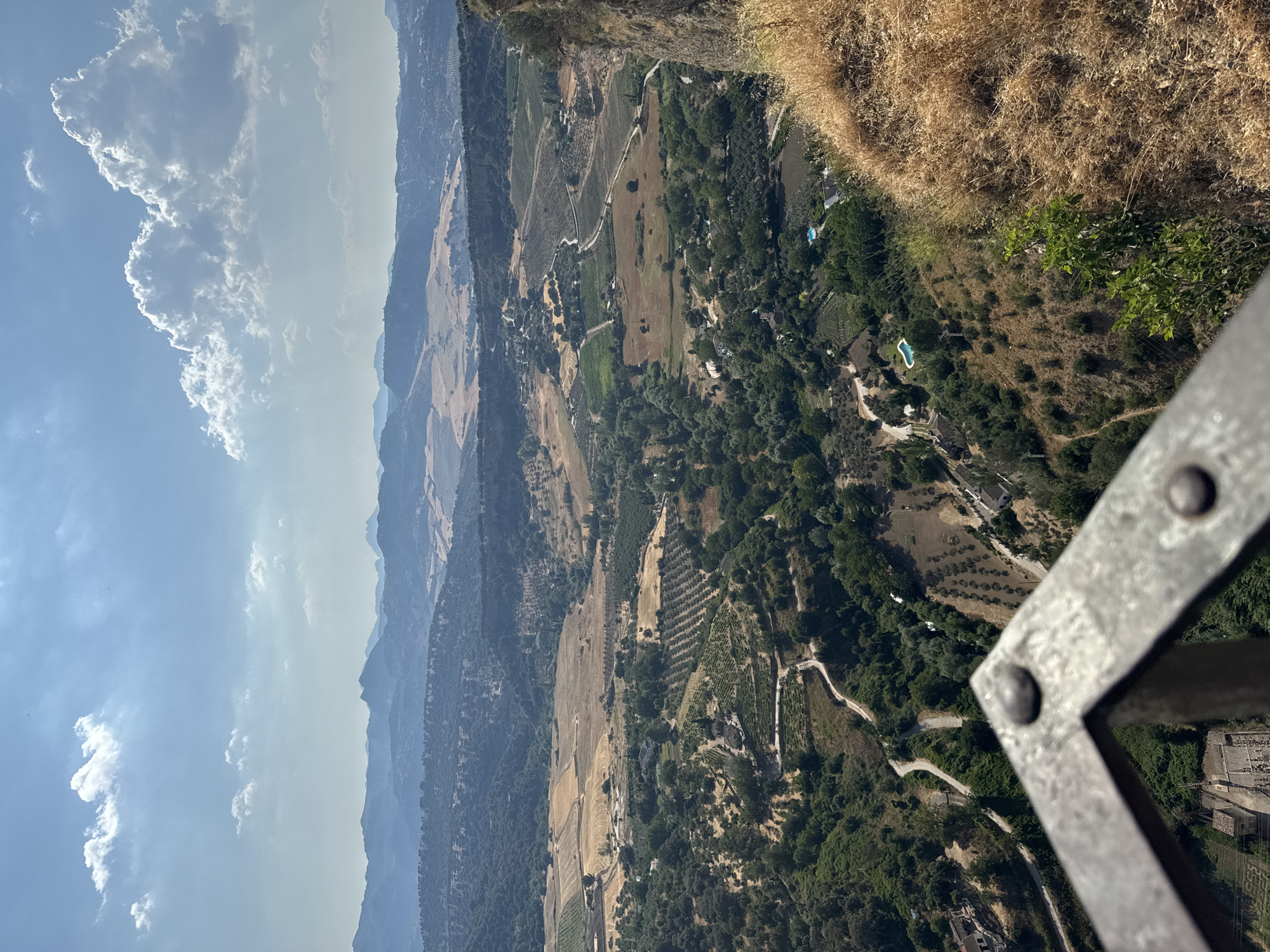
This is a landscape photograph taken from a high vantage point, likely a viewpoint or balcony, overlooking the Guadalevín River canyon in Ronda, Spain. In the foreground, a portion of a dark metal railing is visible, out of focus. The midground and background reveal a sprawling valley filled with agricultural fields, vineyards, and olive groves. Winding roads snake through the landscape, connecting scattered buildings and clusters of trees. A bright blue swimming pool is visible amongst the greenery in the valley. The terrain is hilly and dotted with various types of vegetation, ranging from dense green trees to dry, golden grasses on the slopes. In the far distance, a series of hazy blue mountain ranges stretch across the horizon under a bright, partly cloudy sky. The clouds are white and fluffy, with some larger formations contributing to the dynamic sky. The overall impression is one of a vast, sun-drenched rural landscape integrated with a dramatic geological feature. The lighting suggests it is daytime, likely mid-morning or afternoon, with bright sunlight illuminating the scene.
Ronda
A close-up, low-angle selfie taken outdoors in Ronda, Spain. A young man wearing sunglasses and a grey t-shirt smiles into the camera. Behind him, a vibrant bush with bright pink flowers is visible, along with green trees and a clear blue sky. The scene is illuminated by bright daylight.
Ronda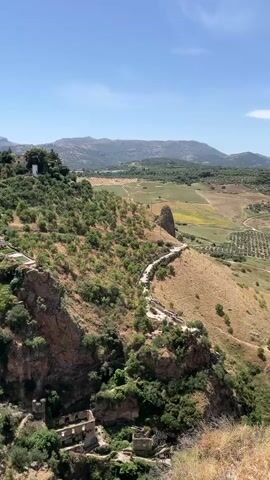
The video shows a panoramic view of a town perched on a cliffside. The town is characterized by white buildings with red-tiled roofs, typical of a Mediterranean architectural style. The buildings are situated along the edge of a steep, rocky cliff, with lush green vegetation growing on its slopes. Below the town, the landscape opens up to a valley with rolling hills, agricultural fields, and distant mountains under a clear blue sky. A winding path is visible on the side of the cliff, suggesting a way to access the town or explore the surrounding area. Some ruins of older structures are scattered on the lower parts of the cliff. The overall impression is one of a picturesque and historic settlement nestled within a dramatic natural setting.
Ronda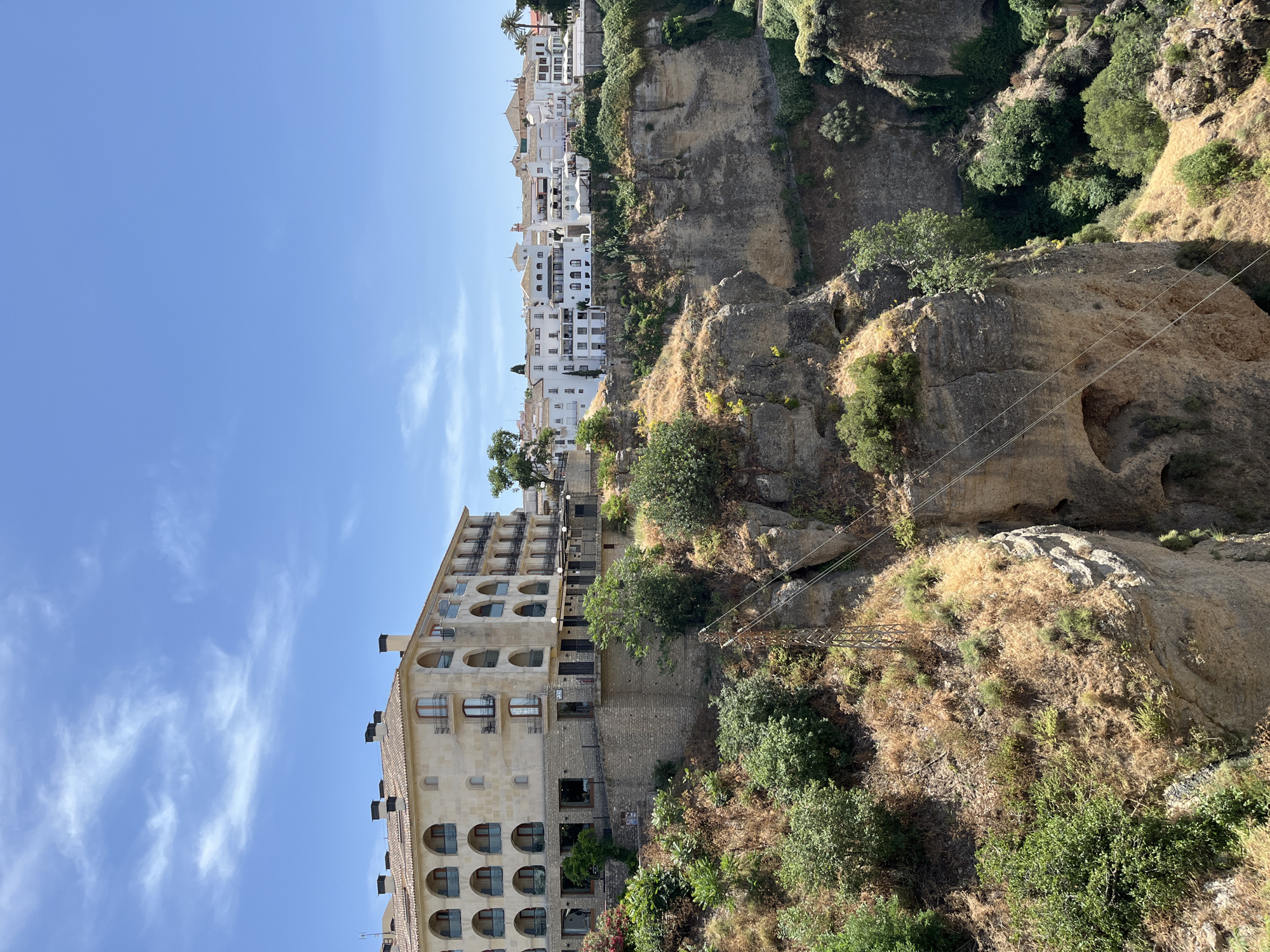
The image shows the Puente Nuevo bridge in Ronda, Spain, a historic stone bridge that spans the El Tajo gorge. The bridge is a popular tourist attraction and offers stunning views of the surrounding landscape. The bridge is made of stone and is about 120 meters long and 30 meters high. It was built in the 18th century and is a symbol of Ronda. The image also shows the city of Ronda, which is built on a hilltop overlooking the gorge. The city is home to a number of historic buildings, including the Alcazaba, a Moorish fortress, and the Plaza de Toros, a bullring. The image is taken from a high vantage point, looking down on the gorge and the bridge. The sky is blue and there are a few white clouds. The sun is shining and the weather is warm. The image is a beautiful and peaceful scene.
Ronda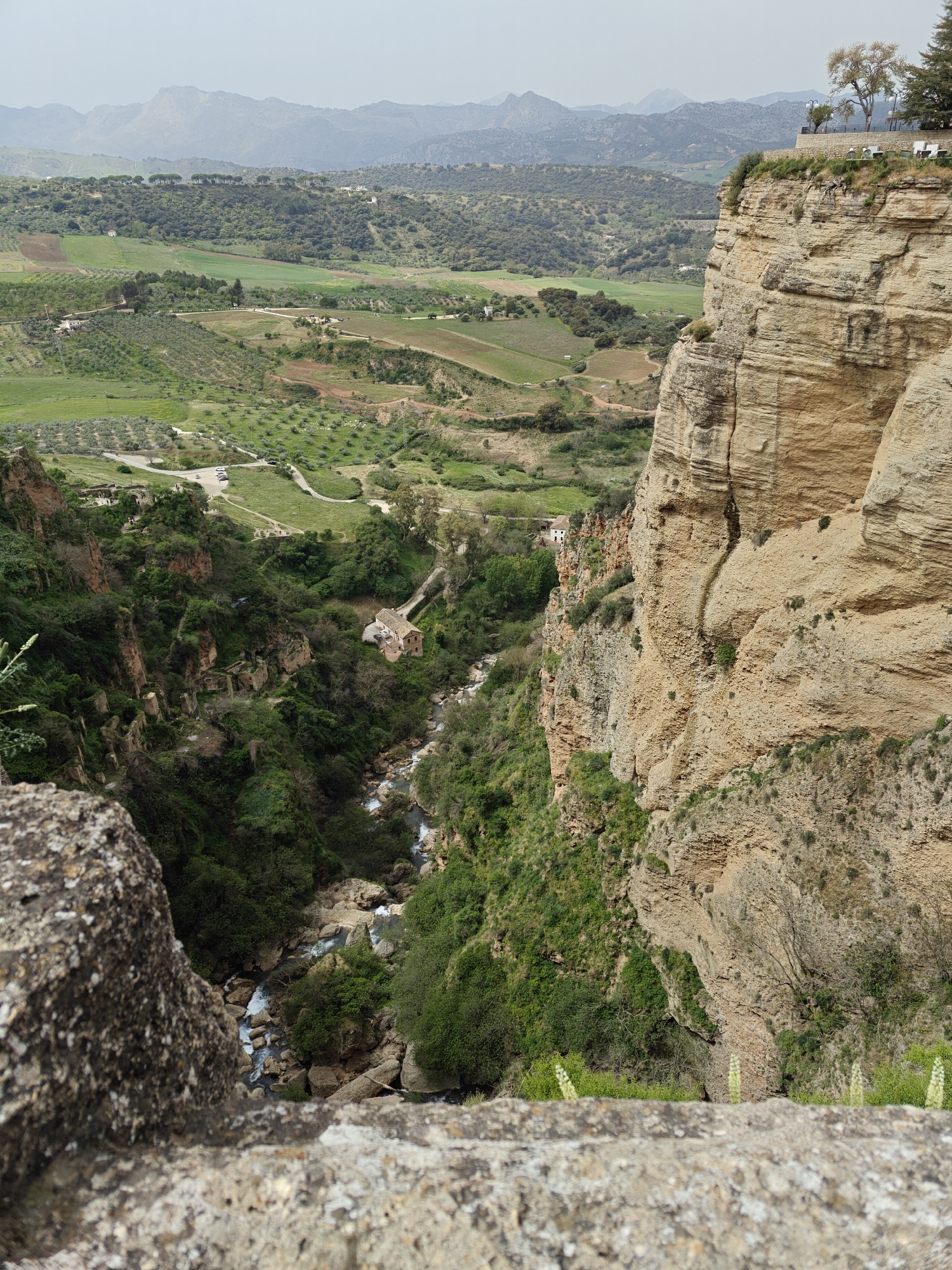
A long shot captures a verdant canyon and expansive landscape, presumably from Ronda, Spain. The rugged terrain is punctuated by a stream, its course marked by occasional white water. Buildings peek through the dense foliage along the stream's path. On the canyon's edge, a towering rock face shows layers of sedimentary rock. Across the canyon, a landscape of fields and forests unfolds, extending to distant mountains under a hazy sky. The foreground features a stone ledge, providing an immediate depth of field to the dramatic scene.
Ronda
Two young children are in a park on a cloudy day. One child stands while the other kneels on the ground next to a stone bench. Both children wear dark jackets with a colorful pattern. The park has trees, grass, and ornamental plants. The ground is paved with stone tiles in a geometric pattern. A black metal lamppost stands to the right. One child speaks while the other listens.
Ronda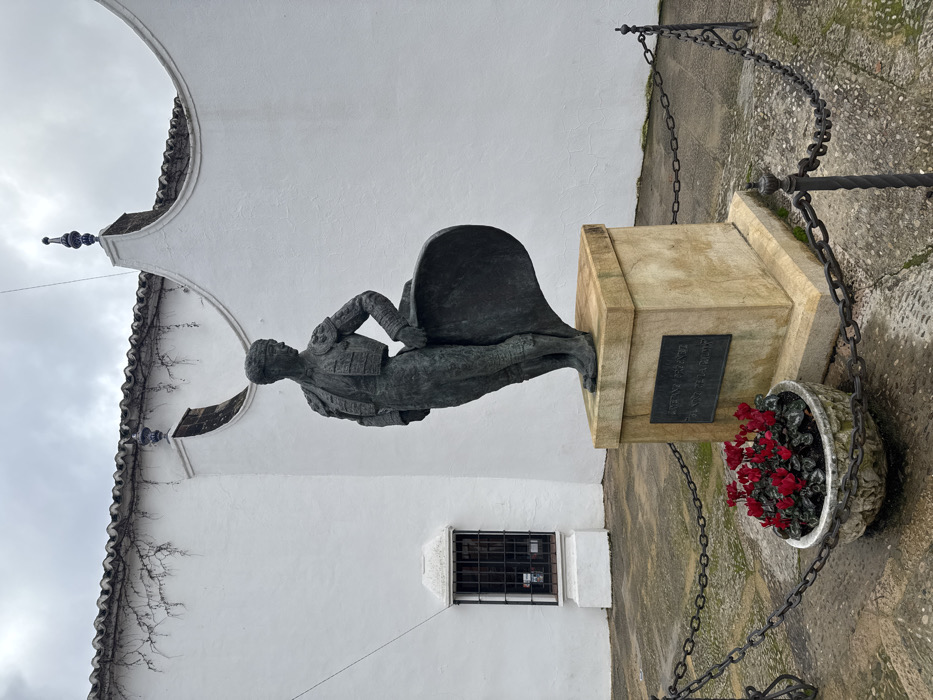
This image depicts a bronze statue of a matador in an outdoor setting within the city of Ronda, Spain, likely near the Real Maestranza bullring due to its subject matter and architectural context. The dark-patinated statue stands on a rectangular, light-colored stone pedestal, facing slightly right of the viewer. The matador is dressed in traditional bullfighting attire, with his left hand on his hip and his right hand holding a folded cape at his side. A dark, rectangular plaque is affixed to the front of the pedestal, displaying an inscription that is illegible. Behind the statue, a white stuccoed building, characteristic of Andalusian architecture, forms the background. Its upper section features a terracotta tiled roof, beneath which sparse, dry vine tendrils cling to the white wall. The building's parapet includes two decorative curved architectural elements, each topped with a blue and white ceramic finial. To the left, a small, recessed rectangular window with a dark metal grille is visible in the white wall. The ground consists of irregularly shaped, damp-looking paving stones. A dark metal chain barrier, supported by ornate posts, encloses the immediate area around the statue and its pedestal. To the left of the pedestal, a textured, grey stone planter bowl holds vibrant red cyclamen flowers with dark green leaves. The sky above is overcast and light grey.
Ronda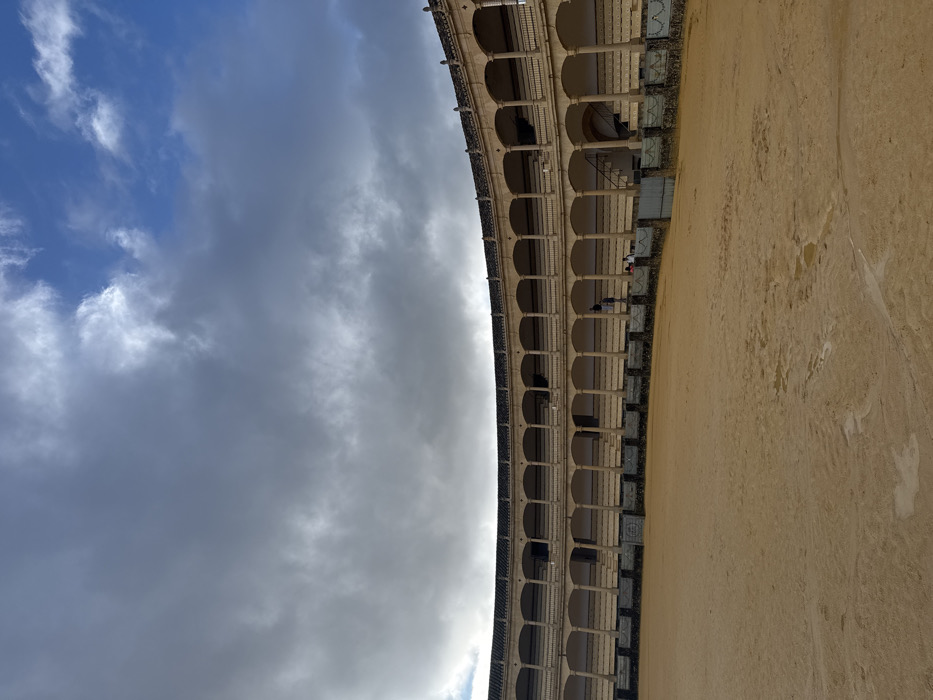
The image displays an interior view of the Plaza de Toros, a bullring located in Ronda, Spain. The scene is dominated by a circular, sandy arena floor, which appears largely empty, with visible darker, possibly damp, patches. Encircling the arena is a low, decorative barrier constructed of grey and white tiles. Beyond this barrier, the bullring's structure rises with multiple tiers of arcaded seating, built from light-colored stone or concrete. The structure features a lower seating area, topped by two distinct levels, each comprising a series of uniform arches supported by columns. The uppermost edge of the bullring is adorned with decorative architectural details. On the right side of the image, a grey metal gate is visible within the barrier, providing access to the seating areas or internal corridors. A few individuals are present on the lower seating tier: one person stands near the barrier, seen from the back, dressed in dark clothing, while two other figures are partially visible, seated or standing further back in the seating area. The sky above is largely overcast with extensive dark grey clouds, though patches of clear blue sky are visible in the upper right portion of the frame.
Ronda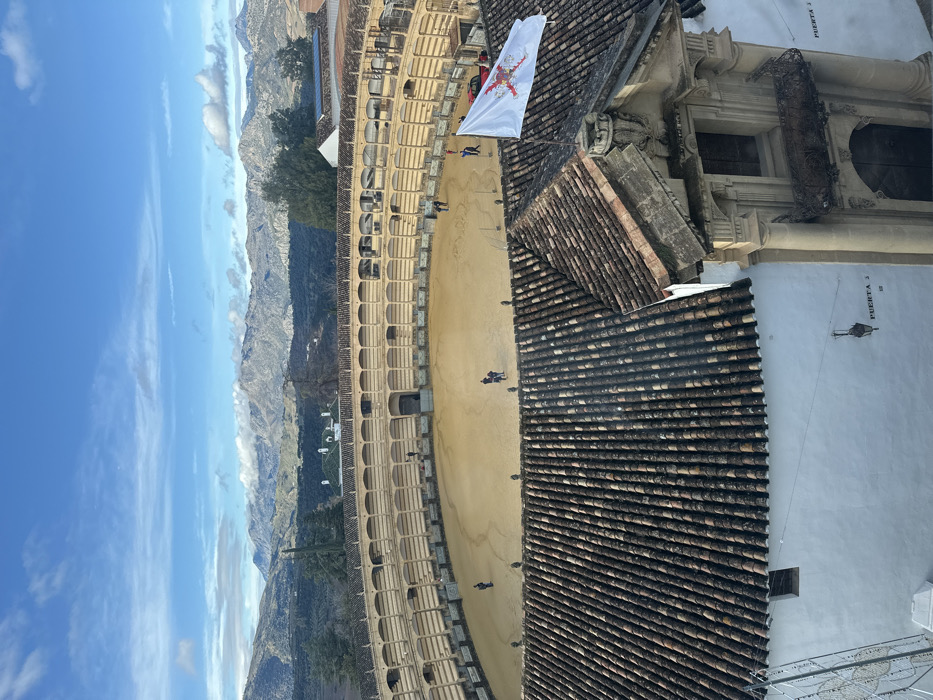
An elevated, wide-angle image captures the Plaza de Toros de Ronda in Ronda, Spain, under a partly cloudy blue sky. The central feature is the circular bullring, characterized by its light-brown, sandy arena floor. The surrounding spectator area consists of multi-tiered, arcaded stands constructed from light-colored stone or stucco, showing two distinct levels of arches. Approximately 10-15 individuals are observed in small groups on the arena floor, walking and standing. In the foreground, the steeply sloped, terracotta-tiled roof of an adjacent building occupies the lower portion of the frame. An ornate, light-stone architectural structure with columns and a small, wrought-iron balcony is integrated into the building on the right, from which a white flag bearing a red Cross of Burgundy is flying. The white-painted wall of the building below displays the text "PUERTA 3" (Gate 3) in two locations and features a dark metal lantern hanging near one inscription. Beyond the bullring, rugged, green-grey mountains dominate the distant horizon, partially veiled by wispy white clouds. Verdant trees and scattered white buildings with red-tiled roofs are visible between the bullring structure and the mountain range. The scene is illuminated by natural daylight.
Ronda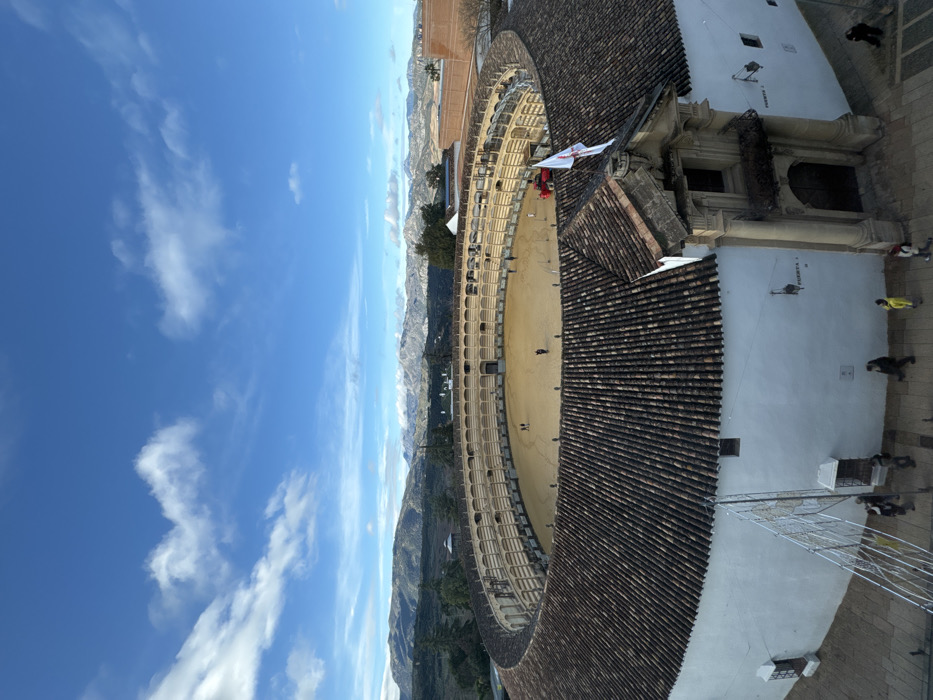
The image provides a high-angle view of the Plaza de Toros de Ronda, the bullring located in Ronda, Spain. The central feature is the bullring's circular sand arena, light tan in color, where approximately 10-15 individuals are dispersed, walking or standing. A small red utility vehicle is parked near the arena's right edge. Surrounding the arena are several tiers of seating, characterized by light-colored walls, archways, and supporting columns. The bullring's structure includes a multi-pitched dark brown tiled roof that covers the spectator areas. The exterior wall visible to the viewer is white, presenting a prominent, ornate entrance (Puerta Grande) on the right side. This entrance features two large columns, a dark wooden double door, and a small balcony above it, topped with a tiled roof. A white flag with a red cross-like emblem is affixed to a pole above this entrance. Another entrance, labeled "PUERTA 1," is visible further to the left along the white exterior wall. At street level, in front of the white wall, several individuals are observed walking on a paved surface. A decorative white light structure or archway is partially visible on the far left. The background reveals a clear blue sky with scattered white cumulus clouds. A vast range of rugged mountains, some appearing rocky and others vegetated, stretches across the distant horizon. Sparse green trees and other buildings with reddish-brown tiled roofs are visible between the bullring and the mountain range.
Ronda
The video shows a view of a white and yellow church with two towers, a dome, and a cross on top of each. The sky is blue with some clouds. The church is in the middle of a city with white buildings. There is a red roof below the camera. The sound of church bells can be heard.
Ronda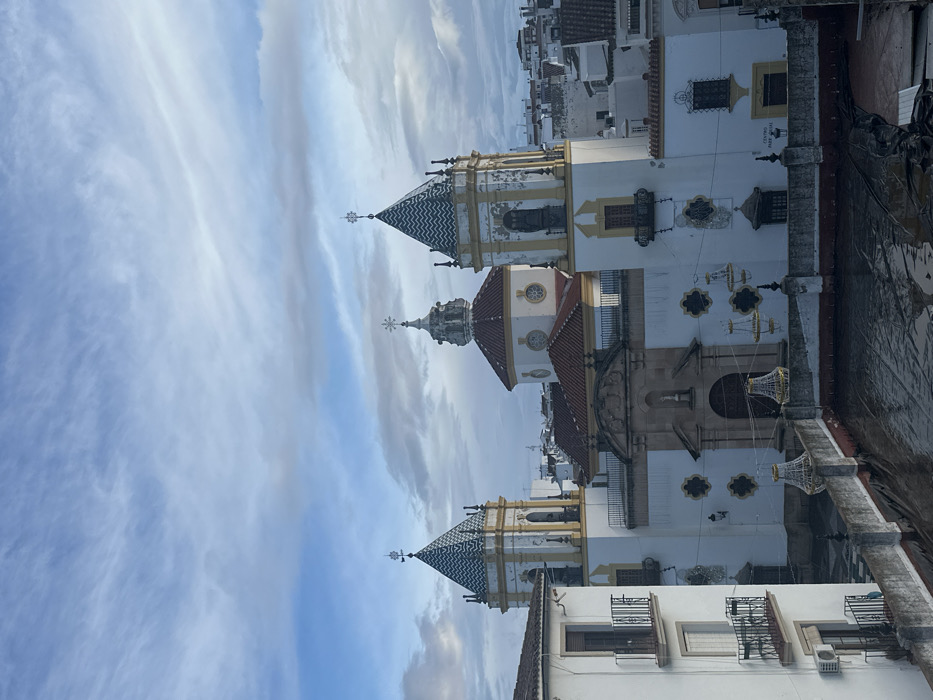
An elevated, daytime view captures the Church of Nuestra Señora de la Merced in Ronda, Spain, beneath a partly cloudy sky. The prominent central structure features a white stucco facade with yellow ochre trim. It includes two symmetrical bell towers topped with pyramidal roofs adorned in a blue, white, and ochre chevron tile pattern, each surmounted by a decorative finial or cross. A central, reddish-brown tiled dome is topped by a smaller white cupola and a cross. The church's main entrance displays an ornate, classical-style portal with a statue of a robed figure positioned within a niche above the doorway. In the immediate foreground, a dark, flat rooftop, possibly covered with a tarp, appears wet and reflects ambient light. A low, gray concrete parapet wall defines the edge of this rooftop. Several large, ornate chandelier-style decorative light fixtures, composed of gold and white elements, are suspended at various heights between the foreground rooftop and the church facade. To the left, a multi-story, white residential building with dark balconies and an external air conditioning unit partially obscures the left bell tower. The background reveals a dense urban landscape of white-washed buildings with reddish-brown tiled roofs, typical of a Spanish town, receding into the distance under the soft light. No individuals are visible, and no overt actions are occurring.
Ronda
A man wearing a maroon sweater and a watch is sitting at a restaurant table. In front of him is a sizzling cast iron plate with a sliced steak covered in coarse salt, a baked potato with cream and arugula, and a small dish of yellow sauce. The man is using a knife and fork to cut a slice of the steak. There is a small white plate in front of him and a larger white plate at the bottom of the frame. The table is wooden.
Ronda
Two men are performing in a dimly lit room. The man on the left is playing an acoustic guitar and singing. He is wearing a black t-shirt and pants, and white sneakers. The man on the right is singing into a microphone. He is wearing a white t-shirt and pants, a black jacket, and white sneakers. There are two speakers on stands behind them, as well as music stands and a sound mixer. The room has black walls and a red curtain backdrop. There is a chair in the foreground and a ceiling fan overhead. The lighting is primarily blue.
Ronda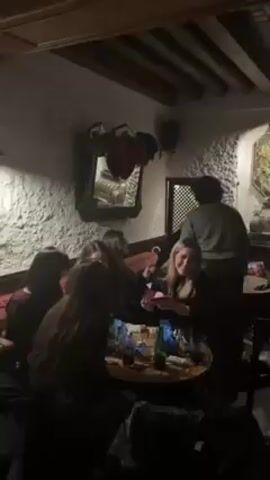
The video depicts a crowded pub interior. Several people are seated around a table cluttered with drinks. A staff member, wearing an apron, moves among them. The camera pans across the space, showing a bar area filled with people standing and talking. Decorations, including lanterns and lights, hang from the ceiling. The pub has a rustic feel, with exposed wooden beams and stone walls. An old clock hangs on a pillar.
Ronda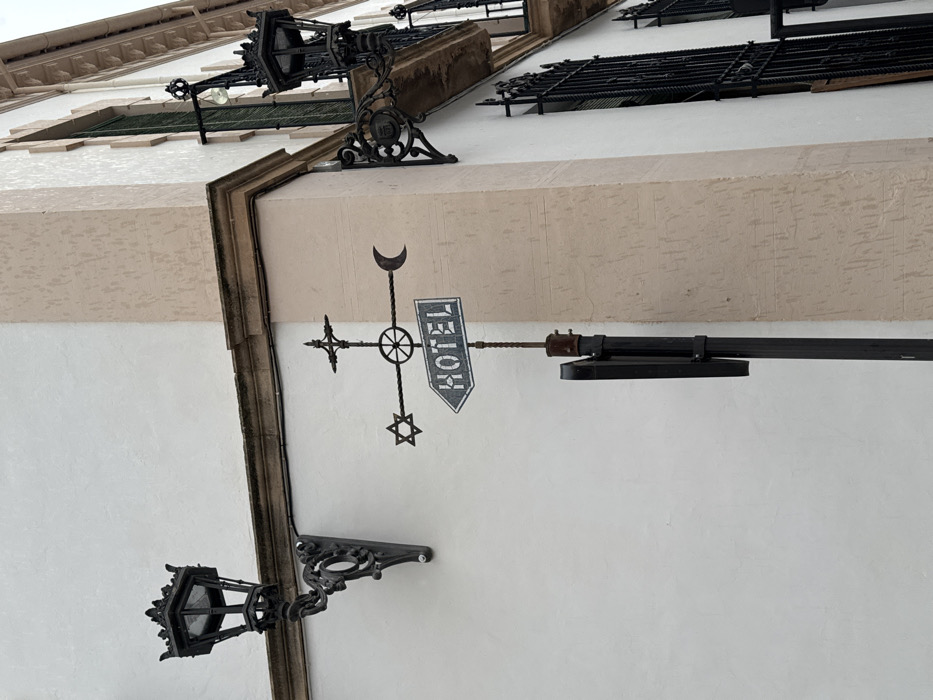
An ornate metal hotel sign is affixed to a pole at the exterior corner of a multi-story building in Ronda, Spain. The building features textured white stucco walls with a vertical beige-textured corner column and a horizontal brown trim line. The sign itself is crafted from dark metal, forming a directional arrow with the word "HOTEL" in white capital letters on a dark blue background within its shaft, pointing left. Above the "HOTEL" sign, the metalwork extends horizontally, incorporating a Star of David on the left, a central spoked wheel, and a crescent moon on the right. A cross surmounts the central wheel. Two ornate, dark wrought iron street lamps with decorative scrollwork brackets are mounted on the building's walls; one is prominently displayed on the left wall, and another is partially visible on the right wall, positioned above a window with dark green shutters and black wrought iron security grilles. A portion of an upper-level balcony with similar black grilles is visible on the right. No individuals are present in the scene.
Ronda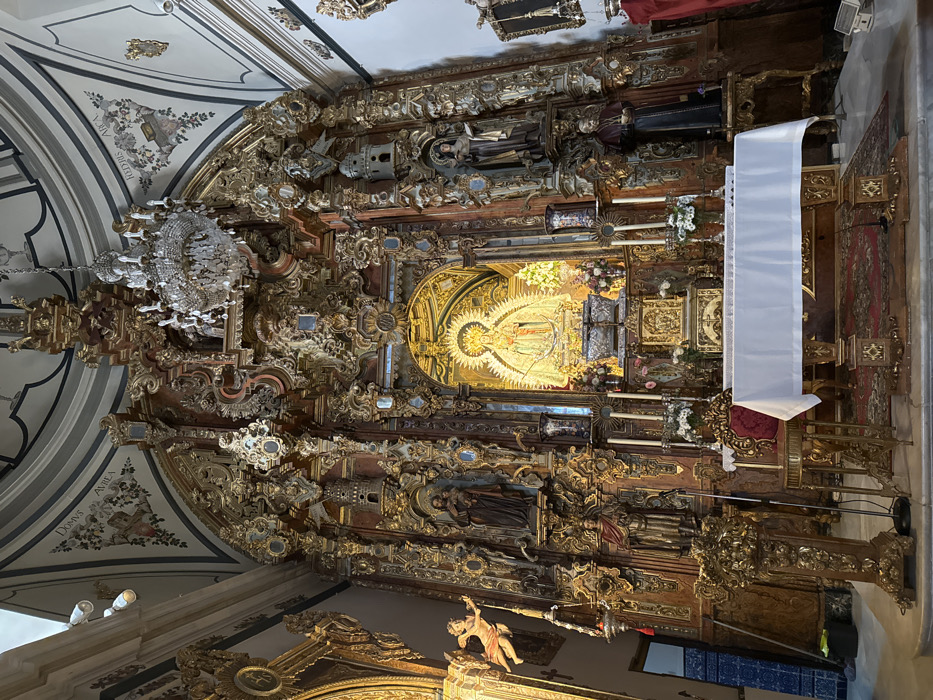
The image displays the ornate Baroque main altarpiece of the Church of Santa María la Mayor in Ronda, Spain. The altarpiece is a multi-tiered, gilded wooden structure featuring extensive gold leaf ornamentation over a dark wooden base. At the center, within a brightly lit, deeply recessed golden niche, is a statue of the Virgin Mary, likely the Virgen de la Paz, adorned with a radiant golden halo and rich vestments. Below this central figure, on the altar table, a smaller golden tabernacle or reliquary is positioned, flanked by a silver vessel and two tall white candles in ornate gilded holders. Two decorative vases containing white and pink floral arrangements are also present on the altar. The altar table is covered with a white linen cloth, and its base is gilded. A patterned red and beige rug lies on the floor in front of the altar. The altarpiece incorporates multiple statues: a male saint holding a child (possibly Saint Joseph with the Infant Jesus) in the upper left, a female saint holding a book or staff next to a small tower-like structure in the upper right, a robed male saint in the lower left, and a seated ecclesiastical figure, resembling a Pope or Bishop, in the lower right. To the left of the altar, an elaborate gilded lectern with a microphone stands. An angelic figure in flight, also gilded, extends from a side architectural element on the left wall, above a section of blue and white tiled wainscoting. The vaulted ceiling above is adorned with frescoes featuring striped patterns, floral motifs, and Latin inscriptions, including "DOMVS AVREA" (House of Gold) on the left and "FOEDERIS ARCA" (Ark of the Covenant) on the right. A large, multi-tiered crystal chandelier hangs centrally from the ceiling in front of the altarpiece. No individuals are present in the scene.
Ronda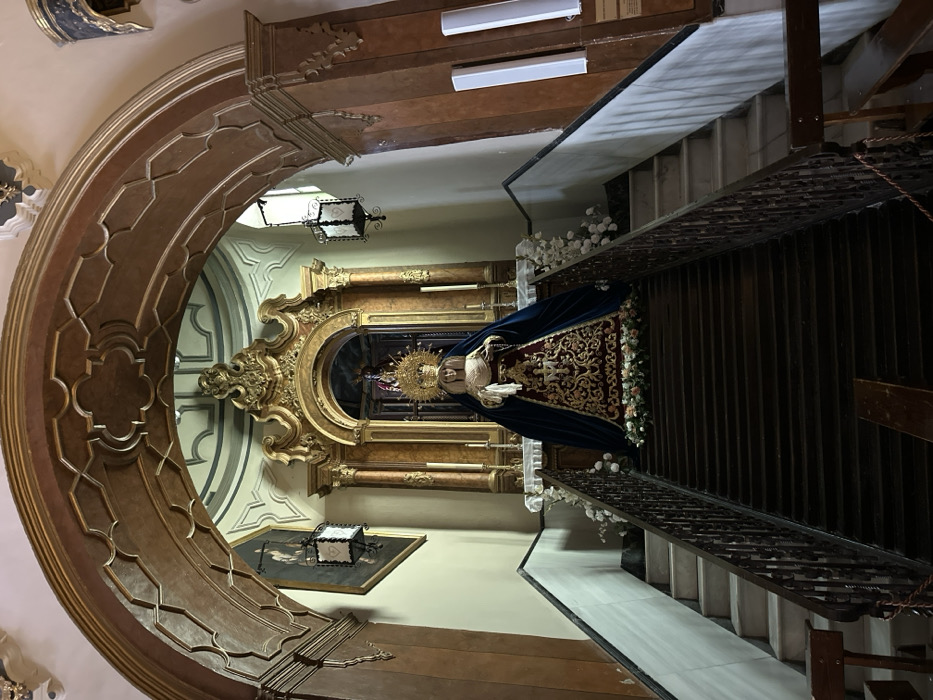
The interior of the Santuario de María Auxiliadora (San Roque) in Ronda, Spain, features a prominent religious display. A sorrowful statue of the Virgin Mary, known as a Mater Dolorosa, is centrally positioned at the top of a wide, dark wooden staircase. The statue is adorned with a golden, radiating halo, a dark blue velvet cloak richly embroidered with gold thread, and an intricately patterned underskirt. Her hands are clasped, holding a white cloth, and a rosary hangs from her right hand. The statue stands within an ornate, gilded wooden reredos featuring fluted columns and elaborate carvings, set against a dark background in its central niche. Two tall golden candlesticks with lit candles flank the statue on the altar. The base of the statue, at the top of the steps, is decorated with an arrangement of white and light pink flowers interspersed with greenery. The central wooden staircase, comprising approximately 15 steps visible, has dark banisters and leads directly to the statue. This central staircase is flanked on both sides by narrower, lighter-colored marble staircases with dark handrails, ascending to the same elevated platform as the altar. The entire religious ensemble is framed by a large, intricately carved wooden archway with geometric and quatrefoil patterns. The surrounding walls are light-colored. A dark framed painting hangs on the left wall, below a suspended ornate dark metal lantern with glass panels. A similar lantern is visible on the right side. On the right wall, two vertical, rectangular white light fixtures are mounted. A partial view of a dark wooden pew is visible in the lower right foreground. No individuals are present in the scene.
Ronda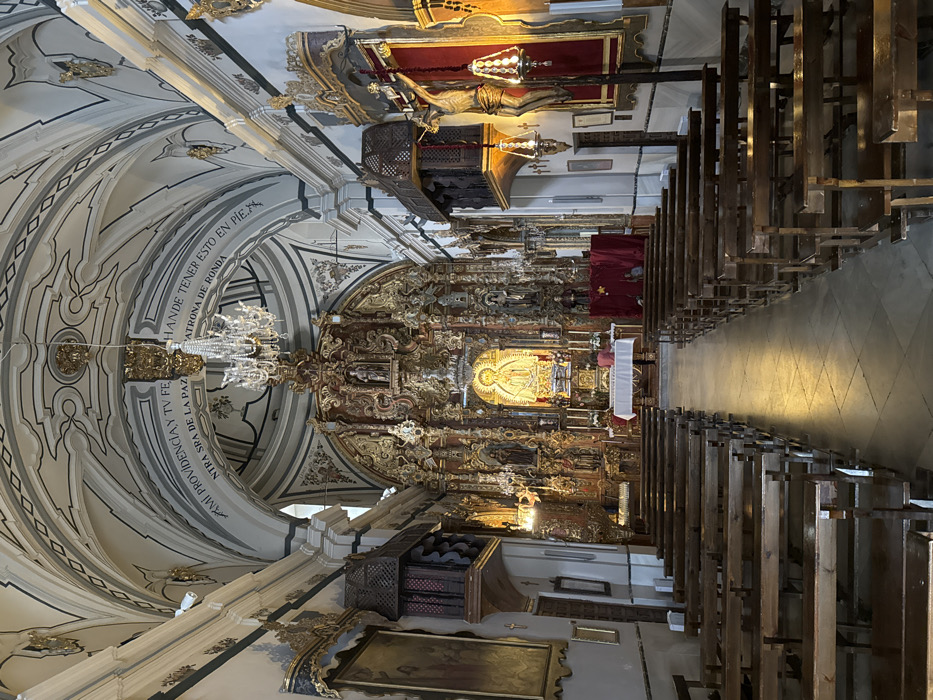
The image displays the interior of the Sanctuary of Nuestra Señora de la Paz, located in Ronda, Spain. The perspective is from the nave, looking directly towards the main altar. The environment is a large hall with a vaulted ceiling painted in white with grey and black geometric and curvilinear patterns. Several crystal chandeliers are suspended from the ceiling. The walls are white and extensively adorned with gold-gilded ornamentation and cornices. The floor is covered in light-colored, patterned tiles, with a central aisle leading to the altar. Dark wooden pews are arranged in parallel rows on both sides of this aisle; most appear unoccupied. At the far end, a highly ornate, gilded Baroque altarpiece (reredos) dominates the scene. It features multiple tiers and niches, each containing statues. A central figure within a niche at the lower-middle section of the altarpiece is illuminated with a warm golden glow. In front of this altarpiece, a table draped in white cloth serves as the altar, decorated with white floral arrangements and candles. Two individuals are present in the sanctuary area to the right of the altar. One person, wearing a reddish top, stands positioned behind the altar table, facing towards the right side of the image. Another individual, dressed in darker clothing, is seated on a low structure further back on the right, partially obscured by a draped red fabric. Behind this red fabric, indistinct forms are visible. To the right of the altar, a large crucifix depicting a wooden corpus of Christ is mounted against a red fabric panel, flanked by decorative hanging lamps. Above the pews on the right wall, a dark carved wooden structure is affixed. On the left wall, a large painting with a prominent gold frame is visible. A small, white security camera is mounted high on the left wall, directed towards the altar.
Ronda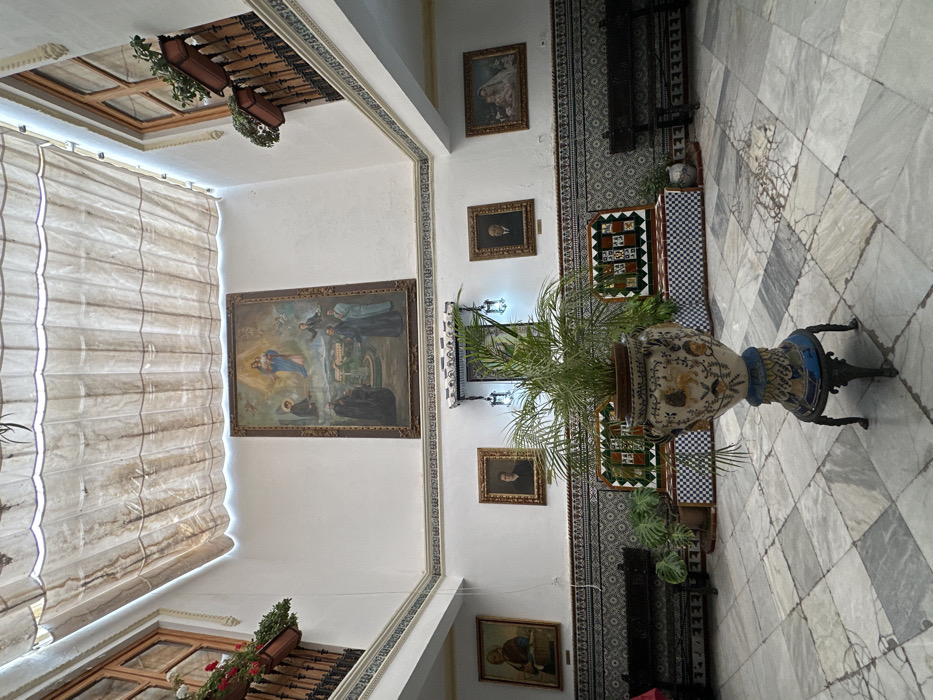
This image captures the interior courtyard of a building in Ronda, Spain. The scene is devoid of human presence. A high-angle, wide-shot perspective frames a multi-story, open-top space with a pleated, translucent fabric canopy stretched overhead, providing diffused light. The canopy shows some signs of staining and wear, with white strip lighting visible along its edges. The walls feature a white upper section and a lower wainscoting comprised of intricate blue, white, and brown patterned ceramic tiles (azulejos). Two wooden-framed windows, each with a small dark metal balcony railing and flower boxes containing red and green plants, are visible on the upper level of the left and right walls. A large, framed religious painting depicting the Virgin Mary and child in the sky above a landscape with multiple robed figures is centrally affixed to the back wall. Below and to the left of this painting, two ornamental lamps with multiple light sources hang from a decorative bracket. Flanking the central religious painting are several smaller, dark-framed portraits: a man in a dark suit to the right, and an older woman and another individual in dark attire on the left wall. A smaller religious painting, possibly depicting the Madonna and child, is visible on the far right wall. The floor is composed of a mosaic of square marble or stone tiles in shades of white, grey, and light brown, exhibiting natural veining and some surface cracks. In the foreground, slightly off-center, stands a large, ornate ceramic vase painted with intricate designs, including what appear to be animal figures. This vase rests on a dark, decorative metal tripod stand and contains a vibrant green, multi-fronded potted plant. Dark carved wooden benches are positioned against the tiled walls on the left and right sides, beneath the smaller portraits. Additional small potted plants are visible at the base of the walls.
Ronda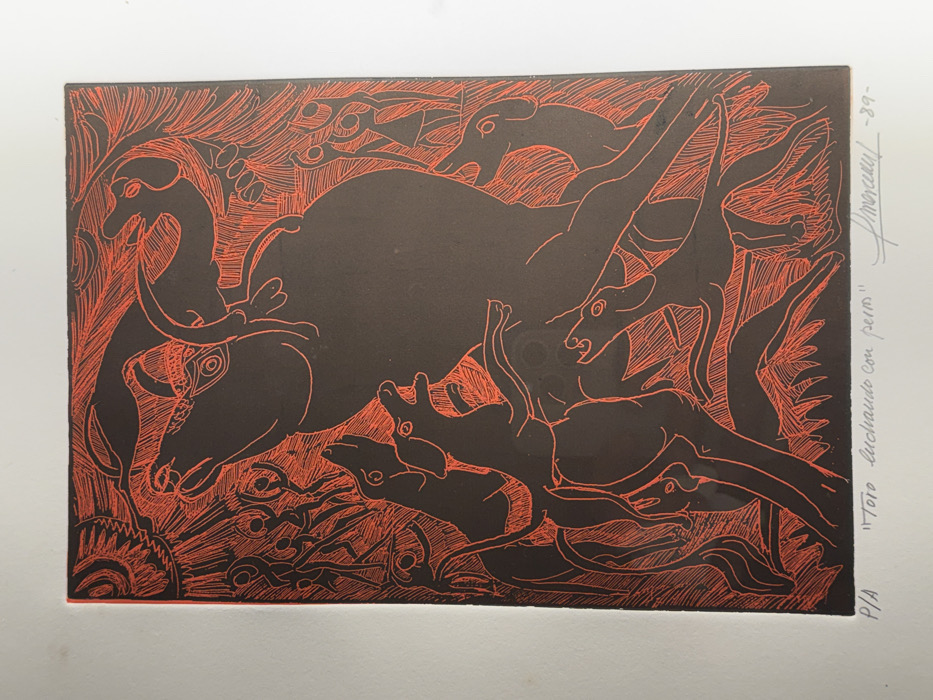
The image is a linocut print, predominantly black figures on a vibrant red-orange etched background. It depicts a chaotic scene titled "Toro luchando con perros" (Bull fighting with dogs), signed "Amorcery" and dated '89, with "P/A" indicating an artist's proof. This artwork evokes the traditional cultural practice of bullfighting, relevant to cities like Ronda, Spain, known for its bullfighting heritage. In the center, a large, dark-silhouetted bull is positioned, facing upwards and left, appearing distressed or in mid-action with a stylized eye visible. Surrounding the bull are at least six smaller, dark-silhouetted dogs in dynamic poses of barking, running, and lunging. A small, stylized bird-like figure with wings is perched on the bull's upper back near its neck. In the background, on both the left and right sides, numerous slender, stylized human figures are rendered in dark silhouette against the red-orange etched lines. Many of these figures have raised arms, suggesting movement, participation, or observation. The entire background is filled with dense, radiating red-orange lines and patterns, creating an energetic and intense atmosphere, including a prominent sun-like or starburst motif in the upper left corner. The composition relies on stark contrast between the solid black forms and the intricate red-orange linework.
Ronda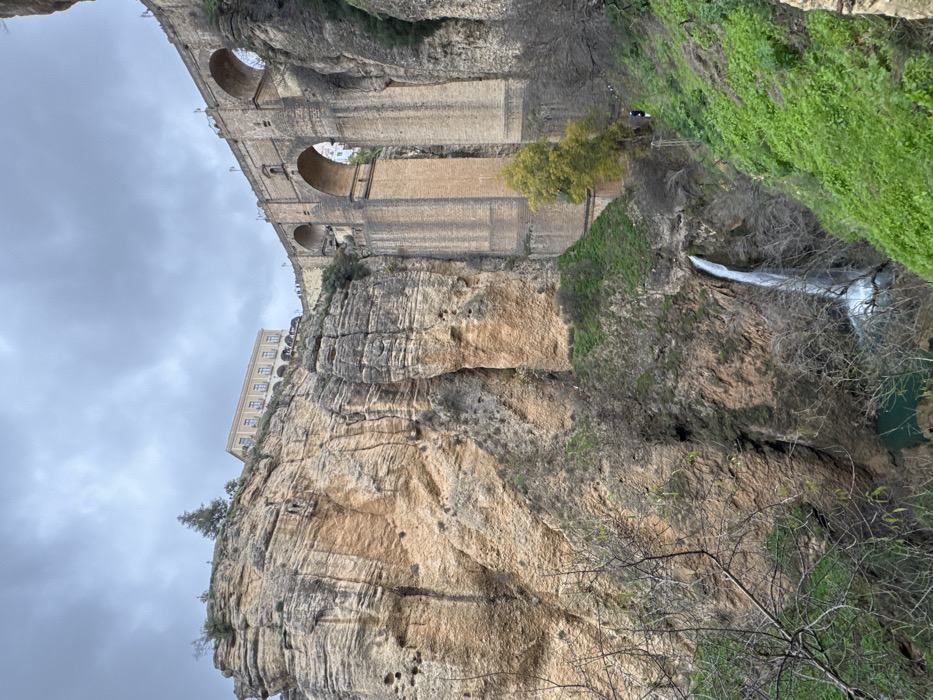
The image depicts the El Tajo gorge in Ronda, Spain, viewed from below and to the left. The prominent subject is the Puente Nuevo bridge, a large stone structure spanning the deep gorge with multiple arches and a tall central support. The bridge features stone balustrades and lampposts along its upper edge, where several small figures of individuals are discernible. To the left of the bridge, a towering, multi-layered rock cliff rises steeply, displaying striations of tan, grey, and brown rock. On top of this cliff, a light-colored, multi-story building with numerous arched windows is visible, along with a solitary coniferous tree. At the base of the central bridge support, a significant waterfall cascades into a small, vibrant turquoise-colored pool situated at the bottom of the gorge. Bare-branched trees and sparse green vegetation cling to the lower sections of the cliffs and foreground. A single tree with yellow-green foliage stands on a ledge near the waterfall's origin. On the right side of the gorge, a steep, vegetated slope descends, revealing a visible dirt path. A single individual, dressed in dark clothing with a prominent white accent, is observed on this path, appearing to be in motion. The sky is overcast with dense, grey clouds, casting diffused light across the scene.
Ronda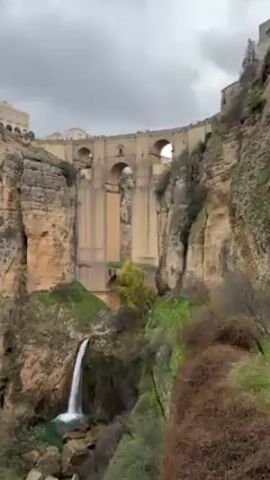
The video shows a view of the Puente Nuevo bridge in Ronda, Spain. The bridge spans a deep gorge, and a waterfall flows into the pool at the bottom. The cliffs of the gorge are covered in greenery. The sky is overcast.
Ronda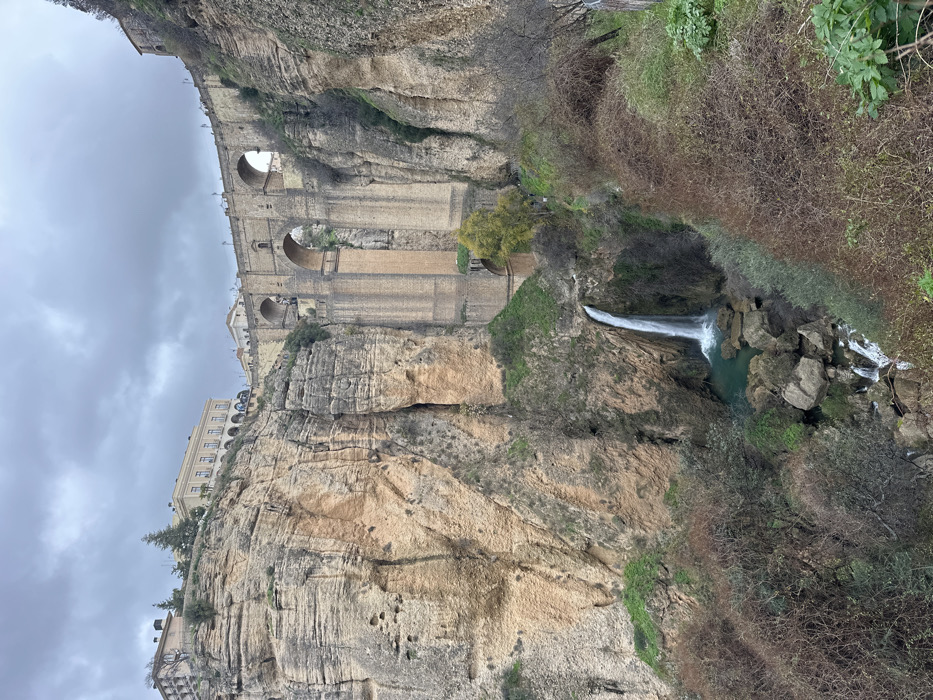
This image presents a detailed view of the El Tajo gorge in Ronda, Spain, dominated by the multi-arched Puente Nuevo bridge under an overcast sky. The massive stone bridge spans the deep chasm, featuring a large central arch and smaller ones, connecting the clifftops. Buildings of traditional architecture, including a prominent light-colored structure on the upper left, line the gorge edges. The sheer rock faces of the gorge display stratified layers in shades of tan and brown, with some pockets of green foliage. A significant waterfall cascades down the left side of the gorge, feeding into a tranquil, turquoise pool at its base, from which water continues downstream over rocks. The foreground and lower gorge slopes are densely covered with a mix of leafless shrubs and scattered evergreen plants. There are no individuals or specific human activities visible within the frame.
Ronda