Pueblo Libre, Peru
30 memories from Pueblo Libre, Peru
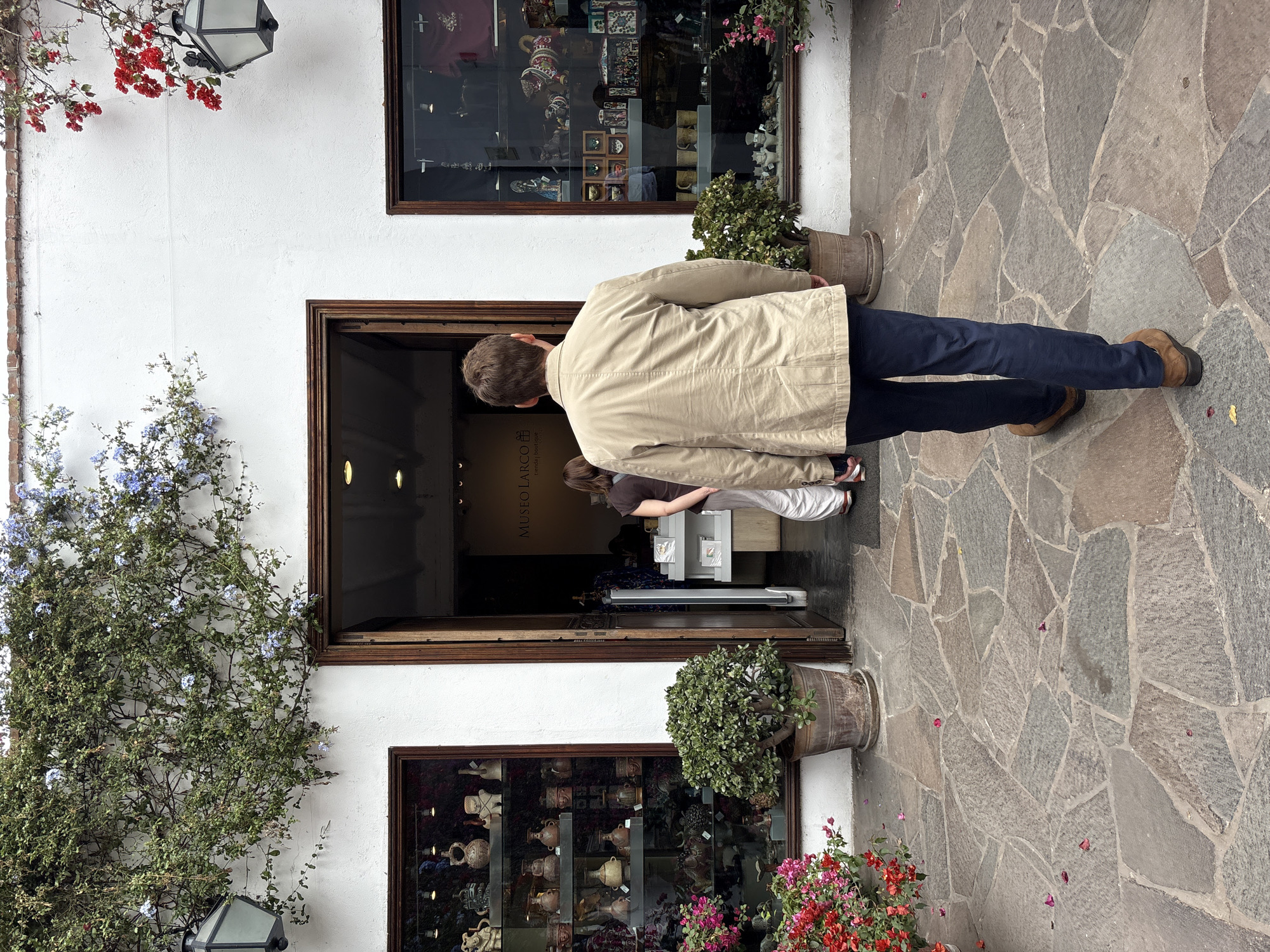
The image captures a daytime scene outside the "Museo Larco Tienda & Boutique" in Pueblo Libre, Peru. A man, viewed from behind, stands prominently in the foreground, wearing a beige jacket and dark blue pants. He appears to be approaching or about to enter the open doorway of the establishment. Inside the entrance, another individual is partially visible, leaning forward as if attending to something or someone. The building features a white stucco facade with dark wooden frames around its windows and doorway. Two display windows are visible: one above the doorway, showcasing various decorative items and small sculptures, and another below a potted green plant, filled with numerous ancient-style pottery pieces. A second potted plant with vibrant red and pink flowers is situated to the right of the lower display window. Lush green vines with small blue flowers climb the left side of the facade, while red flowers cascade from the top left, near a dark, traditional-style lantern. The ground is paved with irregular, flat stone tiles, creating a rustic pathway. The words "MUSEO LARCO TIENDA & BOUTIQUE" are clearly visible on the wall inside the entrance, confirming the location and type of business. The overall atmosphere is bright and inviting, suggesting a leisurely visit to a museum shop.
Pueblo Libre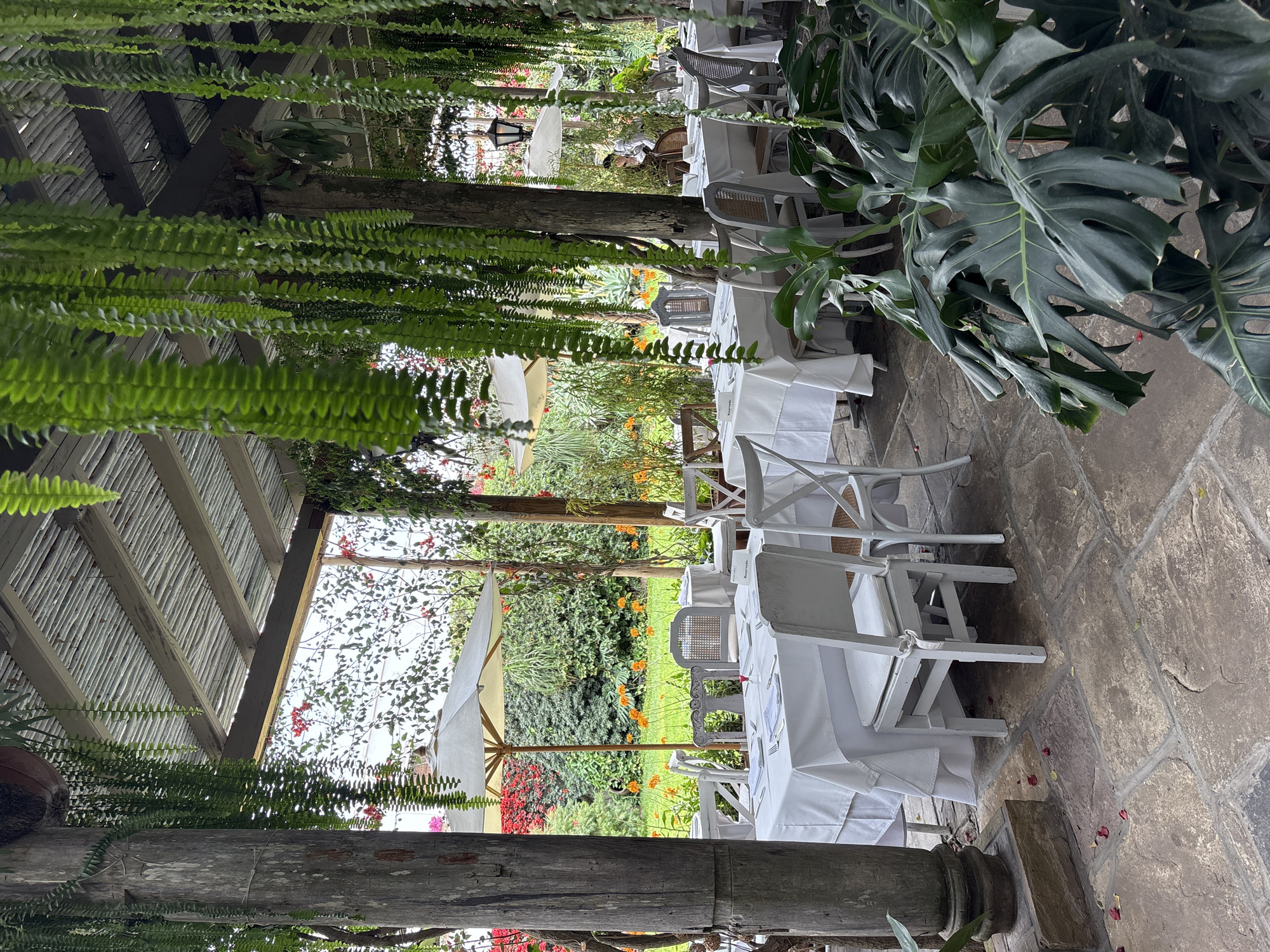
This image depicts an elegant outdoor dining area, likely a restaurant patio, set amidst abundant greenery under natural light. The view is angled slightly upwards and appears to be rotated 90 degrees clockwise from its natural orientation. In the foreground and overhead, a pergola-like structure with wooden beams is visible, from which numerous lush green ferns hang down, creating a verdant canopy. A large staghorn fern is also attached to one of the beams. To the right, large, dark green, deeply lobed leaves, possibly from a Monstera plant, frame the edge of the scene. The ground is a rustic stone patio with irregularly shaped flagstones. The central part of the image features multiple white-clothed tables, each set with white chairs. The chairs have a classic design, some with woven rattan-like backs, and are arranged neatly around the tables, suggesting preparation for diners. One table clearly displays a small sign that reads "RESERVADO," indicating it is reserved. Scattered red and pink flower petals are visible on the stone floor near the tables. In the mid-ground and background, a vibrant garden or landscaped area unfolds. It features a variety of plants, including a prominent tree trunk, and bushes adorned with colorful flowers, primarily in shades of orange, red, and pink. White outdoor umbrellas are strategically placed within the garden, and a decorative lantern can be seen. The overall impression is one of a tranquil, natural, and inviting setting for an outdoor meal in Pueblo Libre, Peru. No people are clearly visible, and the bright, diffused lighting suggests it is daytime.
Pueblo Libre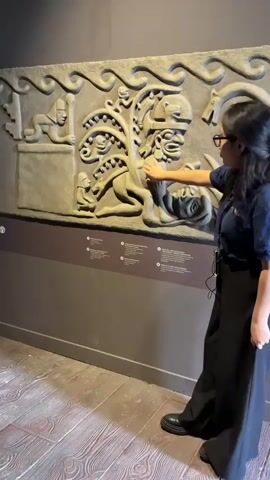
In an indoor setting, likely a museum or gallery in Pueblo Libre, Peru, a woman is seen standing next to a large stone relief artwork. She is wearing a dark blue polo shirt with a visible "LARCO" logo, black wide-leg pants, and black shoes. She has glasses and a lanyard with an ID badge and a small electronic device. The woman is actively gesturing with her right hand towards the intricate gray stone relief, which features various figures and decorative elements. She appears to be giving a presentation or guiding a tour, speaking enthusiastically and smiling. Her left hand is resting by her side. The relief is mounted on a dark gray wall. Below the artwork, several small white informational plaques with text and icons are visible, though their content is unreadable. The floor is made of light brown, textured wood or a material resembling wood. The lighting is bright, illuminating the scene and the artwork clearly. The overall atmosphere suggests an informative and engaging cultural experience.
Pueblo Libre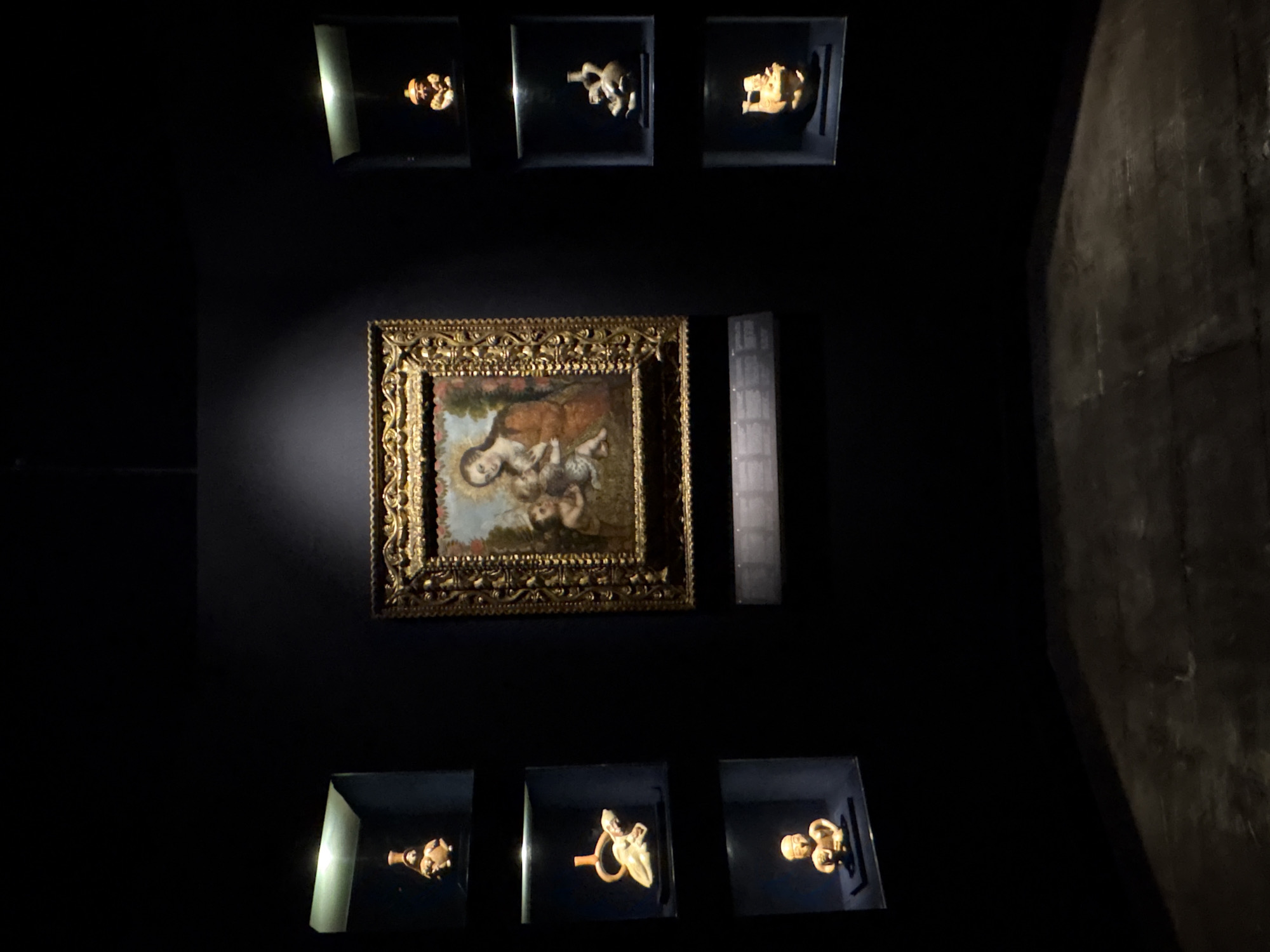
The image displays an art exhibition or museum setting in Pueblo Libre, Peru, characterized by a dark, minimalist aesthetic with focused lighting on the artworks. At the center of the frame is a large, rectangular painting, prominently displayed with an elaborately gilded and carved frame. The painting itself depicts a classical or religious scene, likely a Madonna and Child with accompanying figures, possibly cherubs or angels, rendered in warm tones. Above and below this central painting, arranged in two rows of three, are six smaller, light-colored artifacts or sculptures. Each artifact is housed within its own dark, recessed display case and illuminated by a spotlight, making it stand out against the dark wall. These sculptures appear to be crafted from materials such as terracotta, ceramic, or possibly a metallic alloy like gold or bronze. They feature distinct forms, including stylized human figures, busts, and potentially abstract or animalistic representations, consistent with pre-Columbian or early colonial Peruvian art. The background is a dark, uniform wall, which enhances the visual impact of the illuminated artworks. To the far right, a textured, darker wall, possibly made of concrete or stone, is partially visible. The overall mood is one of quiet contemplation and reverence for the exhibited pieces. No visible text or informational signage is present on any of the displays. The lighting strategy emphasizes the details and forms of each artwork, creating a dramatic and immersive viewing experience.
Pueblo Libre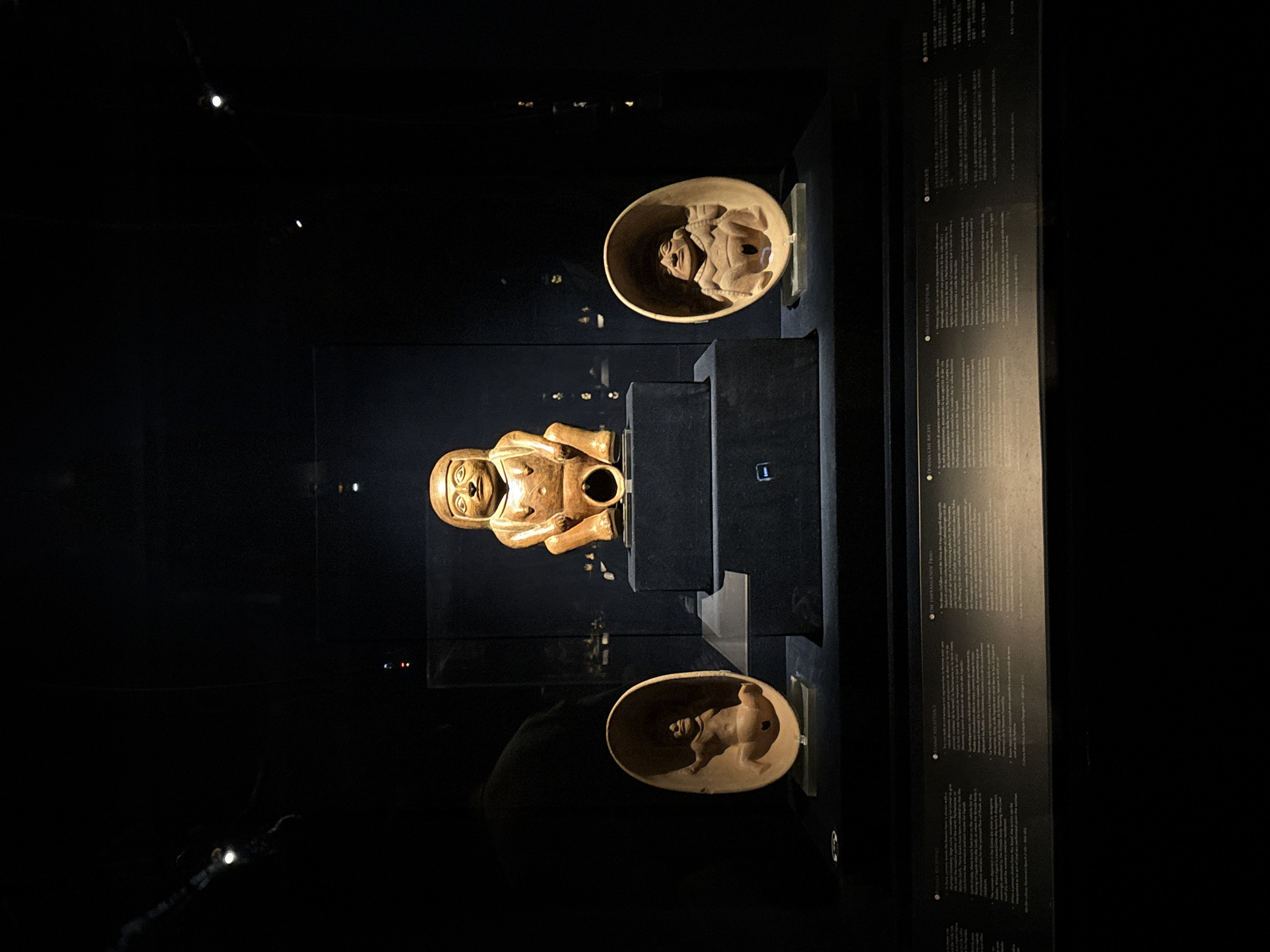
The image captures an indoor museum display featuring ancient ceramic artifacts, spotlighted in a dark room. The scene is illuminated by directed light sources, casting dramatic shadows and reflections on the dark, possibly glass or polished, display surfaces. In the center, a prominent anthropomorphic ceramic figure, primarily in shades of light brown and terracotta, stands upright on a dark, multi-tiered pedestal. The figure possesses distinct facial features including eyes, a nose, and a mouth, and appears to be a vessel with a circular opening in its chest area. Its arms are bent, and its legs are visible. To the upper right of the central figure, a light brown, bowl-shaped ceramic object is embedded in a dark display surface. Inside this bowl, another smaller, light-colored ceramic figure is discernible, lying down, with visible facial and body features. Similarly, to the lower left, another identical bowl holds a smaller ceramic figure. This figure, also light brown, appears to be an animal, possibly a stylized llama or dog, lying within the bowl. On the right side of the frame, a tall, dark vertical panel is visible, covered with text in multiple languages, likely providing interpretive information about the displayed artifacts. Although largely unreadable due to lighting and angle, phrases such as "MISERIA RICCATURA" and "DONNA CHE MUOVE" are partially legible, suggesting the presence of Italian, among other languages. Small white text or labels are also visible on some of the dark pedestals. The artifacts' style suggests pre-Columbian Peruvian origin, consistent with the location context of Pueblo Libre, Peru. The display setting aims to highlight the historical and cultural significance of these ancient works.
Pueblo Libre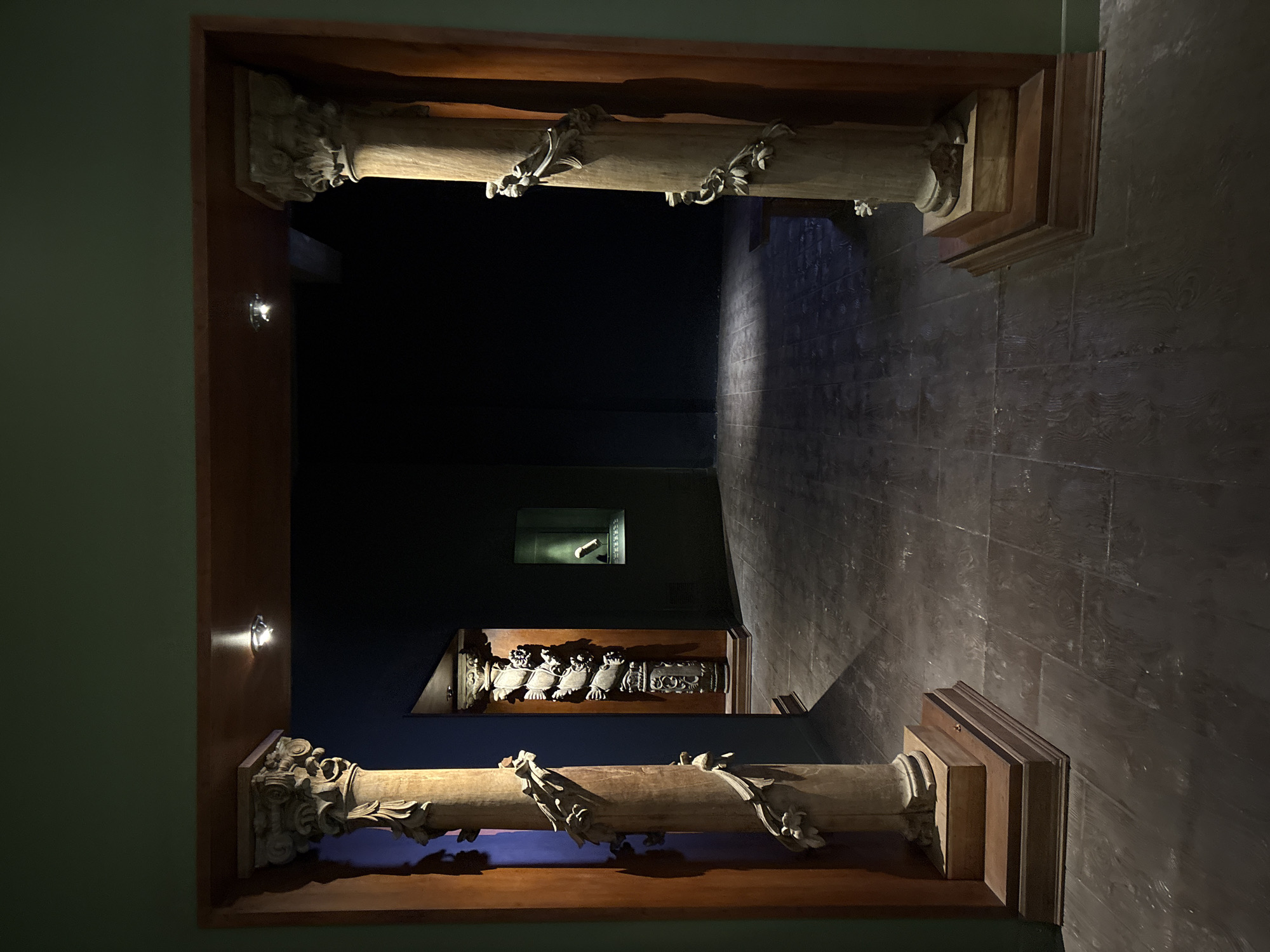
The rotated image captures a dimly lit interior, likely a museum or cultural exhibition in Pueblo Libre, Peru. The viewer looks through an ornate, dark wooden archway or portal into a darker chamber beyond. The wooden framework of the archway is richly decorated. Along its inner horizontal sections, intricate carved wooden motifs, possibly representing foliage or scrollwork, are visible. At each of the four inner corners, there are elaborate carved wooden structures resembling classical column capitals, featuring detailed leaf designs and volutes. Small, embedded spotlights on the vertical parts of the wooden frame illuminate these carvings, creating dramatic highlights and deep shadows. To the immediate left of the archway, a plain, dull green wall is visible. Beyond this ornate portal, the space recedes into shadow. The floor or wall on the right side within this darker area exhibits a textured, dark surface, possibly composed of distressed wood panels or dark stone tiles with a subtle grain. Further back, an illuminated recessed alcove stands out on a distant wall. Inside this alcove, a light-colored, elongated object, potentially an ancient bone or artifact, is displayed. Directly below this alcove, a horizontal wooden panel is mounted, featuring a series of intricately carved, stylized figures that appear to be birds or mythical creatures. The scene conveys a sense of historical reverence, typical of a museum setting designed to showcase ancient or cultural artifacts. The artificial, focused lighting creates a dramatic and contemplative atmosphere. No people are visible, and there is no discernible text in the image. The time of day cannot be determined due to the interior lighting.
Pueblo Libre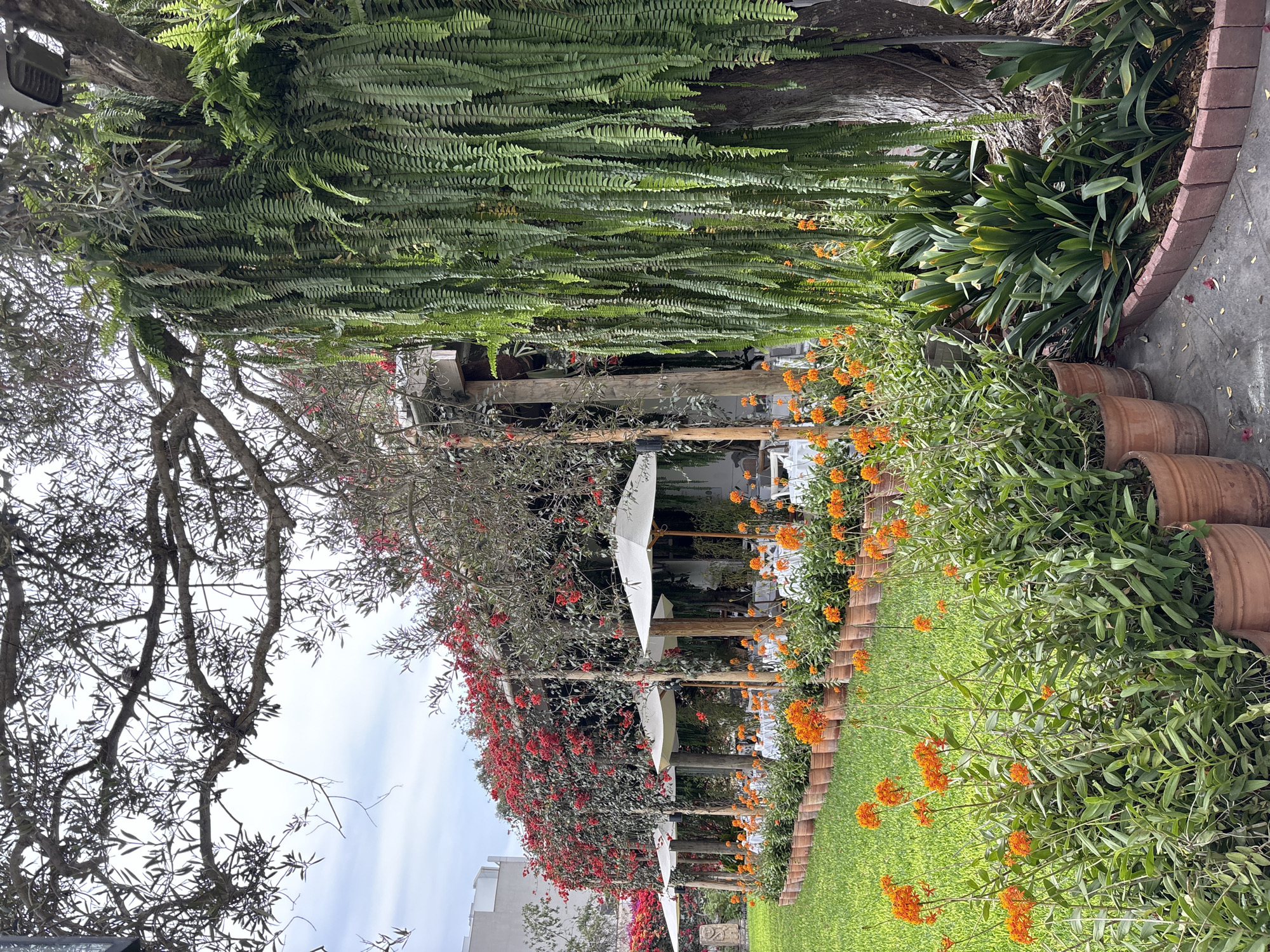
This media file captures a vibrant outdoor garden and dining area in Pueblo Libre, Peru, characterized by lush greenery and colorful flowers under a bright daytime sky. The scene features a verdant canopy of densely hanging ferns, possibly growing on a large tree trunk or a shaded structure, dominating the upper left portion of the image. Below this, a mature tree with gnarled branches and sparse foliage extends across the left side, with a clear sky visible through its branches. Towards the right, a charming outdoor dining setup is arranged, featuring several white, open umbrellas shading tables and chairs, suggesting a restaurant or cafe ambiance. This dining area is framed by climbing plants adorned with abundant red flowers, likely bougainvillea, which trail along wooden pergolas or beams. In the foreground and along the right side, a neatly manicured green lawn is bordered by a row of terracotta pots and a low brick wall. Along this border, and extending into the garden beds, are numerous plants bearing bright orange flowers, adding a vivid splash of color. Other diverse green plants fill the garden spaces, contributing to the lush environment. The lighting suggests a clear day, likely late morning or early afternoon, with soft, natural light illuminating the scene. No people are visible, emphasizing the serene and inviting atmosphere of the outdoor space. There is no visible text in the image.
Pueblo Libre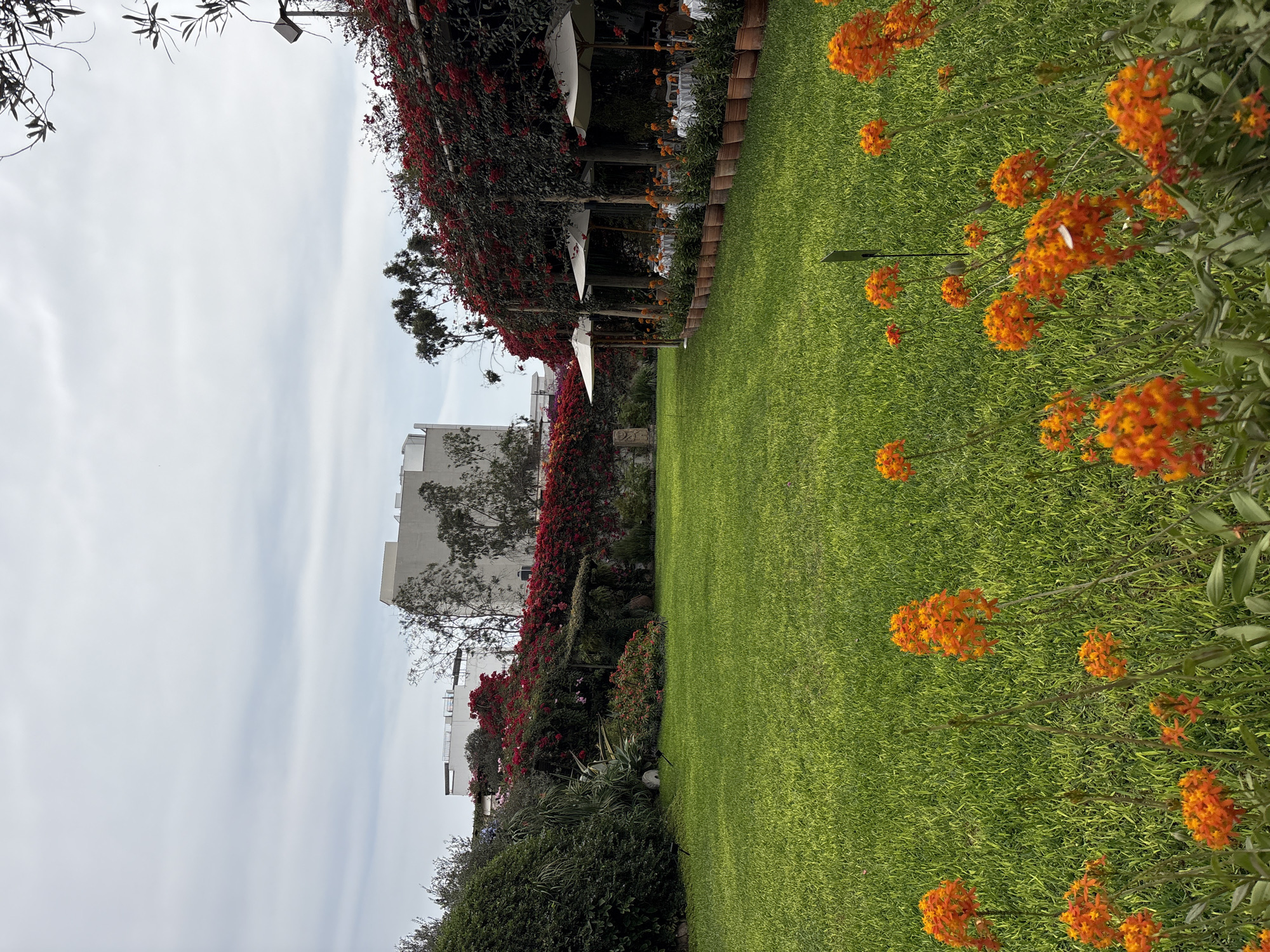
The image displays a lush, well-maintained garden scene, likely an outdoor dining or event space, under an overcast sky. A vibrant green lawn dominates the foreground and midground, stretching into the distance. To the right of the frame, a border of vivid orange flowers, possibly *Epidendrum* orchids, stands out against the green grass, forming clusters of bright color. Along the left edge, dense green shrubs and other varied foliage create a natural boundary. In the middle ground, a long, pergola-like structure is heavily adorned with brilliant red bougainvillea flowers, forming a dramatic wall of color across the scene. Beneath this floral canopy, several white parasols or large umbrellas are strategically placed, suggesting an outdoor seating area with tables and chairs, although no people are present. The setup indicates a prepared space for dining or social gatherings. In the background, behind the garden elements, a large, light-colored building with a flat roof is visible, along with parts of other structures, providing a hint of an urban or suburban setting. The sky is entirely overcast with soft, grey clouds, indicating a cloudy daytime with diffused light and no harsh shadows. The overall impression is one of tranquility and inviting lushness, reflecting a beautiful outdoor environment consistent with a garden in Pueblo Libre, Peru. No visible text is present in the image.
Pueblo Libre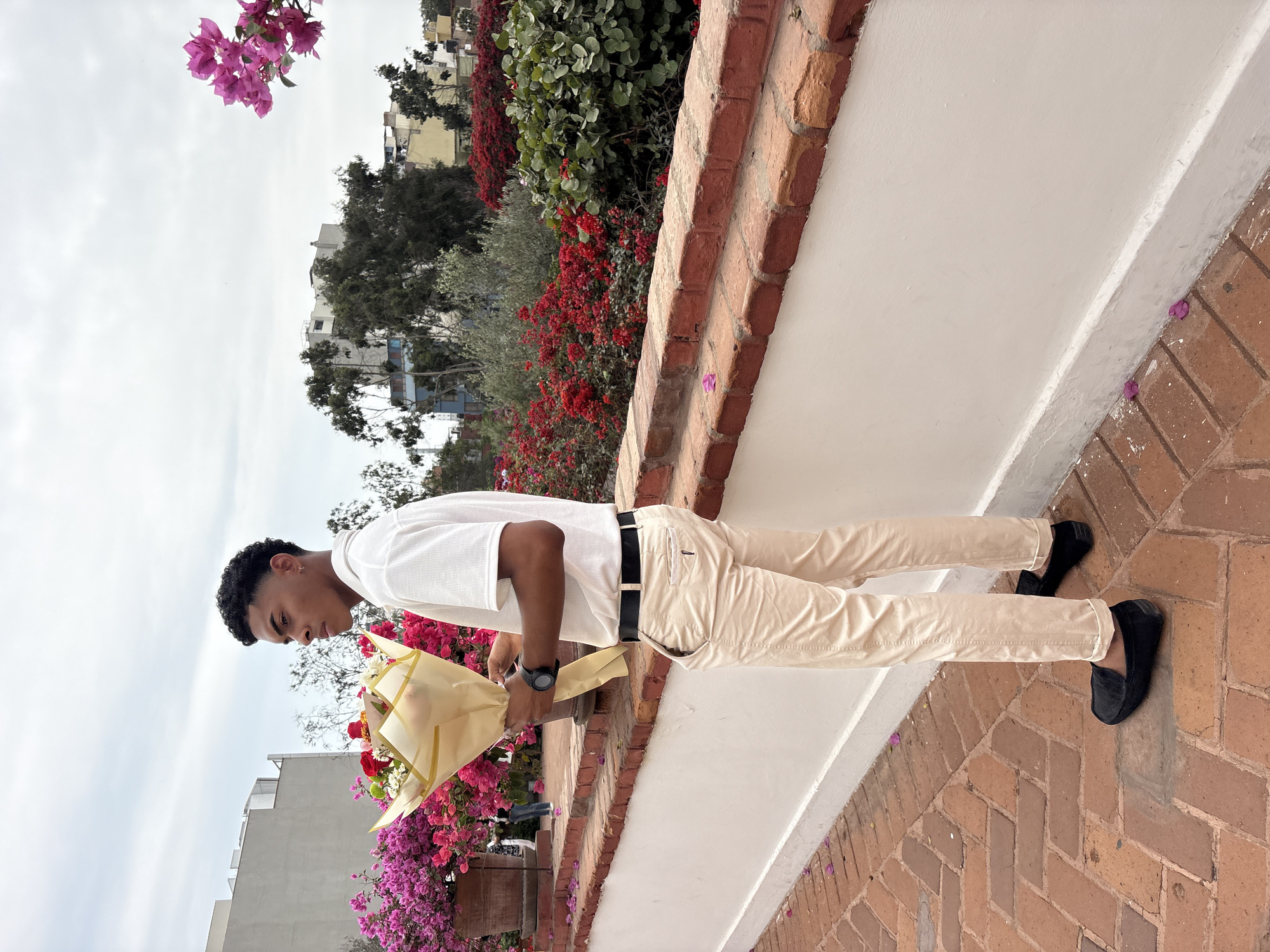
The image captures a young man standing on an outdoor terrace or balcony, set in what appears to be an urban or suburban environment, specifically Pueblo Libre, Peru. The man, likely of mixed ethnicity, is dressed in a casual yet smart attire, featuring a white short-sleeved collared shirt, light-colored (khaki or cream) chinos, a black belt with a gold buckle, and black loafers. He has short, dark, curly hair with a fade and wears a black watch on his left wrist. He is holding a bouquet of fresh flowers, artfully wrapped in light yellow paper. The bouquet contains a mix of vibrant red and white blooms, possibly with some other colors and green foliage, and he is looking down at them with a focused or appreciative expression. The setting includes a patterned brick surface underfoot and a sturdy brick wall or railing on the right, topped with a white coping or wall. Beyond this, a lush landscape of flowering plants is visible, dominated by vibrant red and pink bougainvillea, along with various green bushes and trees. In the distance, several buildings and structures can be seen under an overcast or partly cloudy sky. The overall lighting suggests it is daytime, possibly late morning or early afternoon, with diffused natural light. No visible text is present in the image.
Pueblo Libre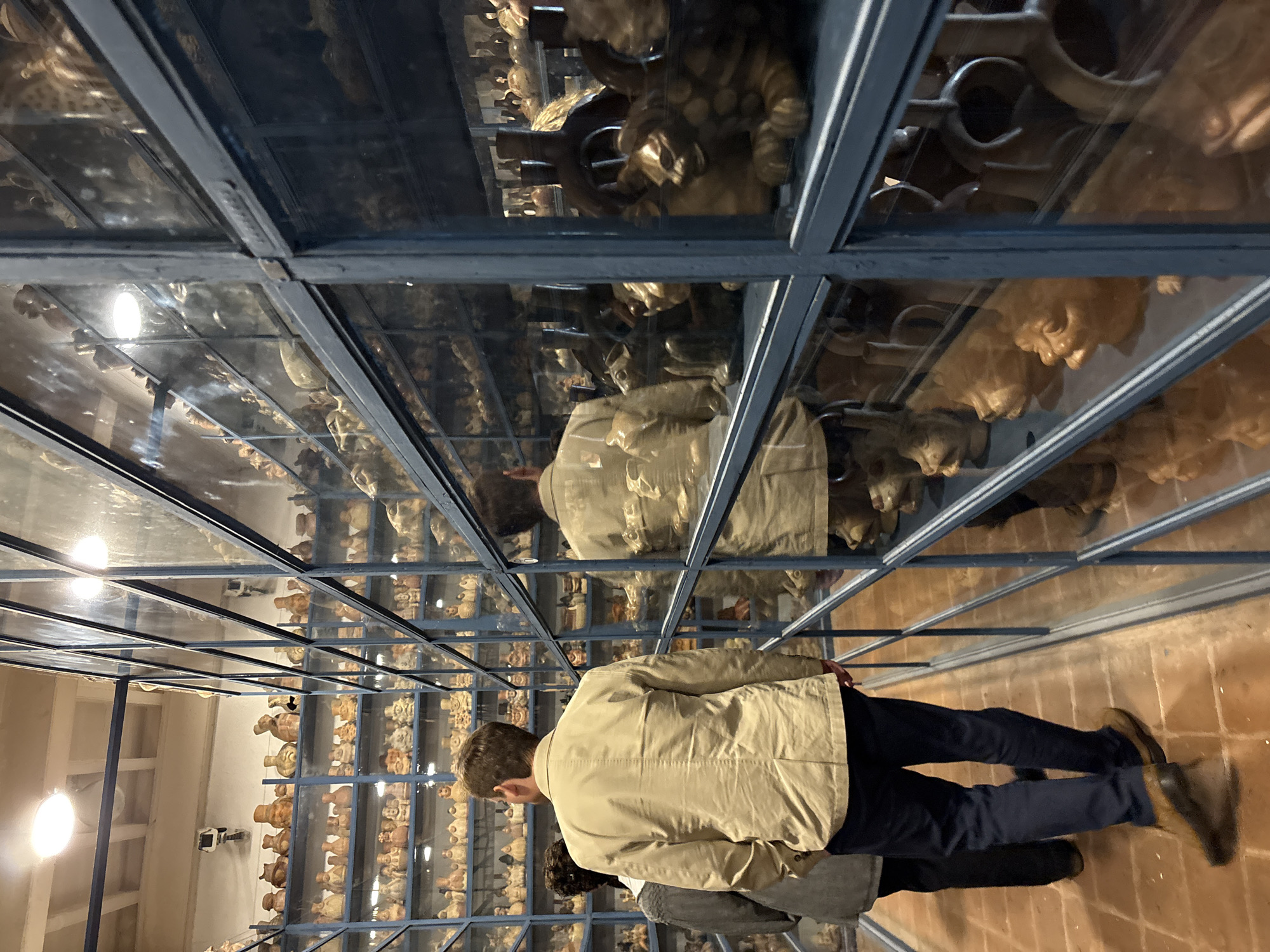
The image captures an indoor museum or gallery space in Pueblo Libre, Peru, viewed from a low angle, looking upwards at a transparent walkway or display structure. Two individuals are seen from behind, walking on the glass surface. The person in the foreground wears a beige jacket, dark blue pants, and brown shoes, looking down into the display beneath them. Another person, partially visible, walks behind them in a grey top. Beneath the clear glass floor, numerous ceramic or terracotta artifacts are meticulously arranged on shelves within a dark metal-framed display case. These artifacts appear to be ancient or historical, possibly pre-Columbian, comprising various forms including human heads, busts, and other small figures or vessels, all in earthy tones. The reflections of the people and overhead artificial lights are prominently visible on the glass panels, creating a layered and somewhat distorted view of the display. The floor visible through the lower sections of the glass display appears to be made of terracotta-colored tiles. The setting suggests a well-lit, curated exhibition of cultural heritage. There is no visible text.
Pueblo Libre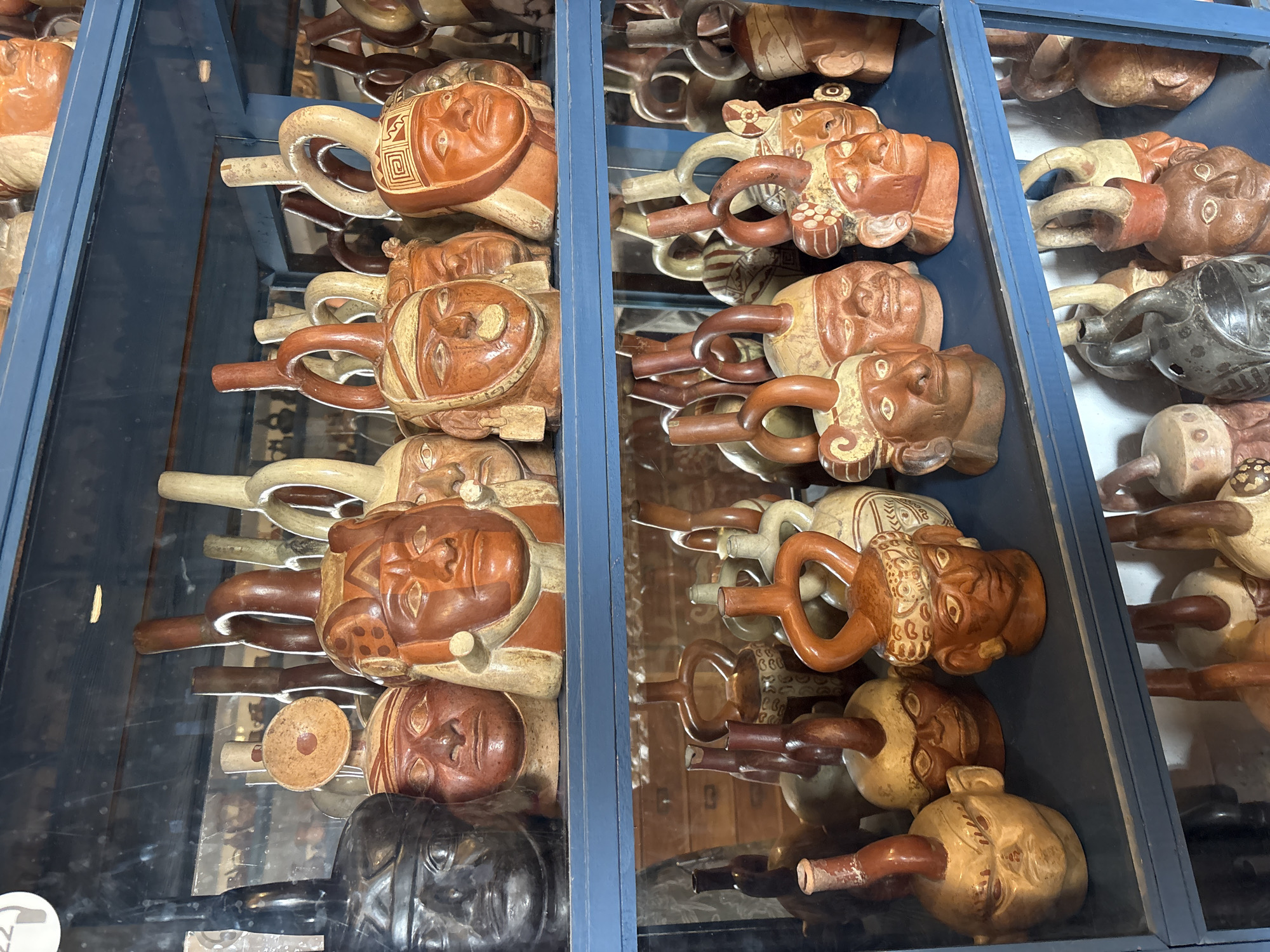
This media file captures a close-up, slightly angled view of numerous ancient Peruvian ceramic vessels, likely stirrup-spout bottles known as "huacos," displayed in a case. The vessels are predominantly made of terracotta-colored clay, with some featuring cream, beige, brown, or black accents. Many depict anthropomorphic faces or heads, often with stylized features, elaborate headwear, or intricate patterns resembling pre-Columbian iconography. The artifacts are arranged horizontally on multiple shelves within a display case, which has dark blue wooden frames and glass panels. The dense arrangement suggests a collection or inventory, possibly in a museum or an artisan shop, aligning with the location context of Pueblo Libre, Peru, known for its rich historical and cultural heritage. Reflections on the glass surfaces partially obscure some vessels and suggest an indoor setting with ambient lighting. There is no specific activity or event taking place; the image is a static display of cultural artifacts. The time of day and weather are not discernible. The expressions on the ceramic faces vary from serene to more stylized, reflecting the artistic conventions of their originating cultures. A small, circular white sticker is partially visible in the bottom left corner, but any text on it is illegible.
Pueblo Libre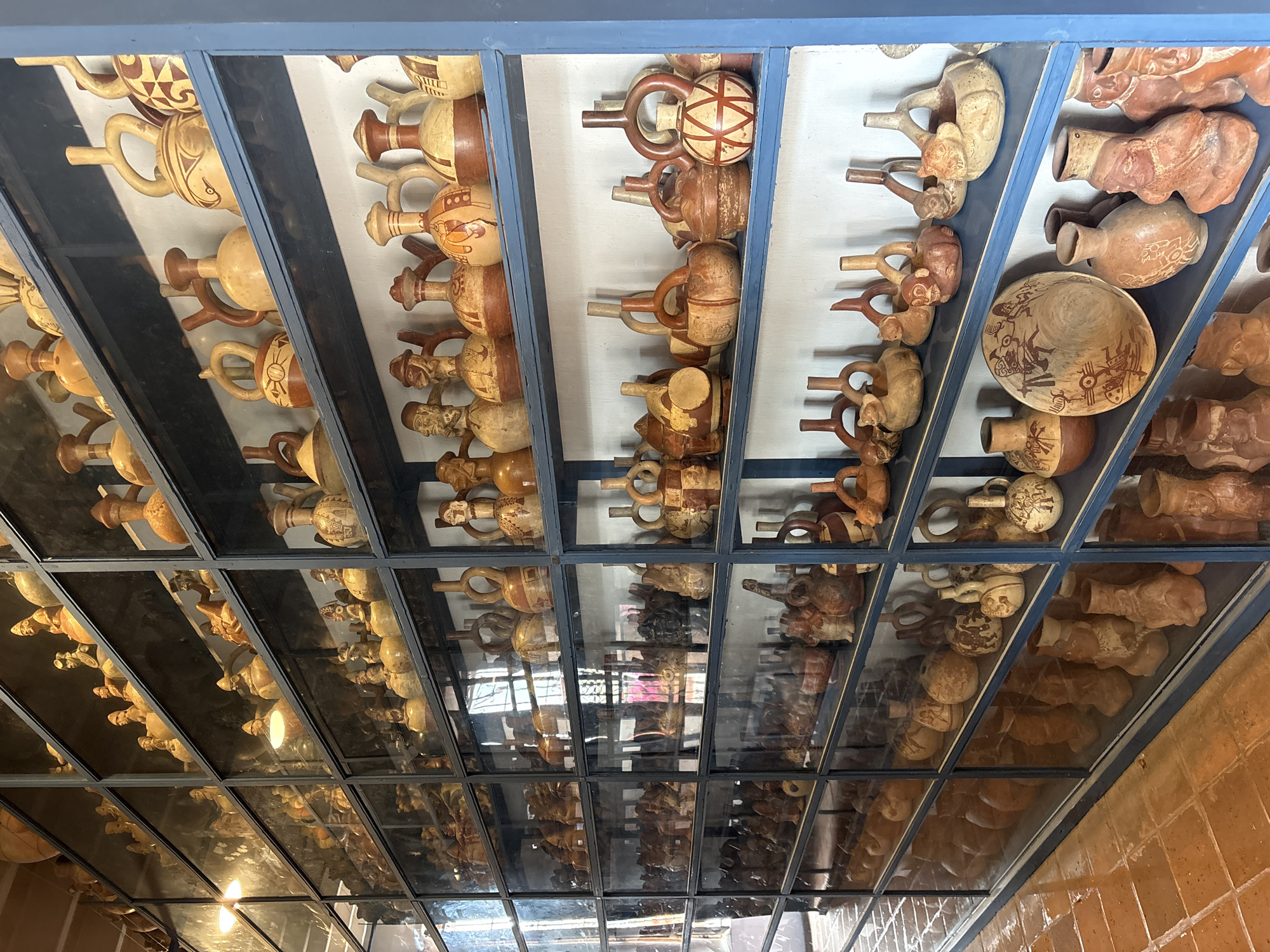
This media file captures an extensive overhead display of numerous ancient Peruvian ceramic artifacts, primarily pottery vessels, within what appears to be a museum or gallery setting in Pueblo Libre, Peru. The artifacts are showcased in a series of glass-covered compartments, segmented by blue-painted wooden or metal frames. The vessels are arranged horizontally on a white background, likely illuminated from within or above the display cases. They exhibit a rich diversity in form, size, and decoration, characteristic of pre-Columbian Peruvian cultures such as Moche, Nazca, or Chimú. Many pieces are stirrup-spout vessels or feature bridge handles, common to these traditions. The pottery ranges in color from light cream to reddish-brown, often adorned with intricate geometric patterns, stylized animal figures, or anthropomorphic representations, including human faces and full figures. One notable piece is a shallow bowl with painted scenes depicting several figures. The perspective is looking upwards, highlighting the unique ceiling-mounted exhibition style. The glass surfaces of the display cases reflect the surrounding environment, showing glimpses of the room's architecture and light sources. On the far right, a wall clad with terracotta-colored tiles is partially visible. The scene is static, documenting a carefully curated collection of historical and artistic ceramic works. No visible text is present on the artifacts or display cases themselves.
Pueblo Libre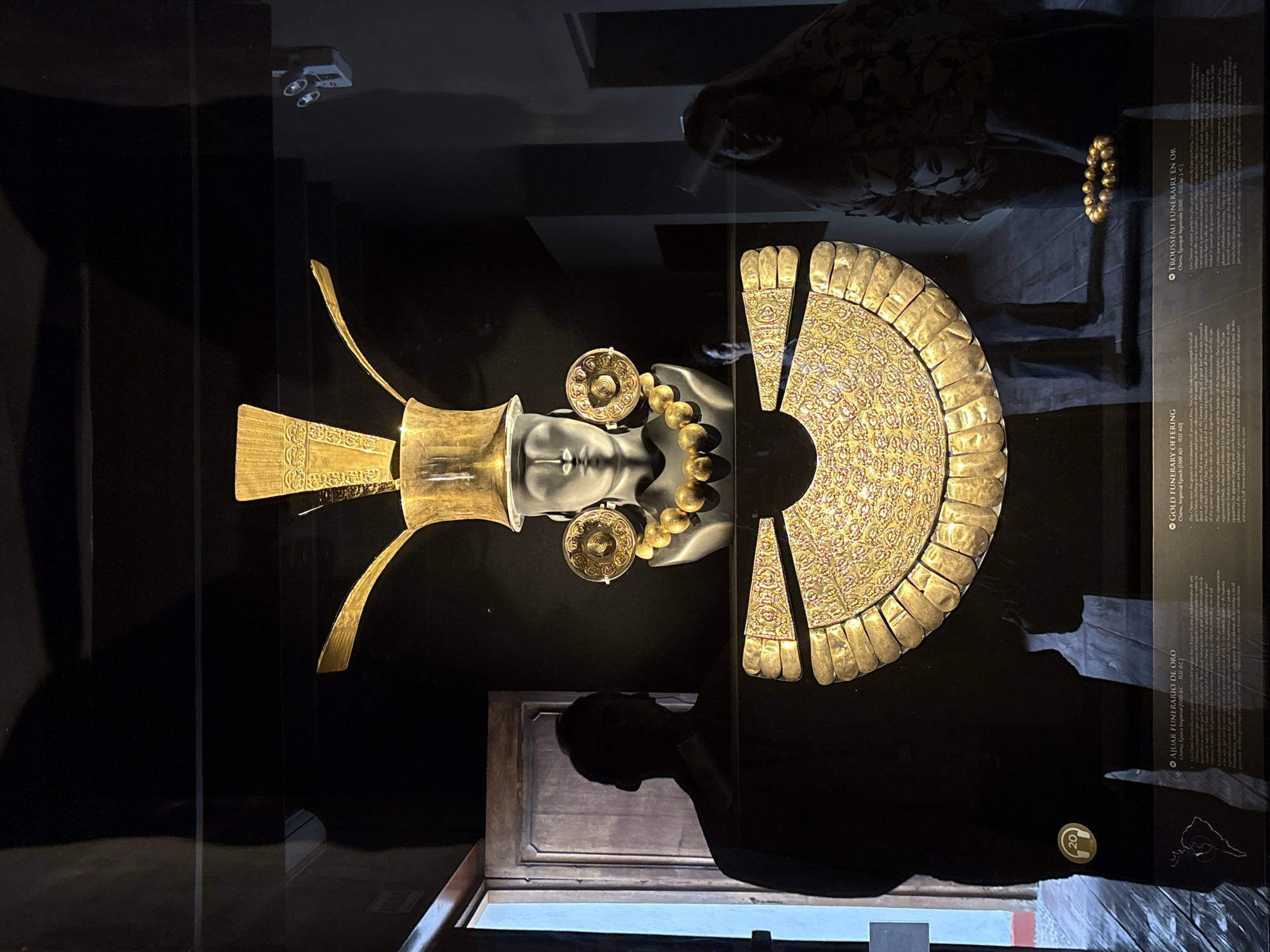
This image captures a gold funerary offering from the Chimú Imperial Epoch (1300-1532 AD) displayed in a museum or exhibition hall in Pueblo Libre, Peru. The central artifact is a resplendent golden ensemble, featuring a prominent crown with feather-like extensions, large circular earrings, a multi-strand beaded necklace, and a substantial, intricately patterned, semicircular pectoral. These golden elements adorn a dark, stylized head or mannequin. The artifacts are housed in a dimly lit display case, creating a dark background that accentuates the gold. Reflections on the glass surface are noticeable, showing silhouettes of visitors (including possibly the photographer), a wooden architectural element, and overhead lighting fixtures, indicating an indoor setting. Another smaller golden artifact, resembling a beaded ring or bracelet, is visible towards the upper right. Information plaques, partially visible on the right, provide details in English, Spanish ("AJUAR FUNERARIO DE ORO"), and French ("TROUSSEAU FUNERAIRE EN OR"). The text identifies the artifacts as a "GOLD FUNERARY OFFERING" from the Chimú Imperial Epoch (1300-1532 AD), explaining that it was part of a great lord's burial from Chan Chan, the capital of the Chimú kingdom, and describing specific components like the crown, pectoral, and figures depicted on them. A small circular label with the number "20" is also present. The scene conveys a sense of historical significance and cultural heritage.
Pueblo Libre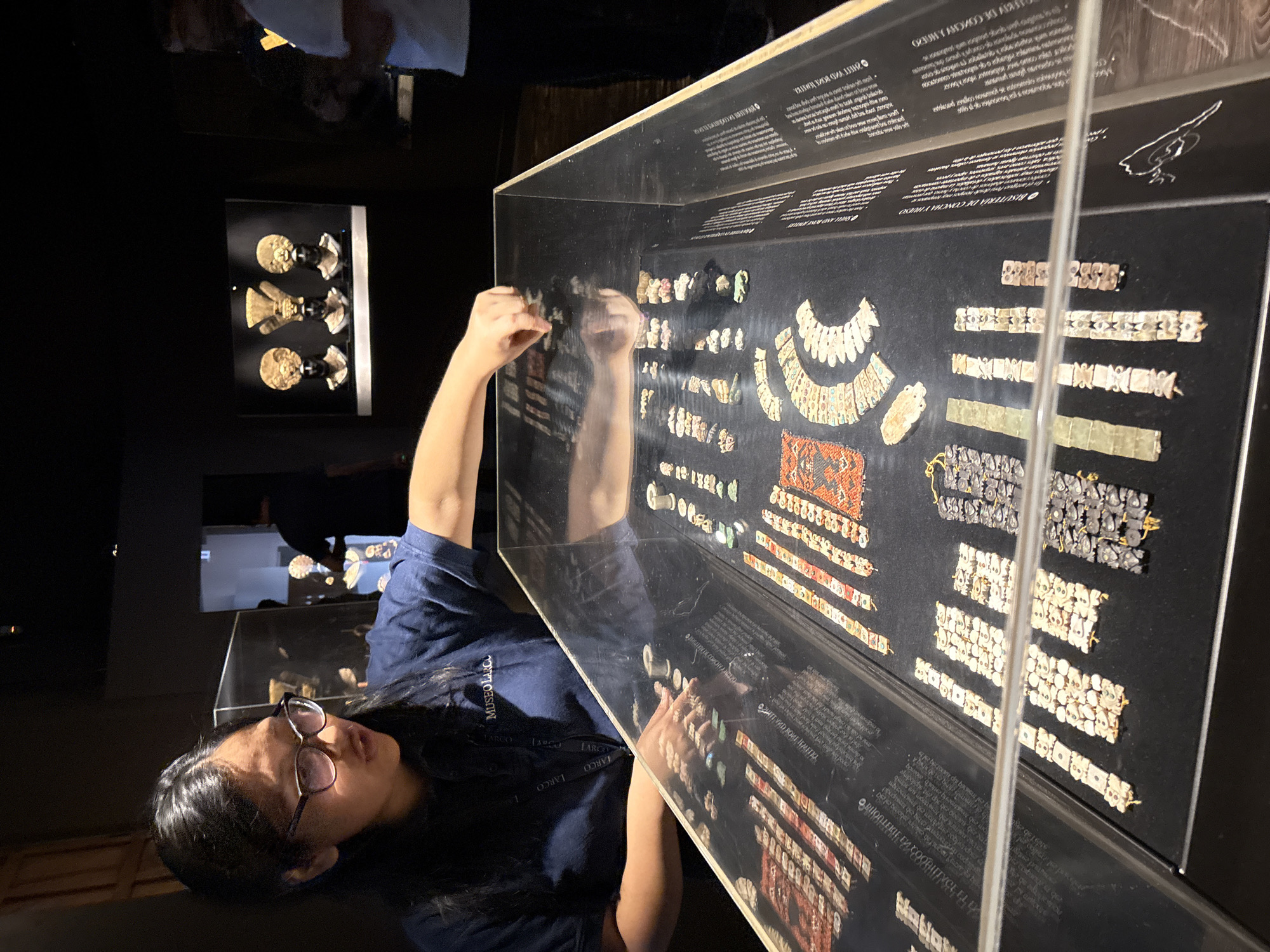
The media file captures a young woman with dark hair and glasses intently observing an exhibit in a museum. She is wearing a dark blue t-shirt prominently displaying "MUSEO LARCO," indicating the location is the Museo Larco in Pueblo Libre, Peru. Her arms are raised and reflected on the glass display case, suggesting she is leaning in to get a closer look or possibly pointing at a specific artifact. The exhibit within the glass case showcases an array of ancient jewelry and decorative items, meticulously arranged on a dark surface. These include several rows of intricate necklaces and bracelets, many composed of small, uniform pieces that appear to be crafted from shells, bones, or possibly jade. Some segments feature patterns, while others incorporate small skull-like elements. A colorful, patterned textile fragment is also part of the display. The museum setting is dimly lit, with spotlights illuminating the exhibits. In the background, other display cases containing golden artifacts are visible, though out of focus, along with faint reflections of other visitors. Visible text on the exhibit panel, some mirrored due to the glass, includes "BISUTERÍA DE CONCHA Y HUESO" (Shell and Bone Jewelry) and "TEXTIL DE CONCHA Y HUESO" (Shell and Bone Textile), identifying the materials of the displayed artifacts. The scene evokes a sense of quiet exploration and historical appreciation.
Pueblo Libre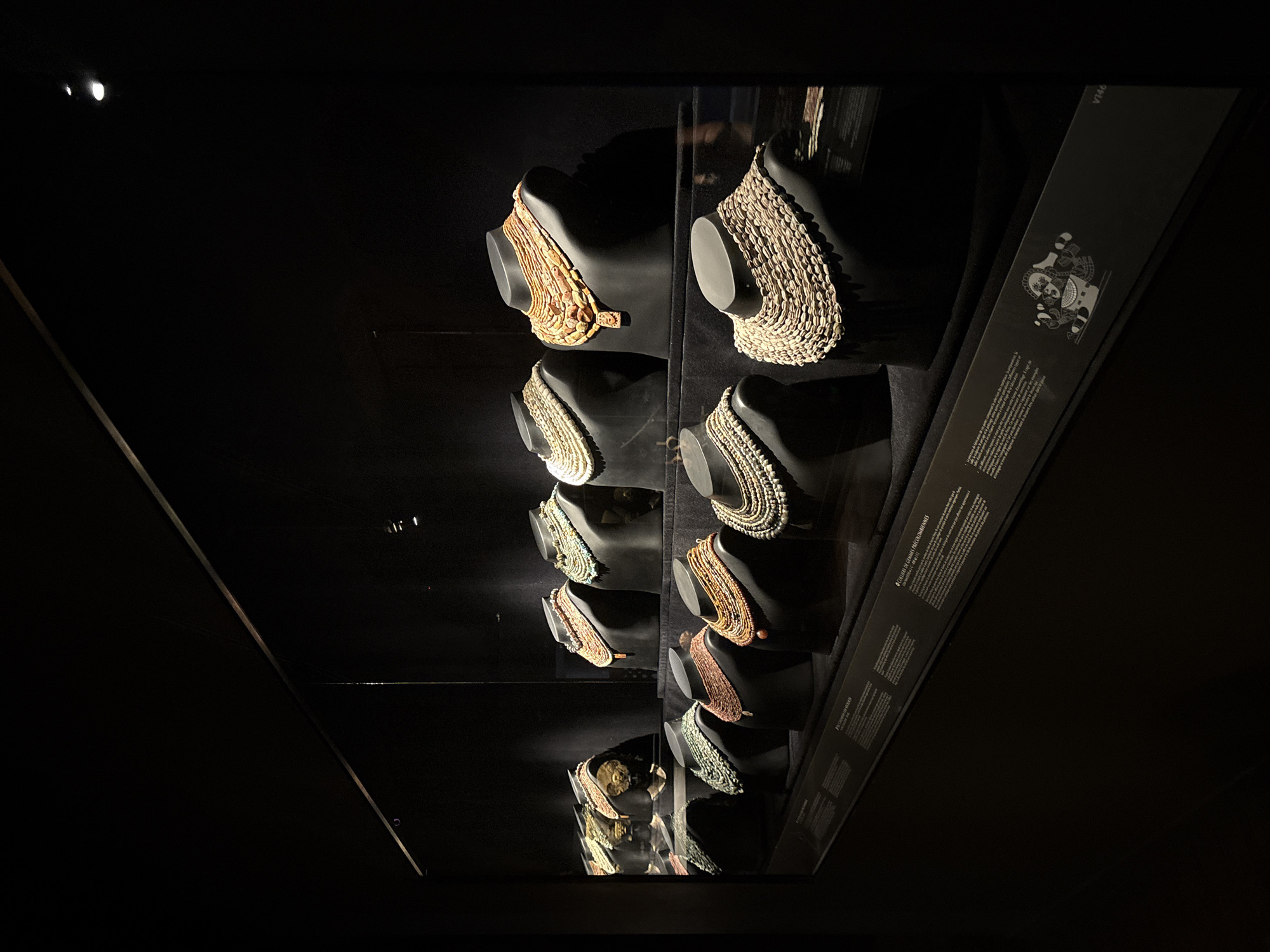
This media file captures a dimly lit museum display case showcasing a collection of ancient or traditional necklaces on black mannequins. The scene is set indoors, likely within a museum or exhibition hall in Pueblo Libre, Peru. The primary subjects are the numerous necklaces, meticulously arranged in rows within the glass enclosure. These intricate pieces appear to be crafted from natural materials such as shells, beads, or woven fibers, exhibiting a range of earthy tones, whites, and subtle greens. Each necklace is unique in its design, showcasing remarkable craftsmanship and varying textures. The black mannequins provide a stark contrast, allowing the details of the jewelry to stand out under focused spotlights. Reflections on the glass are visible, hinting at the dark environment outside the display. To the right of the display, a tall, dark information panel is visible, containing white text in what appears to be Spanish, along with a small, stylized illustration at the top. Although the text is largely unreadable due to the distance and lighting, phrases like "DEL COFRE DE ORO HALLADO EN CUMBES" (FROM THE GOLD CHEST FOUND IN CUMBES) and "ES CORTE DE REY" (IT IS KING'S COURT) can be discerned, indicating the historical and cultural significance of the artifacts. A reference number, possibly "V744," is also partially visible at the top of the panel. The illustration depicts figures and objects consistent with ancient Peruvian iconography. The overall impression is one of respectful exhibition, designed to highlight the beauty and historical value of the displayed artifacts. The focused lighting and dark surroundings draw the viewer's attention directly to the necklaces, emphasizing their artistry and cultural heritage.
Pueblo Libre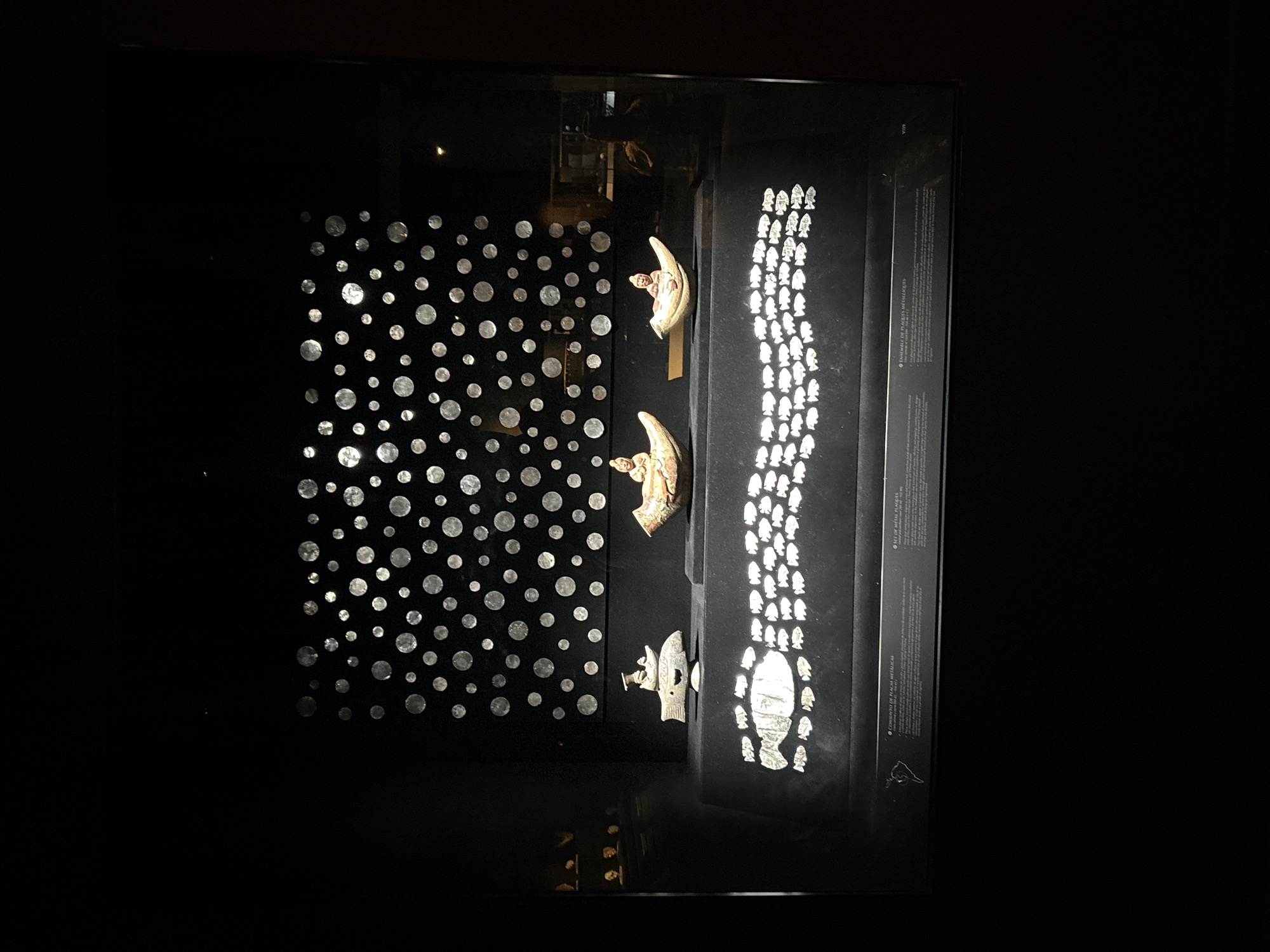
The image captures an illuminated museum exhibit in a dark setting, likely in Pueblo Libre, Peru. The display features various metallic artifacts against dark backgrounds, creating a high-contrast visual. On the left side of the frame, a vertical panel is adorned with numerous circular, metallic discs of varying sizes, reflecting light and forming a speckled pattern. In the central area, two prominent, crescent-shaped objects appear golden or made of a similar precious metal. Each crescent cradles an intricately sculpted figure, possibly representing a deity or human form. Below these, a third, smaller metallic artifact with an abstract, possibly anthropomorphic or zoomorphic design is visible. To the right, a tall display panel showcases numerous small, metallic plaques. These plaques are predominantly shaped like fish or stylized human figures and are arranged in vertical columns, collectively forming a larger, distinct outline. Below these, a larger, oval-shaped metallic object is displayed, followed by more smaller plaques. Visible text on the right display panel includes "ENSEMBLE DE PLAQUES METALLIQUES," "SET OF METAL PLAQUES," and "CONJUNTO DE PLACAS METALICAS," identifying the items as metal plaques. Additional smaller descriptive text in multiple languages is present but mostly illegible due to distance and resolution. The code "66A" is also visible at the top of this panel. The overall scene suggests a carefully curated exhibition of historical or cultural artifacts. The artifacts are brightly lit, standing out against the dark environment, typical of a museum display designed to focus attention on the items. No people are visible, emphasizing the displayed objects.
Pueblo Libre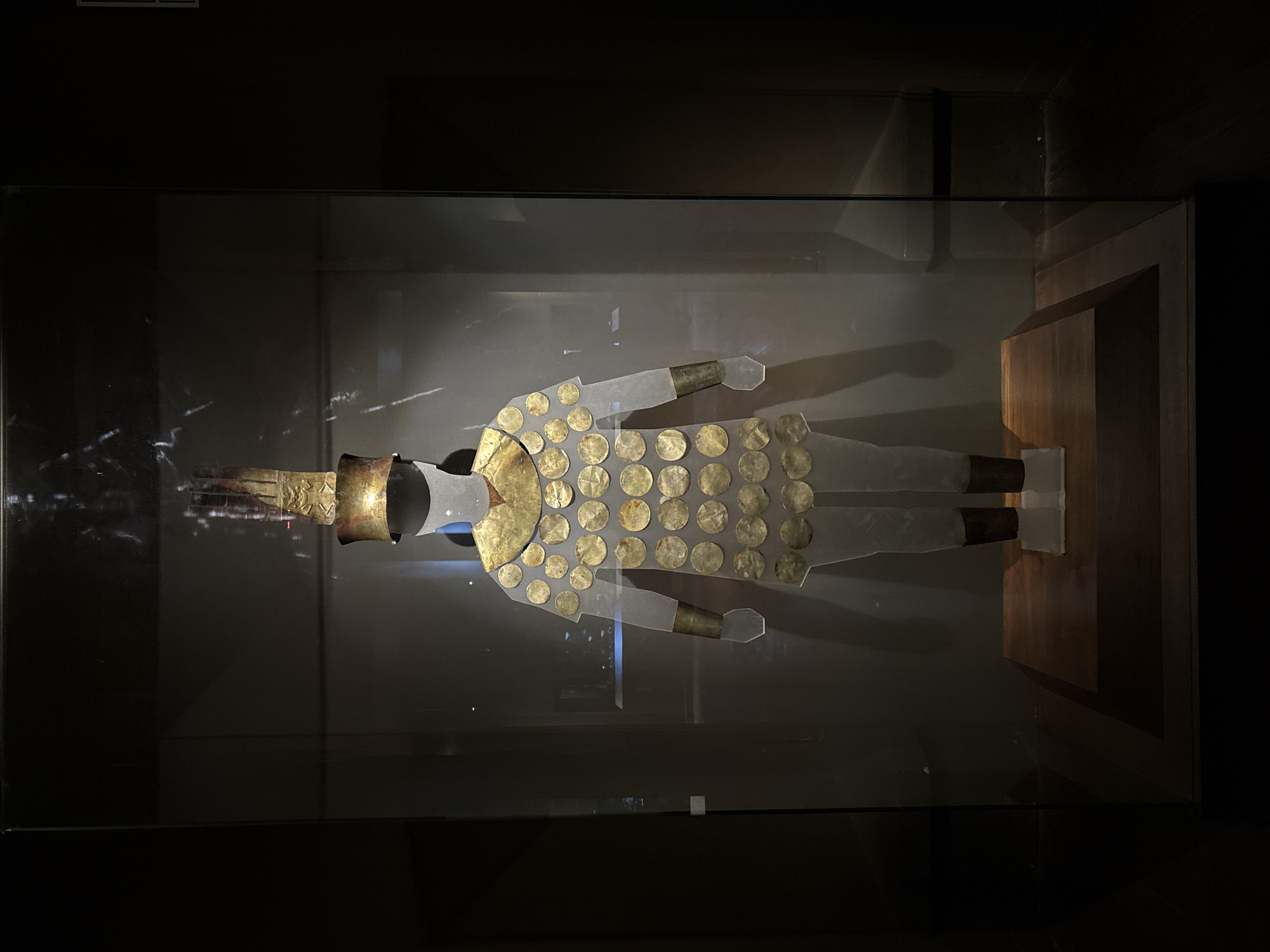
An ancient ceremonial or funerary costume is displayed horizontally within a rectangular glass case in a dimly lit museum setting. The artifact, likely originating from an ancient Peruvian culture given the Pueblo Libre context, features a light-colored, possibly fabric or leather, body garment adorned with numerous circular golden discs covering the torso and upper leg areas. Metallic bands are visible on the arms and lower legs. A prominent golden headpiece, conical in shape with intricate details and reddish-brown elements at its peak, completes the ensemble. The costume is laid out on an unseen support structure, which appears to be a stylized human form. The glass case reflects ambient light and some internal elements of the museum. A dark wooden display component is visible at the right end of the case. The overall environment suggests a carefully curated exhibition, emphasizing the artifact's historical and cultural significance. A small, dark display label with illegible text is barely visible in the top left corner of the main image. No human activity is depicted, focusing solely on the displayed artifact.
Pueblo Libre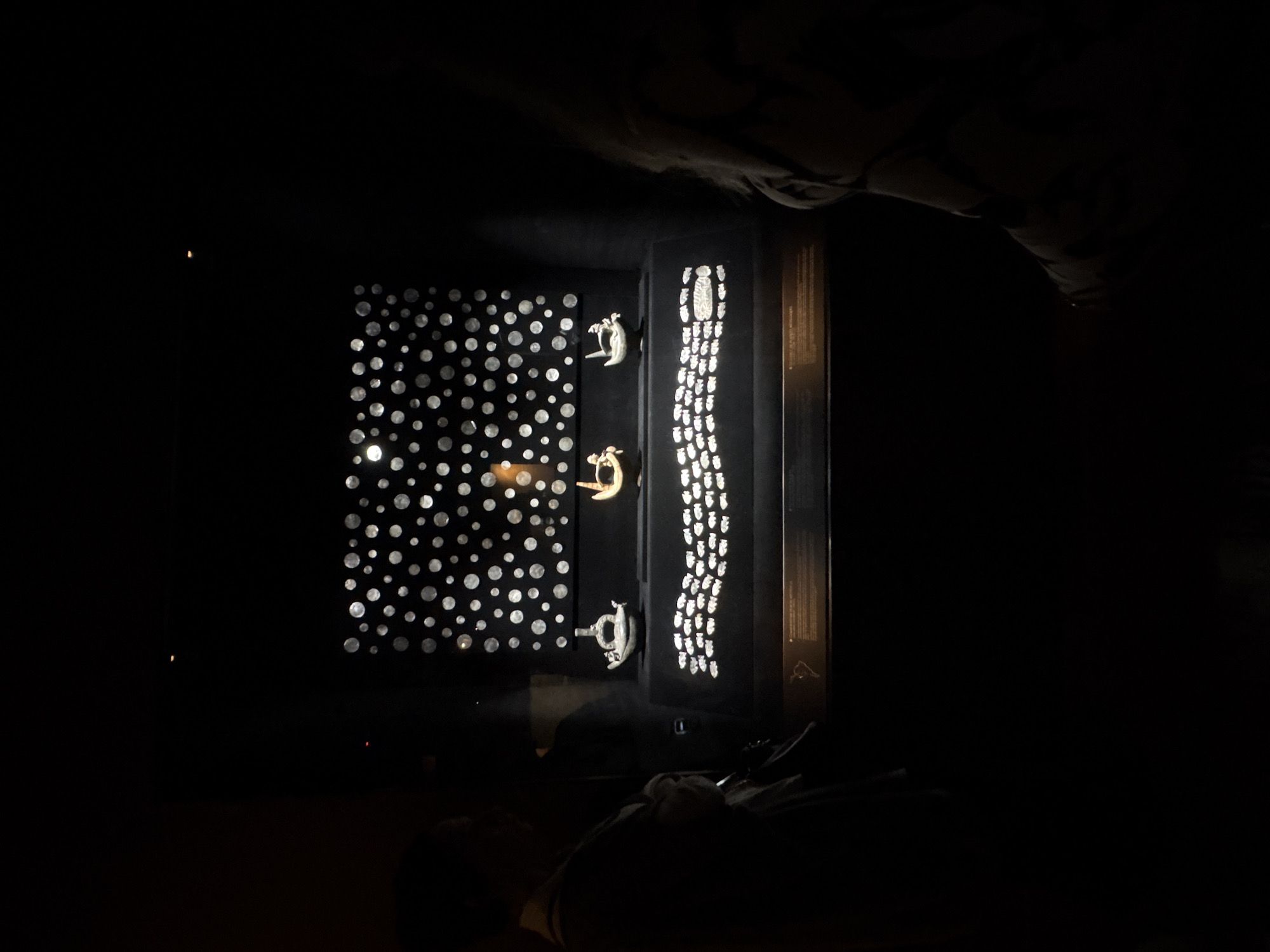
The image displays a dimly lit museum exhibition space, focusing on illuminated artifacts against dark backgrounds. The overall atmosphere is one of focused viewing in low light. In the center-left, a large, dark panel features numerous circular cutouts of varying sizes, some of which are illuminated, creating a sparkling, patterned effect. To its right, a tall, narrow display case showcases three golden, stylized animal figures, possibly llamas or similar, mounted vertically. These figures are brightly lit, contrasting sharply with the dark surroundings. Adjacent to this, another vertical display case exhibits a large collection of small, light-colored objects arranged in a dynamic, wavy pattern. These objects appear to be ancient artifacts, possibly pre-Columbian Peruvian, resembling stylized figures or symbolic forms, and are also brightly illuminated. On the far right edge, a thin vertical panel contains faint, unreadable text, likely descriptive labels for the exhibit. At the very bottom center, partially obscured by deep shadow, the head and shoulder of a person are vaguely discernible, appearing to be lying down or seated, potentially observing the displays. The setting, consistent with Pueblo Libre, Peru, suggests these are Peruvian archaeological or cultural artifacts. The controlled lighting creates a contemplative environment for viewing the exhibits.
Pueblo Libre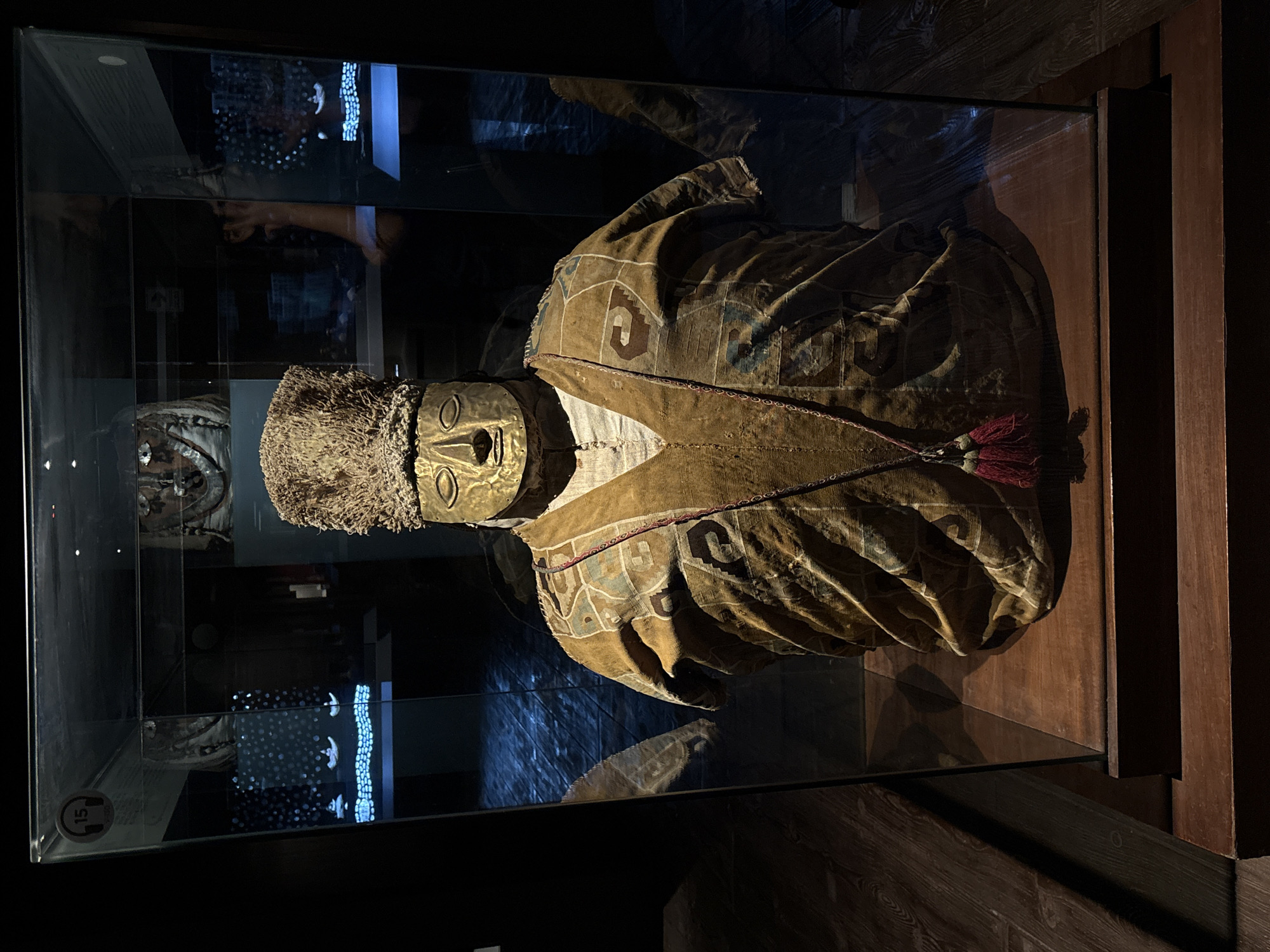
This media file captures a mummified figure or effigy displayed horizontally within a clear glass case in a dimly lit museum setting. The central subject wears a stylized mask, possibly made of gold or brass, featuring geometric eyes, nose, and mouth. Surrounding the mask is a textured, fibrous material, resembling a headdress or fur. The body is enveloped in an elaborately patterned textile cloak, predominantly brown and tan, adorned with intricate geometric motifs in blue, white, and lighter brown. A decorative dark red tassel hangs from the garment. The glass display case reflects various elements of the museum environment and visitors. Notable reflections include a human hand reaching towards the glass, abstract patterned lights or digital displays, and blurred shapes in the background. To the right and below the case, dark wooden panels are visible, indicating the structure of the exhibition space. A white circular sticker with the number "15" is affixed to the bottom left corner of the glass case, possibly an exhibit number or age guideline. The scene depicts a static cultural or historical exhibit, characteristic of a museum in Pueblo Libre, Peru, showcasing an ancient artifact. The low-key lighting enhances the focus on the exhibit, creating a contemplative atmosphere.
Pueblo Libre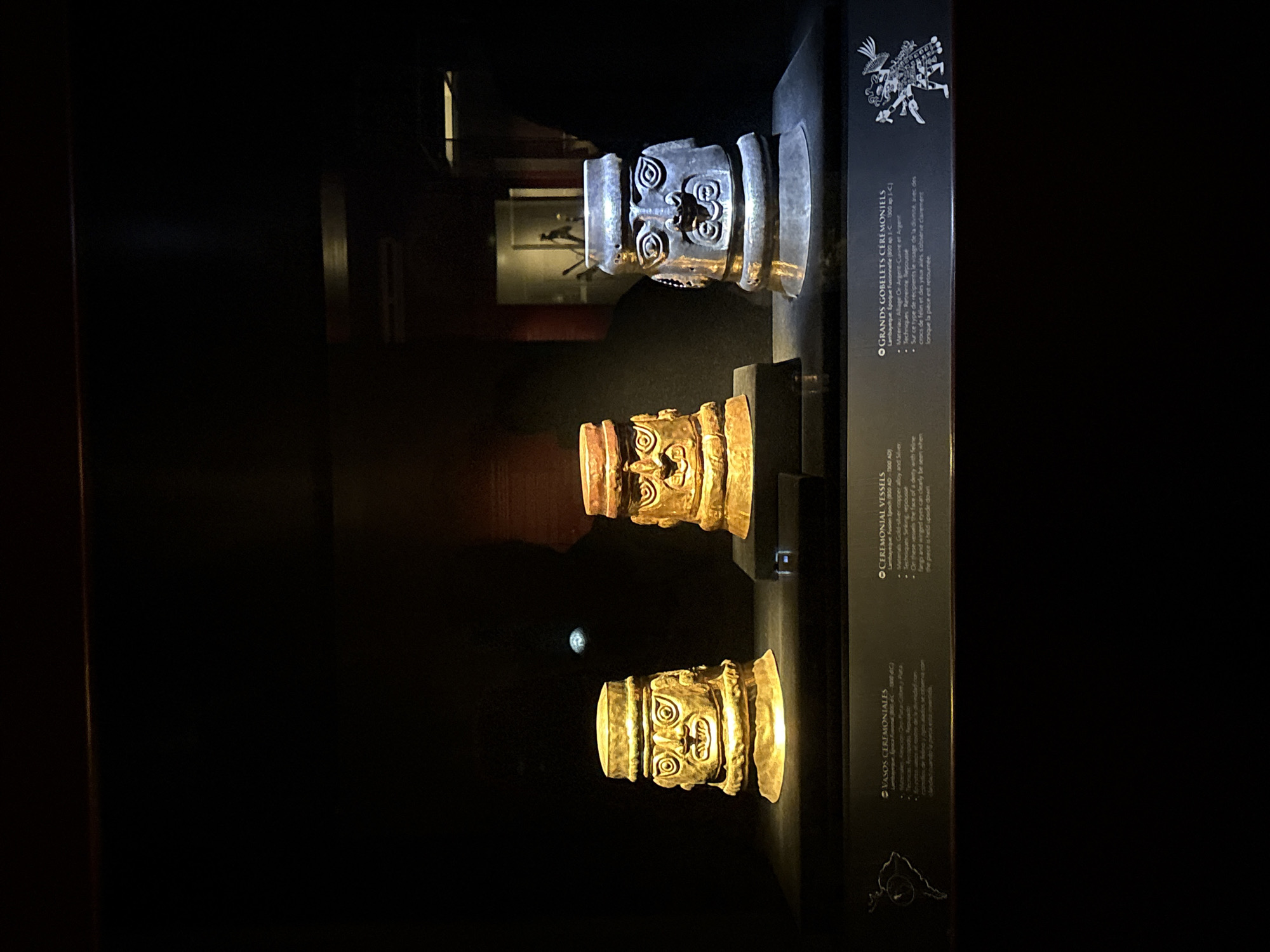
The image captures a dimly lit museum display featuring three ancient ceremonial vessels, likely gobilets, against a dark background. The scene suggests an exhibit showcasing historical artifacts. The primary subjects are the three vessels, vertically stacked on individual stands. The top vessel appears to be made of a silver or metallic alloy, while the two lower vessels are golden or bronze. Each vessel is cylindrical with a flaring base and features an intricately detailed human-like face, possibly representing a deity. The faces are stylized with prominent eyes and mouth, and the texture suggests they were crafted using techniques like repoussé. An information panel is visible to the right of the vessels, providing details in French, English, and Spanish. The text identifies the objects as "GRANDS GOBELETS CEREMONIELS" (Large Ceremonial Goblets) or "CEREMONIAL VESSELS" from the Lambayeque culture, dating to the Fusion Epoch (800 AD - 1300 AD). The materials are specified as a gold-silver-copper alloy and silver. The inscription also notes that the face of a deity, characterized by feline fangs and winged eyes, can be clearly observed when the piece is held upside down. This detail is notable as the vessels are currently displayed upright. The setting is an indoor museum or gallery, designed to highlight the artifacts with spotlights, creating dramatic shadows and reflections. The location context of Pueblo Libre, Peru, aligns with the Lambayeque origin of these pre-Columbian artifacts.
Pueblo Libre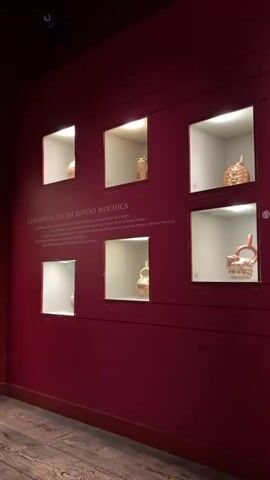
The video showcases an exhibition hall, likely a museum, in Pueblo Libre, Peru. The walls are painted a dark pink or maroon color. On the left side of the frame, there are six square wall niches, each illuminated and displaying an ancient pottery vessel or artifact, possibly from the Moche culture. Above these displays, the text "CEREMONIA DEL SACRIFICIO MOCHICA" (Mochica Sacrifice Ceremony) is visible. As the camera pans to the right, a large white outline mural on the pink wall becomes visible. This mural depicts stylized figures and scenes, characteristic of ancient Peruvian art, specifically Moche. Text accompanying the mural reads "LOS DIOSES MAYORES" (The Major Gods) and "EL SACRIFICIO DE LOS VENCIDOS" (The Sacrifice of the Vanquished). A woman, wearing glasses, a dark blue polo shirt, and dark pants, stands in front of this mural. She appears to be explaining or presenting the information, gesturing towards the artwork on the wall. She is speaking, suggesting she might be a guide or an expert sharing knowledge about the exhibition. The overall scene conveys an educational and cultural experience within a museum setting.
Pueblo Libre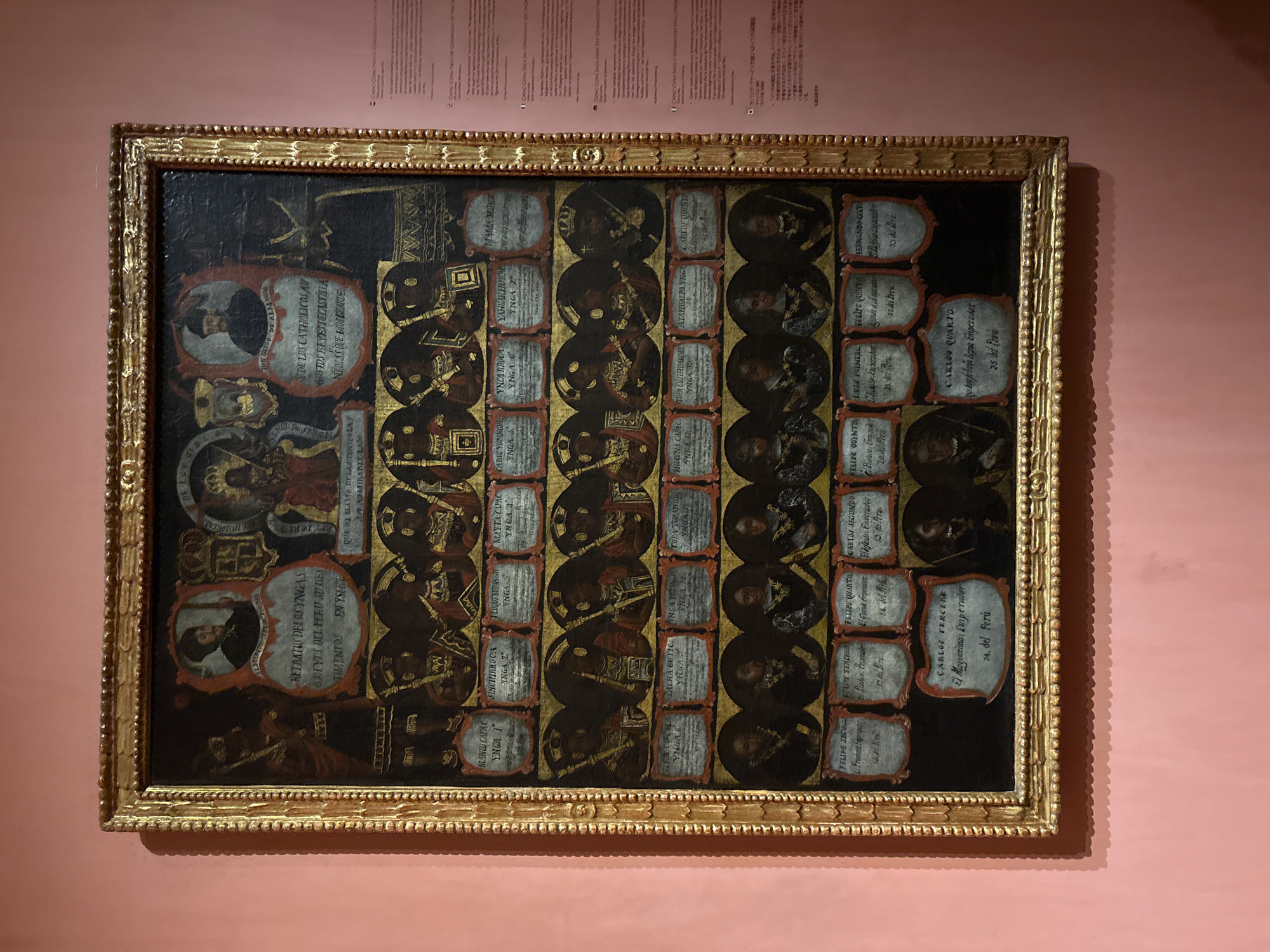
This is a vertically oriented, rectangular oil painting, framed in elaborate gilded gold, depicting a historical genealogy or chronicle of rulers. The painting is mounted on a plain, light pinkish-orange wall, likely in a museum or gallery setting in Pueblo Libre, Peru. Information panels with text in multiple languages are visible on the wall above the painting. The artwork features a dark, possibly black, background adorned with gold accents. It is organized into multiple columns of individual portraits, arranged in a grid-like fashion. The left side of the painting presents a lineage of indigenous rulers, primarily the Inca "Yngas," shown in circular or oval busts with distinct attire and headwear. Each portrait is accompanied by a small label providing their name and sequential number, such as "MANED CAPAC YNGA 1," "SINCHIRROCA YNGA 2," "LOQUI YUPANGUI YNGA 3," "MAYTA CAPAC YNGA 4," "CAPAC YUPANGUI YNGA 5," "YNCA RROCA YNGA 6," "YAHUAR HUACAC YNGA 7," "TOPA YUPAN GUI YNGA 10," "HUAYNA CAPAC YNGA 12," "TOPA CUSILLASCAR YNGA 13," and "ATAHUALPA YNGA 14." The right side of the painting showcases portraits of European monarchs, specifically Spanish kings, also depicted in busts within similar frames. Their labels include names like "CARLOS QUINTO," "FELIPE SEGUNDO," "FELIPE TERCERO," "FELIPE QUARTO," "CARLOS SEGUNDO," "FELIPE QUINTO," "LUIS PRIMERO," "FERNANDO SEXTO," "CARLOS TERCERO," and "CARLOS QUARTO." These labels often include titles such as "Emperador" and references to "del Peru" with associated numbers (e.g., "20. del Peru," "24. del Perú," "25. del Peru"). A prominent central text block, set against an ornate background, likely describes the painting's purpose. Partially legible phrases include "HETAATOS DELOS YNGAS REYES DEL PERU SUBES TIMENTOS EN YSERIE QUE DI TRAMO DELASTINIEBLAS AS ADMIRABLE LADO YDE LOS CATHOLICOS AU GUSTOS REYES DECASTILLA NROISS QUE DIOS GUARDE," suggesting it chronicles both the Inca kings of Peru and the Catholic kings of Castile. The overall activity depicted is the historical sequencing of these rulers, creating a visual record of succession.
Pueblo Libre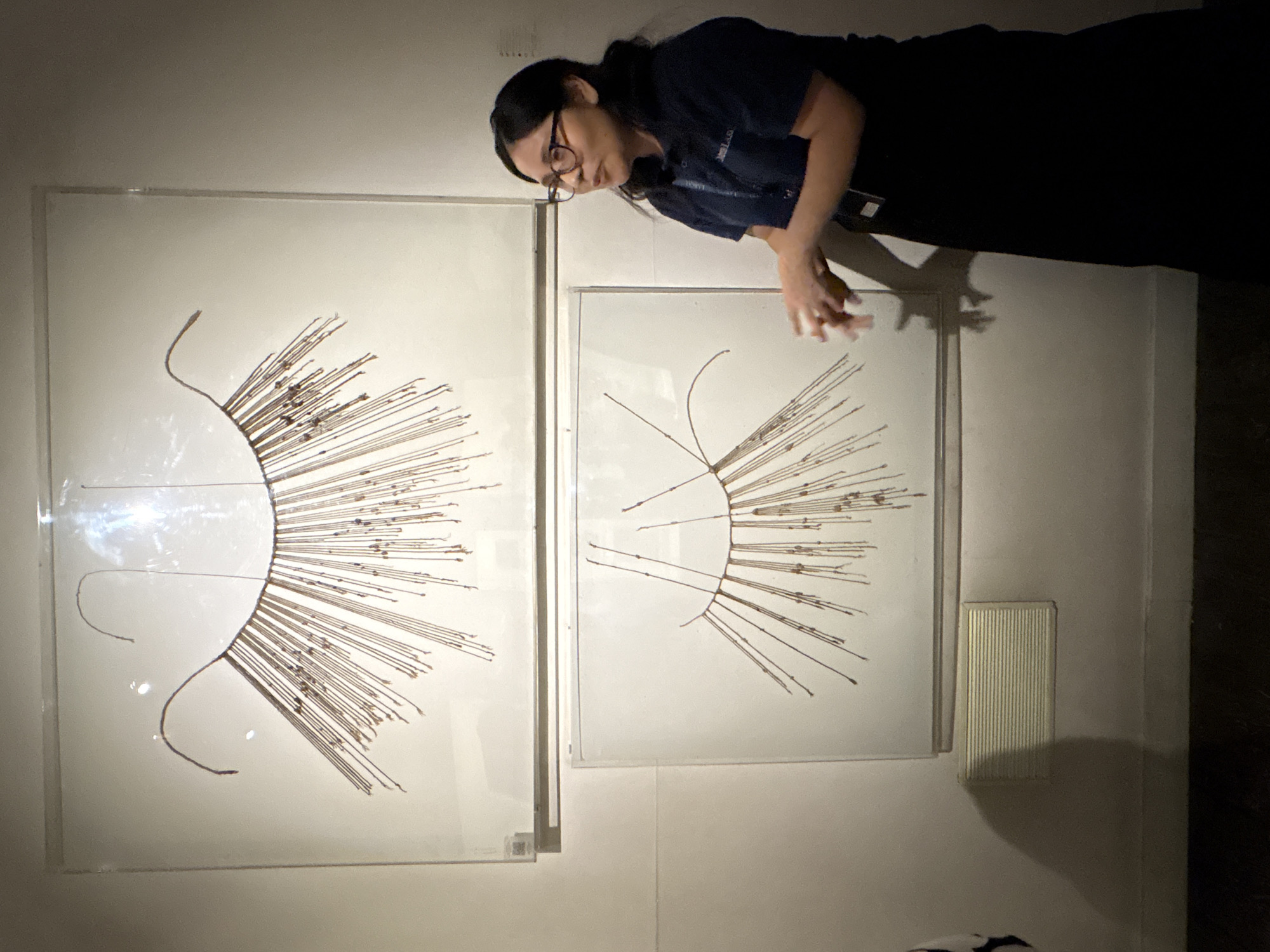
The image displays an indoor scene, likely a museum or art gallery located in Pueblo Libre, Peru. A woman is positioned on the right side of the frame, leaning forward and intently observing two framed artworks displayed on a light-colored wall. The woman has dark hair pulled back and wears glasses. She is dressed in a dark short-sleeved top, possibly a uniform given the visible but illegible logo on her chest, and dark trousers. Her hands are slightly raised and open, suggesting an active observation or interaction with the display. A prominent shadow of the woman is cast on the wall and floor to her right, indicating the direction of the light source. Two abstract artworks are featured, both encased in clear, rectangular, box-like frames. The artwork on the left is noticeably larger than the one on the right. Each piece consists of numerous thin, delicate strands or fibers, arranged in a semi-circular, radiating pattern, resembling a stylized half-sun or a fan. These elements appear organic or natural, possibly dried plant material or fine wires, often with small nodes or beads along their length. The left artwork includes two additional longer, curving strands extending from its base. Between and slightly below the two frames, a small, white, vertically ribbed rectangular object, possibly a vent or speaker, is mounted on the wall. The overall lighting is subdued, creating a gallery atmosphere, with reflections visible on the clear surfaces of the artwork frames. The woman appears focused and engaged with the exhibition. No other legible text is visible within the scene.
Pueblo Libre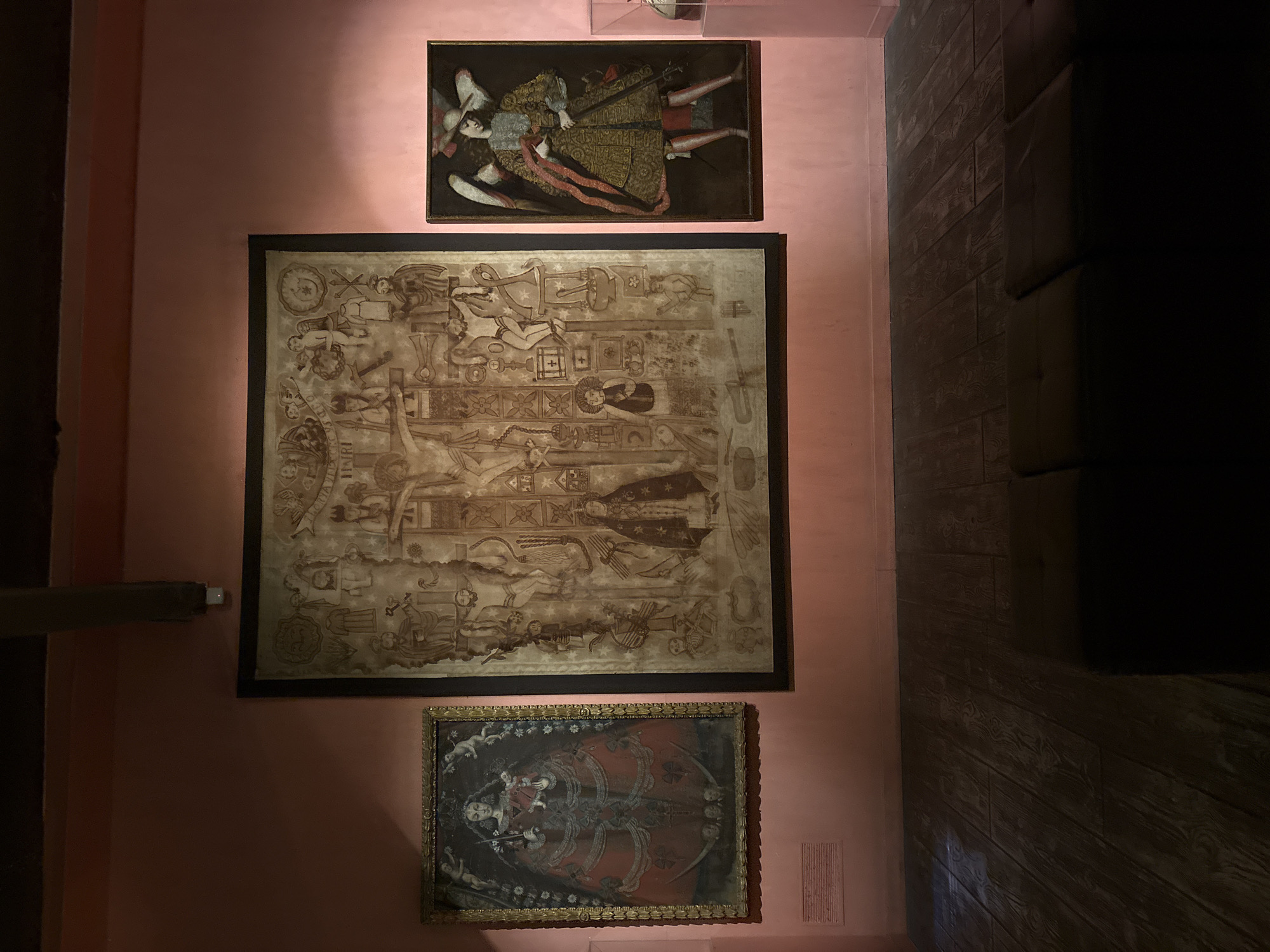
Three framed artworks are displayed vertically on a light reddish-pink wall in what appears to be a dimly lit museum or gallery, likely in Pueblo Libre, Peru. To the right, a section of the room features a dark wooden-paneled wall or column, and further right, a dark, possibly padded or upholstered architectural element is visible. The top artwork is a rectangular, landscape-oriented painting depicting a winged figure, likely an Archangel, dressed in elaborate colonial-era attire, including a patterned jacket, sash, and boots. The figure holds a staff or spear against a dark background. The central, largest artwork is a square-ish framed piece, rich with intricate details in muted, faded tones, possibly sepia. It appears to be a complex religious or allegorical chart, featuring numerous small figures, religious symbols, and scenes. A prominent detail shows a crucified figure, and the Latin inscription "INRI" is partially visible above a cross. Other textual elements are present but illegible. This piece suggests a diagrammatic representation of Christian theology or history. The bottom artwork is a rectangular, landscape-oriented painting with a ornate gold frame. It portrays a central female figure, possibly a syncretic representation of the Virgin Mary, with multiple arms holding various attributes. The figure is flanked by smaller cherubic or angel-like figures. The palette is rich with reds, dark tones, and gold accents. The overall setting suggests a display of historical and religious art, characteristic of the colonial period in Peru, with controlled lighting emphasizing the artworks. No specific activity beyond viewing the art is depicted.
Pueblo Libre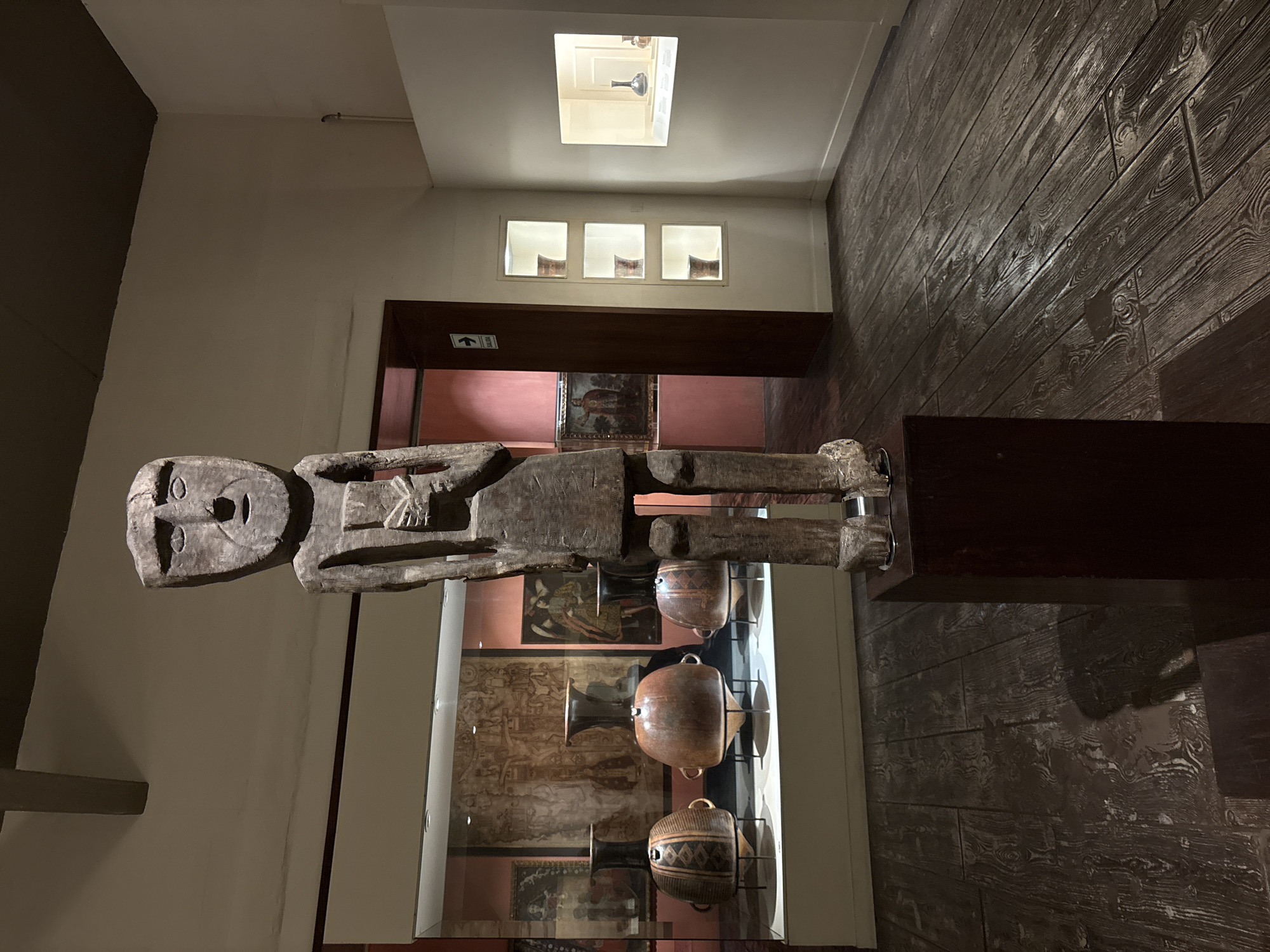
An image captures an indoor museum or exhibition space in Pueblo Libre, Peru, showcasing cultural artifacts. The central subject is a tall, stylized carved wooden figure, possibly an idol or effigy, standing on a dark pedestal. The figure features a flat, round head with simple carved eyes and mouth, and its hands appear to be crossed over its chest. Behind the wooden figure, to its right, a glass display case houses three distinct pottery vessels, likely ancient urns or jars, arranged on pedestals. The pottery exhibits earthy tones, with one featuring geometric patterns. Behind the case, sections of framed artwork or tapestries depicting figures and scenes are visible on a reddish-pink wall. The room has light-colored walls and a dark, distressed wooden plank floor, giving it a rustic yet refined appearance. A doorway with a dark wooden frame is visible in the background, leading to another section of the exhibit. Above the doorway, three square openings in the wall, possibly display niches or windows, show glimpses of other artifacts. The ceiling features a larger square cutout with an ornate object, possibly a vase or candlestick, illuminated within. The lighting is controlled, with spotlights highlighting the artifacts and recessed lighting in the ceiling. A small white sign on the doorway frame displays a black arrow pointing left and the Spanish word "SALIDA" (Exit). The overall atmosphere is quiet and reverent, typical of a historical or cultural museum exhibit.
Pueblo Libre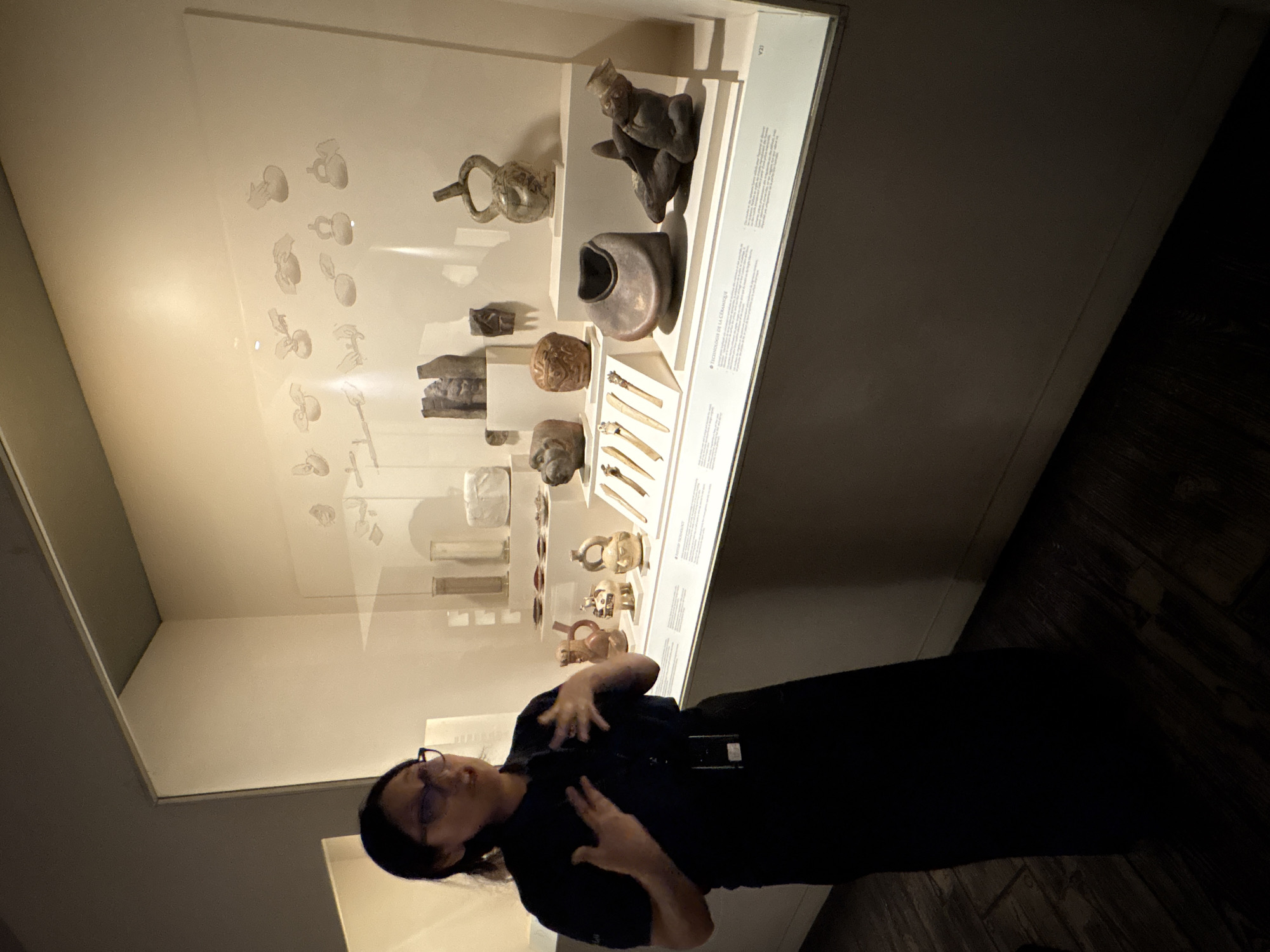
The image captures an indoor scene, rotated 90 degrees clockwise from its natural orientation, showing a person in front of a museum exhibit. In the foreground, slightly to the left, a woman with dark hair and glasses is visible from the waist up. She is wearing a dark shirt and dark pants, and appears to be actively presenting or explaining something, with her hands raised and open, palms facing slightly upwards, as if gesturing or emphasizing a point. Her expression seems engaged. Behind the woman, and filling a large portion of the background, is a brightly lit display case containing numerous artifacts. These items appear to be ancient ceramic pottery, figurines, and tools, likely made of bone or wood. The collection includes various styles of pots, such as spouted vessels and those resembling human or animal forms, as well as carved heads and other intricate pieces. The artifacts are arranged on shelves within the case, some elevated on white risers. The display case is made of glass, reflecting some light sources and possibly other elements of the room. White informational panels are placed among the artifacts inside the display. Text is visible on these panels; one prominent section reads "TECNOLOGIAS DE LA CERAMIQUE" (Technologies of Ceramics), which is French, indicating a multilingual presentation or museum. Another label shows "V21". The lighting within the display case is strong, highlighting the artifacts, while the surrounding room appears somewhat darker, with a dark wooden floor visible on the right side of the image. The setting suggests a museum or an archaeological exhibition, likely in Pueblo Libre, Peru, given the contextual information provided.
Pueblo Libre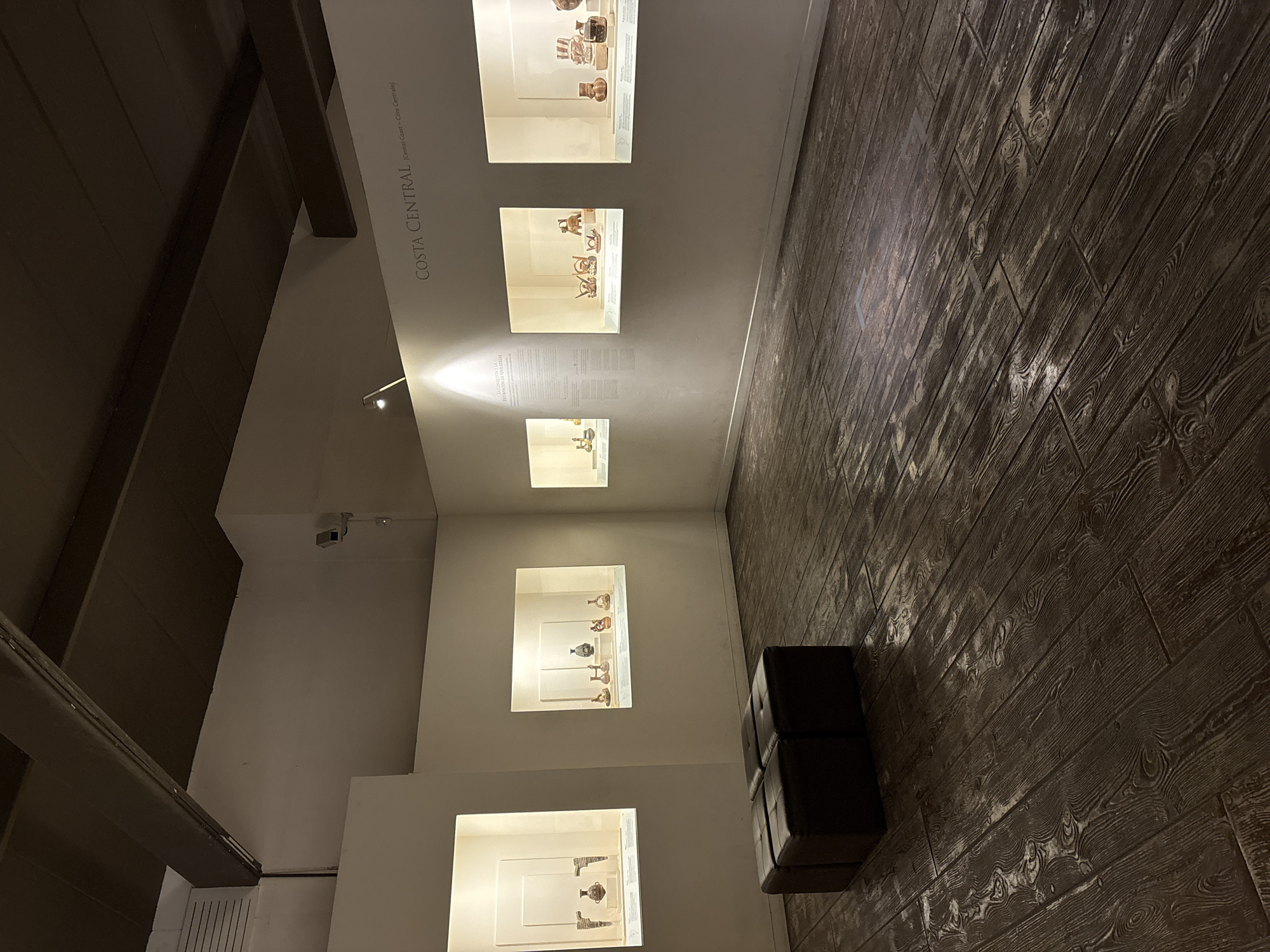
This image captures an interior view of a museum or exhibition hall, likely located in Pueblo Libre, Peru. The scene is dominated by a long, light-colored wall featuring multiple illuminated display cases, each showcasing various small artifacts, primarily ancient pottery and figurines. The exhibits are arranged vertically along the wall, with information panels, one of which clearly displays "COSTA CENTRAL (Central Coast - Côte Centrale)" and another partially visible, stating "LA CONQUISTA Y LA EXTINCIÓN DE IDOLATRÍAS," suggesting a focus on pre-Columbian and colonial history of the central Peruvian coast. The floor is made of dark, richly textured wooden planks, appearing well-worn or distressed, contributing to a historical ambiance. In the foreground, two dark, square, cushioned seating cubes are positioned on the wooden floor, inviting visitors to rest and observe the exhibits. Overhead, dark wooden beams and modern track lighting fixtures are visible, providing focused illumination on the displays. A security camera is mounted discreetly on the ceiling in the upper background. No people are present, allowing for an unobstructed view of the exhibition space. The lighting is artificial, creating a warm, focused glow on the artifacts. The overall setting is clean, well-organized, and designed for educational viewing, characteristic of a cultural institution.
Pueblo Libre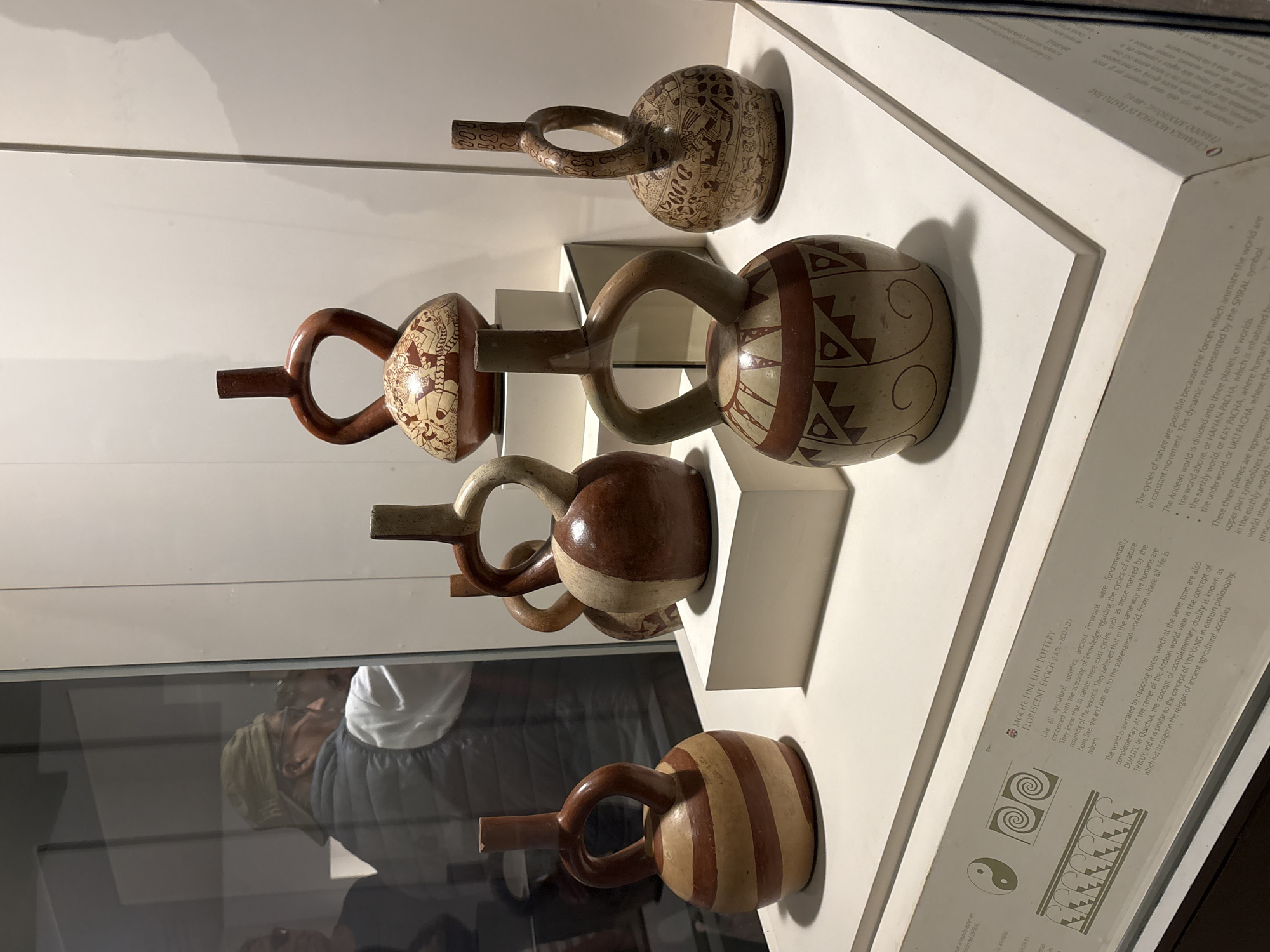
The image captures a museum display case featuring five ancient Moche ceramic vessels, likely from the Florescent Epoch (1 AD - 800 AD). The pottery, characterized by distinct stirrup handles and spout formations, is crafted from terracotta-colored clay and decorated with reddish-brown and cream designs. The vessels showcase a variety of artistic styles: the top vessel features complex, detailed figures (possibly anthropomorphic or zoomorphic), while others exhibit geometric patterns, including triangles and spirals, and striped motifs. These artifacts are arranged vertically within a white display enclosure. To the right, a white informational panel provides context for the "Moche Fine Line Pottery." The text explains that ancient Peruvian societies were fundamentally concerned with the cycles of nature, life, death, and rebirth. It introduces the Andean concept of "DUALITY" or "TINKUY," which is likened to the Eastern philosophy of Yin-Yang, describing it as the balance of opposing yet complementary forces. The text also outlines the division of the Andean world into three planes: HANAN PACHA (the world above), KAY PACHA (the earthly world), and UKU PACHA (the underworld), with the SPIRAL symbol representing the constant movement and dynamic forces animating the world. Spanish text, including "CERAMICA MOCHICA DE TRATTO FINE," is also visible. The glass of the display case reflects the blurred figures of at least two people, indicating visitors observing the exhibition. The setting is clearly an indoor museum or gallery, consistent with a display of ancient Peruvian artifacts in Pueblo Libre, Peru. The image itself is oriented 90 degrees clockwise.
Pueblo Libre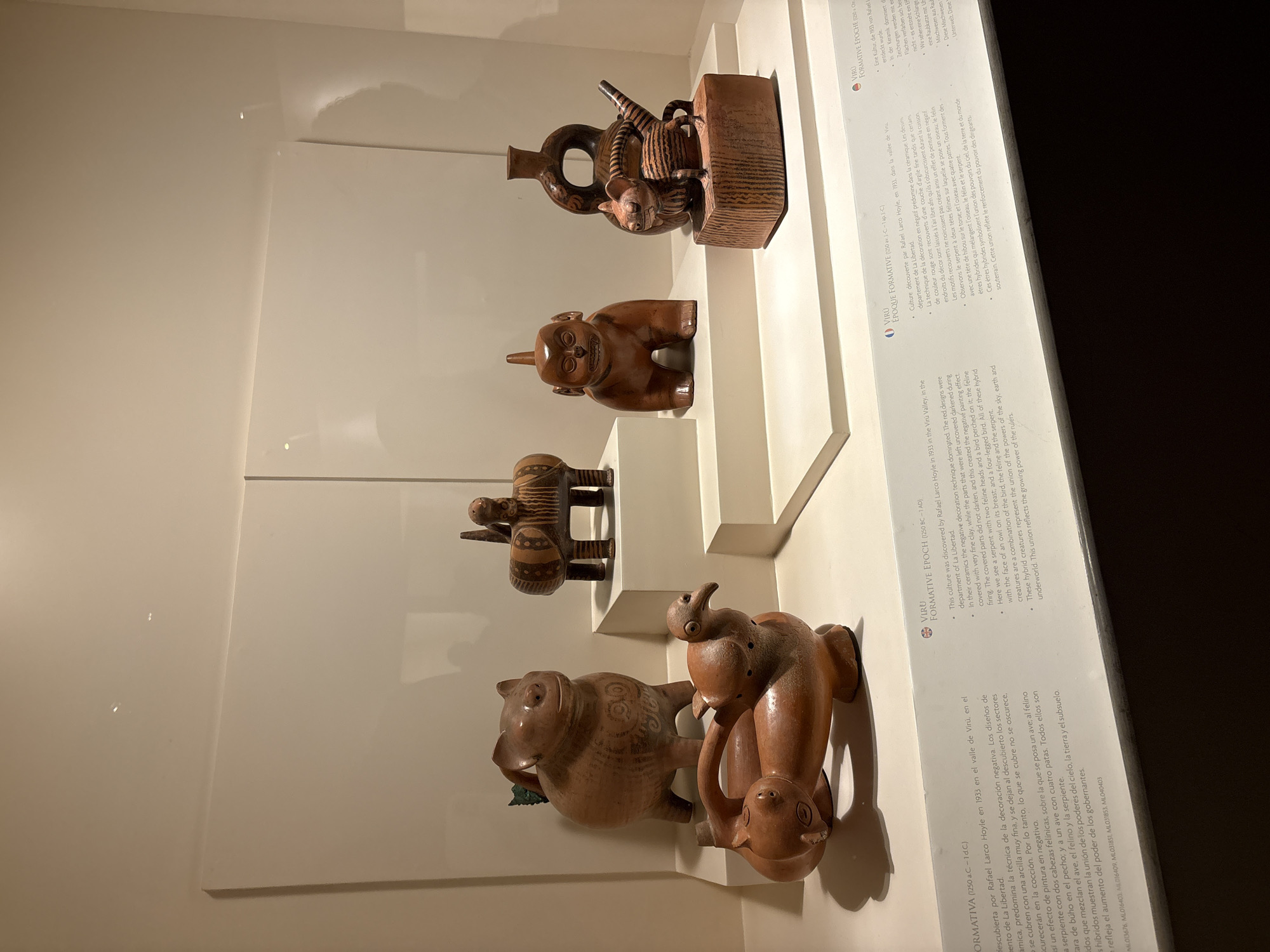
An exhibition display at the Museo Larco in Pueblo Libre, Peru, showcases five ancient ceramic artifacts from the Virú Formative Epoch (1250 BC - 1 AD). The pottery pieces, made from reddish-brown clay, are arranged on white tiered shelves, likely within a glass case, as evidenced by reflections. From left to right, the artifacts include: 1. A complex sculpture of intertwined animal figures, possibly representing a bird and other creatures, featuring rounded forms. 2. A large, stylized animal, possibly a hippopotamus or pig, with faint patterns on its body and a green element near its head. 3. An abstract, four-legged animal figure with distinct striped patterns covering its body. 4. A squat, humanoid-like figure with prominent facial features (eyes, mouth) and small horn-like protrusions on its head. 5. A vessel incorporating an animal figure (resembling a feline or dog) resting on a rectangular base adorned with striped patterns, with another vessel integrated into the design. Informational plaques visible next to the artifacts describe the "VIRÚ FORMATIVE EPOCH (1250 BC - 1 AD)." The text, presented in Spanish, English, French, and German, explains that the culture was discovered by Rafael Larco Hoyle in 1933 in the Virú Valley of La Libertad. It highlights the dominance of the negative decoration technique in their ceramics, where covered red designs remained light while uncovered areas darkened during firing. The plaques also describe some hybrid creatures depicted in Virú art, such as a "serpent with two feline heads and a bird perched on it," and a "feline with the face of an owl on its breast," as seen in the collection. These hybrid figures symbolize the "union of the powers of the sky, earth and underworld," reflecting the growing power of rulers. Museum inventory numbers (e.g., ML013676, ML016403) are also listed.
Pueblo Libre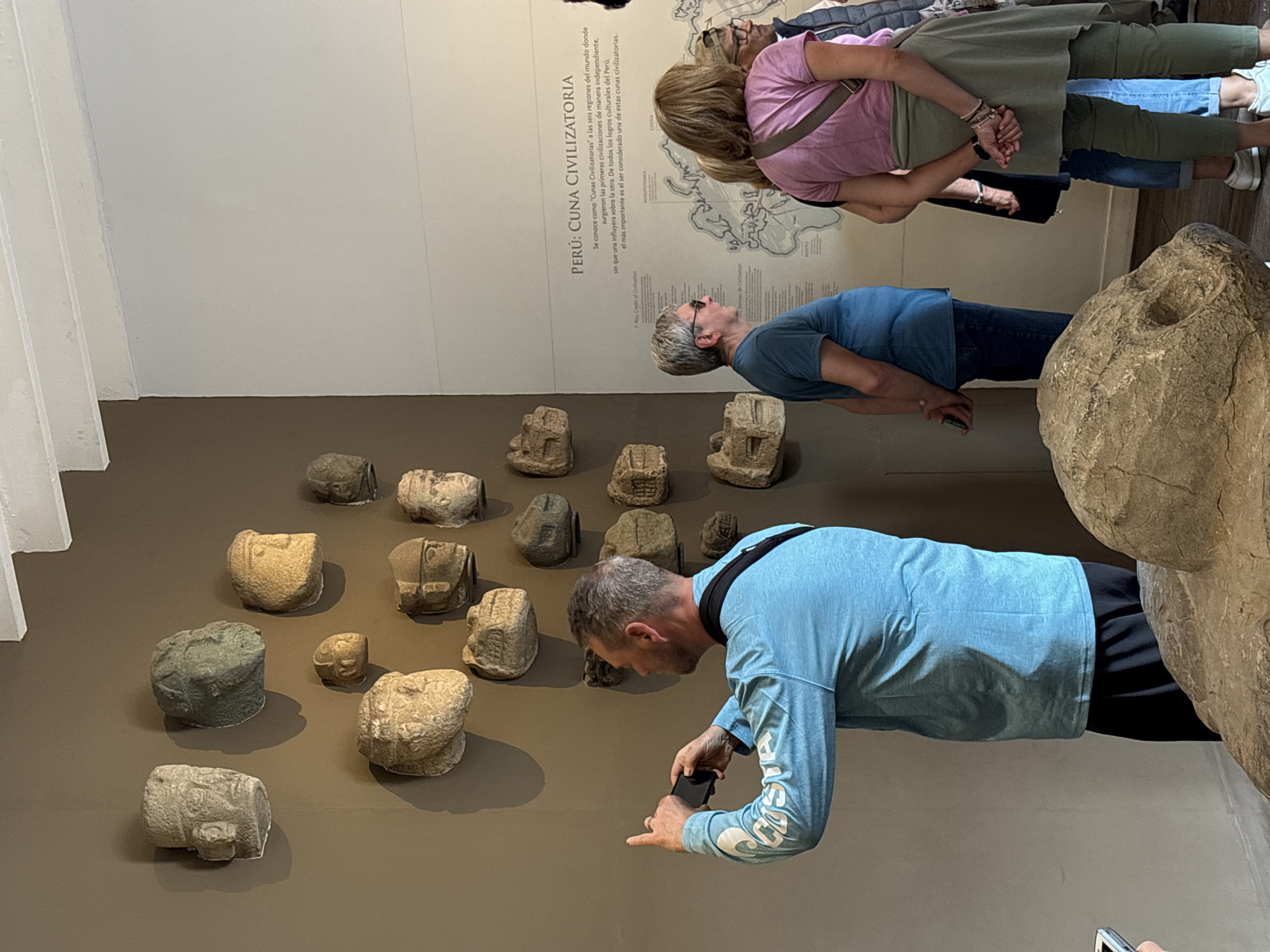
This image captures an interior scene within a museum or exhibition hall, likely located in Pueblo Libre, Peru, focusing on ancient civilizations. In the foreground, a man with short gray hair, wearing a light blue long-sleeved shirt and dark pants, is bent over, taking a picture of a collection of small, carved stone artifacts displayed on a dark brown surface. He is holding a black smartphone with both hands, angled downwards to photograph the objects. The artifacts, varying in size and color from light beige to greenish-gray, are scattered across the display surface. They appear to be remnants of ancient sculptures or tools, showing detailed carvings and textures. A larger, roughly textured brown stone object is visible on the far right, partially out of frame. Further back, two women are observing a large wall exhibit. The woman closer to the foreground has blonde hair and wears a pink shirt, light green pants, and carries a brown shoulder bag. She is looking upwards at the exhibit. Behind her, another woman with darker hair, wearing a gray top and blue jeans, also gazes at the display. The wall exhibit features a prominent title in Spanish: "PERÚ: CUNA CIVILIZATORIA" (Peru: Cradle of Civilization). Below this, text explains that "Civilizational Cradles" refer to the six regions worldwide where the first civilizations emerged independently, highlighting Peru as one of these important cradles. A map depicting various global regions, with labels like "CHINA" and "MESOPOTAMIA," is also part of this exhibit, illustrating the global context of early civilizations. The overall atmosphere suggests an educational and engaging museum visit, with individuals attentively observing and documenting the exhibits.
Pueblo Libre